Enabling & stewardship

The season of seed catalogs is upon us, and I begin to fantasize about all of the vegetables and flowers I want to grow and how I will arrange my small garden area to accommodate them. I imagine having time to keep the rows cultivated and the foliage free of insect pests. Yes, I need to do some work on the fencing. And yes, some terracing might help where the garden’s taking a decidedly southeasterly dip. The asparagus patch finally played itself out, so it will need some restructuring and weeding; I’ll have an opportunity to use that area in a new way.

There’s snow on the garden now. All of this planning is purely speculative on my part. Yet–how clearly I can envision it, in my mind. One of my concerns is whether I’ll feel hale and hearty and energetic enough to get all of this work accomplished!

Ah, my garden-consciousness brings me to the mind-body problem, though perhaps in a more physical way than philosophers encounter it. My conscious mind imagines the garden that does not yet exist. Is that garden real or an illusion? What makes it possible for me to conjure it so vividly? Is it merely memory of past experience? If so, why does my imagination invent a slightly different garden–this year’s ideal? My animal self takes action, physical action (phenomenological action) in order to bring about fruition to feed the physical body that loves the taste of vine-ripe tomatoes and fresh beans and tender lettuces. Do my actions cause the plants to grow? No. I’m more of a steward or a guide. I help them get a better-than-average start.

This sort of thinking brings me around to a (2011?) post by biologist Stuart Kauffman, on the NPR philosophy blog.

Kauffman says:

We think we live in a web of cause and effect. We do. We also live in a web of enabling opportunities that may or may not be seized, and the living world, biosphere up, unfolds in a different way, creating ever new possibilities of becoming.

But these possibilities often can’t be stated ahead of time. No one foresaw Facebook when Alan Turing did his work in the first half of the 20th century. Nor can we foresee all the possibilities of the evolution of life.

Life is not a well-formulated, complex optimization problem to be solved. We do not know all the variables that may become relevant.

Science is my life, and it is wonderful. But science will not ultimately know everything.

In the world of modernity, our values have become badly deformed. Gordon Gekko’s “greed is good” has replaced “integrity, generosity, and courage” as our First World cultural ideal. Modernity does not serve our humanity well, although it does offer enhanced standards of living. We are reduced — to price tags, cogs in an economic system making often useless products in the name of forever GDP growth on a finite planet. The bankers corrupt themselves and our government. Our government does not yet realize that its better job is to enable, not command, to “garden,” to coach, to enable the creativity of its peoples, here and around the globe.

Yes, that’s it. I engage with my environment partly by enabling things to grow or flourish. The term enabling has garnered some negative connotation in recent years due to its use in psychology: we are warned not to enable alcoholics, manipulative people, or those who need to learn some grit and self-motivation. The idea of enabling is, however, essentially positive: to help, to nurture. In fact, I think I prefer to think of myself as one who enables the earth rather than as a steward–though both concepts suggest that we human beings must engage willfully with the world.

We have work to do here on earth. And I am well aware that I do not know, with my garden, “all the variables that may become relevant.” (Past complex variables have included drought, hail, flooding, and beetles.) My small part this year includes serving the land I temporarily inhabit as well as serving myself and my family our favorite foods.

31281_1488041725309_1074892_n

My favorite sources for seed include: Seeds of Change, Territorial Seed Co., Peaceful Valley Farm Supply, and–while less on the organic spectrum, the British firm of Thompson & Morgan for its amazing variety of herbs, vegetables, fruits, ornamentals and grasses from heirloom to the latest hybrids. For American gardeners interested in some truly historical strains, Thomas Jefferson’s Monticello offers quite a selection.

(Photo: a previous year’s garden in May)
Not a dry spell

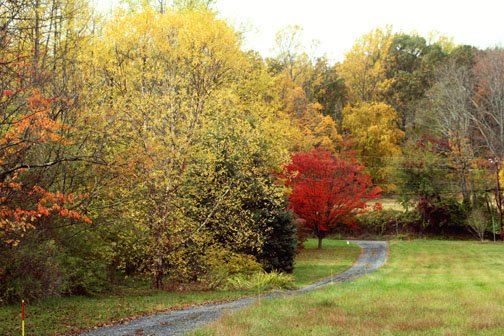
October arrived in a remarkably ordinary way, considering how inconsistent the weather in my valley has been during the past year. There were a few clear days of brilliant sky, some heavy breezes with leaves beginning to drift into the lawn, a couple of glorious autumn days–mild and crisp–followed by a spate of rain and humid air (and toadstools and mushrooms cropping up everywhere), a further yellowing and reddening of foliage, and then, chilly rain.

This is “normal” weather for our area in early- to mid-October. Although the heavy skies and damp chill are not always welcomed by residents, including me, the gardener in me feels relieved. We need the rain and the coming dormancy. The birds relish the late, large insects that frequent gutters and fields, ponds and puddles, providing proteins for a trip south or for winter ahead. Seeds need the watering-in and the cooling-down. Trees need reminders to store their nutrients deep inside when the cold air really sets in.

And pretty soon, I will have bulbs to plant. I want the soil to be moist enough to dig up and the ground temperature cool enough to keep the daffodils still and quiet for several months.

Some years, I write prolifically in autumn; it’s as though the change in season effects a kind of transition within me, and creativity abounds. Other years, not so much. I do notice that when I spend a good deal of time out in the garden, I write more. This fall has not been that kind of season. I have been busy with writing tasks that do not exercise the philosophical or metaphysical side of myself–though I have been writing, most of the work has been reviews, proposals, pedagogy.  I will be posting links to the reviews and essays on the sidebar to the right, adding to the list…

Should fortune–and the Muse–smile upon me, there may be a few new links to poems, as well, in the coming weeks. In November, I’ll be giving a few readings locally. In January, I’ll be teaching Introduction to Poetry again, and I’m eager to try new texts for my students.

Perhaps the post-equinox period will have a creative harvest after all.

Philosophy of cities

I’m going to let the late Lewis Mumford speak for himself in a couple of excerpts from The City in History. Even though I love history and have perused many a book on the subject(s), I learned a great deal about Western history from this book. What intrigues me most as I’ve read, though, is Mumford’s roles as historian-as-sociocultural-critic and historian-as-philosopher. When writing a book of this scope, no matter how founded on data, archeological and textual records, it’s hard for this writer to avoid thoughtful forays into philosophy. Mumford looks forward, too, speculating on city life in the future–and he takes rather a dim view of where megalopolises were heading in 1961. He was prescient indeed. While today’s citizens may argue that his judgments are overly negative, it is difficult to refute the accuracy of his speculations, particularly when he foretells the modern city’s environmental impact on society and on earth’s resources.

So much of the book is a warning: cities have a tendency to collapse, and there are reasons for that. Such reasons have to do with greed, power, poorly-applied technology, lack of foresight, overcrowding, ignorance of the need for balance in any system–governmental, agricultural, environmental, social, economic, etc. He sounds like a Cassandra at times, and we all know that aphorism about being doomed to repeat history, as does Mumford. But ultimately, he makes a passionate call to creativity and human life, warning us not to let our burgeoning technology reduce human activity to the level of the hive. He revels in the arts, in the conscious purpose of human living, in the genuine communication among persons, and in the joys available to those who understand an organic system must be balanced.

[He refers to men and mankind using the typical non-gender-neutral language of the era, which I am not going to alter in these excerpts.]

green

A bit of green…

Here he is discussing the “Green Matrix.” Remember, he’s writing in 1961!

~

“The maintenance of the regional setting, the green matrix, is essential for the culture of cities. Where this setting has been defaced, despoiled, or obliterated, the deterioration of the city must follow, for the relationship is symbiotic. The difficulty of maintaining this balance has been temporarily increased, not merely by the incontinent spread of low-grade urban tissue everywhere, dribbling off into endless roadside stands, motels, garages, motor sales agencies, and building lots, but by the rapid industrialization of farming itself, which has turned it from a way of life into a mechanical processing business no different in content or aim or outlook from any other metropolitan occupation…”

~

Following Mumford’s observation that overpopulation is often a result of privation, rather than the expected other way around, and leads to the “bursting” of the city as a healthy, organic system, he notes (with clear reference to his much earlier chapters on the decline of Rome):

“No profit-oriented, pleasure-dominated economy can cope with such demands: no power-dominated society can permanently suppress them. Should the same attitude spread toward the organs of education, art, and culture–man’s super-biological means of reproduction–it would alter the entire human prospect, for public service would take precedence over private profit, and public funds would be available for the building and rebuilding of villages, neighborhoods, cities, and regions on more generous lines than the aristocracies of the past were ever able to afford for themselves. Such a change would restore the discipline and the delight of the garden to every aspect of life; and it might do more to balance the birthrate, by its concern with the quality of life, than any other collective measure….significant improvements come only through applying art and thought to the city’s central concerns, with a fresh dedication to the cosmic and ecological processes that enfold all being…the best economy of cities is the care and culture of men.”

The care and culture of “men” meaning, “human beings”: that’s a lovely purpose for a city–or a nation–a noble one, and one too many people tend to forget as we occupy ourselves with the busy-ness of our own isolated lives.

~

Of note: The USA’s 50 “greenest” cities…which does not mean they are good cities by Mumford’s definition, but which is probably a good start. Click here.

Snow scene

photo Ann E. Michael

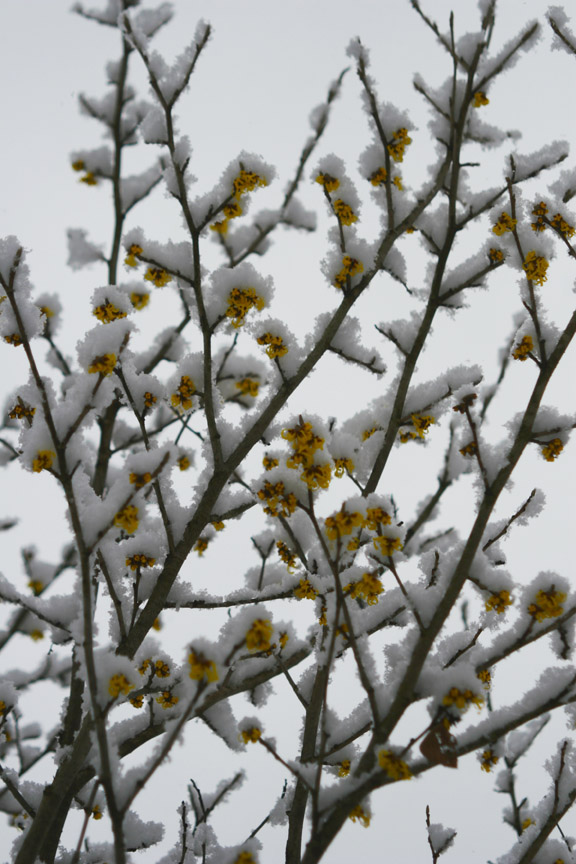
winterhazel

Temperate regions in zones 5 and 6 benefit from snow cover, which moistens soil as it melts and insulates the living things that depend upon soil–a cold “open” winter is particularly hard on plants. Except for an unusual late-autumn blizzard, this season has been mild; so I welcome today’s snow even as signs of spring become visible: a few blooms on the hazel boughs, some snowdrops, reddening stems in the hedgerow shrubs.

phot Ann E. Michael

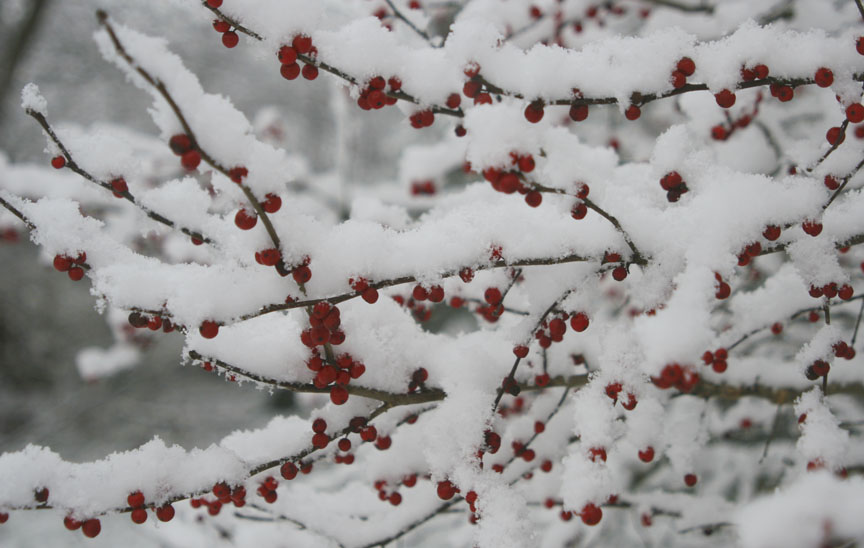
winterberries

Winterberries are beginning to shrivel, and soon bluebirds and the earliest robins will pick them off for sustenance before the grubs and insects are plentiful. Today, as winter gently asserts itself, there are revelations in the outlines of white against shadow. The squirrel dreys are visible, loaded with dollops of snow, amid treetops. The deer paths and deer beds are more obvious because those areas are flattened by use and thus blanketed more evenly than the surrounding grassy spots.

Meadow’s stalks droop in criss-crossed patterns. If I look closely enough, I can identify the species, dry and broken, tangled together and covered in snow: solidago, eupatoria, aster, clematis, ryegrass, penstemon, milkweed. The snow’s ephemeral, yet I find myself thinking of Steve Tobin’s Earth Bronzes.

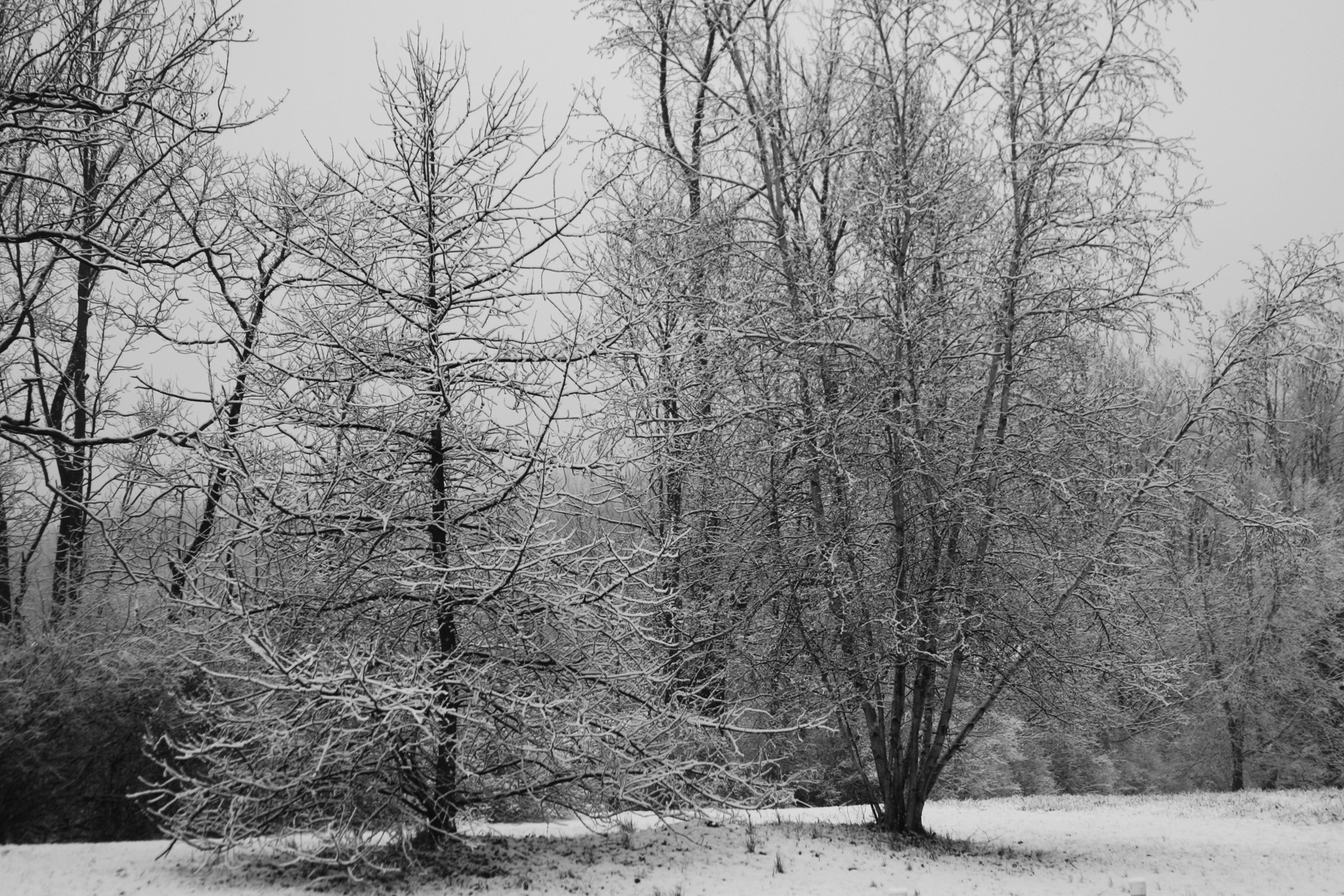
The ways shrubs and trees collect snow fascinate me, too; I love the fractal sketching of dogwood and Japanese maple, the calligraphic hatchwork of long-needled pines and the way thorns embrace little cups of ice along vine-y stems. I love the larch and birch that create the perfect image of lacework when a light snow coats their branches:

photo by Ann E. Michael

larch and birch

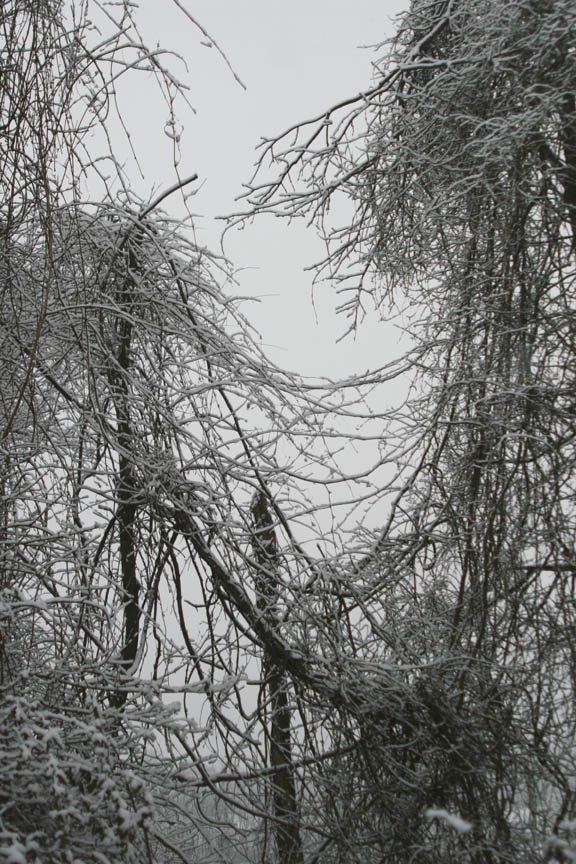
Overhead, vines rope trees together, creepers that take on a creepy mien, ghostly and dripping, when snow-covered. Vines have become a hazard in our region, with both native varieties (poinon ivy, wild grape) and non-natives (too many to name!) choking wooded areas, killing off tree crowns, usurping the niches of native plants, and adding to the hazards of storm damage.

Maybe that is why the ice-draped vines appear sinister to me.

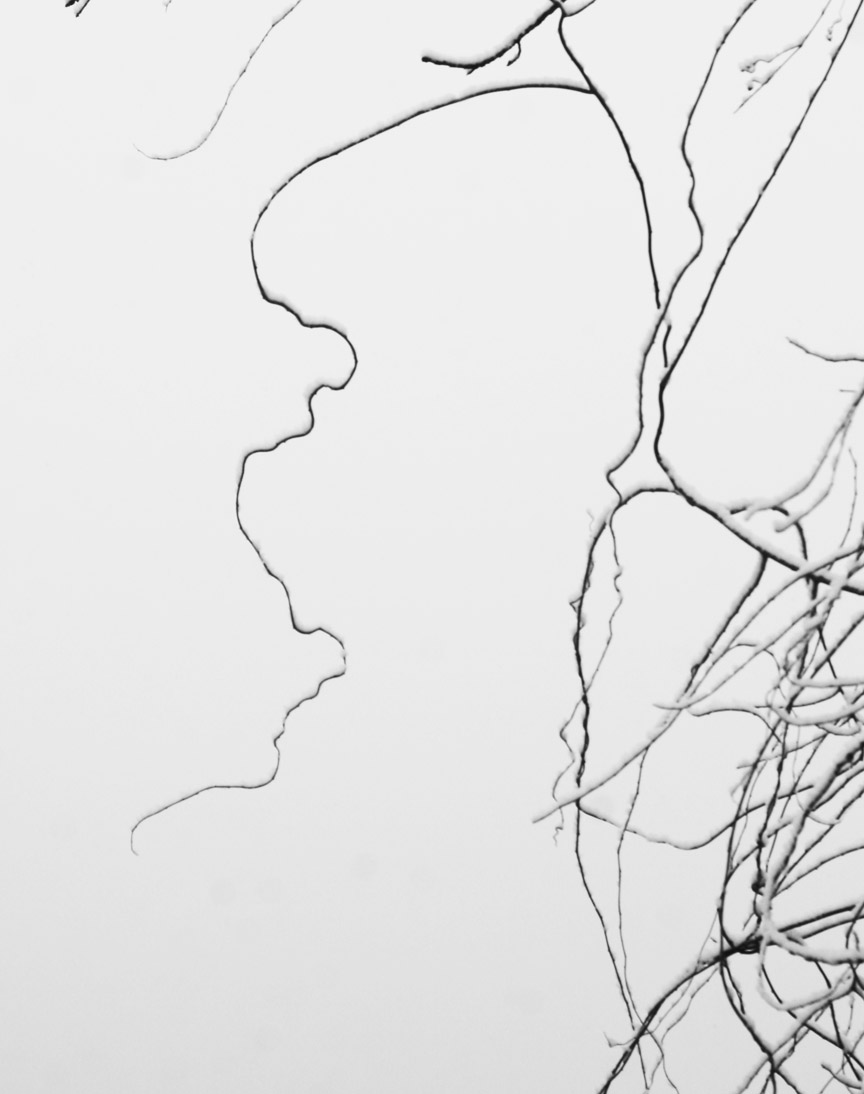
And yet. A plant is neutral, alive, neither good nor bad, possesses no conscience, cannot be evil, plays its role in the environment–and can serve as inspiration. One woody tendril sways high above the ground, a line drawn against the featureless sky. Using a stick, I copy its shape in the snow at my feet. It might be part of an alphabet I do not know, an ideogram I have yet to decipher, the course of a river. Imagination steers from that point on: I take up my pen and write.