Recuperating

Last week took a lot out of me, many reasons for that, mostly keeping those reasons to myself. I needed some rest from exertion and from social media, so I’m re-reading Les Misérables. In which Hugo seems to be trying hard to convince readers that compassion and goodness can be awakened in the hardest of hearts through the process of gentle persistence and genuine decency. Radical decency, as a friend of mine put it. Well.

I won’t write that off as an impossibility, since lord knows many things that seem impossible are not. But yes, Hugo was writing fiction, and one turns to fiction for escapism but also for reference, and for understanding human actions and feelings, and for perspective, and for information. I just completed Richard Powers’ Overstory, which offers a vast range of perspectives on the above-mentioned and adds ecology and forest infrastructure and the psychology of groups into the mix. Novel-reading has been giving me a sense of overarching historical range that lifts me a bit from my too-close focus on my own small life and my ability to sustain hope and make art. That acts as a form of recuperation, if you’re me.

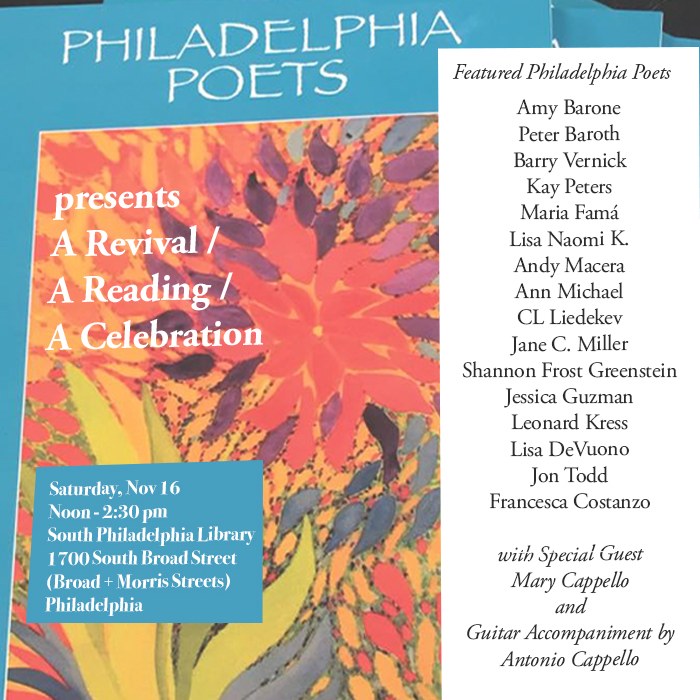
This week, though, happens to be full of poetry. Tomorrow, I’m attending a reading at a nearby public library, where I’ll see many poetry colleagues, the sorts of folks who create a community of local writers. Friday, I’ll be reading with Montgomery County’s Poet Laureate, my friend Lisa DeVuono, at the retirement community where my mother resides. Saturday, I’m heading down to Philadelphia to read with another long-time poetry community in celebration of Philadelphia Poets, a long-running zine established decades ago by the late Rosemary Cappello.
It is good I have had some reading-novels time, and it is good I’ll be having some reading-with-poets time ahead. Both are nourishing to my soul. I haven’t been writing much lately, but I will be eventually. Meanwhile, I’m still waiting for the drought to break…we got a fraction of an inch of rain a couple days ago, and I really hope there is more ahead.

Whatever you happen to need to nourish your own soul, make time for it.

Autobiographical?

Although poems can be anything–philosophies, arguments, histories, internal monologues, passions, information, invention, dreamscapes, jokes, narratives, parodies, you name it–poems sometimes parallel a writer’s individual experiences in the world in a way that would, in prose, be termed memoir. When readers think of poems that are “from the heart,” they usually mean work that authentically describes what appears to be personal acquaintance with environments and behaviors: something autobiographical, or “true.” I have tussled with this perception in some of my own work, for example, my chapbook Barefoot Girls, in which the poems describe fictional experiences that in many cases were not my own but those I heard as a teen; and yet, some of them are memoir-ish.

How to decide what categorizes memoir-ish poetry collections? On the one hand, maybe everything ever written by any poet, since connecting the personal with the so-called universal has long been considered the job of poetry. Even narrative and heroic epics, when they are lasting and successful in their aims, contain some aspects we might call personal (motives and emotional responses to a situation, for example), though the writer’s life and its events may be obscured by centuries.

But memoir is not autobiography; readers should keep that in mind. Maybe it’s Vivian Gornick who said that autobiography is what happened and memoir is how it felt–I’m sure I am misremembering, so don’t quote me on that. In a past interview in the New York Times, Sharon Olds derided her own poems as narratives–even personal narratives–but sidestepped the term autobiography; she still refers to the first-person in her own work as “the speaker.”

…even though her poems have been called
diaries, “I don’t think of it as personal,”
she said. “These are not messages in a
bottle about me,” said Ms. Olds.

“The Examined Life, Without Punctuation” by Dinitia Smith, 1999 (New York Times)

Where does that leave us as readers? I don’t know–and I think it’s okay not to know. That said, I have recently read a number of poetry collections that fall decidedly on the memoir side of the continuum and found them interesting, informative, well-written, at times beautiful and also at times hard to read (i.e., profoundly sad). If you, my reader, are intrigued by the challenge of what is or is not memoir in poetic form and are open to experiencing the circumstances and knowledge of other lives and perspectives that such work offers, here are a few books you might investigate. There are many, many more–this list is just from my more recent perusals. Not one of them is anything like the others.

Edward Hirsch, Gabriel, a poem; Jeannine Hall Gailey, Flare, Corona; Emily Rose Cole, Thunderhead; Daisy Fried, The Year the City Emptied; Sean Hanrahan, Ghost Signs; Lisa DeVuono, This Time Roots, Next Time Wings.

is or isn’t is memoir?

Reading friends’ books

One thing about being a writer is that, after awhile, you meet other writers one way or another: sometimes through social media, Zoom events, or in person at book signings and readings; sometimes through conferences, workshops, or various educational programs; sometimes by finding local writers groups or getting an introduction to someone through a friend. When you meet writers, you get the additional privilege of reading their work. It so happens that lately, many of my writerly friends and colleagues have published books, and I’ve been busy reading them!

First, I want to mention that whenever possible, readers should purchase literary volumes from the writers themselves or from their publishers, or–if it’s an option in your region–from an independent bookseller. I do resort to ABE and Thrift and Amazon when a book has gone out of print or when the publisher prints through Amazon, but I want to remind people that the other sources will support the writers themselves or the independent small bookshops and publishers who launch these books into the world.

Now that my virtuous aside has been accomplished, here are a few of the books-by-friends-&-colleagues I’ve been consuming lately–not all of them newly-published (it takes me awhile to get around to the reading).

~

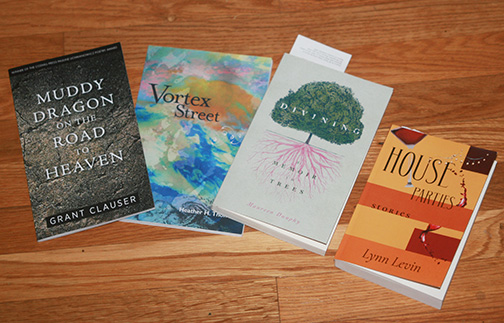
The near-abstract imagery and the concrete place-names and lyricism in Heather H. Thomas’ 2018 Vortex Street appealed to me on several levels, from the scientific (a repeating pattern of swirling vortices, see “fluid dynamics”) to the particular: my husband grew up in Reading, PA, where some of these poems are suspended in recollection. I’ve also loved reading Grant Clauser’s latest, the 2021 Codhill prize-winner Muddy Dragon on the Road to Heaven, a collection of poems that strikes me as both deeply beautiful and tenderly sad. Poet Lynn Levin has published a terrific book of short stories, House Parties, that remind me of the wry sense of humor and wide-ranging knowledge her poems have while proving she’s also a deft hand at plot and character. Maureen Dunphy’s memoir Divining, A Memoir in Trees, brought to mind parallels with Lesley Wheeler’s memoir in poems, Poetry’s Possible Worlds. In both books, the authors have chosen a locus [an American tree, a contemporary poem] and used the exploration of that “trigger” to draw out something personal. What better way to connect with readers than through something we love and value? Which brings me to a shout-out to Jane Satterfield, whose poetry collection The Badass Brontës isn’t in this photo because I’ve already lent it to someone who’s a Brontë fan.

~

In addition to the above books, I am eagerly awaiting new works from a host of other poet-friends: chapbooks by Beejay Grob (forthcoming from Moonstone Publishing) and Lisa DeVuono, poetry collections from Jerry Wemple, Jeanine Hall Gailey, and others that slip my mind at the moment. My only regret is that I have all this reading to do just as gardening season gets really underway!