Lyric, narrative

I love hearing stories. Telling stories. Inventing stories. Often I choose to create a story using the first person perspective, whether the story is my own, someone else’s, or totally invented. In poetry this gets called the lyrical narrative.

~

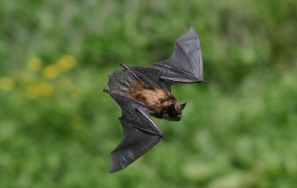
A Toast to the Brown Bat

We are on the porch, drinking wine
late in the long summer day, dusk hovering
the way small storms of insects do
the day after a hard rain, and we’re talking
about something not especially dear to us,
no deep discourse, past that, watching
candles glow and the first wink of fireflies
when a brown bat flutters over like
an autumn leaf and my friend asks, “what
is it like to be a bat?” And as I’m somewhat
versed in philosophy I mention Thomas
Nagel, whose essay with that title is
justly famous but who does not really answer
the question; and she responds, “it must be
alternately stifling and soaring.” I think she
means that every flight’s like Christmas—
freedom and feasting—and every day an
imprisonment in the tightly-packed dark.
“But what if colony life is cozy?” I ask, imagining
small bodies light as sparrows breathing
together softly, fur-lined and snuggled,
fingers folded over the bellies, a generous
communion of sleep. “I can’t quite get over,
though,” she says, “that they sleep upside-
down.” “It might cure your migraines,” I say,
and we devote our next toast to the bat.

~
Patience

Okay, day … six? Thanks to Marilyn Hazelton, my tanka expert and today’s muse, for engaging with the idea of patience and suggesting a book that gave me this quote by Rodin (long a favorite sculptor of mine):

~

“Patience is also a form of action” –-Auguste Rodin

Clay. Thumb and fingers pressed.
Coolness and warmth awaiting form
or formulation–chemistry binding
components under heat’s influence.
Here, the potter attends the kiln,
biding her time. Or the craftsmen
check and check again as barley
ferments, as bronze hardens, careful.
The woman holds inside herself
for nine months the evolving child
and every moment is one of multiplying,
expending energy during the wait
which may result in either life
or death. Even the Zen place of repose
requires breath: action, inhalation,
oxygenation, illumination. Notice:
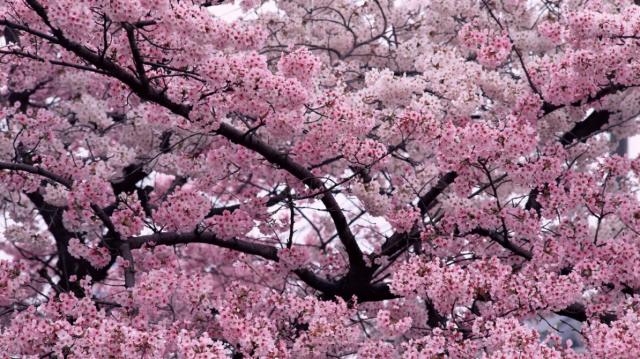
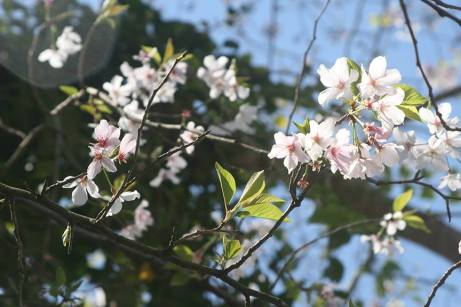
this morning, the plum trees blossomed.

~

DSC100109879


Letters

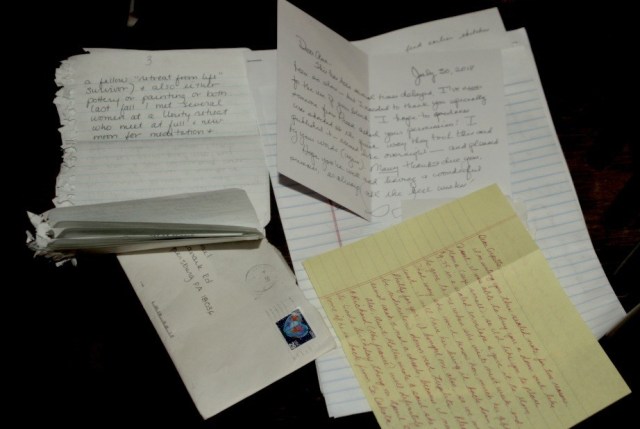
I have been reflecting on the practice of letter writing and how it improves writing skills because it is, essentially, practice in written composition.

I teach writing, and one thing I notice among students who ‘don’t write well’ (in their words) is that they struggle to develop a voice in their written essays. In the hundreds of years before telephones and tablet devices, literate people learned a voice and style not through school essays but through frequent letter-writing practice. If a total stranger were to read aloud to me letters from my two grandmothers, I could identify which grandma penned which letter by style alone.

The adventurous 19th-c. traveler Isabella Bird, to take another example, once wrote a 116-page letter to her sister, Henrietta! Bird’s letters form the basis of her many travel books, which are entertainingly told with an eye for humor and for accurate, sense-based description–her voice remains intact in her work, long after her death.

Today’s poem draft is a prose poem in the epistolary mode.

~

Entanglement

I think of you so often, especially when weeding the perennials, a task
we have so often done side by side and in so many seasons, you and I knee-deep
in goldenrod and wild aster that invades the irises and wild indigo each June,
or earlier in the season, on chill and drizzling April days, clearing shot-
weed, ground ivy and chickweed from the creeping phlox and daffodils.
You’d be dismayed at the state of my ornamentals this year, your perfectionist
streak critical of the stray wanderers, stands of sedum that need dividing,
the dust on my piano, ottoman replete with cat hair, my cupboards in disarray.
I miss your diligence and vivaciousness, the way you take your coffee scalding
hot, your eye for color, your bold opinions I have so studiously ignored.
Today it is raining and the book I’m reading describes quantum entanglement
theory, “a physical phenomenon that occurs when pairs or groups of particles
are generated, interact, or share spatial proximity in ways such that the
quantum state of each particle cannot be described independently of the state
of the others, even when the particles are separated by a large distance.”

I miss you.


~

IMG_5768


Poetic naturalism

I have been reading poetry, as usual, and also non-fiction about various aspects that could be deemed scientific, such as Michael Pollan’s Changing Your Mind and physicist Sean Carroll‘s book The Big Picture. 

On my way to work, I posed (in my mind) an argument with Carroll about his use of the word “poetic” in his definition of poetic naturalism, which he defines thus:

Naturalism is a philosophy according to which there is only one world — the natural world, which exhibits unbroken patterns (the laws of nature), and which we can learn about through hypothesis testing and observation. In particular, there is no supernatural world — no gods, no spirits, no transcendent meanings.

I like to talk about a particular approach to naturalism, which can be thought of as Poetic. By that I mean to emphasize that, while there is only one world, there are many ways of talking about the world…

The poet Muriel Rukeyser once wrote, “The universe is made of stories, not atoms” … There is more to the world than what happens; there are the ways we make sense of it by telling its story… The world is just the world, unfolding according to the patterns of nature, free of any judgmental attributes. But these moral and ethical and aesthetic vocabularies can be perfectly useful ways of talking about the world … We just have to admit that judgments come from within ourselves.

Despite my doubts about his use of “poetic,”  it may be that Carroll’s term describes me; at any rate, his definition comes close to my own thinking about the world.

And hence, another draft for my poem-a-day challenge.

~

Brown leaves bouncing across Preston Lane
late afternoon, air currents swirling.

Road shoulder cradles raccoon carcass,
fur shudders, though body’s still, and sun

highlights the gray-white hairs as travelers
speed past. Chlorophyll greens local lawns

and ditches beside the creek, molecules moving,
nitrogen atoms taken up through root and rhizome.

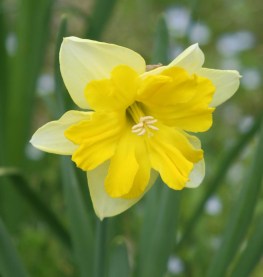
Sudden, yellow, early–narcissus blooms near
the neighboring farmhouse–all of which

recommends itself as The World As It Is.
A reality for at least one universe,

even though there exist other possibilities
in the realm of Undiscovered.

daffodil photo Ann E. Michael

Kisses & Bees

Today, I have opted to use an Osip Mandelstam poem as a prompt. I apologize in advance to his memory and to his lovely poem, translations of which are here, here, and here.

In a blog post some time ago, I discussed this poem and the problems of translation.

~

Kisses Tattered as Bees
-after Osip Mandelstam

Your claim asserts that kisses
can be tattered
and bees emerge from
floral tussles or hive dances
in a disordered raggedness
so the two are as like
simile disperses into breeze:
loose petals and torn wings
fail to impress upon your lips
any tactile memory.

But oh, there were kisses once
so fevered they evaporated
on meeting your cool skin
while you traversed the woods
beguiled by honey’s scent–
and kisses that stung,
leaving a trail of the dead,
soft, gold-and-black bodies
in each of your footprints,
beads strung along your path.

~

be-quince

~

Three days, three poems, one tenth of National Poetry Month having passed; I can do this, right? NaPoWriMo has a site that includes daily poetry prompts, if you happen to be interested. It is worth trying even if you do not plan to write a poem a day.


April experiment

It is National Poetry Month once again. I usually do not take part in poetry month writing challenges, but I thought this year I might try something out of my comfort zone.

My plan: post a poem draft a day for this month. I have never blogged daily before, and I have never tried to compose a poem a day as Luisa Igloria has been doing on the via negativa blog for, I think, more than three years!!

This concept–er, this practice–will be super-challenging for me and scary on several levels, mostly on the level of posting unrevised, often unfinished or awkward material publicly. But I have just about 3,000 followers and only a minuscule percentage of them read my blog regularly, so I have to think of this as reading to a small room.

I can deal with that. At least–I think I can.

We’ll have to see how the month goes. Meanwhile, welcome to my month-long experiment in immediacy.

~

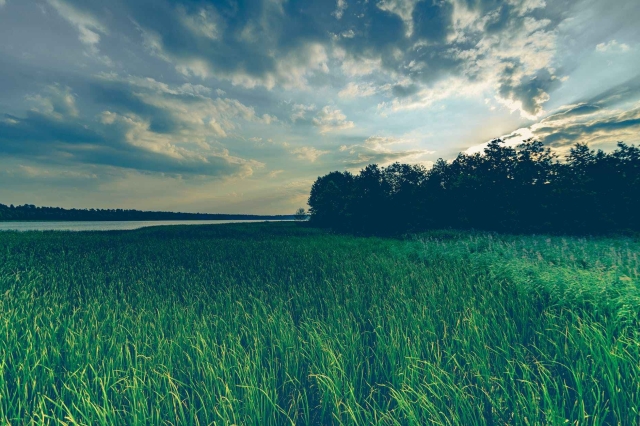
Tom’s Green Field

In your landscape
light exists as waves, not particles

active, roiling
over the placid horizontal planes: sky, treeline,

cropland in wind.
For there must be currents of air, speedy thrill

storm can assume
chopping at clouds miles distant, changing hue

illuminating
the dense grove’s surface so it shines

and no rain’s fallen
and perhaps no rain will dampen the field today–

only luminescence
pigment trapped in layers of oil, bouncing

cobalt, cadmium
iron oxide through your swirling glaze

that gazed once
on energy in patterns, an hour’s moment, waving green.

~

agriculture clouds countryside crop

Photo by Pixabay on Pexels.com

Bounds against chaos

It is easy, even comfortable, to think of the past as a linear narrative; but that is not actually how brains record and archive our experiences.

Marilyn McCabe notes: “So much of the past is only what we think we know based on what we remember, or think we remember. The past is a fun-house maze of stretchy mirrors and blind corners.”

~

The brain and consciousness intertwine through so much complex, possibly fractal, and certainly inter-relational connections that chaos looms as an option all the time; human experience is an edge phenomenon. I have long considered the meadow and forest, the clearing or glade, the hedgerow, the riverbank, ditch, or roadside berm as metaphor for what keeps us curious–interested in life and its inter-relationships, its connectedness and its chaos.

~

By complete coincidence, a biologist/blogger posts a poem by Robert Duncan; an excerpt here:

Often I am permitted to return to a meadow
as if it were a given property of the mind
that certain bounds hold against chaos,
that is a place of first permission,
everlasting omen of what is.
Robert Duncan

~

Yes. Often I am, myself, permitted to return to a meadow. Pretty much daily, when I’m home. And what I learn there! What the edges and the chaos (and the patterns, and the simplicity) reveal to me!

IMG_5123

~

As an aside: Dave Bonta writes poetry blog roundups here: https://www.vianegativa.us/2018/04/poet-bloggers-revival-digest-week-14/ Each of the links he posts is worthy of a read.

Dave has even posted his wedding to Rachel Rawlins–video, context, porcupine, open-sourced wedding vows, poems, & all: https://www.vianegativa.us/2018/04/mountain-wedding/

When it’s done well, lived well, marriage can be one of the bounds that hold against chaos, “a place of first permission”–even for anarchists.

Namaste! And keep reading poetry.

Poetry books & the $

April has been designated National Poetry Month by the Academy of American Poets–the campaign was launched in 1996–and because I write poetry and love the art, and read poetry and know poets personally as well as through books, I try to keep the awareness of the month-long love-feast for the crafted word going in whatever small way I can. Hence, if a reader should happen to type the words “National Poetry Month” in the searchbar on this page, said reader would find tagged posts on the subject going back about eight years.

Some years I have endeavored to draft a poem a day for 30 days, some years I have been active giving and performing readings, some years in teaching; it varies on circumstance and energy. This year, I am celebrating by reading more than by writing.

When I buy poetry books, I try to purchase them–if possible–from the author or from the author’s original publisher rather than more cheaply (Amazon, used books, etc.) The author gets no royalties from books bought second-hand, and because few poets are rolling in cash from book sales–and while gaining an audience may be of value–even a small royalty check is a welcome thing, a confirmation of the work in the world.

Best-selling poetry is not necessarily the “best” poetry. Those of us who love the art can contribute in small ways by using the almighty dollar to support the writers we think need to be read.

Here are some poetry books I have bought, or borrowed from my library, in the past two weeks or so. I don’t usually go this crazy with poetry-bingeing; but as I’m not doing much else for Poetry Month this year, I figured I would contribute by doing what I love best: reading books!

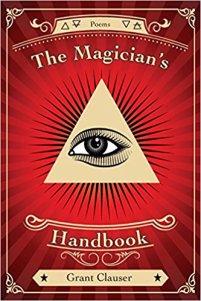
Lesley Wheeler, Propagation; Louise Gluck, A Village Life; Grant Clauser, The Magician’s Handbook; Jan Clausen, Veiled Spill: A Sequence; Luisa A. Igloria, The Buddha Wonders If She Is Having a Mid-life Crisis; Aaron Baker, Posthumous Noon; Ian Haight, Celadon; Erica Dawson, The Small Blades Hurt; Brian Turner, Here, Bullet; Margaret Gibson, The Broken Cup. There will be others!

And two notable non-poetry books I loved, Elena Georgiou’s The Immigrant’s Refrigerator, short stories; and Laura Miller’s The Magician’s Book: A Skeptic’s Adventures in Narnia (a subject close to my own heart–her approach to the book and her history with it ring close to my own experiences).

There will be others, if I have any spare time. I am also planning to read a book by philosopher Andy Clark and a biography of C. S. Lewis and to proofread my brother’s latest paper on Samuel George Morton. If only the weather were warm enough that I could read in the hammock!

hammock

image from www.meditationrelaxationclub.com


Blogs

The snow’s receded, and the crocuses open; yet another wintry storm looms. Nonetheless, the past three days have felt less like thaws and more like spring itself. Today, I’m listing some great blogs to browse, breeze through, or peruse…as I am at present falling a bit behind on the Blog Tour (among other things).

muscari


There may be a hiatus to follow…in the meantime, follow these!

~

Good blogs on what it means to be a poet, in or out of academia, and to keep slugging away at the job:

Jeannine Hall Gailey, who has a new book about promoting & marketing one’s poetry (available from Two Sylvias Press): http://webbish6.com/

Diane Lockward: http://dianelockward.blogspot.com/

Lesley Wheeler: https://lesleywheeler.org/author/thecavethehive/

Grant Clauser: https://uniambic.com/

Donna Vorreyer: https://djvorreyer.wordpress.com/author/djvorreyer/

Kelli Russell Agodon: http://ofkells.blogspot.com/

Dedicated poem-a-day or nearly a-poem-a-day bloggers who actually write good poems:

Lou Faber: https://anoldwriter.com/

Luisa Igloria, whose fine book The Buddha Wonders If She Is Having a Mid-life Crisis just came out from Beth Adams’ (15+ years of blogging! @ Cassandra Pages) Phoenicia Publishing: https://www.vianegativa.us/author/luisa/

And Dave Bonta, also 15 years blogging, who does a mighty job of crowdsourcing poetry and poets: https://www.vianegativa.us/author/dave/

Then these blogs, which often blend visual art with poetry, or poetry with visual art, such as:

Marilyn McCabe: https://marilynonaroll.wordpress.com/

Art critic and artist Sigrun Omstreifer: https://omstreifer.com/

Artist Deborah Barlow: http://www.slowmuse.com/

And finally, a field biologist (specialty: entomology, bees in particular, but she photographs omnivorously) who loves poetry and posts the occasional poem amid her informative essays on birds, bugs, landscapes, hikes, travel, dogs, and all things lively and worth investigating: https://standingoutinmyfield.wordpress.com

~

That should keep readers busy for National Poetry Month and beyond!


Blooms, books, buddies

I headed southward on a recent trip to visit a friend and to see if I could find spring, since my Pennsylvania valley has been extensively clobbered by late-winter/early spring snow storms. In southeastern North Carolina, the air was cool but the plants were blooming. Spring at last! May it head northward soon.

springblooms

~

On my travels, I took along Grant Clauser‘s collection The Magician’s Handbook. One of my best-beloveds has been learning sleight-of-hand and card tricks lately, and as a result I found it especially fun to “get” Clauser’s references to trick names and magicians’ moves in these poems. The poems demonstrate Clauser’s sense of humor, balanced with insights about contemporary life and a good use of metaphor, sound (nice alliteration in particular), and poignancy that never teeters into sentiment.

I thought my hostess in North Carolina would enjoy The Magician’s Handbook; she randomly read a few pages and liked the book so much that I gave it to her.

~MH poems

Poetry collections are terrific gifts for poet friends, of course; but it is particularly rewarding to introduce a friend to a poet’s work. I would not have discovered half of the writers whose work I love if it had not been for friends and fellow writers’ recommendations, although various public libraries and many a bookstore browsing session have been places of discovery, as well.

I like to read poems while traveling. On the one hand, it proves difficult to keep from being distracted by crowds, announcements, and departure times–which can make it hard to focus on the challenges a poem presents to its readers. On the other hand, poems tend to be brief enough that the inevitable interruptions do not completely disrupt the flow or content of the page; for that reason, I tend to struggle to read fiction while traveling. The brevity lends itself to gesture, so I can pick up on mood and tone and the sound of the poem (in my head–I don’t read aloud in airport terminal lounges). Later, when I am home again, I re-read the poems. That gives me a different perspective on the work.

So…I guess I will have to purchase another copy of The Magician’s Handbook for my re-reading pleasure. Meanwhile, my friend in North Carolina has something to read as a start to National Poetry Month, which is April!

Hey, that’s what friends are for! [And many thanks to BJG for her hospitality, Southern and South Jersey style.]