Paper files

Frankly, I have never been much of a fan of organization. I don’t mind planning, in brief and purposeful bursts, but getting things in shape after the fact–once the mess exists–well. I know people who truly enjoy pitching in and re-organizing, but I am not one of them. Besides, I’m also facing similar tasks in my household, rooting through the kids’ rooms (they left years ago) and our attic and basement to cull, straighten up, and organize. The tasks are mutually distracting. And often tedious. I’m working on my attitude, though, trying to find some method of making these chores, er, “creative” in some way. (File under “Lying to Self”).

Call me old-fashioned, I’ll readily admit to it; but lately I have decided that the most efficient way for me to keep track of my own writing is by using a physical filing system. I have experimented with various spreadsheets (I have no patience with Excel, however and alas) and computer folders. I do use the latter for a year-by-year archive of my work, but I cannot easily extract what I am looking for that way. Now that I’ve retired from my 40-hour work week, I have wanted to manage my creative work better and keep track of what needs revision, what seems finished, what has been submitted, what’s been published. That strikes me as a necessary part of tending to myself as a writer. The past year has been a time of working through options, with accompanying irritation and tedium.
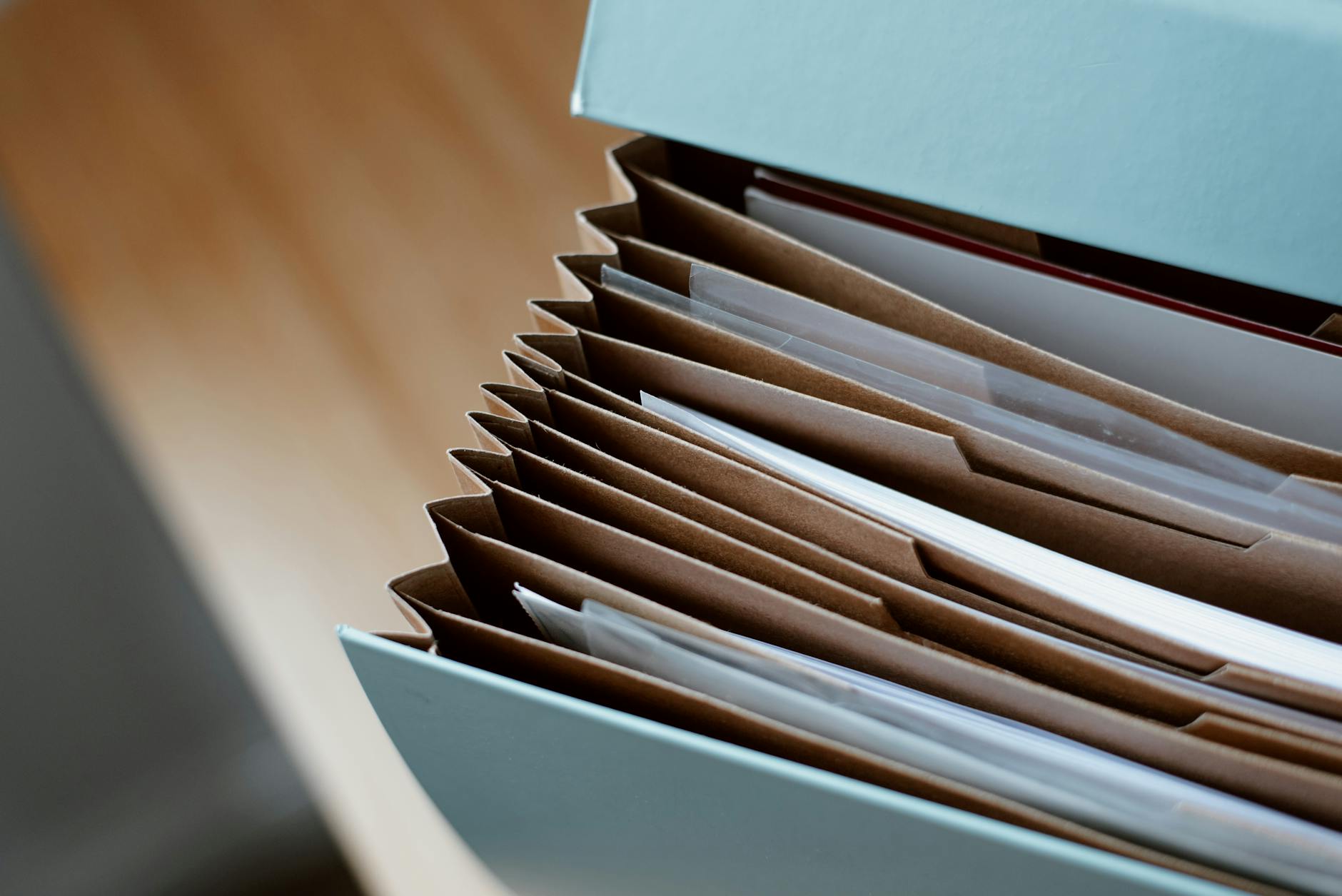
Photo by Anete Lusina on Pexels.com

After years of endeavoring to use electronic files, it came to me that there’s nothing wrong with old-fashioned paper systems, organized alphabetically by title, with the computer-file names and draft number at the bottom of each poem. This is how I think about the poems when I want to work on them or submit them, so it feels natural to me. Why operate against one’s own operating system?

I suspect one reason (oh, there are many, but let’s start with one) I am so angry about Elon Musk’s “DOGE” initiatives is that efficiency is never all it is cracked up to be and is also not the be-all and end-all of any society’s best organization. Of course those who push AI believe that algorithmic calculations can make the world run smoothly, but said people are egregiously uninformed about human nature and the myriad forms of individual thought processes. We are non-standard. Averages account for almost nothing, really. We do not think the same thinks. (And yes, I meant thinks not things, autocorrect). Diversity is what keeps evolution going. There is no change without it; and without change, we die.

So: I’m inefficient, to a degree, when it comes to keeping my creative work in order. However, the paper filing system, with a notebook and index cards and files on my hard drive, assisted by my still-useful memory (a human brain!!), have so far been working pretty well. It has taken me several weeks to put my stuff together, but now it’s far easier to fetch what I want to work on, send out, or collate, which I need to do to prepare for upcoming reading [I have two online readings coming up–one on Feb. 18 and one on May 2]. I’m also grateful that the task kept me busy while I was anxious and worried and grieving over recent not-so-terrific experiences in my (physical, real) life. Real life, which is not averaged. Seldom predictable. Inefficient. And something to celebrate for all its strangeness.

Equinoctal

Torrents. We had rain in torrents, and it went on for days from February into March and then on…and on. Constant alerts on the cell phones: “Flash flooding.” Doldrums set in. In an effort to accomplish anything at all, I even started to sort through and organize my attic.

Talk about desperation!

The attic project isn’t finished–the weather turned mild and clear two days ago, so I ran to the garden to get to work out there–but it turned out to be a more rewarding task than I expected. I started by tackling the Christmas stuff, then the books (SO many books), children’s toys (the kids are in their 30s and there are no grandchildren), and moved on to paper correspondence. Letters! Postal mail. Epistles. Why I have saved so much of my correspondence from 1975 to the present, I cannot explain. Maybe that’s a thing that people who love words just naturally do, the same reason I have kept so many books. I certainly don’t need all of it; but that was part of the task, sorting what I want to keep and agreeing to recycle the rest. I also found odd ephemera, such as photocopied posters for long-ago poetry readings, broadsides of poems, xerox-zines from the early 1980s, and ancient mixtapes on cassette.

~

There’s some sorrow with this project. So many of my former correspondents have died. I find my grandmother’s looping script, my dad’s distinctive handwriting, my dear friend David Dunn’s nearly-illegible scrawl. Reminders of times past. Maybe that is why we keep ephemera: to remember what we thought, at the time, was important.

Maybe it is, maybe it isn’t, by the time we reach our later decades–if we’re fortunate enough to reach them.

I keep gardens for different reasons. Not to remember the past but to see what the present can bring.

~speaking of the present~

My new book can now be ordered from the publisher, if you find Amazon problematic (and there are good reasons for that). The link is here.

In print

I have been lucky in print this year. Two literary journals that I’ve long admired, Bellevue Literary Review and Prairie Schooner, published my poems, and so did the newer journal Naugatuck River Review. This is “a big deal” to me, because it is always exciting to be admitted into the pages of a magazine I like and because, despite the advantages of online/cloud-based literary journals, I love print!

There’s something inexpressibly marvelous about holding a book in my hands, turning the pages, and having a physical object–paper, binding, print–to carry with me.

Online magazines, theoretically at least, have a longer reach and can capture more readers (“hits”) than print. Literature requires audience, and the interwebs offer potentially millions of visitors to the poem online; but the operating word here is potential. What’s possible isn’t what generally happens. The readers of online literature, those people who stay on the poem long enough to read it–and then read the next poem, and the next, on-site–are not as legion as we poets might wish.

Through moderate use of social media, I do publicize my own work when it appears online (see links to the right on this page!). I welcomed the appearance of literature on the internet because one of my purposes for writing is to communicate with people. Readers matter to me. Getting my words into the public domain is the only way to begin that process of communication, and though online journals seem like the most ephemeral form of ephemera, they do make it easier for me to “share” (thanks to Facebook, I am beginning to despise that word) the poems or essays I’ve crafted.

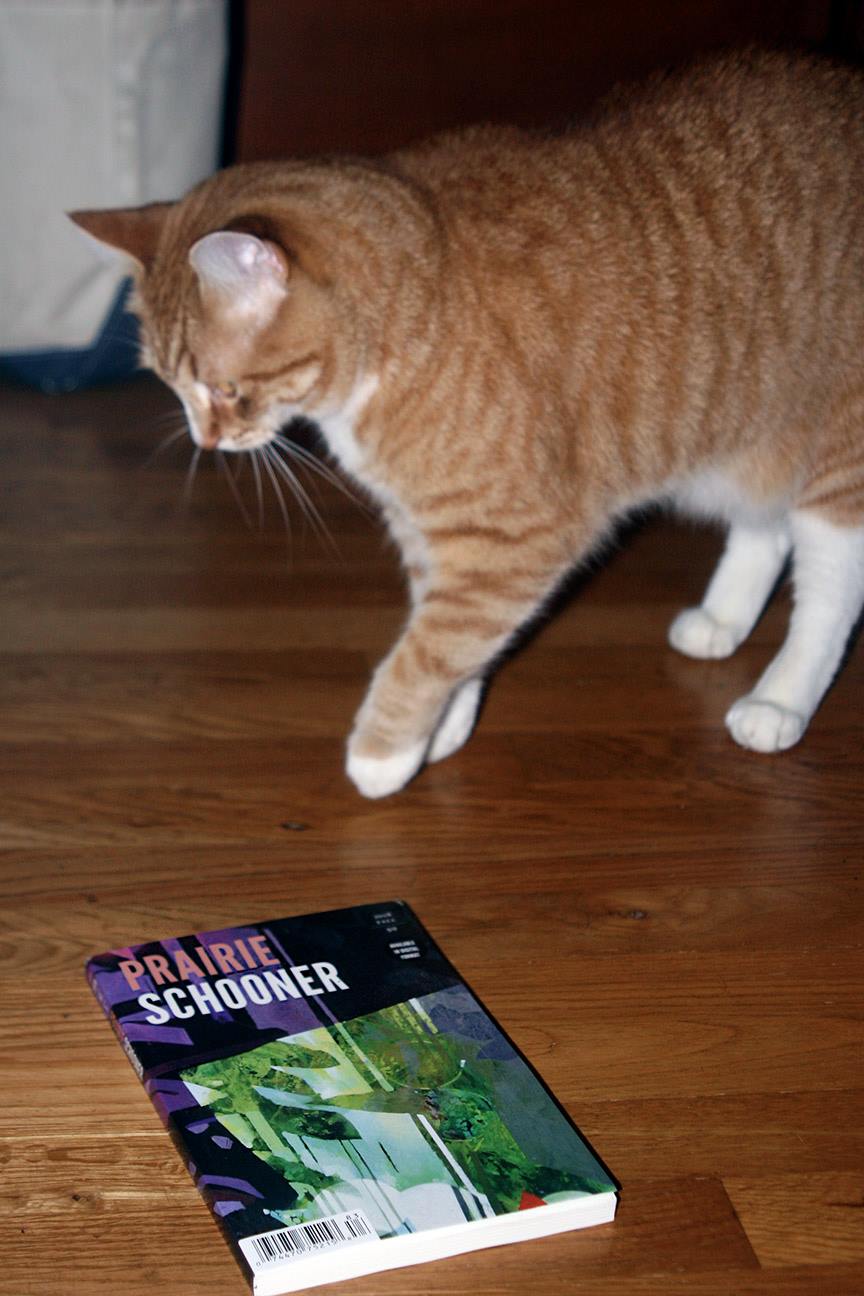
schooner&scooter

Print journals, like books, lack the immediacy of the online publication. They are not interactive in the way some online journals can be (see my recent audiofile and poem in The Maynard as an example), although some print journals are pretty experimental and interactive in quite innovative ways, such as Ninth Letter.

I encourage anyone who reads my blog to check out other bloggers on literature and poetry, and a good place to start is with Dave Bonta’s Poet Bloggers Digest. Searching the internet will open up a world of excellent poetry in carefully edited and curated literary journals.

The internet platform permits poets to read their own work, in podcasts and on YouTube, and to launch videopoems into the world. It has been a boon for poets to find audiences of all kinds, not just people who read poetry journals.

However, my cat will never circle and then settle on an online literary journal. So there’s that…

~

[I tried to snap his photo when he sat on Prairie Schooner, but he jumped up and moved on.]