Riches

The past week gave me riches galore; though I am somewhat poorer in the pocket for it, my cup runneth over in about every other way. It’s true that often, lately, I’ve felt that I am living in “interesting times” that are all too much and too awful to contemplate for long. Then again, I could have been alive (possibly quite briefly!) during Boccaccio’s time and weathering the bubonic plague. Thanks to The Decameron, readers later in history have been able to get a picture of what people were thinking about and imagining–or trying to escape–when things were truly terrible all around. And while I’m not pollyanna-ish about the present, I do feel grateful that I live during an era when travel to distant places is possible and rather speedy, that books are readily available, and that some of the wealthy people of the not-too-distant past decided that philanthropy included funding libraries, gardens, and museums for the average citizen to visit and enjoy. Current billionaires, please take note!
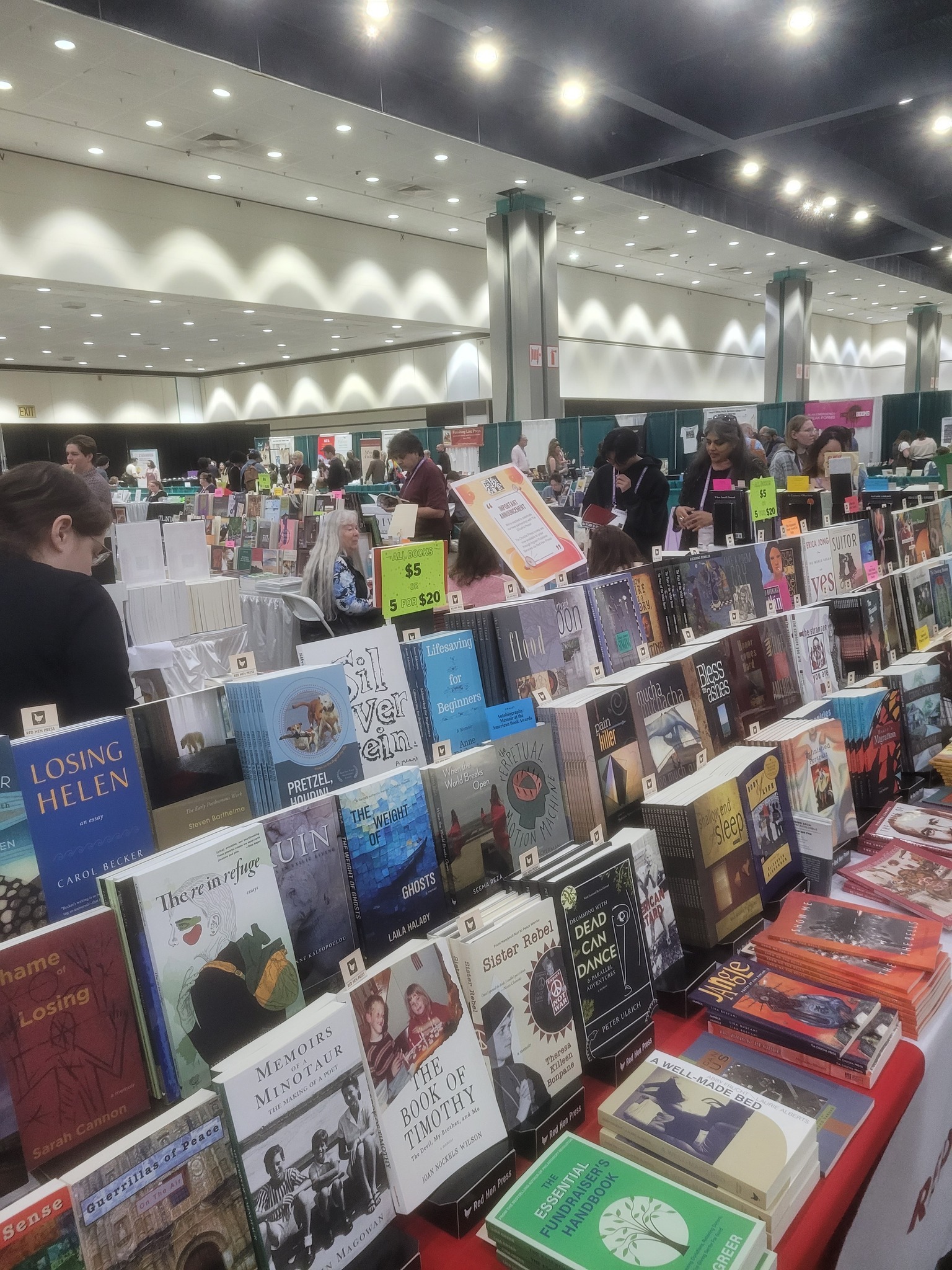
What the week entailed was a trip to Los Angeles to visit my eldest child and, while there, to spend a morning at the AWP conference book fair. Riches indeed! I “packed light” to be sure I had space in my carry-on for poetry books, which thankfully tend to be slim paperback volumes. I bought almost 20 books, I confess. So I came home weighted with literary riches, and while at the convention managed to connect (however briefly) with numerous poet colleagues. A shout-out here to Lesley Wheeler, whose book I had to purchase online because Mycocosmic had sold out! Congratulations, and I cannot wait to read it.

My days in LA were limited to four, but my son had curated a things-Mom-would-like-to-do list that included Mom’s necessary down time. It’s terrific to have offspring who are now old enough to respect my limits. [They have not always been so accommodating.]

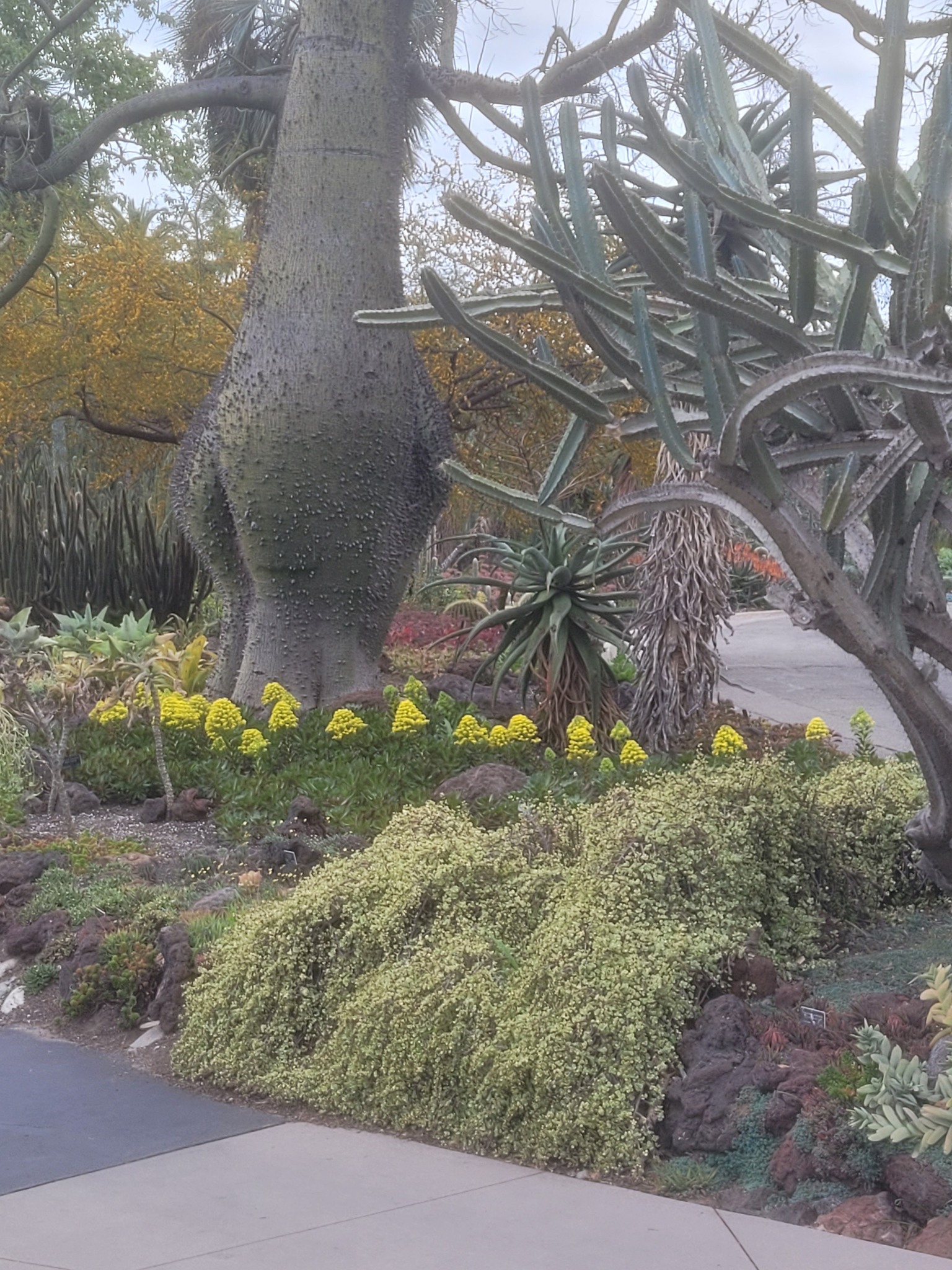
The list included several lovely meals out, a full day at Huntington Gardens and Library, a day trip up to Santa Barbara, a visit to LACMA to get an “art fix” for me and for my son’s best beloved, who loves art and architecture, and a visit to the amazing Museum of Jurassic Technology which, as far as I am concerned, is basically a series of amazing poetry prompts. I cannot possibly explain it; and the museum’s website is purposely a bit obscure and limited, compared to the immersive experience of going to the place in person. I am still thinking about it and will be for weeks.

The barrel cacti at Huntington

While photo ops abound at the gardens, no photos are permitted in the Museum of Jurassic Technology; I will lead you to the website and just keep you guessing. But among the riches of the last week are germs of new poem drafts. We shall see what emerges.

Four+ days away, and I returned to spring in eastern PA: narcissus, magnolias, glory-of-the-snow, squill, bloodroot, forsythia, ornamental plum. Even more richness. Gratitude for the glory.

Giving in secret

“All the poems I have written were written for love.” ~ W.H. Auden

But when you give to the poor, do not let your left hand know what your right hand is doing, so that your giving will be in secret…” Matthew 6:3-4

~

Acts of compassion, great or small, are good for us. I state this not because of ancient Greek philosophers’ concepts about the Good, nor out of any religious dogma, but because psycho-neurological studies almost definitively align with this aspect of received wisdom. Hanson writes, “Compassion draws on the anterior cingulate cortex (ACC) and insula,” which help us observe (or “read”) the reactions of others, an action critical to the survival of a social species. It turns out that when we pay attention to others, we are more likely to help them; that’s how the average human brain works.

Unfortunately, human beings often stop paying attention once we think we have ascertained another person’s intentions and have passed an internal judgment upon them. We tend not to attend past that initial observation. Thus, we may miss actual intentions. Usually this miscommunication of intent leads to problems, but not always. Some people desire to hide their deeper intentions, and not because those intentions are “evil” or even merely narcissistic.

Viz: W.H. Auden, as portrayed in this quietly-written, reflective essay by Edward Mendelson in The New York Review of Books (March 2014). Mendelson begins:

W.H. Auden had a secret life that his closest friends knew little or nothing about. Everything about it was generous and honorable. He kept it secret because he would have been ashamed to have been praised for it.

Auden was a Christian who had an often challenging relationship with his religion (being homosexual did not help with the dogmatic wrestling match). In this essay, Mendelson says that “Auden had many motives for portraying himself as rigid or uncaring when he was making unobtrusive gifts of time, money, and sympathy. In part he was reacting against his own early fame as the literary hero of the English left.” The author also looks at Auden’s era: Fascists, Nazis, dictators, and how they managed to sway so many potentially and otherwise “good folks” to bad causes, the use of “good/evil” in the literature and intellectualism of those times and the writers who used celebrity to lionize their causes–a posture Auden found distasteful.

Yet Auden was willing to make himself distasteful, socially awkward, arrogant, in the service of a hidden compassion. There’s no good word for this in English. “Modesty” does not suffice. “Humility” does not quite hit the mark, either.

~

It seems to me that Auden, and others like him (there are others, many undiscovered), chose to follow Jesus’ words in Matthew 6:3.

A contemporary person may ask why all the modesty. After all–a good deed is a good deed. Does keeping it “hidden” increase the inherent goodness? Are anonymous philanthropists somehow more authentic to the concept of compassionate giving than those who allow their names to grace buildings and organizations? Those people who benefit by good works and kind acts–surely they feel a desire to thank whoever is responsible, so why disguise the giver?

~

One possible answer: compassion does not need a specific object, though that is generally how we learn compassion in the first place.

The gratitude a human being feels when he or she is the receiver of a kind, anonymous act has no immediate object. We do not know whom to thank. Although the receiver’s response may initially be one of suspicion, in most cases the sense of gratitude will be directed more widely into society; the receiver of a kindness is more likely to be kind to others, to perceive others as potentially benefactors or at least to view other people with less suspicion and envy–because the secret donor is somewhere among all of us.

The secret gift works to spread compassion to all sentient beings.

~

It turns out that, as far as the brain is concerned, doing good sets up a kind of feedback loop. Doing good for others improves how good we feel in general. Not how good we feel about ourselves in an egotistical way but how good we feel mentally, emotionally, and even physically.

Love is all you need

Love is all you need

We not only write for love. We live for love.

~