Illusions, connections

Reading Proust again returned me to some of my own past reflections on memory and self, the capital-S Self. A decade or so ago I spent considerable time reading in philosophy, physics, and neuroscience in an endeavor to get a grip on human consciousness and, perhaps, behavior. I posted about some of these texts on this here blog, in between writing about poetry, the garden, and my teaching job. Recent coincidences of reading returned me to this topic, “the hard problem of consciousness,” and made me consider how our embodied selves/minds/awareness: use shortcuts to manage the overwhelming inputs of our environments; define who we are using subjective if physically-based perceptions; and fail to see the obvious because of habituation and the apparent need to confirm what we believe we know. Illusions! The Vedic concept of Māyā, Plato’s Theory of Forms…propaganda, Penn & Teller, quantum physics, complexity theory, Marcel Proust, complementarity. I have a lot on my mind.

If it IS on (or in) “my” “mind.” For there’s even some question about that, as proposed by Neil Theise in his book Notes on Complexity. Just as light can be a wave or a particle, depending upon perspective and viewer (see: complementarity), it’s possible that our minds or selves can be individual and separate but also connected and boundary-less. The subtitle of this text is what appealed to me: “A Scientific Theory of Connection, Consciousness, and Being;” so far, I’m enjoying it and finding inspiration.

It’s needed, inspiration. Despite a few plunges into new drafts (see here), I have not been writing much for at least two months, and I miss it. The ideas from physics and neuroscience that intrigue me include potential metaphors and terms such as quenched disorder, endosymbiosis theory, and holarchy. These–along with the hard problem of consciousness–all have some relationship to complexity theory, and Theise does an elegant job of writing about complicated science concepts for the non-expert.

I ran across Notes on Complexity right after finishing Sleights of Mind, a book about the neuroscience behind the sort of illusion we call entertainment magic: sleight of hand, sawing people in two, mentalist “mind-reading,” and other performances; the authors, Susana Martinez-Conde, Stephen Macknik, and Sandra Blakeslee, are trying to discover more about how brains work (or filter, and sometimes don’t work so well) by studying how we get fooled by illusionists. This is a fun book, even more fun for me because one of my Best Beloveds has long been an enthusiast of magic shows and magicians. Martinez-Conde and Macknik are neurologists, so–unlike Theise’s text–this book is very body-mechanics in its basis. Their work reminded me of how amazing the human physiological system is. And it’s entertaining.

Before these non-fiction reads, I was finishing up with Proust who, in his own creative way, was exploring the interiority of the human self and carefully observing human interactions, behaviors, assumptions, prejudices, and aesthetics. Not neuroscience, because there is no science to it, but definitely related to how our brains and bodies process experience. My sense is that poetry works that that way for me: it’s not an abstract stream of thought but something inextricable from bodily experience, maybe even, through the environment in which we exist, something deeply connected to everything, a global being-there.

The way we process experience (and is this consciousness?) is largely what leads us to the arts, to make art or to appreciate it, and to decide what feels compelling, important, beautiful. And it’s not all in our heads.
Astronomy

As a freshman in college, seeking to expand my limited science knowledge, I enrolled in a Physical Astronomy course, an introductory seminar class that taught students how physicists study the cosmos. At any rate, it introduced us to how that was done in the early 1970s. Thanks to computer tech and so many rapid changes in the field (we were using slide rules!!), the discipline has changed in some respects. I was terrible at the math, never having gotten beyond Algebra II in high school, but I had a terrific professor and loved the material. As may be obvious to readers of this blog, the cosmos and all that is in it provides me with endless opportunities for learning, speculation, and reflection.

Rebecca Elson, whose book A Responsibility to Awe I just finished reading, keenly reminds me of how fascinating the study of the universe can be and how little we know of it. Each decade the science and the theories take immense leaps in measurement and exploration, and each leap reveals how many more questions we have yet to ask, let alone answer. Not just inquiries into the galaxies, but also biological and ecological worlds to explore: salmon, eels, oceans, mountains, our own histories and our own mortality. Elson’s area of study centered on galaxy formation–the chemical evolution of stars, and globular clusters. But she started out collecting rocks with her geologist father who was doing fieldwork in Canada, then studied biology. It wasn’t easy to be a young woman studying the sciences in the 1970s, and she felt she was drifting a bit; writing, however, she felt more sure of. In the essay that ends this collection, she states that the atmosphere at Princeton during her post-doctoral study was “a stronghold not just of men, but of theoreticians” who looked down on work which involved “mere” observation, which is what she had painstakingly been doing in her research in Australia and Cambridge. At Princeton, though, she met a group of poets who encouraged her work and who made her stay at the university more comfortable. Good observation skills make a terrific foundation for poets.

~

If the ocean is like the universe
Then waves are stars.

If space is like the ocean
Then matter is the waves
Dictating the rise and fall
of floating things...
  --from "Some Thoughts about the Ocean and the Universe"

She was diagnosed with non-Hodgkins lymphoma when she was 29, died ten years later, and this book is the only example I’ve been able to find of her poetry. But it is revelatory what Elson does with simple language and deep, theoretical concepts as metaphor, topic, or theme. Some of the poems are so brief, yet I find myself thinking about them again and again. Like good haiku, they are not aphoristic–but they linger. Her sense of awe is palpable in these poems; I think that’s what I like most about her poetry.

Evolution

We are survivors of immeasurable events,
Flung upon some reach of land,
Small, wet miracles without instructions,
Only the imperative of change.

~
Salmon Running

Who isn't driven
Up the estuaries
Of another's flesh,
Up rivers of blood,
To spawn close to the heart?

~

A poem titled “OncoMouse, Kitchen Mouse” thanks the laboratory mice whose lives led to the cancer treatments that, for a time, prolonged her life; “Antidotes to Fear of Death” finds her eating the stars, or stirring herself into a young universe. While one late poem is bleak (“There is no poetry to cancer/To the body betraying itself”), another–the last entry in her notebook–observes the flourishing of spring. Much to learn here. Enough admiration that I wish, selfishly, she’d had more time on earth so I could enjoy more of her poems.

~

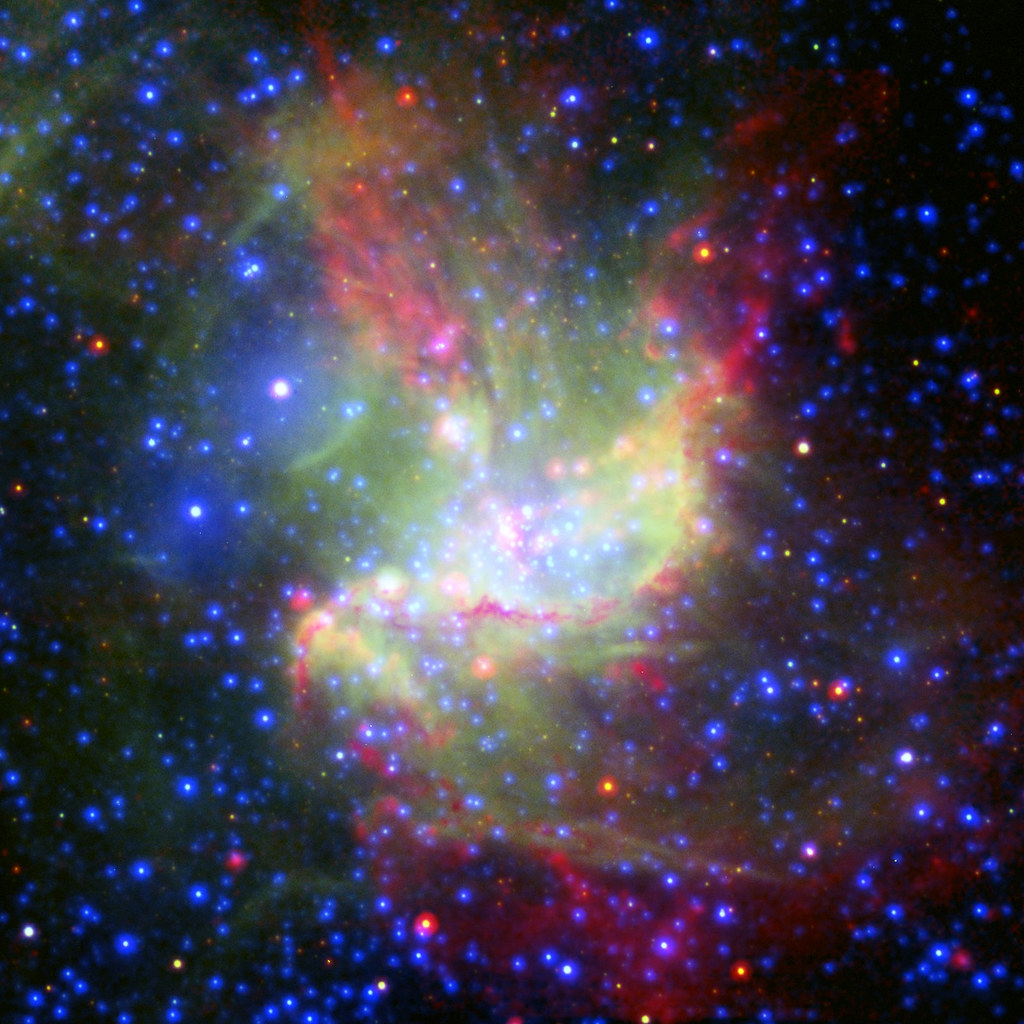
Fledgling Stars in Stellar Nursery by NASA Goddard Photo and Video is licensed under CC-BY 2.0

Pebble in the well

Thanks to WordPress for its “Hokku” image.

A pebble is dropped into a deep well, and 3.0 seconds later the sound of a splash is heard as the pebble reaches the bottom of the well. The speed of sound in air is about 340 m/s. (a) How long does it take for the pebble to hit the water? (b) How long does it take for the sound to reach the observer? (c) What is the depth of the well?

https://www.physicsforums.com/threads/pebble-being-dropped-into-a-well.611630/

~

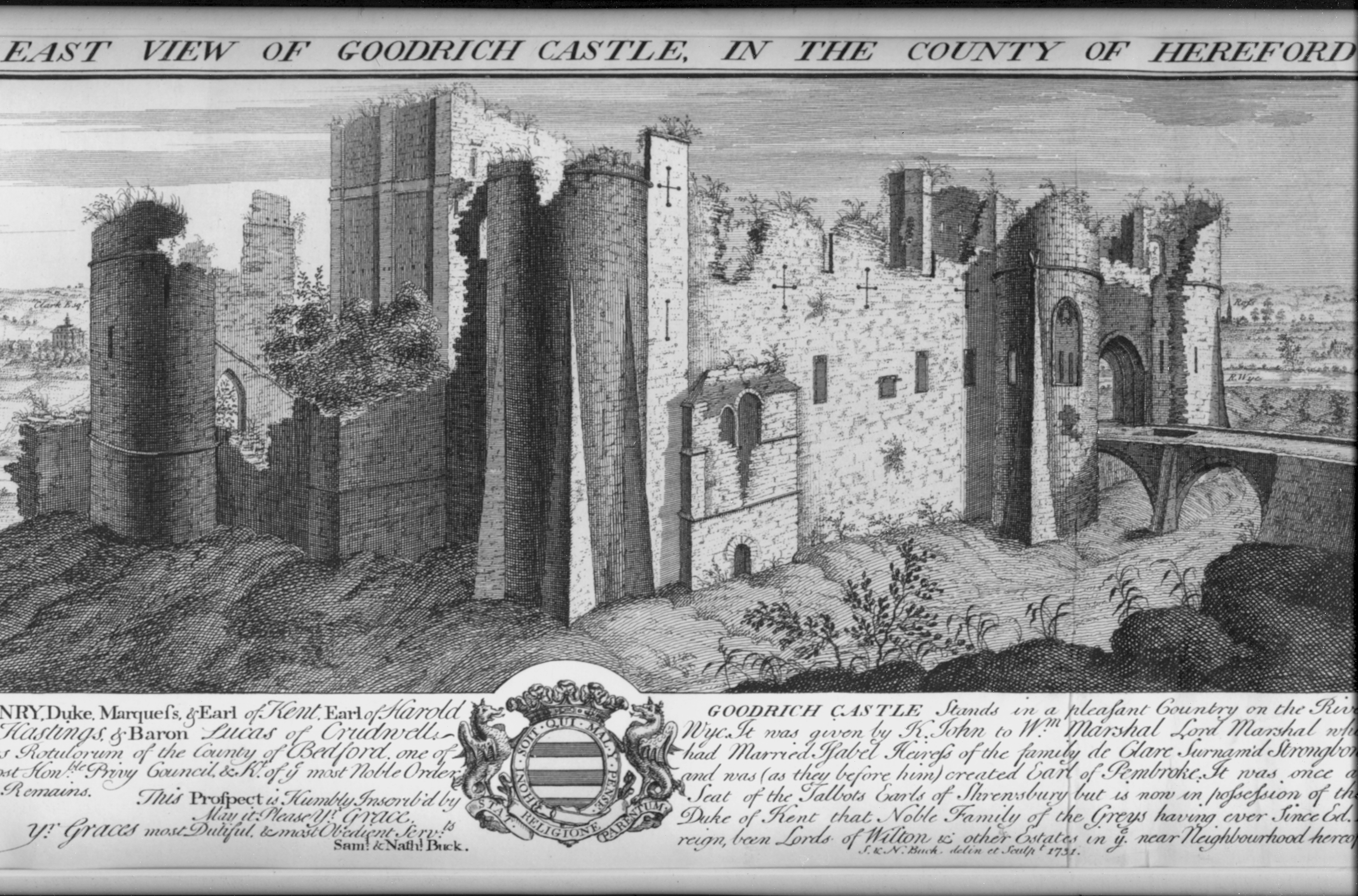
Indeed–what can we determine based upon the little we know for certain? This physics problem came to mind when I was listening for responses to, say, a short poetry collection that came out recently. (Yes, Strange Ladies.) And I recalled a visit in 1984 to Goodrich Castle in Ross on Wye, Herefordshire, England, where we did just that–dropped a small stone into the well–and waited what seemed a long time for the sound to reach us. From what I understand, tourists can’t do that anymore; the National Historic Trust has upgraded the ruins to make them safer to visit. The tourist board doesn’t want anyone falling down wells.

But I digress. I meant the metaphor to apply to how writers listen eagerly for response to their work once it is published. Will anyone review it? Will anyone read the review? Will anyone post about it on social media? Will anyone contact the writer to say those words we want to hear: “I love your book!” –?

Sometimes, yes. And for those who have done so already, a million thanks.

~

According to family records, some of my maternal grandmother’s family were related to these Goodriches; but as the castle’s later owners were Normans (and then, Parlimentarians), it’s kind of hard to be certain. I can vouch for the depth of the well, however.

Physics, poetry, notes

In a discussion among some of my poetry-reading friends, two readers said they feel “stopped” when they encounter unfamiliar words or terms in a poem. They feel poets should avoid writing work that uses specialized knowledge as metaphor, in imagery, or to establish the poem’s context. Their argument is that when a reader feels stopped by anything in the poem–from an unusual line break or stanza structure to an unfamiliar word–a kind of alienation occurs between reader and text, and that when poets choose to employ the unfamiliar they need to explain somehow/somewhere (notes? prose headings?) to guide the reader. But then they added that referring to notes is, in poetry, distracting.

“Some vocabulary and allusions just make me feel inferior,” one friend says. I don’t think they’ve spent much time with Ezra Pound’s later work but imagine this statement by Sam O’Dell applies: “Now, whether or not Ezra Pound intended to make others feel less intelligent while pulling obscure outside references into his poems and essays is up for debate. The guy seems the type who may have enjoyed making sure others knew he was smarter than they were.” (Read the rest here).

Nerdy autodidact that I am, I rather like those stop-the-reader moments in poems–if there’s a payoff. If I learn something new, and if that thing I have learned enriches the poem’s meaning and also enriches me, then I don’t mind feeling surprised or puzzled or even interrupted. Some poems take more work to read than others, and that’s ok. Some novels prove less easy to read than others, and some movies make the audience-experience fraught, unnerving, or strange. For me, the essential work that artistic endeavor does is open new perspectives, present puzzles, invite inquiry. Make me curious!

Example: Recently I re-encountered the work of poet Daniel Tobin, whose collection From Nothing speculatively examines the life–the interior, intellectual, and spiritual life–of the Belgian priest and cosmological physicist Georges Lemaître. In the process, this series of poems covers war, genocide, the atomic bomb, physics. I haven’t read anything by Tobin since his book The Narrows (2005), and the Lemaître poems take considerably more work to comprehend. That work on the part of the reader is rewarded, I should add, especially a reader with more than a passing interest in cosmology and the cosmos itself. A reader who doesn’t mind a bit of theology or physics or history and quite lengthy notes at the end of the book, and who will actually read said notes. And then refer to her books on the expanding universe theory and Hubble Effect and look up more about Lemaître. [That reader would be me; but Tobin has many readers with all kinds of interests and expectations about poetry.]

In Tobin’s lovely poem “(Origin),” I found the word marver, and while looking up the definition learned that when molten glass is poured onto a slab for cooling, the process is called gathering the glass–and I love that use of the word gather. Maybe it will make its way into one of my poems someday. Even if it does not, I feel happier knowing that little fact.

But most of From Nothing contains allusions to cosmology, to Einstein and Planck, to World War II and conflicts of many other kinds, internal as well as external. I kept being wowed by Tobin’s research into Lemaître and by the poet’s imagination as he plumbs his subject’s complicated world of math, motion, and a conceptual physical universe that could also have room for God. I mostly remembered his earlier work that was so tightly crafted, often rhyming (or employing surprising and delightful assonance). In this collection, I didn’t notice the craft aspect until I went back and did some re-reading. I was too caught up in the complexities of physics and the momentum of the subject’s life-as-scientist/life-as-priest. The lines each have six strong beats, the stanzas are tercets, and there are eight stanzas in each poem. There’s more to the craft than that, but what I like is that–unlike some of Tobin’s earlier work–the craft takes a backseat to the narrative (though I think that’s also true in The Narrows, to some extent.)

Maybe this “difficult” book appeals to me because I like difficult books. Maybe it appeals because it reminds me of my father, a person invested in the world of reason and fascinated by science…who yet believed there can be faith, that god exists. Here’s an excerpt of Tobin’s “(Cinema)”:

You, who chose two ways equally at once, circuit 
the conferences, meetings fueled by enigma, mixing 
with the eminent and their sidereal regard,   

your morning Masses before library and lab.

~

My dad was not a Catholic, but the balance between faith and reason was one he wrestled with, too.


Expanding universe

I just finished reading Lisa Randall’s book about the Large Hadron Collider, which I read because…well, I knew it would be over my head as far as the applicable physics experiments go; but I was curious about what exactly the Higgs boson particle is and how it fits into the Standard Model of physics. And now I know. Sort of.

It is difficult not to feel a bit awed by the strides made in science as a result of rapid technological advances. On the sociological and personal level, I am not a big fan of rapid tech updates; they lead to planned or unplanned obsolescence and hence to constant capital expenditures and to waste (trash waste and time waste). The technology leads to experimental possibilities we would not have had otherwise, however.

At the close of the book, where the author wraps up the way engineering tech has dovetailed with abstract and speculative physics theories to show evidence for the Big Bang and the existence of quarks (among other things), there’s an illustration of the “ballooniverse,” an analogy physicists use to explain the expanding universe. I felt a rush of memory flooding me:

Freshman year in a seminar college. The class was Astronomical Physics and Cosmology. For context, Hubble had discovered red shift galaxies in 1929; cosmic microwave background was detected in 1964; Wilson and Penzias won the Nobel Prize–three years after my freshman year–for their work, which led to confirmation of an expanding universe. The term “black holes” was relatively new, coined during the mid-60s; and a theoretical explanation of them had not yet been determined. Oh, and because desk calculators were large and prohibitively expensive, my fellow students and I were using slide rules for calculations of stellar magnitudes.

Did I mention I had never taken a maths course beyond Algebra 2?

But our professor was enthusiastic and encouraging and loved using metaphors to help our teenaged brains decipher challenging concepts. I have forgotten most of his analogies, but the ballooniverse stayed with me. Everything in the universe is moving away from everything else. Our future is distance.

Physics classes in high school still use this 3-d visual analogy

So it seems at present. Each of us moving away from one another. Defoe’s narrator says the best method of avoiding plague was to run from it.

But oh, my Beloveds, how I wish to be close to you.

Waves & relationships

I had planned to take a little “vacation” from difficult books this summer and read a bit of fiction, go to the movies, work in the garden. And while Maryanne Wolf’s Proust and the Squid covered the challenging topic of reading and delved into some neurological explanations for the process of how we read and how literacy changes our brains, Wolf writes in layperson’s terms and divides her text into easily understandable chunks. It was a relatively easy read on a complex topic and reminded me that I need to re-read Proust’s famous essay “On Reading Ruskin.”

Then my dad said I should read Reflection in the Waves by Pablo Bandera. Here’s a physicist with a philosophical bent who tries “reconciling the realism of Aquinas with the empirical evidence of quantum mechanics.” I like Bandera’s interdisciplinary approach, a blend of physics–his main area of expertise, a “true” science–and philosophy, anthropology, evolution, even theology. Does Bandera entirely succeed in persuading me that the observer effect of quantum physics is a human-based, perspective conundrum that may not be a problem at all? Not completely, but it is an intriguing theory about which I remain open-minded. The recognition that being human alters the observing mechanism seems sensible to me.

I would never suggest that Reflection in the Waves is an easy read for the average informed person. It contains a few fascinating observations and summaries, however, that relate to human relationships (our need to connect), to communication, literature, and art. He writes:

What distinguishes us humans from other objects around us, including other measurement devices, is not that our reality is not somehow irrelevant for the physical world, but that our relationship to this world is such that it transcends the mere subject-object relationship currently envisioned by the physicist.

Reality=relationship to others and the world. That’s a contemporary way of interpreting Aquinas. I’ve never before thought of myself as a Thomist, and the very idea makes me giggle. But as a writer, especially as a poet, the relationships and connections in the physical world are the stuff of metaphors that engage the conscious mind of abstract thought and help to put the poem across to other readers’ minds (thank you, Maryanne Wolf). Perhaps not so far from philosophy, or physics, or neurology, after all.

Burning

letter I t’s fascinating to me how memory and associations work; this weirdly human cognitive process (or set of connective processes) seems to wire us for poetry, for art, for metaphor, analogy, and symbolism–for dreams and the surreal, and for curiosity and wonderment.

I visited the Cathedral of Notre Dame when I was in Paris at age 16, an experience indelible in my mind. And yet, what arrived when I sat down to write my poem for this particular April day is a different, though related, image and experience. One I had not thought about for many years, not since this post, probably.

~

Cathedral, Burning

In a work of fiction, the church aflame would act as symbol; in a sermon,
as analogy, something metaphorical in both church and fire; but listen,
my childhood church, First Presbyterian of Yonkers, burned to the ground–
steeple towers, bricks, stained glass, oak pews–in 1968, faulty electric
wires, not an act of God, nothing symbolic about it, no medieval art, no
gargoyles, no rose window; and I can attest to fire’s brute facts, the physics
of heat, the combustion chemistry my father’s brother studied for years, how
even stone can change in fire, transmute, char, chip, and timbers light up
like a droughty forest, glass fused into new-made forms and smoke erupting
to chorus its own pronouncement louder than prayer; and there is no alleluia
yet there is no satan, only what the earth is made of changing its form
(molecular re-arrangements) but not its substance, which is earth, and ours.
~

Archival photo here.

Poetic naturalism

I have been reading poetry, as usual, and also non-fiction about various aspects that could be deemed scientific, such as Michael Pollan’s Changing Your Mind and physicist Sean Carroll‘s book The Big Picture. 

On my way to work, I posed (in my mind) an argument with Carroll about his use of the word “poetic” in his definition of poetic naturalism, which he defines thus:

Naturalism is a philosophy according to which there is only one world — the natural world, which exhibits unbroken patterns (the laws of nature), and which we can learn about through hypothesis testing and observation. In particular, there is no supernatural world — no gods, no spirits, no transcendent meanings.

I like to talk about a particular approach to naturalism, which can be thought of as Poetic. By that I mean to emphasize that, while there is only one world, there are many ways of talking about the world…

The poet Muriel Rukeyser once wrote, “The universe is made of stories, not atoms” … There is more to the world than what happens; there are the ways we make sense of it by telling its story… The world is just the world, unfolding according to the patterns of nature, free of any judgmental attributes. But these moral and ethical and aesthetic vocabularies can be perfectly useful ways of talking about the world … We just have to admit that judgments come from within ourselves.

Despite my doubts about his use of “poetic,”  it may be that Carroll’s term describes me; at any rate, his definition comes close to my own thinking about the world.

And hence, another draft for my poem-a-day challenge.

~

Brown leaves bouncing across Preston Lane
late afternoon, air currents swirling.

Road shoulder cradles raccoon carcass,
fur shudders, though body’s still, and sun

highlights the gray-white hairs as travelers
speed past. Chlorophyll greens local lawns

and ditches beside the creek, molecules moving,
nitrogen atoms taken up through root and rhizome.

Sudden, yellow, early–narcissus blooms near
the neighboring farmhouse–all of which

recommends itself as The World As It Is.
A reality for at least one universe,

even though there exist other possibilities
in the realm of Undiscovered.

daffodil photo Ann E. Michael

Evolution of the neuron

I have just read, albeit slowly, Werner R. Loewenstein’s Physics in Mind: A Quantum View of the Brain. Having finished the book, I can attest I understand his argument even though my grasp of the physics involved is decidedly at the novice level. The last three chapters of the book were what drew me to reading it in the first place–those chapters cap the text with his model of how Evolution (he anthropomorphizes the theory) “chose to design”–in its exemplary, concise way–complex systems that led not just to life but to sentience.

Loewenstein compares neuro/biological processes with computers in terms of their being processors of information from the environments. He seems enthusiastic about computers in general, but he argues that artificial intelligence remains far away from evolving into sentience because consciousness requires many kinds of parallel processing that intersect and interact and filter out information. That complexity, he claims, will be difficult to engineer; yet over eons, the process of evolution accomplished it through a combination of physics, chemistry, and biology.braintrust-small

Loewenstein prioritizes the physics aspect: how electrical pulses in neurons parallel electrical pulses (attraction and repulsion) in atoms, how these behaviors can combine to create compounds or release energy; he uses analogies and spends several chapters on the eye, its neurons and dendrites and cones and rods, to demonstrate how a system of information reception and filtering can occur that relays information to the brain and then back to other information receptors and actors in the body of a worm, bird, or human being. Get enough relay systems going, and sight + touch + smell + hearing + taste evolve into the living animal. At some point, the multiple parallel information systems develop into consciousness (Loewenstein does not speculate where that point occurs–it is still “a mystery,” he admits).

~

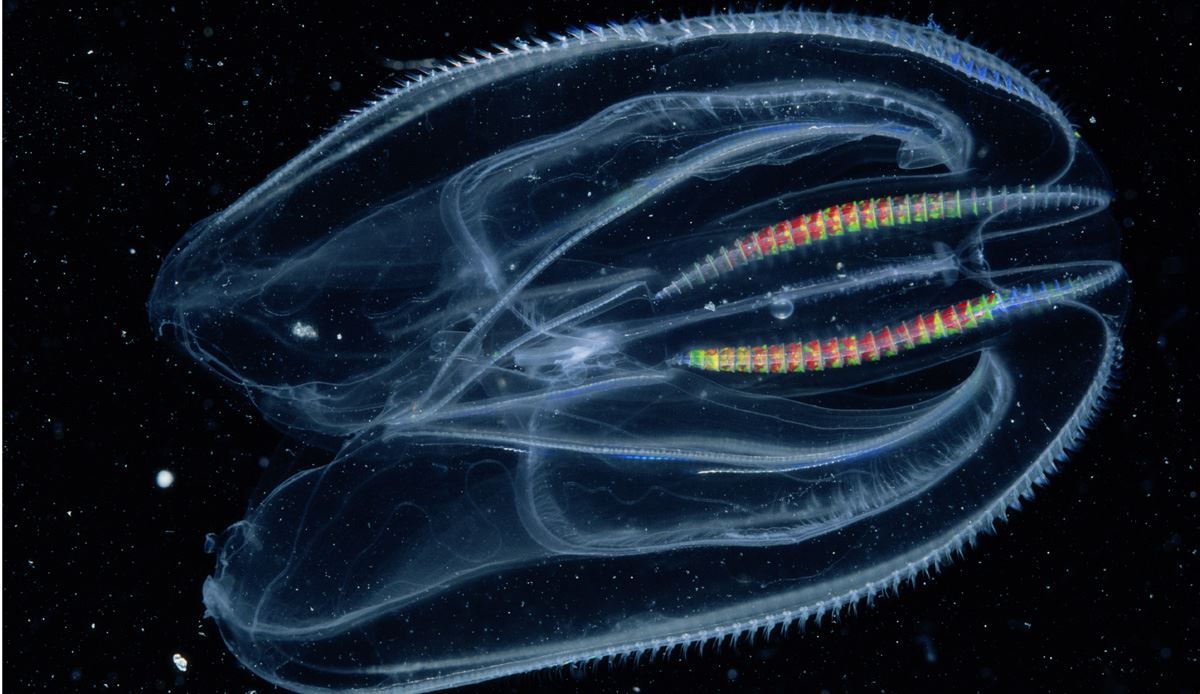
Douglas Fox, writing in Aeon, quotes neuroscientist Leonid Moroz as saying, “There is more than one way to make a neuron, more than one way to make a brain.” In this fascinating article, Fox follows Moroz’s lengthy study of ctenophores, jellyfish-like creatures about which little is understood–though Moroz and his team of researchers are changing that. At the same time, their work suggests that our previous understanding of brain development is not necessarily the only model out there for how neurons and synapses can get information processed and acted upon to sustain a life. If that life is lived under very different environmental circumstances, maybe evolution might “choose” different paths of systematic information processing (ie, “thinking”).

…when he failed to find common neurotransmitters in ctenophore nerves back in 1995, it wasn’t simply that his tests weren’t working; rather, it was because the animal wasn’t using them in any way. This, says Moroz, was ‘a big surprise’.

‘We all use neurotransmitters,’ he says. ‘From jellyfish to worms, to molluscs, to humans, to sea urchins, you will see a very consistent set of signalling molecules.’ But, somehow, the ctenophore had evolved a nervous system in which these roles were filled by a different, as-yet unknown set of molecules.

Fox poses the researchers’ questions this way: “how divergent can nervous systems be? Do we truly understand how life senses its surroundings and behaves?” Science has generally, post-Darwin, followed a straight-line approach to evolution; but good scientists recognize that sometimes the road less traveled by has made all the difference.


Although the very idea of “sentient jellyfish” might appall many people, I wonder what sort of consciousness ctenophores would develop.  🙂

Mind & gray matter

After an interlude of fiction-reading and the start of the semester, during which there is little time for personal reading, I have returned to some of the topics of neurology, consciousness, and the evolution of the story-telling mind that have so often diverted me from–yet influenced my thinking on–poetry.

Just a brief overview of my “difficult books” of the past four or five years…I have a background in philosophy and, to a much lesser extent, theology. Both disciplines endeavored over thousands of years to explain why we think the way we do and why or how we reason, make decisions, and make clearly unreasonable decisions.

The Free Will paradox, the Mind-Body Problem, ethics, tribalism, the body politic, you name it.

My thinking tends to sway slightly Eastern in terms of intention, mindful behavior, and non-theistic compassion despite my being raised pretty much Western Protestant with Enlightenment ethics and values (also compassion, as based upon the teachings of Jesus).

Throw in a bit of psychology built upon philosophical foundations, Freud, William James, Darwin, Thoreau, and my constant searching for what makes a being conscious, and I end up with an eclectic but not unreasonable reading list.

Also poetry. But I digress.

Here’s the barest outline of my more recent forays into understanding the probably not-understandable: I read Stuart Kauffman’s book At Home in the Universe to obtain a grasp of a chemistry-and-statistically-based (Boolean) thinking concerning how consciousness may have arisen in the universe and whether we Earthly human beings may not be entirely alone as conscious beings in a huge and expanding cosmos. Frances Crick’s The Astonishing Hypothesis offers a biologist’s view of how we ought to go about trying to study consciousness and its evolution based upon biological science. Douglas Hofstadter’s I am a Strange Loop, a deeply engaging look at an interdisciplinary concept of consciousness, examines evolution, biology, neurology, and a bit of physics and philosophy; Dennett & Lakoff’s Philosophy in the Flesh grounds philosophy in neurological underpinnings. Just to be sure the physicists are not overlooked in my overview of consciousness, I’m now reading Werner Lowenstein’s Physics in Mind: A Quantum View of the Brain.

Referenced in almost all of these books are Patricia Churchland, the D’Amasios, Thomas Nagel, Thomas Kuhn, Charles Darwin, Descartes, and Kant.

To name a few.

brad-hammonds-flikr-books

~

What good has this reading done me, in terms of understanding what constitutes consciousness, from what it is derived, and how it evolved? Do I know any more than I did about human beings? I certainly know more about the human body, especially the brain, than I did. I know more about the cellular level of information processing and more about theories people have posited during the past centuries–and what aspects of those theories seem to have had either intuitive, reasonable influence or scientific (empirical) value.

That last paragraph appears to be question-dodging, doesn’t it?

~~

I love to read. I love human beings. I love the phenomena of the visible and experiential world. I love the urgent fuel of creativity. Can that be enough, for now?

In time, maybe I will come to accept the fraying of the consciousness, the decay of memory and the intimate Beloveds as they fade into senility or pass out of the tactile world.