Rest in poetry

National Poetry Month has brought with it a sad bit of poetry news: Harry Humes has died. If you are unfamiliar with his work, you might want to check Penn State’s PA Book site’s biography of him, and then find one of his books:

https://pabook.libraries.psu.edu/literary-cultural-heritage-map-pa/bios/humes__harry

He was an excellent poet, influential for many folks–especially for Pennsylvania writers–and while I never knew him well, our lives intersected in some surprising ways over the years…

~

In 1982 or thereabouts, I resided in Philadelphia and was participating in many poetry readings, mostly open mike events. Carol Ann Robertson, who lived at that time in Philly but who had connections in the Lehigh Valley, told me that Bethlehem’s Godfrey Daniels listening room hosted a monthly poetry reading and invited me to drive up with her to hear someone named Harry Humes read. If I recall aright, three or four Philadelphia poets crammed into her compact car and headed north. We arrived early and were introduced to Harry, who seemed to have quite a case of nerves; that surprised me, since he was my parents’ age and a professor. Apparently this was one of his first, or perhaps his first, public reading–whereas I had been reading at open mikes since I was in my early 20s and was pretty much over my nervousness. (Years later he told me he’d fortified himself with a bit of scotch before the event.)

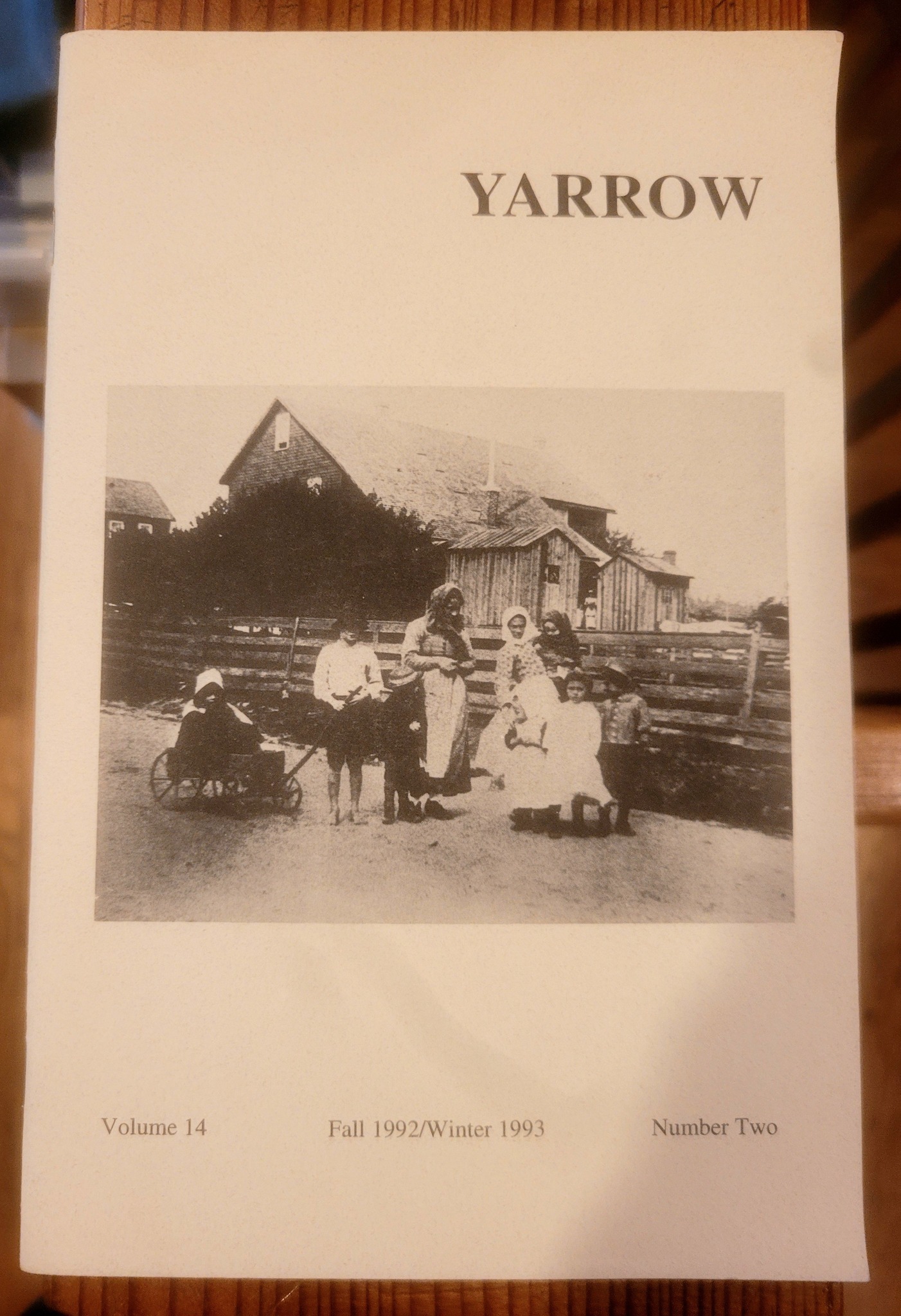
It was a beautiful reading. His work was both accessible and mature, and he clearly knew what he was doing when it came to writing poems. Indeed, his first full-length collection, Winter Weeds, came out shortly afterwards. Anyway, I moved out of Pennsylvania for awhile and, when I returned, it was to the very suburban Lehigh Valley. In 1992, I sent some poems to Yarrow, a lit journal published at Kutztown University–Humes was the faculty advisor and editor then, and he chose to publish my prose poem La Barbe.” For which, Harry, many thanks. I was so busy with toddlers that I was hardly submitting any work anywhere, or finding much time to write. The publication was a boost for me.

Then, in the peculiar way of small-world eventualities, my husband hired Harry’s wife, Nancy, as copyeditor for a Rodale Press magazine. I found that out when, a few weeks after she’d been hired, my beloved asked whether I had ever heard of a poet named Harry Humes! (By that time, Humes’ fourth collection, Bottomland, was in print)…

~

When I was hired at DeSales University around 2005, I learned that DSU held an annual poetry event for high school students. I attended/participated often, and Harry Humes–who was a good friend of the program’s administrator (Steve Myers)–was always involved in the workshops and events. Humes had retired from Kutztown by then, and was writing more poems, fishing, and enjoying family life. He always greeted me with a big smile and asked about my writing. That sums up for me what kind of person he was: generous; possessed of a self-effacing, even self-deprecating humor; kind and encouraging to people just starting out in poetry.

Here’s a poem of his that I like a lot, which I clearly recall him reading that day at Godfrey’s so long ago: https://www.poetryfoundation.org/poetrymagazine/browse?volume=154&issue=3&page=13

And here is one of his best-known poems, the title piece from his 2004 book. Harry, thank you for gracing us with your words. We’ll remember them for a long time.

~

August Evening with Trumpet

Up in the woods a neighbor or stranger
who has had enough of August,
its spider webs and first yellow

near the roots of things,
has out of the blue found his old voice,
wailing away everything

he can remember.
Perhaps he will play
right through fall and winter,

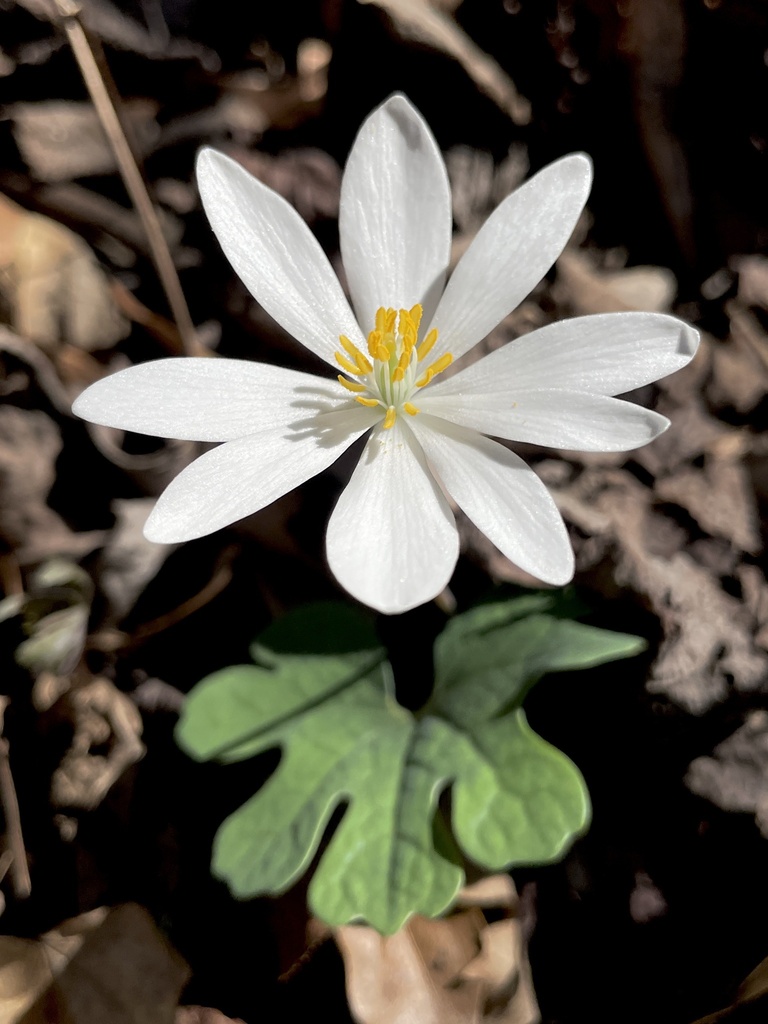
not stopping until bloodroot
and anemone blossom.
But now it is almost dark.

Mist veils the fields,
and last sounds play out
as simply as longing or breath.


Copyright © 2004 Harry Humes All rights reserved
from August Evening with Trumpet
University of Arkansas Press

Poetry month books & doings

~

It is, once again, April: National Poetry Month. My recent trip to the AWP bookfair has given me many poetry books to peruse at whatever pace I please, and because the weather here has been far too wet to do much in the garden, I’m using the free time to read. The outpouring of millions of peaceful protesters who oppose the current administration’s policies and who rallied on April 5 was somewhat heartening to me, but I remain skeptical and am aware that real change takes a long time. For the present, I’m bolstering my spirit through poetry.

~

I met Diane Thiel decades ago, briefly, at the West Chester Poetry Conference. She is incredibly talented, intelligent, frighteningly well-educated, and her work impressed me a lot; somehow, though, I did not get around to reading the many books she’s published since then, so her Questions from Outer Space (2022) is a delight and a revelation. Travel, literary and historical references, child-raising, teaching–the poems here cover a large range of topics. I bought her book at the Red Hen Press tables in LA. Red Hen is a terrific source for contemporary poetry books, if you’re looking…

At Saturnalia’s booth (another good small press with a large catalog), I found three of Martha Silano’s books and rejoiced. So far I have finished reading only The Little Office of the Immaculate Conception, which I love, but I can hardly wait to read her more recent books. She has a wry sense of weird, nerdy humor that’s inflected with science facts and grocery-store labels, pop culture and life in the burbs, and a healthy questioning of, well, everything.

My fellow Goddard alum and friend Lou Faber has a new book here, and it’s so wonderful to read the work of a long-time poetry colleague whom I haven’t seen in years but whose voice comes recognizably through this collection. The second half of the collection, in particular, deals with the emotionally-complex aspects of being an adoptee and this person’s efforts to untangle where (and who) he’s “from.” Contradictions abound over the years; then, DNA testing sort of, but not quite, sorts out some of the mysteries. But life–well, much of life contains mysteries and always will.

~

Meanwhile, this April I will be busy giving and attending in-person and online poetry events–even a radio spot! I’ll be reading mid-day at a local community college, participating in a No River Twice poetry event; and at some point this month, an interview about The Poetry Press Project (and my latest book) will air on WDIY 88.9FM. And a few of my poems will be appearing in print this month, the first of which is here: “Luna, Paloma.” I’ve also signed up for virtual attendance at a couple of poetry reading; and on May 4, I will be among the features for a virtual reading sponsored by One Art journal. My physical stamina isn’t what I wish it were, but thanks to technology that enables me to participate from home, I can manage to do a bit of yard work and STILL get to a poetry event.

Mid-March

Tulip poplars begin to plump out their winter bud scales, where they will leaf out later in spring.

A marsh hawk zips overhead, winging above the treeline and vanishing over the northern hill.

Early ornamentals bloom: crocus, snowdrop, aconite, i. reticulata.

Red-winged blackbirds make the mornings noisy–they have so many different songs and calls that three or four of them sound like multitudes, almost drowning out our year-round singers, the song sparrows. Early migrant passerines have returned, but it’s still winter here. Some bugs have gotten active and are emerging from hibernation or incubation. No bees as yet. When I turn over rotting logs, I find amphibians’ eggs and lots of different varieties of soil centipedes.

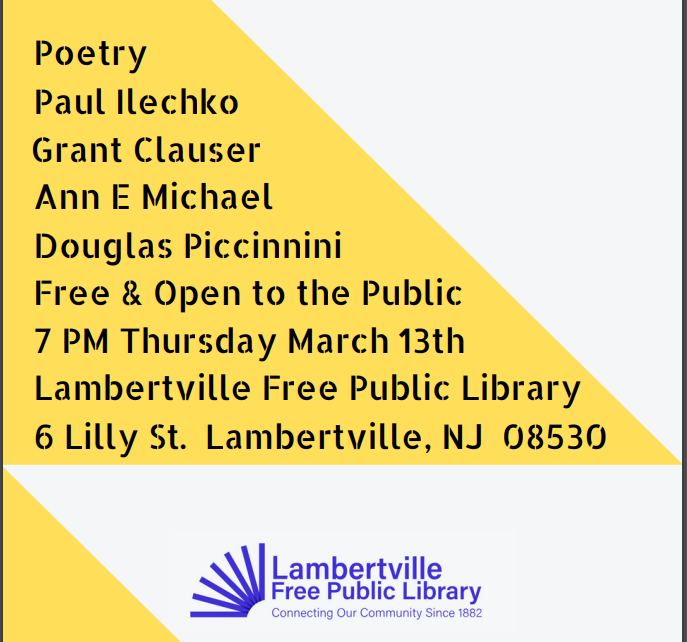
And, of course, worms. March’s moon is sometimes called the Worm Moon, and tonight there’s a total lunar eclipse around midnight here in PA. Is that auspicious? It’s also when I will be reading at the Lambertville Free Public Library in Lambertville, NJ. I’m excited to participate in an on-site, in-person reading again…I’ve been hibernating a bit from poetry events, but it is time to get stirring.

At the end of the month, I’m packing up for a brief trip to Los Angeles, where I will be attending one day only of the annual AWP Conference (Saturday’s Book Fair!) and spending the rest of the visit with my son. The conference always offers a terrific infusion of writerly companionship, community, and inspiration. Whereas time with my son offers love, cool places to see and eat and hike, a host of things I didn’t know I wanted to learn, and many moments of hilarity and conversation. It’s hard that he’s so far away–hard for me; I don’t think he minds, he is busy and having fun, which is as it should be.

Also, yes, the whole situation here in the USA is something I never could have imagined as a younger person, when I somehow had an unquestioning faith the US Constitution could actually be workable as an enduring rule of law. That careless people who value money over community could indeed disrupt that 1787 document was always a possibility (the moneyed property owners and slaveholders had their way with the original, after all), but most of us didn’t see this coming–naive, I suppose. Busy with our own concerns. I get it, and maybe we deserve what’s coming, but [ugh]. A concerned European friend recently asked me how I was faring under the stress of these first three months, and I told him that since making art (poetry) has generally been an unconventional act/behavior/response even under the patronage system, my response is to keep making art. Granted, it isn’t much, nothing earth-shattering, not gonna change society that way; but it keeps us observant little non-conformers on our toes, creative, and flourishing in the face of weirdness and oppression.

Which is something we can do. Like early bloomers in the cold days of late winter.

winter witch hazel blooming in snow

Paper files

Frankly, I have never been much of a fan of organization. I don’t mind planning, in brief and purposeful bursts, but getting things in shape after the fact–once the mess exists–well. I know people who truly enjoy pitching in and re-organizing, but I am not one of them. Besides, I’m also facing similar tasks in my household, rooting through the kids’ rooms (they left years ago) and our attic and basement to cull, straighten up, and organize. The tasks are mutually distracting. And often tedious. I’m working on my attitude, though, trying to find some method of making these chores, er, “creative” in some way. (File under “Lying to Self”).

Call me old-fashioned, I’ll readily admit to it; but lately I have decided that the most efficient way for me to keep track of my own writing is by using a physical filing system. I have experimented with various spreadsheets (I have no patience with Excel, however and alas) and computer folders. I do use the latter for a year-by-year archive of my work, but I cannot easily extract what I am looking for that way. Now that I’ve retired from my 40-hour work week, I have wanted to manage my creative work better and keep track of what needs revision, what seems finished, what has been submitted, what’s been published. That strikes me as a necessary part of tending to myself as a writer. The past year has been a time of working through options, with accompanying irritation and tedium.

Photo by Anete Lusina on Pexels.com

After years of endeavoring to use electronic files, it came to me that there’s nothing wrong with old-fashioned paper systems, organized alphabetically by title, with the computer-file names and draft number at the bottom of each poem. This is how I think about the poems when I want to work on them or submit them, so it feels natural to me. Why operate against one’s own operating system?

I suspect one reason (oh, there are many, but let’s start with one) I am so angry about Elon Musk’s “DOGE” initiatives is that efficiency is never all it is cracked up to be and is also not the be-all and end-all of any society’s best organization. Of course those who push AI believe that algorithmic calculations can make the world run smoothly, but said people are egregiously uninformed about human nature and the myriad forms of individual thought processes. We are non-standard. Averages account for almost nothing, really. We do not think the same thinks. (And yes, I meant thinks not things, autocorrect). Diversity is what keeps evolution going. There is no change without it; and without change, we die.

So: I’m inefficient, to a degree, when it comes to keeping my creative work in order. However, the paper filing system, with a notebook and index cards and files on my hard drive, assisted by my still-useful memory (a human brain!!), have so far been working pretty well. It has taken me several weeks to put my stuff together, but now it’s far easier to fetch what I want to work on, send out, or collate, which I need to do to prepare for upcoming reading [I have two online readings coming up–one on Feb. 18 and one on May 2]. I’m also grateful that the task kept me busy while I was anxious and worried and grieving over recent not-so-terrific experiences in my (physical, real) life. Real life, which is not averaged. Seldom predictable. Inefficient. And something to celebrate for all its strangeness.

Recuperating

Last week took a lot out of me, many reasons for that, mostly keeping those reasons to myself. I needed some rest from exertion and from social media, so I’m re-reading Les Misérables. In which Hugo seems to be trying hard to convince readers that compassion and goodness can be awakened in the hardest of hearts through the process of gentle persistence and genuine decency. Radical decency, as a friend of mine put it. Well.

I won’t write that off as an impossibility, since lord knows many things that seem impossible are not. But yes, Hugo was writing fiction, and one turns to fiction for escapism but also for reference, and for understanding human actions and feelings, and for perspective, and for information. I just completed Richard Powers’ Overstory, which offers a vast range of perspectives on the above-mentioned and adds ecology and forest infrastructure and the psychology of groups into the mix. Novel-reading has been giving me a sense of overarching historical range that lifts me a bit from my too-close focus on my own small life and my ability to sustain hope and make art. That acts as a form of recuperation, if you’re me.

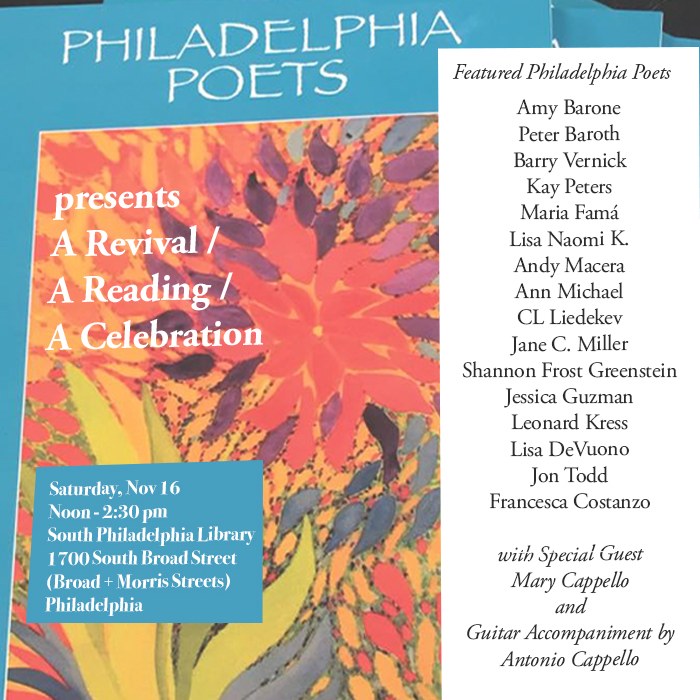
This week, though, happens to be full of poetry. Tomorrow, I’m attending a reading at a nearby public library, where I’ll see many poetry colleagues, the sorts of folks who create a community of local writers. Friday, I’ll be reading with Montgomery County’s Poet Laureate, my friend Lisa DeVuono, at the retirement community where my mother resides. Saturday, I’m heading down to Philadelphia to read with another long-time poetry community in celebration of Philadelphia Poets, a long-running zine established decades ago by the late Rosemary Cappello.

It is good I have had some reading-novels time, and it is good I’ll be having some reading-with-poets time ahead. Both are nourishing to my soul. I haven’t been writing much lately, but I will be eventually. Meanwhile, I’m still waiting for the drought to break…we got a fraction of an inch of rain a couple days ago, and I really hope there is more ahead.

Whatever you happen to need to nourish your own soul, make time for it.

Equinoctal

Torrents. We had rain in torrents, and it went on for days from February into March and then on…and on. Constant alerts on the cell phones: “Flash flooding.” Doldrums set in. In an effort to accomplish anything at all, I even started to sort through and organize my attic.

Talk about desperation!

The attic project isn’t finished–the weather turned mild and clear two days ago, so I ran to the garden to get to work out there–but it turned out to be a more rewarding task than I expected. I started by tackling the Christmas stuff, then the books (SO many books), children’s toys (the kids are in their 30s and there are no grandchildren), and moved on to paper correspondence. Letters! Postal mail. Epistles. Why I have saved so much of my correspondence from 1975 to the present, I cannot explain. Maybe that’s a thing that people who love words just naturally do, the same reason I have kept so many books. I certainly don’t need all of it; but that was part of the task, sorting what I want to keep and agreeing to recycle the rest. I also found odd ephemera, such as photocopied posters for long-ago poetry readings, broadsides of poems, xerox-zines from the early 1980s, and ancient mixtapes on cassette.

~

There’s some sorrow with this project. So many of my former correspondents have died. I find my grandmother’s looping script, my dad’s distinctive handwriting, my dear friend David Dunn’s nearly-illegible scrawl. Reminders of times past. Maybe that is why we keep ephemera: to remember what we thought, at the time, was important.

Maybe it is, maybe it isn’t, by the time we reach our later decades–if we’re fortunate enough to reach them.

I keep gardens for different reasons. Not to remember the past but to see what the present can bring.

~speaking of the present~

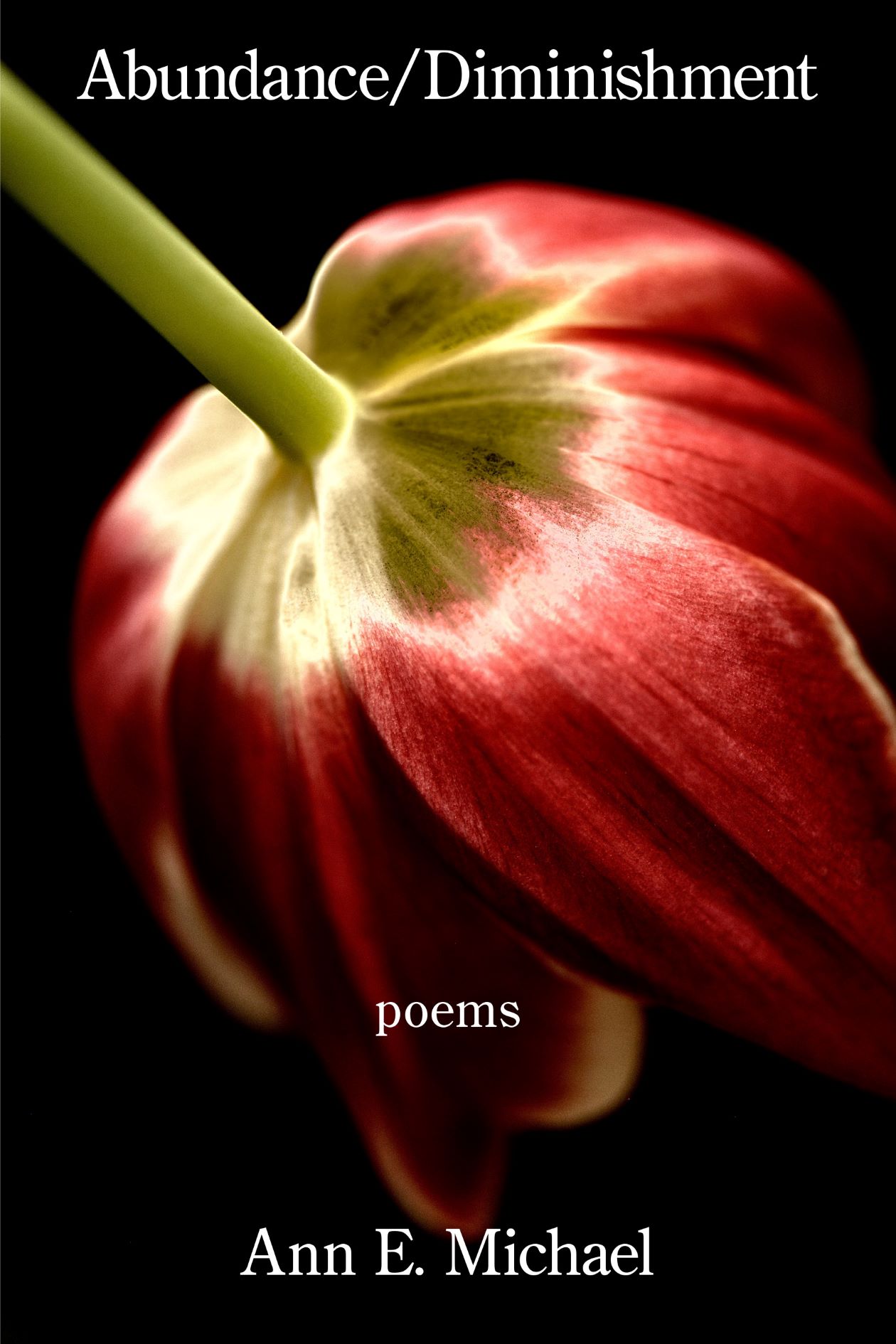
My new book can now be ordered from the publisher, if you find Amazon problematic (and there are good reasons for that). The link is here.

House concert

I can only recall ever attending one house concert. It was during my college days–1977 or ’78–and took place at a large Victorian house in Ann Arbor, MI. We sat about on chairs, sofas, stairs, and the floor to listen to blues/folk singer and guitarist extraordinaire, David Bromberg. It was a pleasant environment in which to hear the musician–an intimate and attentive audience, a sense of camaraderie and shared appreciation, and quite comfortable. But I never managed to attend another house concert…usually, such events are fairly private and by invitation (as I think that one was), so you don’t hear about them until after they’re over.

I was therefore delighted when friends suggested that they hold a “house concert” or, in this case, a house reading, so that they could share my poems with some acquaintances. A new audience! A comfortable, non-intimidating space, terrific food, and the kindness of people willing to listen to a bit of poetry…what’s not to like about that? There were over a dozen folks in our friends’ pleasant home, and at the close of an evening of wine and food and conversation, I was asked to read and talk about my poems. And promote my new book (which is now available to order on Amazon).

My gratitude overflows, Don and Jeannie. You’re the best!

An unexpected aspect of the house concert event was that it was delightful to meet the “audience” first, before the reading–a reversal of the usual order, and very helpful in getting me to feel more comfortable not just in presenting my work but in deciding which poems to read. In addition, the cozy atmosphere meant listeners felt free to ask questions and continue the conversation to include thoughts on song lyrics, “private” poetry (that people write for themselves alone), favorite poets, and the context of the work of poetry in the world.

That was such a marvelous evening. And up ahead, somewhat similar in nature: on March 27, at 7 pm, I will be joining poets Marilyn Hazelton and Susan Weaver–two members of the writing group that I’ve been part of for decades–and folk singer, radio host, teaching artist, and community arts leader Dave Fry for one of Dave’s monthly “Dave’s Night Out” events at Godfrey Daniels, a listening room in Bethlehem PA. Dave has been generous enough to have hosted me with other poets on stage at the coffeehouse before, and the experience was terrific. His guitar accompaniment enhances the sonic delights of poetry. I’m looking forward to this one. Tickets are $15, I think, and they keep Godfrey’s running as a non-profit arts venue in our region.

I’m happy to see this book in the world. Copies can also be ordered from Kelsay Books.

~

Promotional

I keep forgetting to mention a few nice happenings regarding my recent book, so I may as well stuff them all into one post here in case anyone is interested. Have I mentioned how much I hate doing promotion for my poetry? Why yes, I believe I have. And since these days I feel no career ambitions related to my work anymore, why does it even matter?

I think there is an answer to why it matters. Sort of an answer, anyway–that without some form of prompting to the World at Large, my poems will be reader-less. A sad fate for a poem or book, and a common one. I don’t write just for myself: I keep a journal for that. I write as a form of communication, a way to connect with a reader I may or may not know.

Sometimes no one connects because the poems don’t work for them. Sometimes no one connects because no one knows the poems exist. The first lack is unavoidable–there is no kind of artistic creation that works for everyone. The second lack I cannot do much about, but I can do a little. Hence, this post.

Some months ago, a current student at one of the colleges I attended called to ask a few questions about my new collection. I did not expect it to be more than one of those “here’s-a-thing-an-alumna-did” paragraphs, and no one got back to me to make sure the piece is accurate (and, yes, a fact or two are incorrect and no, I didn’t say I believe “anyone can write poetry because anything can be poetry; people just have to look for it,”); but it’s a nice little promo bit all the same. Link here.

Then, Michael Escoubas of Quill & Parchment reviewed The Red Queen Hypothesis. Somewhat to my surprise (I don’t think of myself as very “edgy”), he writes, “Michael’s latest collection is edgy; chock full of poems that challenge everyday assumptions about life.” He does recognize that often what I try to do in poetry is exactly that: confront assumptions, observe from different angles. Less surprisingly, he adds that my poems are “sensitive to analogies between the natural world and human experience.” Um, that would be me. That review can be found here.

I know that in a previous post I mentioned Lesley Wheeler’s generous mini-review of the book, which can be found here; she’s an especially insightful reader. I’m thrilled that she writes: “Michael’s second full-length collection is meditative, witty, and smart, with a scientific and sometimes philosophical bent. Also like her blog, it’s closely observant of the more-than-human world in flux…The Red Queen Hypothesis suggests the advantage of sexual reproduction, and there are plenty of seductively “soft persuasions” in this collection. Like the “Stew Cook” speaking to her beloved, this is a book to “fill nooks with aromatic hours.” Shout-out to all the tasty slant-rhymes amid a profusion of traditional forms.” Thank you again, Lesley!

Another little thing to celebrate is Highland Park Poetry’s nominating my poem “Game” for a Pushcart Prize. By the way, that poem appears in The Red Queen Hypothesis!

Finally–or maybe, down the road, there’ll be more to add to promotional posts–I have been getting out and around to readings a bit, in person and virtually. The latter is easier, since many readings are in the evening; these days, I am not too terrific most evenings thanks (ha! as if!) to fibromyalgia fatigue and symptoms. But I do enjoy in-person events and have been glad to read at the Easton Book Festival, at Nowhere Coffee in Allentown PA, and at Bethlehem’s Sun Inn, to mention a few. I was featured in a Mad Poets “OK Zoomers” online reading (love the pun) virtually and will be participating in a group launch of Inlandia‘s most recent issue online on November 19th (info below).

That’s about all the energy I can spare right now for self-promotion. And no, I don’t use Instagram or Tik Tok or Substack or YouTube, at least not yet, so this is all I got, folks. Thank you for bearing with me. Less promotion and more poetry and philosophizing and nature/gardening next time.

If you join the Inlandia event–make sure you account for the time zone! That’s 1-3 pm PACIFIC time.

Language power

In advance of my reading this weekend, Jennifer Dotson of Highland Park Poetry asked a few questions and created the flyer below. I especially like the last question and have more to say about it below.

~

The graffiti on the NJ and NY Palisades sent a thrill through my childish mind and body. I first recall seeing words spray-painted on the cliffs when I was under age five and barely cognizant of letter forms. The view puzzled and frightened me, partly because of the heights (I was acrophobic from a very early age) and partly because I had no idea what those huge, high-up letters signified. When I got to kindergarten and began deciphering letters, the graffiti confused me because it contained signs that weren’t in the alphabet I was learning at school: Ω, Φ, the scary-looking Ψ; θ, Δ, and Σ, which resembled a capital E but clearly wasn’t. Once I could read and still could not understand them, I asked my father what those letters were and why they were up there on the rocks. They reminded me of the embroidered on some of the altar cloths in church, but I didn’t know what that stood for, either.

Frat boys from the colleges painted their Greek symbols on the rocks long before spray paint was invented, my dad said, possibly as part of hazing rituals. By the time I was a child, the 50s-era “greasers” had begun announcing their love for Nancy or Tina through daring feats of rock and bridge painting; then the graffiti era came into full swing after the mid-sixties, and the process got colorful–the Greek symbols vanished, replaced by “tags.” All of which just reinforces the importance of words in the world.

I will never climb up high to write or declaim my own words, as heights continue to terrify me. But I continue to push ideas, words, arguments, pleas, elegies, and gratitude into the world. Writing is the only way I know how to do that. It’ll have to be enough.

Book launch, travel, PR

Highland Park Poetry press has set up a book launch/poetry reading for The Red Queen Hypothesis (and me) with poet Rene Parks and an open mic to follow. This event takes place Saturday, September 9th at 5 pm, at Madame ZuZu’s, 1876 First Street, Highland Park IL. Here’s a link, and here’s another link. It’s a ways to travel from eastern Pennsylvania but a good reason for yours truly to visit a new place, meet new people–including the book’s publisher–and listen to other poets.

Too often, perhaps, I stay around the home front, indulge in my introversion by gardening and reading, and shy away from promoting my work. Lately, it’s been months since I did any submitting. There was my participation in the annual Goschenhoppen Festival, then a short but lovely week in North Carolina, camping and seeing friends. Now, the veggie season is starting to wind down–tomato sauce simmers on the burner–and I will have fewer excuses for why I am not sending out poems.

But my travel for the year is not quite done. In September there’s one more trip away from PA, and after that we can settle into autumn. I have writing plans, so once we return, I need to create a schedule that is flexible enough I can stick to it but framed clearly enough that it feels necessary and not difficult to integrate into my days and weeks. Every one of my writer friends knows how challenging that can be. Wish me luck. There’s a chapbook that’s been languishing in my desk area for quite a long time, but to which I’ve recently returned; there’s a ream of poems under 21 lines that might make up a collection, too. Then there’s the next manuscript, rather grief-heavy at present, that I need to re-think and revise.

Oh, and all those poem drafts I have not looked at in awhile…

Then there will be the next round of promotion, not just for RQH but for a collection for which I just signed a publishing contract! That book may be released as soon as April or May of 2024. We shall see. After the drawn-out publication wait for this last book, I will not be holding my breath. Still–it’s heartening news on the poetry front.

Above, Blue Ridge Mountains in August.