Reading by day

While I await the eventual drying-out of the garden soil so I can plant a few early veggies and herbs, it seems a good time to ready a few more poems. I’m revising, drafting, but not sending out work. That feels comfortable at the moment; anyway, I much prefer writing to submitting poems.

I’ve also reserved myself some quiet hours to read books of poetry and a novel or two. Jessica Cuello’s Yours, Creature just arrived in my mailbox, and I’m on an Isabel Allende kick at the moment, so I definitely need some time to devote to reading. My husband, who tends to do his reading in the evenings, recently forwarded a Washington Post column by Stephanie Shapiro about why so few people read for pleasure during the day. Its title is “Why Does Daylight Reading Feel So Wrong?” She writes, “Although I am retired, I find it hard to allow myself an afternoon with a book or a long magazine article. Just the thought of settling onto the sofa in daylight hours, especially on weekdays, smacks of laziness and stirs up guilt. If I must sit at all, it should be at a desk or a countertop to do something ‘useful’— answer an email, write a grocery list, look up a recipe, what have you.”

I’m sure this is a common feeling, but it isn’t one I acquired, probably because my dad was ALWAYS sitting around reading a book, newspaper, or magazine–day or night. Reading during the day seemed normal to me. It still does, I’m happy to say.

~ Here’s a poem from my chapbook Barefoot Girls.

Night Drawn

I drew the night
with a number 2 pencil
I'd sharpened with
a Girl Scout penknife.
It was 1969. Night
needed blurred edges
so I smudged at it
with two fingers of my
right hand. And then
night left its prints
on my thumbs and palms,
somehow, on the yellow
print blouse and blue
jeans I wore.

I sketched shadows
the way I saw them
under beds and outside
windows, how they
deepened the early hours
when Grandmother
wakened by gaslight
to start her chores--
in darkness
which I learned to draw
with a pencil and
which stayed on my skin
the whole day.
Memoir-ish

While we are self-isolating, how about reading books? As it happens, I have a short chapbook of poems that’s being released just in time for National Poetry Month. Here are some thoughts.

~

I enjoy reading memoirs–a well-written memoir reads like fiction or poetry, with interesting perspective and description revolving around not an entire life but one event or series of events that has a dramatic arc the way fiction does–and, often, some of the same ambiguities. Now that my chapbook on adolescent New Jersey girls in the 1970s is coming out (March 26, Prolific Press), however, I realize that readers are likely to interpret these poems as memoir. After all, I was indeed a teenager in south Jersey in the 1970s. That being the case, I might go only so far as to call these lyrical narrative poems memoir-ish.

barefoot girls cover

What people who read poems often forget is that the poem does not necessarily reflect the poet’s experience, only her interpretation, only the potential or the possible–the imagined. Poets choose personas as narrators when we endeavor to imagine other people’s insights, points of view, or experiences. Or even other beings’ or objects’ “points of view.” But of course, we can only imagine–we cannot really know anyone else’s lived experience. That gives poets and fiction writers and dramatists room to speculate, pretend, imagine: “What must it be like?”

This booklet tries to evoke various voices from a collective past but, I hope, will feel familiar to anyone who has ever been an adolescent. These poems emerged from Bruce Springsteen songs, from memories, from rumors, from attending a class reunion,  from experiences my 21st-c students had, and from my imagination. I filled in some gaps and created perspectives that would certainly not have been my own when I was a teen. And yet, any writer’s disingenuous if she claims her characters or narrators have nothing to do with her own perspective, that everything she writes is completely made up; if that were true, readers would feel left out. There would be nothing in the poem to relate to, nothing from which to derive personal meaning or insights. No “Aha!”

Any poem that can be called lyrical takes up the close point of view. Any narrative poem tells a story of some kind. An example is Patricia Smith’s book Blood Dazzler. Readers find it easy to believe that Smith resided in New Orleans, was there when Hurricane Katrina hit, because the poems are so authentic and personal–fierce, believable voices describing the devastation and its particular toll  on elderly and non-white citizens. But Smith did not live in New Orleans, and it doesn’t matter. It is an excellent and shattering work all the same.

Here’s one of Ren Powell’s posts on the unreliable narrator of our own lives. What we writers work with, often, is evoking the emotional memory, which isn’t the same as other ways humans recall events.

Yet it often fells more “true.”

~

Cover reveal


barefoot girls cover

Coming this spring from Prolific Press.

~ ~ ~

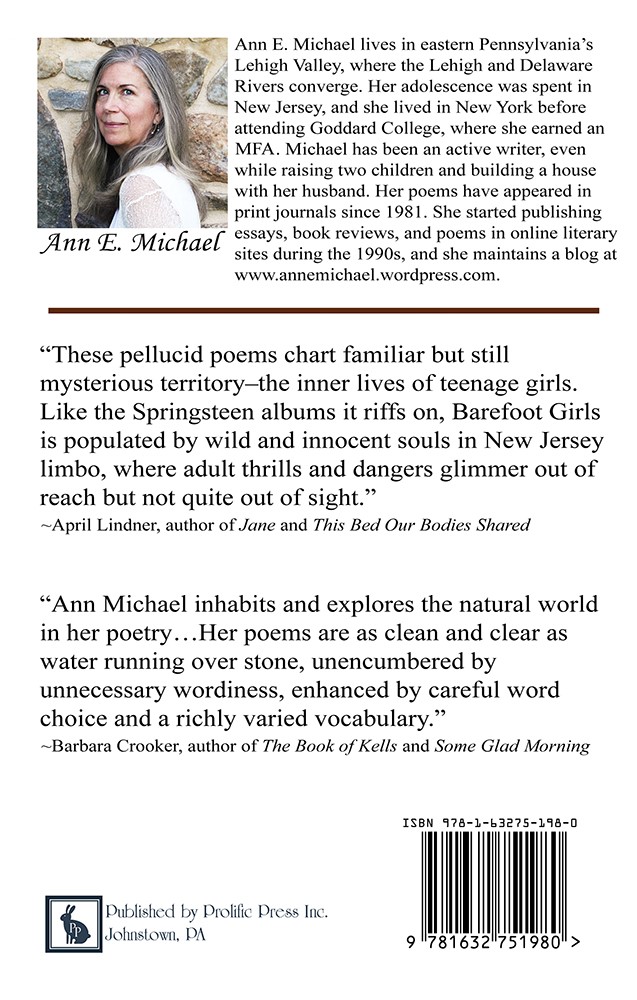
Barefoot-Girls-Cover-Back-MD-1

Anticipation

Public relations and poetry are quite separate pursuits, in my mind, yet how else will readers learn that I have another chapbook nearing publication? Yes! Barefoot Girls, a series of 24 poems winnowed from a much longer set, will be appearing in print from Prolific Press later this year.

2021 still seems quite a way off, but perhaps it isn’t too early to mention that my full-length poetry collection The Red Queen Hypothesis will see publication then from  Salmon Poetry, an independent publisher in County Clare, Ireland.

Anticipation! I’m eager to see what the books will look like, eager to know whether anyone will read them, and experiencing that little frisson that comes with waiting for potential delight.

I cannot express how grateful I am to the folks behind small independent literary presses for all they do to keep poems circulating, to publish lesser-known writers, and to promote the literary arts generally. They are not making money from the process; they do it for love. Society benefits. Bless them all and donate to them if you can. But the best way to help small independent presses and publishers is to purchase books from them. Browse Prolific Press’ bookstore here, Salmon Poetry’s poetry book catalog here, and Brick Road Poetry’s books here (scroll down far enough & you’ll see my book Water-Rites, still available). Another small-press venture that has been plugging along for years is Michael Czarnecki’s FootHills Publishing. Two of my chapbooks are available from its website.

Dear Readers, purchase a few books from these stalwart independents, even when there’s a lower price used on Amazon. I’ll be thrilled if you buy one of my books but gladder still if you take a chance on an author you don’t know and discover some terrific poems and poets in the process.

Of course, when anticipation becomes realization and my new book becomes available, I will try to don my PR hat and let you know it’s in print. Thank you!!

bfg

Barefoot Girl ca. 1974 or 75