Unsettling

We got some rain on Saturday, which we’ve needed, and dismal cold rainy January days are perfect for settling down with a book. I’m reading The Unsettling of America, Culture & Agriculture (1977) by poet, writer, farmer, educator, activist Wendell Berry, still working at 91–his book Sabbath Poems was published in 2024. I’m much more familiar with Berry’s poetry than his prose, though he’s written at least half a dozen novels and many books of nonfiction. This text, I’ve since learned, is one of his more famous–it’s been revised and re-issued six times. The copy I got from the library is the original version and features cover blurbs by Gary Snyder, Wallace Stegner, Edward Abbey, and Stewart Brand, among others; Publishers Weekly summed up the book as “a cool, reasoned, lucid and at times poetic explanation of what agribusiness and the mechanization of farming are doing to the American fabric.”

Which is a fairly good one-sentence précis, though Berry’s wording often strikes me as more passionate than “cool,” and agribusiness is only one aspect of his critique. I was in high school in the 1970s, and at the time it seemed average Americans were beginning to recognize that pollution and overpopulation could be problematic, that maybe we needed to eat more natural and wholesome foods, and that establishing an Earth Day might help people turn focus toward the planet. Simultaneously, we had Earl Butz as Agriculture Secretary, a man who ended many New Deal programs to help “small” farmers and who encouraged large (eventually, corporate) farms. Butz appears several times in this book, and no wonder; he and Berry debated the topic in public and in print, and their thinking was almost diametrically opposed concerning the philosophy behind agriculture. Berry’s book is a social and philosophical argument that is only somewhat dated and really quite prescient, though he might come off as mildly curmudgeonly to today’s readers. Or maybe not so prescient. He was simply paying attention.

The sections of the book that most resonate with me are those in which he writes of nurturing and relationships, and points out that good relationships involve responsible actions and collaborative, mutual care whether they are marital, family, or social relationships or relationships with the soil, the flora and fauna, the whole planet. He predicts a future in which people live in their houses and not with the land, or even within their communities, and where wilderness is “conserved” so that it can be exploited for entertainment and scenic views. People in the US, he says, don’t feel responsible for the land on which they live; they don’t understand its cycles, its weather patterns, its waterways; their property is merely property–a commodity for convenience and investment. I’d say that future is already upon us.
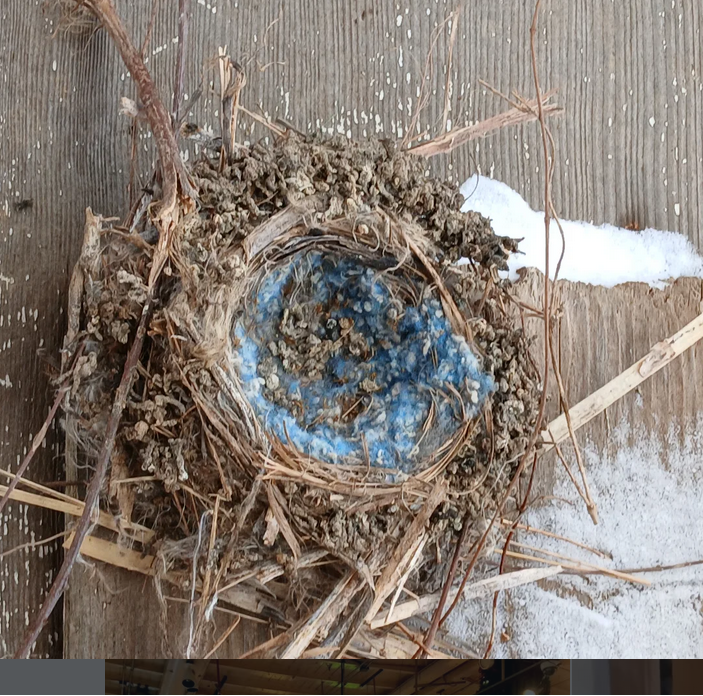
Thus, Berry has made me think more deeply about my relationship with “my” property. If you’ve read this blog for awhile, you may notice how often I consider weather, dirt, local animals, insects (especially invasive or non-native ones), plants, tree diseases, water–I’m no farmer, but I am a gardener and do feed myself at least partly from my own backyard. I take almost daily walks around the perimeter of our 6+ acres, poking around in the hedgerows, scanning the sky, looking down at walnuts and animal scat, watching for new buds or coloring leaves or bird nests or wildflowers. I worry over droughts and hailstorms and flooding. Climate change concerns me in very local and specific ways, not just in general.

One could say I’m at least trying to nurture the earth. I’ve made many mistakes along the way and done some damage that I’m learning how to rectify; I have also realized that I have to accept some changes, such as incursions by invasive species, because they are beyond my control. Through the almost 30 years we’ve lived on this land, I’ve tried to understand it better. After all, we built a house on it. The soil was hard-packed, acidic, overused from previous decades of corn-growing, full of stones, sumac, and asiatic rose bushes, a fallow field that hadn’t been planted or farmed in decades but didn’t necessarily need me to tend it. It wasn’t my family’s land, and I didn’t intend to end my days here; however, I figured if I was going to live on this spot, I had better do whatever tending and nurturing it might require.

Which is about the best I can do as far as a relationship with the land in which I dwell, and about the best any of us can do in any long-term relationship: try to understand it, get acquainted, do some research, make plenty of observations (maybe take notes), and nurture what seems to need special attention and care. The land has given me much more than I’ve ever given it. It’s offered shelter, beauty, an education, food, the companionship of animal life, cricket sounds, tree frog songs, firefly lights on long summer nights, open spaces for my children to play in, owl calls and fox kenning, the grace of leaping whitetails, dead-fall wood we can burn in winter, forest-bathing, hammock-swaying, inspiration for writing. The wonderful porch here, where I often sit to write in my journal, opens a view to the meadow out back. So many poems started on that porch, with that view…

That’s how the earth nurtures me. May I be somehow worthy of it.

photo by David Sloan 2020

Minor snow

We had a mild autumn that seemed to stretch longer than usual. Today, a dusting of snow and temperatures not much above freezing, gray sky, a meadow in beige-brown hues and the trees mostly leafless. According to the Chinese lunisolar calendar, the next few weeks are 小雪 xiǎoxuě, or “minor snow;” it is already winter. The jiéqì seasons follow the agriculture of northern China’s plains, and it’s striking to me how closely they resemble the agricultural seasons here in eastern Pennsylvania.

Lately, I feel the seasonal transitions physically. My body responds to the changing weather–not always a good thing, but not necessarily a bad thing, either. It connects me with the environment, reminds me of my necessary relationship with the world and its many beings and aspects: seasons, weather, water, plants, insects, bacteria, trees, other humans…

More than ever, I recognize the value in those relationships and treasure how varied they are. And I am just another part of the things I love and experience.

I also recognize my humanness as being “part of the problem” here. I use energy systems, I drive a gas-powered car, my house pumps water from the aquifer, I cleanse my house with disinfectants, my trash goes to a landfill, my income’s derived from an elite system of higher-education institutions. All that stuff that has materially altered the Earth for the worse and been unequally distributed among people? Responsible for my part in it. Trying to make changes.

I went out, wearing my robe and slippers, to the porch this morning to appreciate the barely-frosted landscape and breathe in the scent of minor snow. Sparrows and finches flitted through the bare shrubs, alive with activity. Tonight is the dark of the moon and soon the solstice will arrive. Times of transition. What will they bring?

Norway’s Philosopher

I first encountered Arne Naess’ work in 2012 (see this post), and I regret that I failed to follow up by reading more of his “ecosophy T” (deep ecology) and philosophy. I am finally getting around to his very late book Life’s Philosophy, and I love how it speaks to me on many levels. His claim that human emotions can and should be components of human reason makes so much sense that I wonder why so few researchers look into it; some folks on the edges of neuroscience and psychology seem to venture there, but few others. The concept of “relationism” resonates for me, too. It reminds me of the Dali Lama’s teachings that all things in the world are intertwined and valuable, even non-sentient beings.

Relationism, as Naess uses it, acknowledges the vast and impossibly infinite complexity of the universe, more strictly life on earth, and–can I use the word “celebrates”?–the interwoven strands of animal, vegetable, mineral, bacterial, cosmological, emotional, rational aspects of a life in the world: ecology on steroids (he would not have phrased it like that). My urge for balance in my own life makes this philosophy relevant: the opportunities for play and for imagination as well as for seriously abstract concepts, for the importance of emotions as felt in the human body and as interpreted or contained in the human intellect; the necessity of listening to even the tiniest sounds, of savoring the small moments, of not needing to be big or grand or successful but to be mature in how one feels with the world.

The incredible difficulty of saying any of this. Which Naess also acknowledges, saying the difficult job of conveying being felt in the world leads to music, to art, to sitting with the natural and sensing beauty. I might add: Poetry. Though poems are made of words, they often operate through images and felt moments rather than intellectual logic.

The wonderful paradoxes of this book delight me, but then, I always have enjoyed paradoxes. Naess was, indeed, a philosopher, a mathematician, a person who valued logic, reason, and analysis, an analysand himself and briefly a psychological researcher, a mountaineer, a teacher. What to do with the inherently analytical side of himself? Treasure and use it to find wonder! That’s what makes him different from so many thinkers. Wonder. He writes, “To me, the ability to analyze the experiences of the moment is a source of wonder: wonder at human creativity and the result of evolution during hundreds of millions of years. That which happens within us–in our minds and hearts–is so complicated that the psychoanalytical instruction to express everything that occurs to one becomes…and exhortation to to the impossible.”

He opposes Cartesian mind-body separation not just within the body itself (as medical science has proven) but in terms of landscape, natural environment, places. He posits that people need deep thinking about values that move us emotionally just as much as we need to think about rational, pragmatic, socially-pressured values that are based on intellect or the empirical. Place matters, and we need to consider our fundamental place, Earth. Naess’ oppositional stances are, however, never a fight. Instead, discourse, compassion, patience with what is complex. A sound life philosophy requires stillness sometimes, and listening, even–especially–to the “tiny, tiny things,” he urges: “The art of living is to be able to work with small things in a big way.”

How do you feel yourself and the world? is the title of one chapter. I read the question with emphasis on different words and began to realize what a complicated and interesting question it is, though it seems (at first) so simple. Naess says that humans have hewed to the idea that there’s a gap between reason and emotion, and that the gap is an artificial one; a change in perspective, and an understanding that the mind and the body live in a physical world where emotions play a huge role in human communication, might help us to enjoy our lives more–and maybe, while we are at it, treat the earth one which we depend with more love and respect. But we have to feel we are not just ourselves but the world: of it, from it, in it.

mapio.net/pic/tvergastein

Relationships, resistance, AWP

This year’s Association of Writers & Writing Programs Conference vibrated with emotional content, resistance, persistence, and truths through facts and lived experiences–a host of perspectives and a sense of excitement enhanced by the host city: Washington, D.C., where the recent transition to a new government administration has been controversial, particularly among citizens who value social justice, education, the environment, and the arts. Some citizens feel that they are themselves outsiders, outliers, critical observers of the social norm, square pegs, immigrants, misfits, name your descriptor here:_______.

Maybe no surprise, but many of those who are not-quite-the-social-norm also happen to be writers.Adversaries 1

About 15,000 writers, teachers of writing, publishers of writing, promoters of writing, and lovers of writing showed up in D.C.; and I’m guessing a very large percentage of us feel we have, in one way or another, a little trouble “fitting in” with society and social expectations. We happen to write, also. What gives good writing its jazz is that there are zillions of fascinating, off-beat, marvelously creative perspectives a human being can write on just about anything.

One sense that came through to me as I listened to authors and teachers is that writing is almost automatically resistance. Resistance usually connotes against, as against a “negative” behavior, objective, rule, law, or person, for example. We can resist silence, though, and silence on its own is not negative; it is only something to resist in relation to an event or law that might be better spoken about. We write in relation to, and often that looks like against. But it isn’t that black and white (of course). Even when the ink is near-black and the page is near-white and the resistance feels like “writer’s block”–resisting the very act of revealing, speaking, communication.

Relation makes resistance and writing happen. Relationships make community and communication develop. Relationships connect the virtual world, and relationships link the long-dead writer to the living reader in a quiet room or on a crowded train.

~

This past week, thousands of (largely introverted) writers convened in a convention center in the nation’s Capitol; several square blocks hummed with interconnections that spanned far beyond those city streets, those bland conventional multi-storied buildings…into the social world and social media, into the range of the arts, the hearts of fellow human beings. The crowds could be overwhelming, but the energy was palpable and exciting (even to this introvert, who did need to retreat from the throngs now and then–thank goodness for “quiet lounges” and hotel rooms).

Did I mention the slightly off-the-cuff passion and stirring intensity of Azar Nafisi‘s speech, and the resonant coincidence of how relevant it was to have a naturalized American citizen, born and educated in Iran, as a keynote speaker? [The decision to have her speak was made over a year in advance of the conference.] Did I mention the honest and often amusing conversation between Ta-Nehisi Coates and Chimamanda Adichie, who is a dynamic one-person cultural ambassador, much as Nafisi is? What about poet Terrance Hayes‘ brilliant alliterative rhythmic sonnets that were sometimes-brutal take-downs of a president whose motives and values he mightily questions? Did I mention Rita Dove‘s transcendent reading? My discovery of a hugely famous Pakistani writer, Intizar Husain? Marvelous writing on The Body Electric, in three excellent essays–why, yes, I could say more, but I’m tired now and “still processing,” and post-conference life resumes…

~

Given some long-running, almost chronic adversity the beloveds and I are facing, before I close I want to give a thumbs-up to Emily McDowell. Emily McDowell’s line of Empathy Cards are really worth looking at when you have no words.

Sometimes, there isn’t a card for that.