Walking

Numerous so-called health and fitness articles continually pop up on my screen, and many of them not only tout the benefits of walking but claim to know how many minutes or miles of walking (or rate of speed and such) are necessary to ward off dementia, keep your heart healthy, your bones in shape, your muscles well-conditioned, your circulatory system moving, your lungs going, or to extend your life. Oh, and relieve stress. And while you are at it you can get a device for your wrist or an app on your cellphone to monitor your pace, steps, heartbeat, etc.

But not everyone can walk. Too many of us forget that, take it for granted–especially “content” developers online angling for clicks. And, while I do like walking, I don’t particularly relish being told how I should go about it. I agree that it would probably be good for me to walk at a brisk pace for an hour every day, and some days I am inclined to do just that. There are other days I want to hike up a hill, or take a pokey amble around my meadow, or wander through a nearby park, or climb Nemrut Dağ just as dawn breaks. Or curl up on the sofa and read a book. I appreciate routine, but not invariable routine.

Autumn happens to be a time of year I like a slow stroll or hike; save the brisk walks for cooler, lousier weather. Now that most of the leaves have fallen, I can spy bird nests and paper-wasp nests (there’s one of those in our tamarack tree; last year, there was one in the Japanese maple). Milkweed puffs are swirling in somewhat chilly air, red berries decorate shrubs and trees. Red-tailed hawks and black buzzards wheel overhead. No reason to churn through the scenery at a rapid pace.

A. R. Ammons wrote an essay titled “A Poem Is a Walk,” in which he describes the physical act of taking a stroll “with” a poem, rhythm, breathing, the stride; he says both a walk and a poem are useless–though you might want to read the essay before agreeing or disagreeing on the uselessness, since his essay is almost a phenomenological argument (and we have to decide what is meant by “useless”). [Note: The essay is paywalled behind University of Arizona’s site, and–oddly–the one legible free version I found is here, from the Università degli Studi di Milano! Well worth reading, though, and in English.]

I think better when I walk slowly and steadily, with pauses to look around. That’s when images come to mind, metaphors, descriptions, sensations, ideas. Sometimes, it is a kind of haiku-walking, generally undirected. I don’t plan to reflect on anything or come up with prompts for poems. And I don’t do it to improve my life expectancy.

I just like to walk. And maybe, a walk is a poem.
Throwing mud

This week, I got the potatoes in the ground; last week, it was spinach. In between, a lengthy late-March cold snap and yes, more rain. But also a visit from a Dear One and a trip to parts of Pennsylvania I seldom have had reason to explore. Although I have lived in PA’s Lehigh Valley for nearly 40 years–longer than I have lived anywhere else–I confess a lack of familiarity with many areas of the Keystone State. Philadelphia and its suburbs I know well, and Reading and Lancaster, to a lesser degree; and our family often visits Gettysburg. We travel west and north to go camping now and then. I’ve been to Pittsburgh a few times and seen Falling Water and the Cathedral Trees and both branches of the Susquehanna River. Penn State just twice, once when I was chaperoning high school sophomores to History Day competitions.

Pennsylvania is a big commonwealth: 46,055 sq miles. It’s a good place for poetry, though I leave it to poets such as Harry Humes and Jerry Wemple (among others–looking at you, Dave Bonta) to explore its varied climate, geography, history, and culture. Mostly I stay within the confines of my own back yard, which is large and varied enough to inform me for a lifetime.

But the Dear One had planned to give her dad a pottery workshop with a well-known potter, Simon Leach, as a 70th birthday gift. That birthday fell during covid, however; the long-delayed weekend in Millheim PA thus did not take place until this past week. I have never placed my hands on a potter’s wheel (though I ought to try it sometime) and just went along for family togetherness and to visit the arboretum at Penn State, slightly out of season but still a very pleasant place to walk, by myself, on a cold but sunny Sunday. It rained on Saturday, so I sat by the fireplace at our B&B and read novels. Could anything be more perfect?

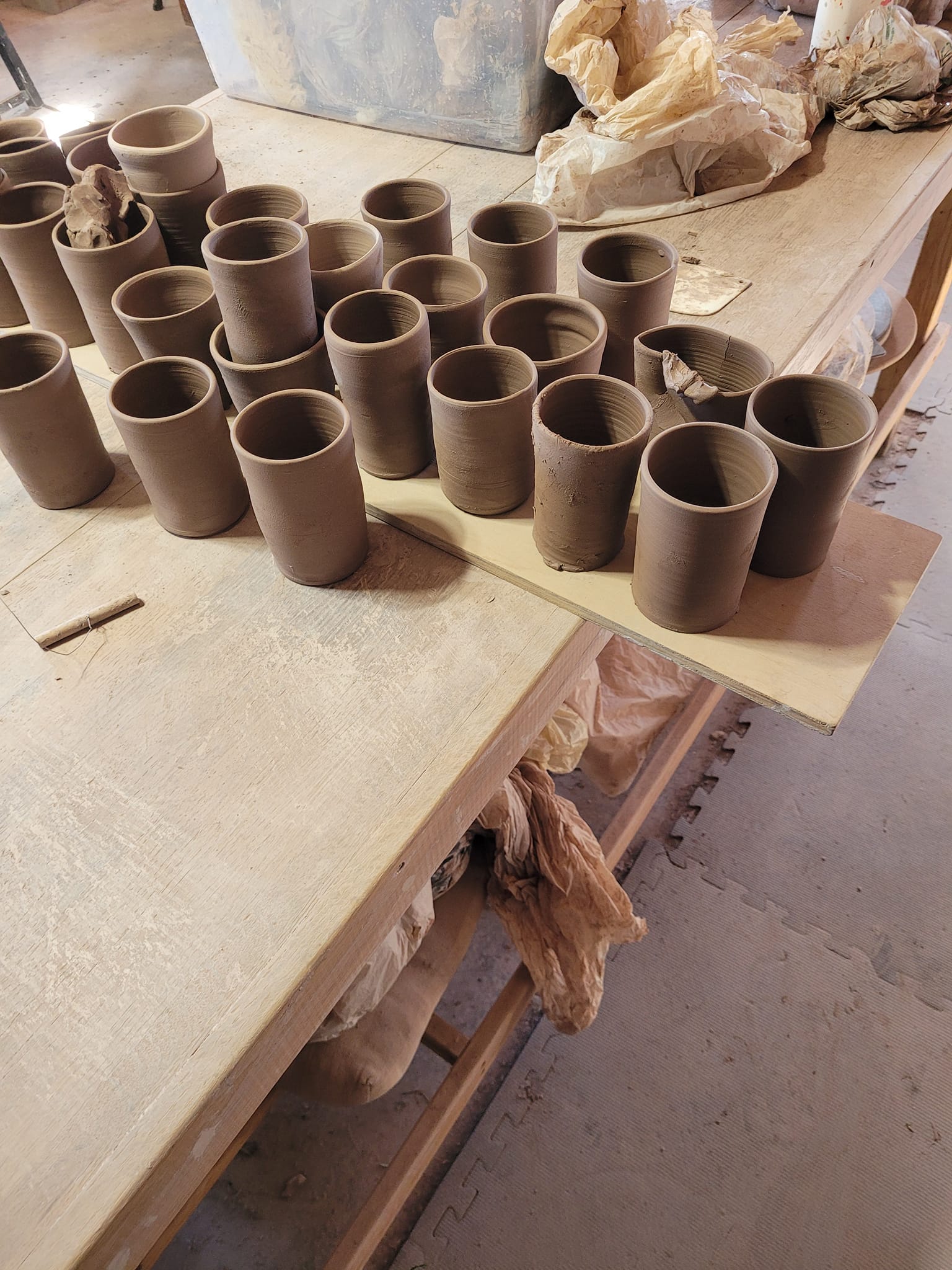
The task of Leach’s workshop was to practice making cylinders. It was a muddy job indeed. Here’s a photo of some of the student results. Dear One is quite adept at cylinders; indeed, she’s a good potter and sells much of her work, a skill she enjoys when she’s not providing emergency medical care to dogs and cats.

Leach uses the slogan “Keep practicing!” Yeah, that’s how you get to Carnegie Hall, right? But it is also how people get better at any skill, even those who are preternaturally talented in music, art, dance, etc. That includes writers. I have to remind myself that it is now time I got back to my routine of writing, revising, and the practice practice practice part of composing poems. The garden, the daughter, the travel, and the novel-reading have been splendid distractions, but as National Poetry Month approaches (April!), I ought to get myself back into routine.

A routine’s generally looked at as mundane–a tedious necessity. It needn’t be that way, I keep reminding myself. It can be as fun and messy and surprising (or frustrating) as throwing mud.

clay cylinder practice in Leach studio