Last messages

End of another year. This one included some truly joyful times that will stay with me for quite awhile. But in that almost-inevitable reflection that arrives with the winter solstice, I find myself recalling dear ones whose lives closed in the past 12 months. I used to have physical reminders of friends and family, the last card or letter they wrote, something to put into a file or drawer or keepsake box and take out from time to time; a photograph or two, or maybe a recording of their voice on tape. Now that human communication has mostly migrated to the digital, to the “cloud,” those tangibles are much less common. But the messages persist.

A few weeks back, I migrated to a newer cellphone and, in the process, moved a year’s worth of text conversations to the new device (I’m not sure how I did that). All the old messages popped up, including three from dear people who are now deceased. Quite a different form of “ghosting.” I’ve kept in an online folder many email messages from my most frequent correspondent and long-time friend, who died February 1st, but I can’t quite bring myself to look at them yet. And it isn’t quite the same experience as opening and unfolding old letters.

I can’t bring myself to delete the messages from my phone, however. I suppose at some point that will occur, perhaps in another upgrade. Letters are ephemeral, too; all it takes is flood or fire. We have to rely on our minds, our memories, when it comes to recalling loved ones. Maybe that is what elegy is for, I don’t know.

~

As for the present–the Spirit of Christmas Present* ?–some of my Best Beloveds will be gathering here and there with me soon. Once the holiday hubbub dies down and the lonelier, cold January days arrive, I have poetry workshops to look forward to. They’ll be online, which suits my schedule in winter. Last year, I enrolled in two such workshops and found they spurred me to get a good deal of writing done, so I figured I might try repeating the process. Anita Skeen is doing another series for The Friends of Roethke Foundation with readings, prompts, and discussion on “writing toward wisdom.” In Dickens’ era, I’d be considered old enough to be wise (though most of us, Dickens certainly included, know better about age inevitably bringing wisdom). But the operating word for Skeen in this case is “toward.” It will be interesting to see where she takes her workshop participants in the new year.
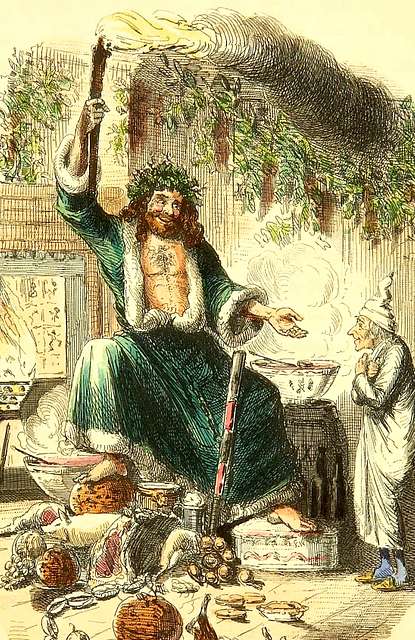
* John Leech illustration

In deepest fog

Autumn here was a bit dry, but as we approach the winter solstice–mild temperatures, rain, and many days of fog. Fog seems apropos. My mind has been fuzzy lately, clarity of intent and expression lacking. It’s one reason I have not been blogging.

When the air temperature gets up to 45° or 50° F, stinkbugs come out of their torpor and slowly climb up the window screens where they have been hiding or buzz noisily about the rooms, acting as sleepy and undirected as I feel. True, the daylight’s dwindling, and that makes many of us go into a sort of hibernating mode, mentally if not physically (likely a bit of both). True, the Fall semester at the university is in its last week or two and, as usual, is wearing on me.

Also true, it’s hunting season until the 10th, and the deer may be grateful for the fog…at any rate, taking advantage of it. It’s not all negative. Water molecules in the air can be good for plants, hydrating them after a dry autumn. Fog means less dry skin for those of us who wander around outside.

But let’s face it: fog encourages molds and increases the chance of traffic accidents and tends to head people into a low-barometer frame of mind. Foggy-headed. Brain fog. Here’s an informative breakdown of fog’s kinds and outcomes (yes! of course there are categories of fog!) https://mrcc.purdue.edu/living_wx/fog/index.html Some of my readers may find poetry in these categories.

Just before dusk this afternoon, I stood at my window and marveled at the dense cloudiness of the valley, at the stark bare trees snaking their way up through the pale damp air. I felt a twinge of European Romanticism: Caspar Friedrich’s “Wanderer above the Sea of Fog” and all that. The view was analogous to my fusty mind. All sorts of possibilities out there in the mist, nothing to strike toward, no path, potential risk. But beautiful in its way. I thought to myself, “There is something hidden in all this, and among the hidden-ness, things that are dear and familiar to me, not just fearful unknowns.”

The garden is there. The deer. The beech tree, some of its leaves still clinging. The bank voles and the red squirrels, the holly bush, the daffodils underground that will emerge in April. My fog will clear.

Then darkness overtook fog, and the coyotes called their carols in the moist air.

Garden breach

Summer solstice. The robins are on their second brood; mulberries are ripening, and the bluebirds have arrived for the feast.

Fifteen years ago, we set up my garden to be as impregnable as possible from incursions by deer, groundhogs, and rabbits. We accomplished this by digging a narrow trench on the perimeter, lining the trench with wire mesh fabric, and filling the trench with gravel–after setting the steel posts and putting the steel wire fencing in place. The strategy even deterred weeds for about three years.

But rain and snow and air and therefore rust, along with ground heave and the occasional bump by lawnmowers, have had their way. While deer still ignore the plot, this year, bunnies have breached the fence. It’s time to find a new way to keep them from the edges.

rabbit-014

I have previously written about how fringes and perimeters can be boundaries or places of activity and fluidity, so it seems I am a hypocrite for keeping my rabbits at bay. Maybe I ought to find a balance? Living with their denuding of my carrot tops?

–No, they’ve plenty to eat in my lawn and in the meadow. The balance goes both ways.

Their persistence interests me. Their movements are both awkward and graceful. Their ears are translucent in the early morning sunshine. I don’t mind having them around as long as they stay out of my vegetable patch, and they feed the owls and hawks, whom I also enjoy.

All along the edges…

~

Curious information note of the day:

According to neuroscientific studies, less than 0.1% of the information carried in the optic nerve at any given moment passes through the visual attentional gateway (“bottleneck”) after the attentional gateway recognizes a cue; the cue evidently serves as a gating mechanism to regulate the flow of image data.*

What this implies (I think) is that the bunny I manage to spot under the leafy tomato plant in my garden gets processed as “bunny” once my saccadic eye movements, taking in the huge quantity of data from a day outdoors in summer, recognizes something in the shadows that signals “rabbit?” and then filters out other, distracting data from my view.

At which point, behavioral habit kicks in and, like Mr. McGregor, I dash after Peter with a hoe.

~

*partial quote/paraphrase from “Dynamic Routing Strategies in Sensory, Motor and Cognitive Processing,” Van Essen, Anderson, and Olshausen 1994 MIT Press Large-Scale Neuronal Theories of the Brain, ed Koch & Davis.


Winterberries & solstice-tide

Wintry hours ahead

Wintry hours ahead: Happy solstice!