We got some rain on Saturday, which we’ve needed, and dismal cold rainy January days are perfect for settling down with a book. I’m reading The Unsettling of America, Culture & Agriculture (1977) by poet, writer, farmer, educator, activist Wendell Berry, still working at 91–his book Sabbath Poems was published in 2024. I’m much more familiar with Berry’s poetry than his prose, though he’s written at least half a dozen novels and many books of nonfiction. This text, I’ve since learned, is one of his more famous–it’s been revised and re-issued six times. The copy I got from the library is the original version and features cover blurbs by Gary Snyder, Wallace Stegner, Edward Abbey, and Stewart Brand, among others; Publishers Weekly summed up the book as “a cool, reasoned, lucid and at times poetic explanation of what agribusiness and the mechanization of farming are doing to the American fabric.”
Which is a fairly good one-sentence précis, though Berry’s wording often strikes me as more passionate than “cool,” and agribusiness is only one aspect of his critique. I was in high school in the 1970s, and at the time it seemed average Americans were beginning to recognize that pollution and overpopulation could be problematic, that maybe we needed to eat more natural and wholesome foods, and that establishing an Earth Day might help people turn focus toward the planet. Simultaneously, we had Earl Butz as Agriculture Secretary, a man who ended many New Deal programs to help “small” farmers and who encouraged large (eventually, corporate) farms. Butz appears several times in this book, and no wonder; he and Berry debated the topic in public and in print, and their thinking was almost diametrically opposed concerning the philosophy behind agriculture. Berry’s book is a social and philosophical argument that is only somewhat dated and really quite prescient, though he might come off as mildly curmudgeonly to today’s readers. Or maybe not so prescient. He was simply paying attention.
The sections of the book that most resonate with me are those in which he writes of nurturing and relationships, and points out that good relationships involve responsible actions and collaborative, mutual care whether they are marital, family, or social relationships or relationships with the soil, the flora and fauna, the whole planet. He predicts a future in which people live in their houses and not with the land, or even within their communities, and where wilderness is “conserved” so that it can be exploited for entertainment and scenic views. People in the US, he says, don’t feel responsible for the land on which they live; they don’t understand its cycles, its weather patterns, its waterways; their property is merely property–a commodity for convenience and investment. I’d say that future is already upon us.
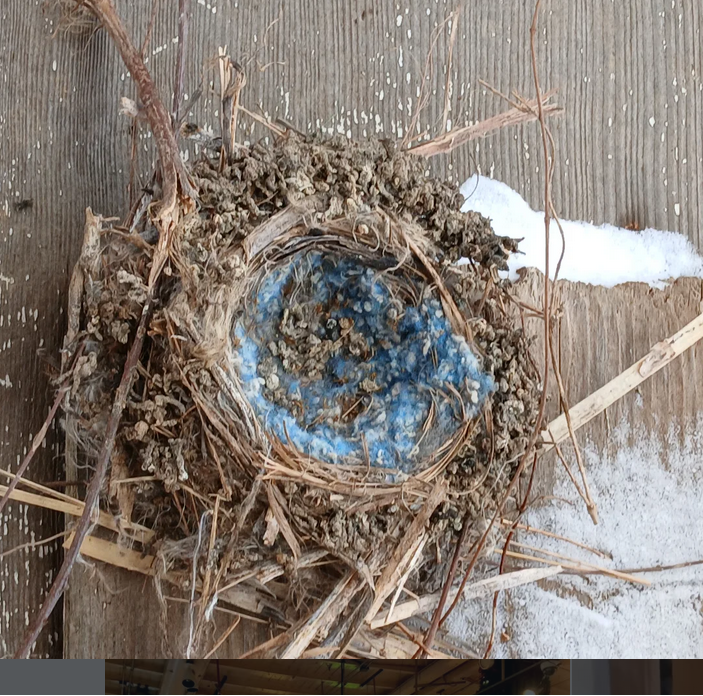
Thus, Berry has made me think more deeply about my relationship with “my” property. If you’ve read this blog for awhile, you may notice how often I consider weather, dirt, local animals, insects (especially invasive or non-native ones), plants, tree diseases, water–I’m no farmer, but I am a gardener and do feed myself at least partly from my own backyard. I take almost daily walks around the perimeter of our 6+ acres, poking around in the hedgerows, scanning the sky, looking down at walnuts and animal scat, watching for new buds or coloring leaves or bird nests or wildflowers. I worry over droughts and hailstorms and flooding. Climate change concerns me in very local and specific ways, not just in general.
One could say I’m at least trying to nurture the earth. I’ve made many mistakes along the way and done some damage that I’m learning how to rectify; I have also realized that I have to accept some changes, such as incursions by invasive species, because they are beyond my control. Through the almost 30 years we’ve lived on this land, I’ve tried to understand it better. After all, we built a house on it. The soil was hard-packed, acidic, overused from previous decades of corn-growing, full of stones, sumac, and asiatic rose bushes, a fallow field that hadn’t been planted or farmed in decades but didn’t necessarily need me to tend it. It wasn’t my family’s land, and I didn’t intend to end my days here; however, I figured if I was going to live on this spot, I had better do whatever tending and nurturing it might require.
Which is about the best I can do as far as a relationship with the land in which I dwell, and about the best any of us can do in any long-term relationship: try to understand it, get acquainted, do some research, make plenty of observations (maybe take notes), and nurture what seems to need special attention and care. The land has given me much more than I’ve ever given it. It’s offered shelter, beauty, an education, food, the companionship of animal life, cricket sounds, tree frog songs, firefly lights on long summer nights, open spaces for my children to play in, owl calls and fox kenning, the grace of leaping whitetails, dead-fall wood we can burn in winter, forest-bathing, hammock-swaying, inspiration for writing. The wonderful porch here, where I often sit to write in my journal, opens a view to the meadow out back. So many poems started on that porch, with that view…
That’s how the earth nurtures me. May I be somehow worthy of it.


 People have told me that poetry has helped them through times of fear and times of grief. That’s a familiar response when, on rare occasion, I happen to tell someone I am a poet. The thing is–I am not sure poems do that for me. Maybe writing poems helps, but reading them sometimes hurts even more.
 ann e michael