Writing act

Lately, I’ve been experimenting again with prose poems and with very short poems that are not quite tanka or haiku, but not much longer. Six to ten lines. Short lines. Then, the online journal Six Sentences got me intrigued about experimenting with that idea as a prompt–long sentences, short sentences, a mix of both–but only six sentences. I like playing around with words. I enjoy writing almost as much as I enjoy reading, and it’s fun to enjoy what I am doing these days, when so much else seems unenjoyable, sad, fraught, scary (another mass shooting, of children, today).

The garden offers comforts, too. Now we are in the harvest-and-rip-up phase as August nears its close. Lots of tomatoes, still a few green beans, plenty of butternut squash and sweet peppers and basil. It looks as though I will harvest a lot of hot peppers, too; although I only have one plant, it is robust and full of spicy peppers that will get hotter as they ripen. And the summer flowers, those glorious annuals, are lovely this year. We even have more butterflies than usual!

So many people have written about gardens, I sometimes find myself wondering what value there is in it, what could be political or artistic in a garden poem, what could make such a poem dangerous or antisocial. Why it is deemed necessary to yank NEA grants from poets, for example. What is it about the act of writing that makes us outliers? Can it be because any description or observation takes a perspective, possibly personal, possibly outside the norm, potentially widening another person’s viewpoint? And is that dangerous? (Perhaps.) Because a plant or animal or place name might evoke an event or person or symbolize something that might rock the boat–a sunflower for Ukraine, a bald eagle for the USA? Could that be risky? And might the interpretation be incorrect, but the writer assumed guilty of…whatever? (There is nothing new in any of this.)

Here’s a draft of a prose poem that came of my reflecting on such questions.

~~

The Act of Writing

only occurs when pen in hand meets paper, or the act is mere mechanics, pressing typewriter keys and imprinting page, or is virtual, encoded onto disk, on cloud encrypted, ephemeral, the act one of persona, a mood or dream, some moment observed, imagined, a recollection, a heart-stab, a shattered vase, anchors dragged along ocean floor, a plea, promise, letters never sent, a life of pain, a sworn compassion, or love that cannot otherwise be expressed, an argument for understanding. The act of writing rallies, rages, sets forth accusation or denial, sues for mercy, brays at nothing, pointlessly puts forth what’s known but long ignored, unacknowledged, unaccepted, an act political by proxy, being the kind of behavior those in power seek to suppress, who make the act of writing into reams of tedious fine print outlawing every fervent danger that clings to the very act of writing which is the practice of free and conflicted expression even when the reader sees only a description of deep scarlet bougainvillea arching over a poet’s unmarked grave in a landscape of olives and oleander.

~

As you wish

Photo by Ahmed u061c on Pexels.com

Discouragement, a regular visitor to this writer (and many other writers), has settled into the house with me. Summer is often, for me, a time of writing less and doing outdoor and social things more; this year, though spring was lovely despite torrents of rain, summer commenced with the deaths of two long-time friends, and I haven’t been able to shake my low mood. Now the rejection slips are arriving thick and fast, and I’m questioning the value of my work in particular and of creative writing in general. Like, why bother? What am I doing this for? For whom? What’s my purpose? And under what circumstances? Why?

Brooding certainly offers no help, nor does it change “declined” to “accepted.” Creative persons often find themselves questioning their pursuits, so I have good company. (Having just about completed the last book of Remembrance of Things Past, I can report that Proust’s narrator–largely a stand-in for Proust himself–wanders in the dark through wartime Paris pondering his own decision to try being a novelist and feels discouragement and doubts aplenty.)

Somewhere on a social media platform, I encountered these words by Virginia Woolf (from “A Room of One’s Own”): “So long as you write what you wish to write, that is all that matters, and whether it matters for ages or only for hours, nobody can say.” Good perspective, that, to stop being concerned for how long your writing matters, or to whom, as long as what you write is what you wish to write. And then if you don’t submit your work for publication? Maybe that is something you can live with. Rather, something I can live with; at this point in my life, I have had hundreds of poems and essays published, six chapbooks, and three poetry collections…maybe from now on, I should write (as I always have) for myself. Even if my work is not in fashion, or considered irrelevant, or judged as potentially lasting, it is still what I wish to write, what I find necessary to express.

Though one does write to express things, and expression seeks audience. That’s a perspective for another day, perhaps. Meanwhile, back to weeding the garden and picking cucumbers, beans, tomatoes, zinnias, and sunflowers.

Heaven, hell, & halos

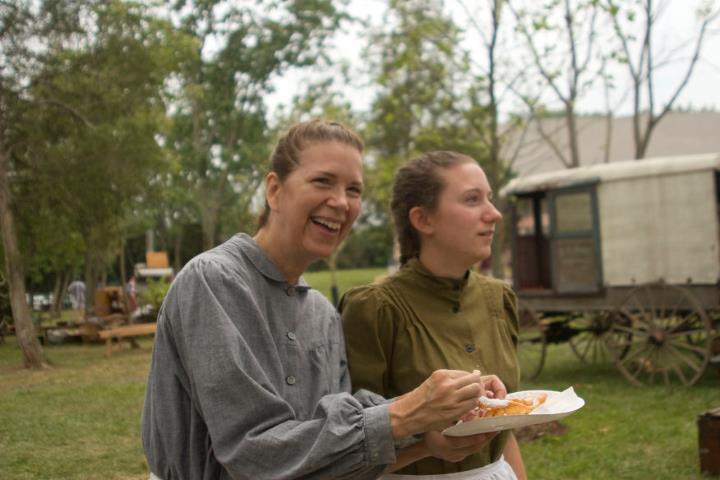
After 30 years, my husband and I still take part in the Goschenhoppen Festival each August. You will find I have mentioned it in many an August blog.

The photo at left is from 2010 or thereabouts, when the festival had newly moved to the park in Perkiomenville, PA, which is where the beautiful Antes House (ca. 1736) is located. My daughter and I were enjoying funnel cake. The park’s trees have grown considerably since then, and there’s more shade for demonstrators (and visitors). We were grateful this past weekend that the sunny days were not as humid as some years and that there haven’t been downpours to churn the parking areas into mud. And though neither of my own offspring could participate this year, it was lovely to see their festival-friends now grown, married–some having kids of their own–and still showing up to volunteer at the two-day reenactment of Pennsylvania German folk life of the 18th & 19th centuries.

My demonstration is in the 19th-c household and foods area, and each year I am assigned a couple of young “apprentices,” girls ages from 12-17 in gingham work-dresses. This year a friend’s daughter was thrilled to be old enough to officially participate. She is full of wondering about life and is the sort of child who poses her questions and speculations aloud. She’s also at the age when she’s taking church classes for confirmation, and she’s interesting to talk with when she wades into her thoughts about Big Subjects. I often find myself telling her that the things she wonders about are puzzling even to grownups. Because it’s true.

Yesterday she asked about someone we knew who had died: “Do you suppose they went to heaven?” Yikes. While it might have been a good opportunity to throw a wrench into religious indoctrination, I felt her parents might not appreciate that. I merely responded that I didn’t see why not. But this little exchange reminded me of my own wrestling with the idea of heaven and hell when I was her age. From fairly early on, I just couldn’t imagine that the cartoonish heaven of winged souls wearing halos was in any way real; and though hell was also mentioned frequently in church liturgy, prayers, and hymns, my dad’s belief in a god who was forgiving made hell seem unlikely. So the information I took in was confusing.

It is no less confusing to me now, but I no longer sweat over it the way I did as a child. Anyway, the conversation with my little friend called to mind a poem I’d drafted after returning from a visit to the Metropolitan Museum of Art’s exhibit “Siena: The Rise of Painting, 1300-1350” which reminded me of how I loved Medieval and early Renaissance art when I was a youngster. All those saints and crucifixions. All that gold and iconography. I must have had a gothic tendency!

This draft may be more about art than about heaven, and more about envisioning than about anything else. It's not a finished poem, but who cares on this bright, late-summer morning?
~


Halos

What interested me most about
paintings of Jesus was
the glow around his head
because I saw such auras everywhere
when sun silhouetted our cat
in the dining room window
or lit up dew on tall grasses.

In later years I studied art
and learned the problem of cheating
light from solid pigments
the paradox of density layered
so some artists applied gold dust
to depict the nimbus gleam.

Yet even my little sister’s
fine blonde curls or the hairs
on my own skin could shine
that way illuminated like crowns
of hickory trees some autumn
morning long in brightness
no art to it at all.