Play’s the thing

My freshman humanities professor, the brilliant, late Larry Fuchsberg, assigned Johan Huizinga‘s The Waning of the Middle Ages as one of the texts for our course…an unusual choice for American teens in 1975, as was another of our books, Burckhardt’s The Civilization of the Renaissance in Italy. At 17, I found Burckhardt rather slow going stylistically (it was published in 1860, after all); by comparison, Huizinga (circa 1919) was refreshingly clear. I really enjoyed it and learned a great deal. I kept meaning to read his 1938 book Homo Ludens, but for awhile it was difficult to find in libraries or bookstores. Also, I lacked the time to track it down or read it. The premise interested me, though–that we humans evolved our culture from the “pointless, imaginative” urge to play, and that play is fundamental to our learning and our social structures. Also, we are not mechanical beings–the messy frolicsome-ness of people is as necessary for our survival as food, water, and shelter.

“Animals play, so they must be more than merely mechanical things. We play and know that we play, so we must be more than merely rational beings, for play is irrational.” 
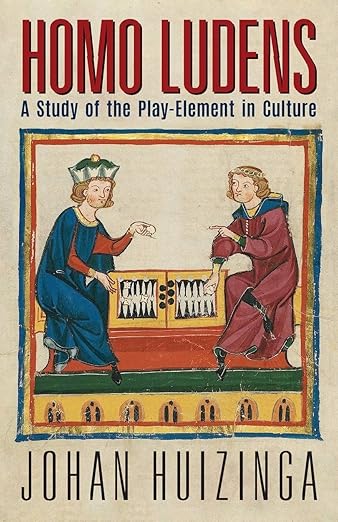
Finally, I’ve begun to read Homo Ludens, and it’s even on Amazon now; also I discovered that it exists online here thanks to Yale University. Fifty years after my initial encounter with the author, I find his thinking just as interesting as I did in college, and just as difficult. As in his other books, Huizinga uses etymology as one of his methods of examining the meaning and culture of play. He was writing for an audience that he assumed was well-educated in the classics, so there are passages in Greek, Latin, and French that neither he nor the English translator bothers to translate for less linguistically-adept readers like me. Fortunately, such passages are brief and are used as sources for his argument, and I’m not reading to find fault with his material. I’m interested in his argument and insights as a whole, and intrigued by his thinking. He apologizes for his lack of sources (ha! There are hundreds of them) because he was “working in haste.” He composed this book in the Netherlands as Germany began to be a serious threat to Europe, and he wanted to get his ideas in print before he was silenced. In fact, his last few years were difficult. He had used his standing as a well-known cultural historian to criticize the Nazis and was arrested in 1942, basically house arrest; he died in 1945 just before the war was over.

I’m only on Chapter 4 but am finding, in the etymological tracings of the words that intersect in meaning(s) for play–game, contest, gambol, gamble, dallying, tournament, match, riddle, performance, frolic, pretending, folly, fun, sport, etc.–fruitful stuff for poetry, for thinking about poems and about how poems work as craft, as poems, and as works of art and imagination. And also, what roles poems may play in culture today, and whether that differs at all from the role poetry played in ancient times. Huizinga writes:

“In the making of speech and language the spirit is continually ‘sparking’ between matter and mind, as it were, playing with this wondrous nominative faculty. Behind every abstract expression there lie the boldest of metaphors, and every metaphor is a play upon words. Thus in giving expression to life man creates second, poetic world alongside the world of nature.”

Language may not be necessary for play but can easily be incorporated into it, and language can become play. Or playful. I don’t know much about Wittgenstein, but I find myself thinking of his theory about words having “family resemblances” that often connect, overlap, shade meanings. So we get jokes, puns, flirting, mocking, and new “rules” for our language use that culture constantly shifts in all kinds of directions. Language is a game-changer, and poets make use of that.

I thank Larry Fuchsberg, musicologist, book-lover, and educator, for introducing me to Johan H. Teachers, you never know how much you may have influenced a student’s life, even decades later.

Last messages

End of another year. This one included some truly joyful times that will stay with me for quite awhile. But in that almost-inevitable reflection that arrives with the winter solstice, I find myself recalling dear ones whose lives closed in the past 12 months. I used to have physical reminders of friends and family, the last card or letter they wrote, something to put into a file or drawer or keepsake box and take out from time to time; a photograph or two, or maybe a recording of their voice on tape. Now that human communication has mostly migrated to the digital, to the “cloud,” those tangibles are much less common. But the messages persist.

A few weeks back, I migrated to a newer cellphone and, in the process, moved a year’s worth of text conversations to the new device (I’m not sure how I did that). All the old messages popped up, including three from dear people who are now deceased. Quite a different form of “ghosting.” I’ve kept in an online folder many email messages from my most frequent correspondent and long-time friend, who died February 1st, but I can’t quite bring myself to look at them yet. And it isn’t quite the same experience as opening and unfolding old letters.

I can’t bring myself to delete the messages from my phone, however. I suppose at some point that will occur, perhaps in another upgrade. Letters are ephemeral, too; all it takes is flood or fire. We have to rely on our minds, our memories, when it comes to recalling loved ones. Maybe that is what elegy is for, I don’t know.

~

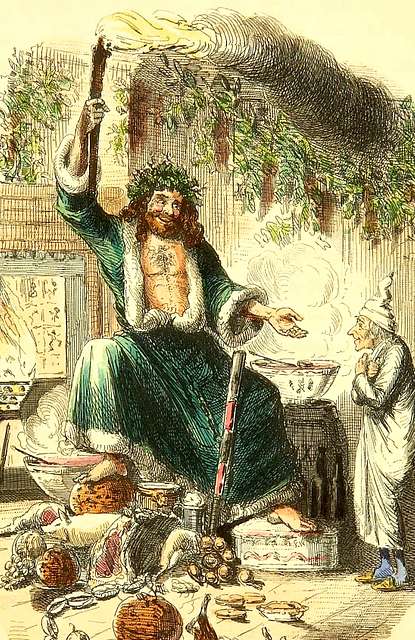
As for the present–the Spirit of Christmas Present* ?–some of my Best Beloveds will be gathering here and there with me soon. Once the holiday hubbub dies down and the lonelier, cold January days arrive, I have poetry workshops to look forward to. They’ll be online, which suits my schedule in winter. Last year, I enrolled in two such workshops and found they spurred me to get a good deal of writing done, so I figured I might try repeating the process. Anita Skeen is doing another series for The Friends of Roethke Foundation with readings, prompts, and discussion on “writing toward wisdom.” In Dickens’ era, I’d be considered old enough to be wise (though most of us, Dickens certainly included, know better about age inevitably bringing wisdom). But the operating word for Skeen in this case is “toward.” It will be interesting to see where she takes her workshop participants in the new year.

* John Leech illustration

Systems

[I am aware that human hair isn’t good nesting material]

Late autumn reveals
oriole’s purse-like nest
constructed of my daughter’s hair.
Breeze touches
what I cannot.
(November 2010)


~

I found this tanka-like poem, written when my daughter was away at college, among some old computer-based file folders I’ve been organizing. It’s one of many old poems of mine I’ve ‘rediscovered’ in the process of trying to keep my poetry systematized. Before I left my job at the university, I imagined that I would manage to organize and update my creative work files during the first year of retirement and keep everything in reasonable order once I had established a system. As if.

It’s not as though I haven’t made progress, made some brave efforts in the direction of archive and revision, culling and filing my drafts and “finished” poems (efforts that are both electronic and paper-based). The fact remains, however, that I do not possess the kind of mind that solves the keeping-track aspects of life very systematically; and, as writing remains a significant part of my life, it suffers from the same inefficiency. I admire artistically-minded people who can keep track of their work using logistically-useful methods that work for them. I’ve read their tips, their essays, talked to them about their systems, tried emulating them. Sometimes parts of their methods are helpful to me, but I lack something. Rigor? Ambition? Energy? The desire to spend the time required?

I keep writing, but I also keep falling behind at staying organized. And then there is the issue of technology constantly updating, so that a method I used in, say, 2015 is not available anymore…unless I invent a bunch of work-arounds. (My long-standing backup method is PAPER, and I still employ it, but I hate file cabinets and folders and don’t use them.) As for spreadsheets? I avoided learning to set them up during my entire career in academia because our department had a brilliantly capable office assistant who did that stuff for us, bless her heart.

All of which means that now and then I cannot locate a draft, a poem I want to revise or to send to a friend, or consider putting into a manuscript. Frustrating. And when I bought a new laptop, I had to decide what files to move from my old desktop; how far back do I want to go? Those poems from 1987, for example–eons ago, as far as computer system lifespans. Yes, I have hard copy from dot-matrix printers. Files originally in AppleWorks and Claris, files that lived on 3.5″ floppy disks. Copies I typed out on various typewriters through the years! Although I’m complaining about it, I realize that in some ways it’s really cool that my poems have undergone so many iterations in terms of tech. It means I have been around awhile and confirms the reasons I think of myself as a writer…and not as an efficiency expert.

~

P. S. I continue to write my drafts with a pen.