Teaching analysis & meaning

My students want to jump to conclusions.

Give them a text, a work of art to view and consider, a billboard, a musical selection…they will make one observation and immediately either evaluate or interpret. I am pleased that young people want to find meaning in so many things–or at least understand that they might be able to find meanings–but I want to tell them to slow down.

It’s tempting to suggest that “kids today” want instant gratification, are spoiled by having instant Google searches on their iPhones, or have no work ethic. I do not think that is true. Perhaps we have not taught our young people how to look, describe, analyze what it is they are noticing. It’s not that they are incapable of these steps; they just do not know that they know them. I think some of my students don’t even realize that they do notice things.

Really, who has not made snap judgments, or interpreted something–a work of art, a remark in passing–without thoughtful analysis? Guilty as charged, in my own case. But I am still learning, and my patience with my own learning process should carry over to my students; at least, I strive for that.

I notice the urge to leap to interpretation most when I am teaching the survey of poetry classes. Students know that poems are supposed to mean, not be (MacLeish got through); but they lack the confidence to explore meaning on their own, in their own ways. They get frustrated and want to find experts to tell them what the poet meant. Delving into their own uncertainties is frightening to them. They’re just out of high school, where they learned that it’s wrong to be “wrong.”

So many good texts out there try to convince students (or other interested, frustrated readers) that there are other ways to be with a poem, to explore, discuss, notice, and find meaning. I read such books to find inspiration for my teaching, for my students, and for myself. When I have time to get back to this post, I’ll begin a list in the comments box below. Meanwhile, if you have suggestions, add them below. I’m always looking for more ideas, more good books, more reasons not to jump to conclusions.
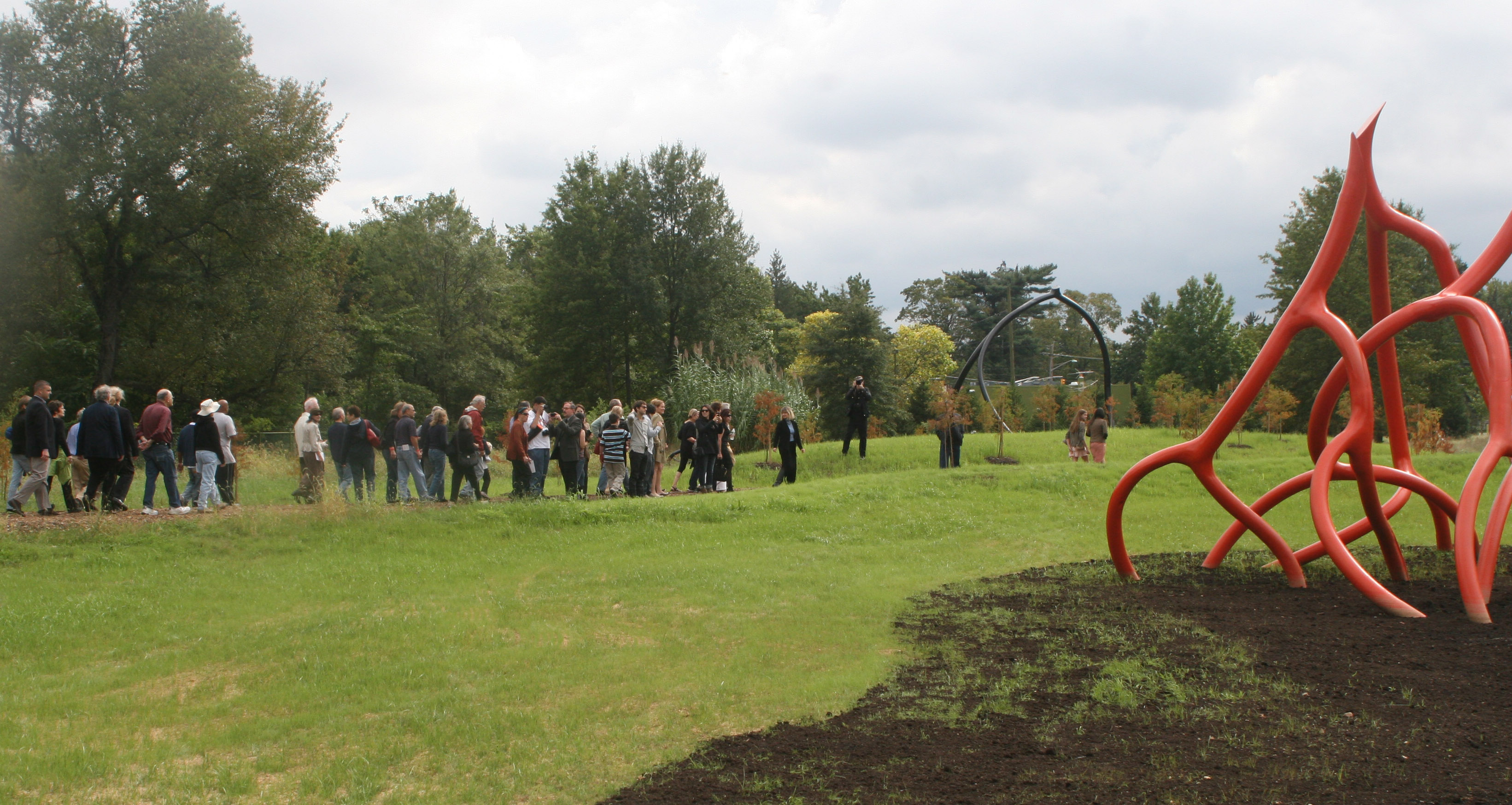
Aerial Roots

The Wildflower Meadow @ Grounds for Sculpture w/Tobin’s Aerial Roots

Visitors descend upon the newly-opened meadow. Aerial Roots will be in residence for about a year. By spring of 2012, the wildflower meadow should be well-established; the plan was to provide a native ecology setting (for central NJ near the Delaware River) in which sculptural works could be displayed. As the smaller trees mature, they will screen some of the sculptures, lending the possibility of surprise as the visitor walks the paths. Right now, the meadow is more of a flat setting for the steel roots–we can see everything from the rise as we enter the park. In time, revelations may be part of the experience. Visit the mature areas of GfS to get some idea of how the meadow may evolve naturally around the artwork.

Surprise is, for me, one of the hallmarks of wonder, awe, and art. I like to be surprised when I view or read or listen to works of art. Surprise leads, when the work is good, to revelation and reflection. It is not the sum of the aesthetic experience, but it seems to me a necessary component.

Syntax

“Syntax” by Steve Tobin. Copper, bronze. 

Syntax:
1a: the way in which linguistic elements (as words) are put together to form constituents (as phrases or clauses)

1b: the part of grammar dealing with this

2: a connected or orderly system : harmonious arrangement of parts or elements [i.e. the syntax of classical architecture].

[Thank you Merriam Webster.]

This is one of my favorite sculptures. A harmonious arrangement of parts or elements. Say, perhaps, letters of the alphabet which permit us to code abstract concepts and concrete objects into recognizable patterns, enabling us to share information of many kinds. “Syntax” is constructed of hundreds of cast-bronze letters, joined together in such a way that the overall form is unified and calm while the letters themselves make a chaos (the letters do not join into recognizable words).

Steve says that this piece encompasses all the things human beings who use speech could express in words. Well, maybe most things. And using Romanized alphabets. No Cyrillic letters in here, or ideograms, so far as I can tell…but the potential exists in this sculpture. I like the central hole: it suggests depth, or the kind of gravity that black holes supposedly possess, pulling everything into themselves that passes the liminal boundary–all the things unsaid.

Lately, I’ve been working with my students to help them see the connections between rhetoric and grammar, the logic of these linguistic elements, grammar’s many constituents, which my students tend to see as an unruly rabble or a horde that demands strict rules in a language that no one understands. After a day of words words words, and no time for poetry, I’d like to sit next to this sculpture for 15 minutes and breathe…in silence.