About art (a poem)

While trying, I fear in vain, to tidy up and organize my poetry files, I came across this poem composed before 1997. Despite its flaws, I decided that rather than revise I should post it here, because it offers a narrative about how a person–shall I specify, this particular person–might come to love the wide, multicultural, historical, spiritual, experimental, transcendent “world” of art.

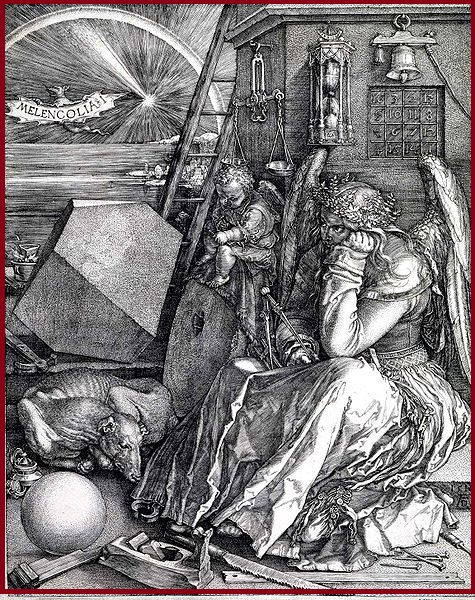
Melencolia_I_(Durero)
A Life Saved by Art

The library’s card catalog led me
to shelves of art books: oversized, glossy-paged,
crabbed with tiny, inarticulate commentary
about volume, form, structure,
perspective, light and shadow,
innovation and rebelliousness
and the emotive content of the line.

What did it mean? I was eleven.
I made a hagiography based upon
the beauty of still things, life arrested,
mid-gesture, on canvas, wood, stucco,
merging all my saints and artists into
a collage of stories as naive
as Rousseau’s jungle scenes–

but I believed Rousseau, and Breughel
and the intimacies of Rembrandt’s Bathsheba
and the endless processions of amazed Magi
through the narrow streets of precarious Italian towns
and Degas’ women tying up their hair
and the rich invitingness of Gauguin’s flowers
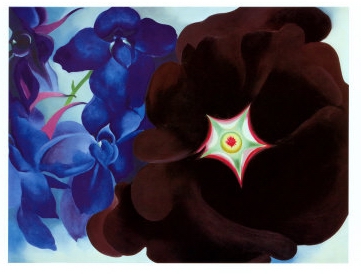
and the stark heart of Georgia O’Keeffe–12-01-05MagiFraAngelico

I believed I would learn to comprehend my life,
put it into perspective through
Giotto’s tiny and exquisite backgrounds,
Dürer’s precise grids, believed I would discover
an understanding of the abstract.
I wanted to be transformed through art,
the sanctity and structure of the line,
and, through them, out
of the coming confines of adolescence.

I forget so much of what I learned,
but still I possess Arles, and Athens,
the buff-colored pages of
Da Vinci’s notebooks, ink and ideas:
ink which now sprawls abstract upon the page
while I consider the emotive content
of each line–and brilliant fields of color
daubed in wild and perfect order:
a moment, a childhood, a life
saved by art.black-hollyhock-blue-larkspur-georgia-okeeffe

~ © 1997 Ann E. Michael

~

There are better poems about art (even by me); but I treasure the yearning outlook this piece suggests, and its tendency toward overstatement as well.

Synthesis & coincidence

&&001“and per se and”

Ah, synthesis! The conjoining and combining of objects, ideas, theories, values and systems, arts, media, experiments, research, disciplines, metaphors, symbols, rhythms, patterns, DNA, et (“&”) cetera.

Synthesis can be planned, hypothesized, purposeful–and it can be spontaneous, unexpected, coincidental. There are times when I feel as though the overlapping and intertwining of experiences seems to have been somehow “planned by the cosmos” (or some higher power); but coincidences occur more often than we think, especially when our consciousness is primed to make connections.

I have primed my own brain, recently, to synthesize thinking about aesthetics, neuroscience, the arts, philosophy and consciousness. So it should not surprise me–though it does!–that the books I have recently been reading connect many threads of my thought, including other recent readings. For example, Martha Reineke’s Intimate Domain: Desire, Trauma, and Mimetic Theory is an exploration of family “romance” in psychoanalytic theory that draws on Freud and Girard; but because Reineke uses Girard’s early writings as her basis, she cites Merleau-Ponty and phenomenology quite often. Furthermore, mirror neurons and the place and operations of consciousness appear in her claims and explorations in this (difficult) text. Mirrors and mimesis, minds and spirits…Gabrielle Starr’s Feeling Beauty, which I’ve mentioned in recent posts, examines the art-body-mind connections in neurological domains and mentions, more than in passing, the phenomenological aspects of the experience we term “art.” Arthur Danto’s The Transfiguration of the Commonplace: A Philosophy of Art (1983, though I read it last month) also wove itself into my thinking as I read Starr’s more current book. In addition (oh, there’s always an “in addition” with synthesis), I am re-reading Csikszentmihalyi’s classic, Flow: The Psychology of Optimal Experience. The states humans experience when we work hard at challenges we enjoy, such as art-making, are deeply connected to our brains and also rooted in our bodies.

So there is a coming-together, a process not unlike chemical bonding, that all of these texts and ideas produce in my mind. This post is one outcome, I suppose. But there will be others.

~

From Carl Sandburg’s “Tentative (First Model) Definitions of Poetry” (1928): “Poetry is the achievement of the synthesis of hyacinths and biscuits.”

387236_10201085579685937_1062169370_n


Studio. Space.

Contemporary artist and blogger Deborah Barlow writes: “A studio, like a womb, is a vesseled space, a geolocation from which one’s work, intentionally free of its context, can emerge.” http://www.slowmuse.com/2013/11/25/up-stairs-in-sight/

In another recent post, she talks about artists’ decisions about whether or not to offer studio tours, and art critics’ decisions about whether or not to visit studios. The critics she mentions (Saltz and Smith) prefer not to see the studios of artists whose work they are reviewing. The sense I get is that the critic needs more objectivity–a disinterestedness–and that a working artist’s studio is a personal space, one through which perhaps the critic might learn too much (context? biography? vulnerability? …one wonders).

I wrote my graduate thesis on how time works in poems, and for a long time I considered writing a followup on space in the poem, particularly the kind of vesseled, nested, interior space to which Barlow alludes (and Bachelard, in The Poetics of Space).

What spaces are conducive to the creative process? Such variety! I have friends who love to write in diner booths or cafes, and others who need complete silence, no distraction (Annie Dillard wrote in a closet; Robert Frost in a shed). One writer I know must be in bed to write. Another must be outdoors. The place matters to many people–but not to all of them.

Writing’s different from painting, sculpting–arts that require at least a few tools at hand.

But some of my writing friends need a computer, or a candle; a pencil and a legal pad, or a fountain pen and a spiral notebook; a bookshelf; darkness; classical music, or the blues.

I don’t really have a studio these days. Maybe it is time I lent my mind to carving out a creative space? –Somewhere nestled, vesseled, interior: (A Room of Her Own).

Below: A location…space, intentionally free of context.  🙂

IMG_0252

Sublime beauty

In his book Survival of the Beautiful, David Rothenberg says perhaps it was the evolution of an abstract aesthetics in art (abstract work as beautiful) that enabled human beings to begin to see natural things as beautiful in themselves–as opposed to the Romantic view that human yearning and elevated sensibility could best be encountered while experiencing Nature or Classicist ideas that found natural things corrupt and irregular, in need of perfection into better-proportioned objectification. In History of Beauty, Eco allows the Romantics their view of the sublime but says that in the late 17th c “the Sublime established itself in an entirely original way, because it concerns the way we feel about nature, and not art.” His text offers the paintings of Caspar David Friedrich as an excellent example, paintings that depict people as observers of the Sublime:

The people are portrayed from behind, in such a way that we must not look at them, but through them, putting ourselves in their place, seeing what they see and sharing their feeling of being negligible elements in the great spectacle of nature…more than portraying nature in a moment of sublimity, the painter has tried to portray (with our collaboration) what we feel on experiencing the Sublime.

I love the idea Eco parenthetically notes here: with the viewer’s collaboration. These paintings permit us to enter into the experience as the great preponderance of the artistic canon did not. Some critics suggest the environmental “movement” (in the USA, at least) owes its lineage to Leopold via Thoreau through Darwin, Wordsworth, and the German Romantics.

Friedrich’s work tends a bit over the top for my personal tastes, but I do think some of his best work (notably The Wanderer above the Mists, Woman on the Beach of Rugen, Moonrise by the Sea) does exemplify a sense I have experienced myself in natural surroundings when I feel myself a “negligible element” amid the remarkable scope of the cosmos and the world.

In the USA, at about the same time as the German Romantics, the paintings of the Hudson River school evoke some of the same sense of nature-as-sublime. (Frankly, I prefer Thomas Cole to Friedrich.)

~

This, too:

“The sense of the Sublime is a mixed emotion. It is composed of a sense of sorrow whose extreme expression is manifested as a shudder, and a feeling of joy that can mount to rapturous enthusiasm…while it is not actually pleasure…”   Friedrich von Schiller, On the Sublime (tr. Alastair McEwen)

~

“Poetry might be defined as the clear expression of mixed feelings.” I am pretty sure W.H. Auden said that. Which, by the way, gets us into the territory of the Sublime as described by Schiller.

~

In Japan, in the 17th century, Matsuo Basho composed haiku, some of which demonstrate the sense of the Sublime (without being Romantic at all)–i.e. that sense of rapture tinged with the shudder of grief or the feeling of awareness of one’s negligibility:

A wild sea-
in the distance over Sado
the Milky Way.

~

paintdaub
I stand on my back porch; I am small and negligible, the sky is large and Sublime.

Poetry and art

A colleague pointed out art critic Holland Cotter’s New York Times piece as a must-read for me with my interests in both disciplines. Here is the link to Cotter’s essay in the “First Crush” series the Times runs: Cotter August 13, 2013.

Cotter says the first love was language, specifically poetry, especially Longfellow and Dickinson.

“If you fall for Dickinson early, you’re committed to language for life, and almost unavoidably to Dickinson’s kind of language. It’s more concrete than just words on a page or in the air. It’s language as a physical material, a substance so concentrated that you can all but hold it in your hands, turn it over, feel its textures.

And it’s addictive. Once in your system, it’s impossible to shake, like a neurological imprint. In my experience, Longfellow’s intensely visual poetry was like a mural or a movie. You just wanted to stand back and let it happen to you. Dickinson’s language was visual, too, but in a startling, flashbulb way — a bang of illumination after which your vision took time to adjust to normal light.

Poetry, in general, made me sense that language could be about big, urgent subjects, the kind that ruffled even a 9-year-old mind. Will everyone I love always be here? If not, where, exactly, is heaven, and what does it look like? Perhaps most important to a writer in formation, Dickinson’s language felt personally usable. It made you want to write, made you think you could. So I did, just for the pleasure and power of creating pictures from words.”

What can I add but “Amen to that”?

It interests me greatly, though, that Cotter made his trajectory from poetry to art; my path went the other direction. I began with a fascination for and study of art and ended up as a writer.

Overlaps and linkages, interdiscipline & creativity. Big, urgent subjects…a kind of power. That’s art.

Here’s something lovely

…from Maria Popova at the Brainpickings site: book loving and writing and art and literacy and library connect to produce this event/display at the New York Public Library. I was in the city just last week–rats, I missed this. (But I did see Ken Price at the Metropolitan Museum of Art and spent part of a lovely afternoon at Untermyer Park again).

~ Please click on the links! (I know they’re kind of hard to see on this theme)~

MEANWHILE…

I’m on blogging hiatus again while I get accustomed to my work week and while we prepare for the Goschenhoppen Folk Festival (or on Facebook here) this coming Friday and Saturday. Not a time to get much writing done, nor much reading.

A festival participant prepares apples for drying

A festival participant (19th c) prepares apples for drying

Young apprentices (18th c) at work

Young apprentices (18th c) at work

“The Atlantic”

 Atlantic by John Sevcik

A few years back, I was privileged to join John Sevcik, his wife Lynne Campbell–who is also a marvelous painter–and a few art students and friends for three lovely days of art talk and plein air painting sessions and terrific food at a beach house in NJ. This painting, by John Sevcik, inspired the following poem, which appears in Water-Rites.

The Atlantic

She and her mother
are knee-deep in water
their backs to the shore

What they discuss
as they look eastward
you cannot hear–

breakers, the wind,
the natter of laughing gulls
cover their conversation

Besides, you are busy
fathoming the sea’s tones
and mixing the sky–

Trying to stake claim
to the reflective shallows
between you and them

At this hour
they are your subjects
as the sea is

and what they say
she will share with you
later. Or she won’t.

It doesn’t matter, you
have set down on canvas
their communion

And your own conversation–
the one between mind’s eye
and artist’s hand.

~~~

Many thanks to John Sevcik for allowing me to post his painting here on my blog. To see John’s other works and find out about gallery showings, visit him at his web page. He is also a teacher, poet, playwright and actor.

Manet and the Sea: a novice’s view

I wrote this essay about eight years ago while taking a class on writing art criticism with the late William Zimmer. I wrote some more traditional art-crit writing, but I liked this short piece best.

The show “Manet and the Sea” traveled several major museums and was mounted at the Philadelphia art museum in, I think, spring of 2003. My daughter is now graduating from college with a degree in biology.

Manet and the Sea: a Novice’s View

My daughter, Alice, is almost 14. She has decided tastes: a preference for the colors red and purple, for Papillion blue cheese and Belgian chocolates (the darker the better), for anchovy-stuffed olives, for horses, for Gary Cooper and Johnny Depp. She listens to Fats Waller, Tom Lehrer and the Beatles. She has no interest in clothing fashions or in 14-year-old boys. All of this makes her not-your-average teen girl, but she still does not exactly jump at the chance to visit art museums. That’s my department.
Alice therefore exhibited typical teenaged foot-dragging when I bribed her into accompanying me to “Manet and the Sea” at the Philadelphia Museum of Art (expensive chocolate desserts were promised). I attended the show with members of an art criticism class, people she referred to as “art geeks”—not a promising start to our evening together; but that’s what people her age are like and I have learned not to take the sarcasm too personally. She spurned the offer, at the gallery entrance, of a taped audio tour. “Those things are always stupid,” she pronounced. The tour was not exactly stupid; but I did decide, after awhile, that the audio part of the program was the least effective aspect of the exhibit. Alice’s intuition is often pretty canny.

My kid is a widely-read, marginally sophisticated teen who’s been to many art museums but never really shown a huge interest in paintings. On the way to Philadelphia, I asked her if she knew who Manet was; she remembered Monet and Renoir, and Delacroix’s horses, but not Manet. I told her about the scandals that revolved around “Olympia” and “The Luncheon,” and we discussed subjects for art and how those change depending on society’s values. She remembered my passion for medieval art, “all those church-y pictures with saints and halos.” Subjects of the times. But this exhibit would focus on sea paintings, I told her. Boats. Harbors. They’ll be pretty to look at, I said.

And they are. Alice was not particularly taken with the early Dutch naval battle canvases, or with Manet’s “Ship’s Deck,” but most of the other paintings appealed to her. She said of “Ship’s Deck” that “you can tell he knew a lot about boats, but this painting is kind of dull and depressing.” More to her personal tastes was one of Manet’s small, impressionistic canvases, which she returned to admire several times during the evening: “Sailing Ships at Sea” (1864). She liked the abstract but sure brushwork, quick-seeming indications of small boats “with their sails moving the right way” (she learned to sail last summer and is full of the hubris of the newly-informed) and the cheerfully-colored bands of sea and sky. This is a painting she wouldn’t mind looking at every day, she said, as opposed to Courbet’s “The Wave” (1869). She admired the Courbet for its power and deep brown hues, its action—“but it’s almost too much; I would get fidgety having it in my room.” Monet’s “The Green Wave” suited her most among the wavescape paintings. She liked the way the small boats were handling the swell.

Her taste for bright colors does seem to affect her choice of favorite paintings. She liked the vivid blue-and-white poles and bright overall feel of Manet’s “Venice—the Grand Canal” and pointed out to me the small, red sailboat and tiny white seabirds that add to the perfect charm of his “Fine Weather at Arachon” (1871). Color is what appeals to her in the Monet paintings, as well, and was what surprised her most in the Morisot harbor scenes. “Look how much white she used! These are so different from the other paintings,” she observed. “Why do you think she chose to paint those scenes?” I asked Alice. She answered that flags must be fun to paint. Color again.

But tedium sets in, even amid the loveliest gallery of paintings. Alice headed out of the show to view the chanfrons (equine face-armor) in the arms and armor gallery and to wander through the European collections. And after a long wait at a nearby restaurant, she was served a warm, chocolate bread pudding with chocolate sauce, whipped cream and fresh strawberries. I opted for the crème brulée. There is food for the mind, and there’s food for the body; we shared a bit of both. On the ride home, Alice said, drowsily, “All those paintings made me want to take a vacation by the sea.” Yes, Alice—life should definitely imitate art.

Haiku impressions

The reading Friday at Blind Willow Bookshop, a lovely used bookstore specializing in literature and unusual or rare books, combined the voices and perspectives of three poets who are exploring Japanese poetic forms.

Here’s a summation of my own remarks, though Marilyn Hazelton and Ann Burke had much to share. I’m not including the poems we read, either–Ann Burke’s haiga-like tanka poems coupled with art work or photos were lovely, though, and I wish I had files to post. Marilyn included work from the tanka journal she edits, red lights.

~

I learned about the haiku form long ago, but I can’t remember exactly when. I think it may have been during my junior high school years, though I certainly didn’t learn it in school—there was no poetry taught at my schools. I was exposed to poetry through other means: church, nursery rhymes, my own reading, relatives, song lyrics.

Initially I learned the syllabic approach, 5-7-5 syllables in English. That is the way the form was taught in the USA the 1970s. And it was clear to me early on that haiku is visual or physically-based; the imagery is sensual and real—in other words, what is in the world is in haiku, and vice versa. So it is not imaginative in the sense of fiction or dream. It engages the imagination in other ways, which means the poet has to corral quite a bit of compressed and specific imagination into a few words. The intense compression of these brief forms requires the poet to work hard at expression through the tightest possible means in language without employing what we in the Western traditions term symbolism. Classic Chinese poems often used symbolism, but Japanese poems relied more on allusions of several types (historical, poetic, seasonal). We tend to term these “symbols” (ie, cherry blossom equals spring romance) but that is not actually an accurate way to define the way concrete imagery is used in Japanese poems.

Later, after more study, I learned some details and contexts for the seasonal allusion, the references to previous poets or poems, the cutting word, the reasons haiku in English may need to be briefer than 17 syllables for maximum effect; and I found out about related forms of Japanese poetry such as haibun, renga, tanka. I met Marilyn Hazelton and learned through her, as she studied and taught the forms, in English, to other aspiring writers. Japanese poetry forms may seem to follow arbitrary rules, but that is no more true than asserting that western sonnet forms follow arbitrary rules.

My study of this poetry brought me a better understanding of the Imagist poets of the early 20th century in the sense of how they were influenced by, and how they misinterpreted, the haiku poem, crafting in the process some critically important poems for western readers. Poetry is a marvelously flexible art, elastic and willing to morph as its authors are willing to experiment. I think of much of my work as based in a ‘haiku moment’ for inspiration or image.

I will be the first to assert that haiku is not my métier, nor is tanka form. My poetry—and I’ve written a great deal of it—is generally more Western in style and tone, no surprise given my cultural and educational background. Yet haiku appealed to me immediately because, I think, of my interest in visual art and in the natural world.
~

My attraction to haiku is therefore image-based. My interest in Japanese poetry also increased after I studied Zen. The two are inter-related, also no surprise. In my notebooks, and on random pieces of paper I use to jot down ideas for poems, nine times out of ten the phrases I want to capture are physical images. Later, I may try to craft these jottings into a haiku. More often, they get employed as lines in other types of poems.

Sometimes, a poem I attempt to write as haiku becomes a tanka…or a longer poem in some other form (free verse, blank verse, etc.); in any case, the sensual first impression is usually what I first observe and note. My own interest in nature and my physical environment make haiku-type poetry sort of an inclination. So the inspirations and influences for me include Zen, visual art, physical or concrete imagery, nature and season, brief observation, compressed or concise language use, and a quality of universality in the poem.

~

For writers who have done Westerners the service of exploring, interpreting, and explicating haiku and the Zen practice that leads to the haiku moment, I suggest Jane Hirshfield, Robert Aitken, William Higginson, Penny Harter, Hasegawa Kai, Earl Miner, Richard Wright, Gary Snyder.
Passion, art, doubt

“We work in the dark–we do what we can–we give what we have. Our doubt is our passion, and our passion is our task. The rest is the madness of art.”  ~Henry James

Azar Nafisi cites this James quote in Reading Lolita in Tehran. In her memoir-based ruminations on James, she identifies deeply with James’ ambiguity, a trait in James’ fiction that her Iranian students find complex and difficult. She spends a couple of pages examining the problematic aspects of James’ work that frustrate and puzzle her students even as the same aspects appeal to her. She likes the doubt.

This quote, with its passionate appeal to the task of art, and its uncertainty, likewise resonates for me. My encounters with the ambiguity inherent in art stem from a set of experiences very different from Nafisi’s, and from James’. But our passions are similar in intensity, although I would probably tone down James’ phrase “the madness of art.”

Where did the doubt and the passionate “need to make a task of art” begin? I can probably come up with dozens of possible answers for myself. I’ll mention just one right now, the way I learned to feel about visual art. A framed print of the painting shown here [The Adoration of the Magi, by Fra Angelico and Lippo Lippi] hung on the wall when I was very young. It was the most fascinating object in the house. I spent what seemed like hours gazing at its details, finding the animals among the throngs of people, old men, and young women with their hair in roped braids, children and peasants and half-naked lepers amid the ruins. I knew the story well, but the way it was told in this painting engaged me more completely than any other way I’d absorbed the Christmas narrative. And it was round! It was the only round picture I’d ever seen.

This Adoration moved me, even though I was only six years old. The idealized, pastel paintings of Jesus that hung in the Sunday school rooms were bland and static by comparison; they did not make me want to love the pretty man in the clean robes. But this painting! Even the peacocks adored the Baby Jesus. And yet the picture contained more than adoration and joy. Pain was implicated–the beggars, the cripples–decay was there in the broken-down building. Horses stamped impatiently; some of the people turned away. The whole thing was full of tension and human frailty and doubt as well as gladness.

It strikes me, now, that doubt is one of our tasks; for it is through uncertainty, curiosity, mild skepticism, and a willingness to weather the problems and puzzles of ambiguity that we keep alive our passion for the task of art, to make new, to express, to challenge, and to celebrate. That is what the devoted students in Nafisi’s book manage to cling to as they read “dangerous” books in Tehran. And that’s perhaps what Henry James meant when he stated that we work in the dark.

If the madness of art exerts itself through the tasks, the doubt, and the passionate devotion to doing what we can–well, I can live with that.