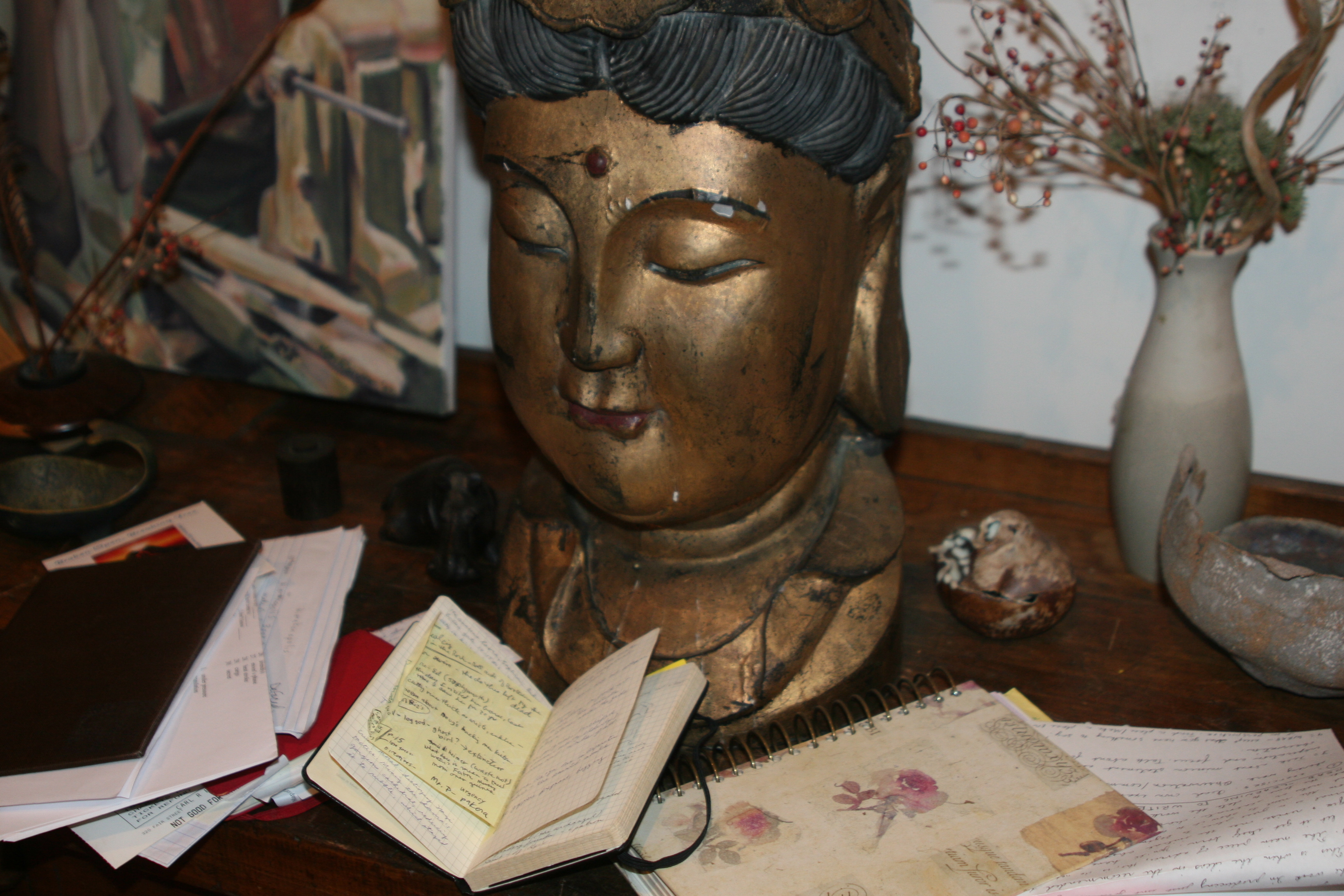
Dozens of views

No one has ever found the traces of memory in a brain cell. Nor are your imagination, your desires, your intentions in a brain cell. Nothing that makes us human is there.

Deeprak Chopra

Chopra is not my favorite writer on consciousness, but he does an adequate job of explaining complicated concepts to people who are just getting accustomed to questioning experience and who are beginning to be open-minded about the mind, the body, and beyond. So often, we have been raised not to doubt, told what God is and is not, and trained into beliefs about the truth. This, in spite of the common human trait of curiosity that asks: who and where are we in the world? What makes me me? What happens when I die? Chopra, with his medical background and his experience spanning several major cultures, can offer both a great deal of information and pose provocative questions to his readers.

In our technologically-obsessed culture, it is easy to turn to science as foremost authority; I happen to be fascinated by neurology and neuropsychology when it comes to consciousness, for example, but I never rule out so-called spiritual insights. Chopra’s writing often falls into the fallacy of stating “there are two views,” when in fact there are dozens of views, even among scientists. My guess (it is but a guess) is that the either/or form of presenting perspective is simpler for the “average reader”–as defined by his editor–to understand. Yet it seems to me a slight to the average reader to narrow these big questions down to “two views.”

Here’s an example, just one of many in his writing:

There are two views about consciousness in science today. One is that consciousness is an emergent property of the brain and. therefore, also an emergent property of evolution. That’s the materialist, reductionist view. There’s another view…[that] holds that consciousness is not an emergent property but inherent in the universe.

Now, I genuinely prefer what Chopra calls the “mind first” argument in which consciousness is a kind of field effect. I would not, however, suggest that matter first and mind first are the only two views today’s scientists hold; and neither would anyone else who has read a number of the elegantly-argued, well-researched, thoughtful, passionate blogs of today’s science researchers. The majority of them are atheists, but some are agnostics and some are inclined toward non-theist teachings such as Zen. Even among the ranks of non-believers (in terms of an anchoring eternal presence or god), the question of consciousness leads to intriguing inquiries.

The philosophers of today cannot ignore scientific advances any more than Maimonides could in the 12th century. Physics is a thing! as my students might put it. For the ways in which this relates to the science of neurology, I return to the framework on consciousness proposed by Douglas Hofstadter in his book I Am a Strange Loop.

What is the world but consciousness? Or illusion, in Hindu and Buddhist teachings (Maya) and, in a slightly different but related way, in Plato. And how many perspectives are there on that consciousness?

Chopra would probably say that each of us has to experience a state of awareness and interaction with whatever deep potential “god” or the creating principle offers for us. Which basically admits of not merely dozens but billions of unique interactions or perspectives…if we even agree to the schema.

goldenrod (solidago) going to seed

goldenrod (solidago) going to seed

Empathy & compassion

quanyin
Quan Yin, bodhisattva or goddess of compassion; the Chinese interpretation of Avalokiteśvara

Sensitive. Or: oversensitive.

These are terms I hear bandied about to describe people who react deeply to anything from wool clothing or sock seams to sarcasm or “charged language.” When I was a child, people told me I was sensitive; initially, I thought that was a kind of compliment, and sometimes that was the intention. The teenager I once was believed that sensitivity made me empathetic and compassionate.

As I matured, however, the term sensitivity took on more negative connotations of the “can’t you take a joke?” sort. Worse yet, the charge of sensitivity came loaded with accusations of narcissism, as in “you take everything personally.” In today’s phraseology, “It’s not all about you.” Under those terms, sensitivity does not resemble empathy.

Empathy is a feeling-response, true. It appears to have a like-kind relationship to sensitivity–but a person must be sensitive to others’ experiences in order to feel empathy; so the similarity’s not as swappable as it first seems. I thought that my feeling-response signaled that I was a compassionate person. Indeed, fiction elicits empathy in me. A lifelong bookworm and early addict to novels, I definitely feel along with the characters of the stories I read. Is it really the experience of others that makes me weep or feel joy as the characters forge through lives such as I will never be able to encounter? Or is it a feeling response to damned good writing?

I ask myself these questions because, given my inquiries into what consciousness is and what poetry does, it seems I have not made clear to myself the differences between sensitivity, empathy, and compassion.

~

My current thoughts on the differences have evolved through reading and writing poetry, not fiction, and through getting older. Nothing like life experience to knock a person’s youthful errors into strong relief.

Here goes:

Sensitivity is the strength of a person’s reaction. That reaction may be physical or emotional and will vary widely from one individual to another.

Empathy always means that one “feels within” another person (from Greek empatheia em- ‘in’ & pathos ‘feeling’); it is an inward response to external stimuli. As Daniel Goleman notes, there are several types of empathy psychologists have identified–here’s a brief article on that topic.

Compassion, while a noun, must be active. I think of it as behavior, as action, as verb in noun form. It is a response or reaction to suffering in others (empathy) that is accompanied by an urgent desire–the word desire isn’t strong enough to convey the feeling–to help alleviate the suffering.

That’s where the activity comes in. Until I feel a desire to act, I am “merely” empathetic and sensitive.

~

Recently, I have begun to recognize that my desire to write poetry is partly compassion-based. Art of any kind is process as well as result, and process is action. Additionally, my career as an educator has compassionate action structured into the job description. There are other ways we–I–can be compassionate in the world. This matters to me.

We can learn from the practice of tonglen: “Breathe in for all of us and breathe out for all of us. Use what seems like poison as medicine. Use your personal suffering as the path to compassion for all beings.” ~Pema Chödrön

And we can live in the world and begin to use our sensitivity to pain, and our sense of empathy, to activate compassion–as a verb.


Safety

I work, and sometimes teach, at a college campus–a small, quiet, safe university surrounded by cornfields and lightly-wooded slopes. The institution has a manual of protocols to ensure the safety of staff and students: lockdown procedures, early alerts, advising on harassment, threat, and signs of various types of needs along with preventive measures, communication protocol, background screening, and referrals. The administration has taken pains to assure the safety of students, faculty, and staff.

It seems that one of the most urgent desires of U.S. citizens is to be safe. We spend millions of hours and dollars on the quest to protect ourselves and our communities. We argue over whose responsibility that should be, though most of us recognize the responsibility–as in any social group–must be a shared one. After last week’s mass shooting tragedy, one Oregon college professor posted an open letter to her legislators (click here for story). Her situation parallels my own except that I have been at my college for many years and am aware of the protocols. But those procedures would be just as useless in my classroom as she envisions they would be in hers.

From a June 2015 New York Times article reporting on the Texas campus-carry legislation: “Opponents say the notion that armed students would make a campus safer is an illusion that will have a chilling effect on campus life. Professors said they worry about inviting a student into their offices to talk about a failing grade if they think that student is armed.” Most lawmakers have never been teachers. I think it unlikely they are aware of the stress and apprehension most of us feel in addition to our interest, concern, and compassion when dealing with a “difficult,” angry, or excessively anxious student. Yet we do not let our fears keep us from doing the jobs we love, disseminating what we have learned through study and experience to others and (usually) actively seeking their engagement in the discipline. That means taking intellectual risks. Occasionally, it means making oneself vulnerable to physical risks as well.

I am not suggesting there is something wrong-headed about wanting to feel secure; certainly that need is basic among human beings, keeping us in groups banded together for safety. But I do wonder whether the craving for safety distracts people from exploring and implementing other, perhaps more helpful, methods of operating as a society. To do so would require rejecting the norm, stepping away from the way we generally tend to do things (the way they’ve “always been done”) and endeavoring to create new approaches to our social maladies.

What might that look like, from the professor’s point of view? Or from the politician’s perspective, or a parental viewpoint? And are we, collectively, ready to take those risks?

photo by Patrick Target

photo, Patrick Target. Mary Mother of God statue above the campus.

Painfully conscious

I’ve just finished reading Melanie Thernstrom’s 2011 book The Pain Chronicles, a journalist’s inquiry into the concepts that “define” pain and the medical discoveries concerning chronic pain, in addition to a bit of memoir as a narrative device. Although I have experience with chronic pain myself, the part of the text that most interested me comes in her concluding chapters, in which she gathers the variously-disciplined evidence of her enterprise to suggest that pain is the ultimate test of the mind-body problem (thank you, René Descartes). The experts Thernstrom interviews disagree on how much we do know or can know about the human brain and how it processes anything, let alone such a complicated psycho-physiological event as pain. Some of them believe human beings will make enormous technological discoveries to unlock our brains’ workings, but the majority seem to have learned from research that each “a-ha!” leads only to further complications. Discussing the outlook for future fMRI scanning in brain research, Dr. John Keltner tells the author:

[N]obody has come up with a rich and complicated enough model to analyze the complexity of the distributed patterns of neural  networks and deduce anything like underlying rules…We’re literally grappling with the fundamental aspects of human beings. We naively believed that pain is simple–it hurts or it doesn’t hurt–so there should be a single brain state we could see every time someone is in pain. But what we’ve stumbled into is the discovery that there’s a relative universe of hurt–that hurting is an immense, rich, and varied human experience associated with an unknown number of possible brain states.

I find some of these analogies, and some of this language, appealing–I can think of poems that express “a universe of hurt.” I embrace the idea that hurting is immense, rich, varied, and human–we are aware (conscious) that we hurt, that others hurt, that hurt can be painful even when it is not caused by a toothache but through loss of a friend or lover…the beloved other, the pain in ourselves. Isn’t compassion born of this awareness? Does art have a place here, too? I wonder.

Thernstrom concludes with the agreement of several expert researchers: “pain and suffering are properties of the mind” [my italics]. That means pain is, at least in part, a property of that elusive thing we generally call consciousness. Scott Fishman of UC Davis explains that “[t]he mind is like a virtual organ–it doesn’t  have a physical address that we know of.” Consciousness, these researchers imply, is not merely the sum of firing neurons, a process that can be considered on some level mechanical. Thernstrom asks, “Do we need to understand consciousness itself in order to understand pain?”

If so, that is a tall order, one the author posits is analogous to understanding aesthetics (what is beauty?). But though the task appears daunting, the discoveries en route make the trek valuable.

Even if we never understand the answer.

neural matrix fiber topography, Johns Hopkins University

neural matrix fiber topography, Johns Hopkins University

Rest & reading

It’s been a busy week, and I am exhausted mentally and physically; I am taking the three-day weekend as relaxation time–which means: reading, mostly. Currently, my “difficult books” concentration is Maimonides’ Guide for the Perplexed, though I am not finding it as challenging as I expected, because Maimonides is a good teacher! I am not among his target audience, however, as I am a woman. He was quite forward-thinking for a 12th century Talmudic scholar with an Aristotelian bent, but women were not considered qualified to study the deep mysteries of metaphysics. [Alas, I read without repentance for my heresy.]

My reading also means catching up with blogs I follow. Here’s the link to Theodora Goss’s latest musings on aesthetics and beauty–a lovely blog-essay. I hope you will read it.

ann e michael


Seeking

The semester has begun. I’ve been immersed in reading Marilynne Robinson (Absence of Mind) and Daniel Ariely (Predictably Irrational) while procrastinating on uploading materials to the software platform for my class and making tomato sauce at home.

Robinson detects, amid all of our human endeavors, a search for answers. That we have questions at all seems proof of sentience, if there can be such a thing as proof. Certainly the process, myth, and language of seeking surrounds most human developments: religion, art, philosophy, science, and others. It’s the classic quest narrative that runs through anthropologically vast distances, from Gilgamesh’s efforts to find eternal life to the Ramayana (with Sita as the prize, in Ravana’s clutches) to Rowling’s Harry Potter, who snags the role of “Seeker” in a game–a metaphor that continues through the series.

But are there answers to our questions? And a corollary: are we asking the “right” questions?

256px-Chaos_Monster_and_Sun_God~

Ariely, like Dan Kahneman, reminds us that we do not always–in fact, hardly ever–choose the most rational actions or answers to dilemmas. We fail to ask ourselves the better questions. We fail to act upon the better actions or decisions.

But we keep seeking. I find that intriguing.

~

Event Ahead:

On September 16, I’ll be taking part in an art-&-poetry event at a gallery in the “Christmas City” (Bethlehem, PA). Info on my Events page, here.


Desire

In a comment on my last post, M. mentioned the sensuality of gardening. Truly, there is little that can offer more joys to the senses or more opportunity for sensual encounters of various kinds than a garden. Bees, wasps, butterflies, moths, all those pollinators going about helping the flowers have sex; the pistils and stamens, the ovaries fruiting, the scents and colors and attractions doing the work of creating what is juicy, spicy, tasty, fortifying, fragrant, or gloriously beautiful. While picking beans in the heat of late July or weeding in the dog days of August, however, the gardener may be forgiven for occasionally overlooking these aspects.

ann e michaelBut the garden can be considered sensual–the garden is all about desire. My desire to feed my family with fresh foods, or to decorate my view with blooms. My desire to share the garden bounty with friends, or to try new varieties of vegetables, or to see what happens if I let that volunteer melon grow.

And if plants can be said to possess any so-called human quality, I can easily anthropomorphize them as desirous. The desire to live, and to live in order to reproduce: these are the most basic purposes of our DNA, and of the plant’s. As a gardener, I manipulate the plant’s desire. I pick the beans before the seeds have ripened in the pods, and the bean plant in its urge to produce seed sends out more flowers, more young and tender green beans. It will continue in its desperate output until the roots are exhausted. Quite the pathetic metaphor, I guess.

The plants evolve each to its own specialty. Those that “choose” dispersal of seed via bird digestive tracts grow vivid against foliage, easy to see. Those that rely on maturing into pulpy rot, to ensure their seeds get nurtured in the soil beneath the parent plant, hide under large leaves close to the earth. The hard pit, the soft seed pouch that requires fermentation to germinate, the barbed husk that gets carried off in the fur on a mammal’s leg–gardeners often foil some of these strategies, but only temporarily. We turn them to our own uses because we desire the sweet kernels, the juicy flesh, the ripe scents.

Meanwhile the plants continue making more of themselves. The wind blows, and delicious summer fragrances enhance it as it floats the pollen toward awaiting receptors; the bees collect pollen on their legs while climbing into and out of flowers (how sexy), the female flowers of the squash stems swell…

What makes our purpose any different from the plants’? Maybe we experience desire not because we are human, but because we exist, as plants do, to leave something of ourselves behind. That something will not always be our DNA, however. It may be a system, a process, a work of art, a story. Something, perhaps, that we desire.


IMG_1547


Buddhism, philosophy, consciousness (poetry)

IMG_1440~

Sometimes, a startling morning.

A few minutes that feel time-free, when the phrase “Be here now” inheres in the body, the air, the mind, the moment.

Free to recognize consciousness as a grounding, not as an end-in-itself. Part of the world, part of the cosmos.

~

Reflecting, I realize another thing: poetry does that for me, hands me a moment. When I listen to or read a poem, it moves me into a moment suspended in “now-ness.” I am with Seamus Heaney’s father, digging; I watch the horses in Maxine Kumin’s field. The poems that move me do so by allowing me, the reader, to enter that moment or that consciousness, that perspective, which I may or may not relate to, and may or may not layer through perspectives of my own. Yet there I am, in a real way.

~excerpt from “Digging” (see this link for the whole poem, and audio)~

Under my window, a clean rasping sound
When the spade sinks into gravelly ground:
My father, digging. I look down


Till his straining rump among the flowerbeds
Bends low, comes up twenty years away
Stooping in rhythm through potato drills
Where he was digging.


The coarse boot nestled on the lug, the shaft
Against the inside knee was levered firmly.
He rooted out tall tops, buried the bright edge deep
To scatter new potatoes that we picked,
Loving their cool hardness in our hands.


By God, the old man could handle a spade.
Just like his old man.

objects, stories

contemplation

~

Sometimes the momentary sense of time-free, liberated unity occurs on its own, smacks me by surprise. Or it may arise from mediation, contemplation, or during “mindless” work–such as digging.

Philosophy and criticism tend not to evoke that sort of free consciousness. They require the brain to operate in a different way, a distancing from one-ness; but I like that sort of brain-work because the intelligent and inquisitive people who write, or write about, philosophy, neurology, psychology, and criticism of all kinds offer insights I would not likely find on my own. They ask the interesting questions (it doesn’t matter to me if they do not have the answers).

~

So there’s a balance, right?

~

Poets also ask the interesting questions. Through reading a good poem, I am there in the poet’s moment, curious and uncertain. It is a kind of contemplative practice to read, with an open mind and an open heart, poetry.

(The criticism and the analysis come later. Let them wait!)


What does a woman want?

In the medieval poem “The Marriage of Sir Gawain,” the knight gallantly agrees to marry a hag-like witch who has helped King Arthur by giving him the answer to his enemy’s riddle, which is “What does a woman want?” One of several ballad-like story poems of the Arthurian legend, this one appears in Eleven Romances of Sir Gawain (an online scholarly edition is here).

For contemporary intellectual types, however, the person who famously posed that question is Sigmund Freud. He spent many years refining the theory we now refer to as “penis envy” and arguing the displacement theory was at work subconsciously. Far too many casual references to Freud have simplified this idea as suggesting that women want to be anatomically arranged like men.

Um, not exactly…nope.

But back to Sir Gawain, agreeing to marry the hag in order to free his king from the evil baron’s grip. According to the poem, Arthur gives Gawain the secret he has learned from the witch herself. Depending upon the version or translation, the answer is: what a woman wants is her way (or her will, or to have her own way). She wants to be free to decide things that affect her and to make her own choices. Because Gawain is not only gallant and loyal and noble but also no dummy, he remembers Arthur’s secret. When the witch reveals herself as a gorgeous woman and asks him whether he’d prefer to see her lovely by day (when others can see her) or lovely by night (when her husband is abed with her), he defers to her. He says she should choose.

Delighted, she chooses to be lovely all the time (she now knows he will never forget that she has a will of her own).

So, if the medieval hag is correct, Freud was right, at least symbolically. Freud dwelt in a culture where men had authority, power, and self-agency, probably also true of medieval European culture, though I’d argue the Victorians were even more constrained. Anyway, women want those things, too–if possessing a penis as part of one’s anatomy could get you those things, one can understand envying the man, if not the organ itself. Indeed, Freud uses a bunch of lengthy theorizing to offer intellectual ballast to what he initially mentioned was an issue of power. Penis=power, in a male-dominated culture. It is almost too simple an idea, and almost too obvious, so he probably felt he had to pack it with a lot of other ideas. Transference and displacement theory have proven useful in other ways, but penis envy just suggests that females too often lack power to make personal choices within a social milieu.

As a feminist who yearns for balance and equality among human beings, I think it is crucial to point out that, despite the stories with which I’ve framed this post, wanting one’s way is not just what women want. It is also what men want.

People, no matter the gender, want to be able to say “No” and to be listened to and heeded. People want to direct their own lives, make their own decisions–and their own mistakes. I work with college students who are 17-22 years old, and I can assure you that they desperately want to make their own choices. Though they often also desperately want to blame someone else for the unfortunate consequences of certain ill-considered choices, they mature once they realize that sort of behavior limits them to the role of the naughty child–a dependent–not a responsible, independent person. If you want to be respected as an adult, I tell my students, you have to be willing to own up to your own poor decisions. And that’s just for starters.

Each young person I teach, tutor, or counsel wants some control over his or her life. Some try to get it by seeking to control other people, others by trying to control their environment, others by endeavoring to control the social situation they find themselves in…the list goes on. Human beings cannot really control as much as we think we can. But we can exert our will and speak up for our way. We can offer respect and seek respect. We ought to be able to make our own decisions as long as we are mature enough to deal with the results for good or ill. That goes for people of any sex.

Yet when a woman asserts that she wants her way, our society tends to judge her as a whiner or a bitch, a ball-breaker or a manipulator. Even now, many years into politically-correct language and Title IX and women as Supreme Court justices, I hear this sort of language bandied about, often “in jest.” Sure, it can be jesting; but it’s also pretty close to jousting–with words. Be a little more careful, my friends. Or as the terminology goes these days, more mindful. Perhaps, given the freedom to exercise our will, more of us will choose to be lovely all the time.

Noesis

noesis~

  1. Cognition; perception.
    2. The exercise of reason.

Interesting that definition number two is dependent upon definition number one. Lately I have been thinking about the difference between consciousness and conscience; the latter seems to me to be specifically human, I guess, because isn’t conscience a sort of cultural or judgmental entity based upon rules? Yes, I am talking about morality, a term I tend not to use much when I consider cognition, consciousness, narrative, being.

I recently perused Patricia Churchland’s Braintrust and found myself intrigued about where and in what ways morality and consciousness or sentience mesh. Churchland is a moral philosopher, but this book relies largely on arguments premised on neurology, biology, evolution, and animal studies. Her critics pose interesting rebuttals, too. I found her book readable and often convincing–and it’s the kind of book that leads me to other writers and scientists; I love that in a book!

braintrust~

The phenomenology of consciousness–the carbon body brain-based “real world” idea of the word–involves intentionality, sentience, qualia, and first-person perspective. We can identify qualities based upon our first-person consciousness and respond to them. This process has led Western thinkers toward the concept of reason or rational thinking. The exercise of reason derives from perception.

This does not mean that phenomenology is the sole form of consciousness or even that it is necessarily human-only, but it seems to me to be the easiest one for human beings to wrap their minds around. Yet the earlier philosophers were not phenomenologists. Their speculations about what consciousness originated in and what morality inhered in were quite abstract.

For a good sum-up of how contemporary scholars define and discuss consciousness, go to Stanford’s site here.

~

Being cognizant or conscious does not necessarily lead to moral behavior or reason…or does it? Here we have an idea that has been debated for centuries. In her book, Churchland often returns to Hume, who wrote about morality from what, eventually, became known as the utilitarian stance (though I would argue Hume is not really utilitarian). Stanford offers an overview of morality as defined by philosophers over the years; The Internet Encyclopedia of Philosophy says this of Hume:

In epistemology, he questioned common notions of personal identity, and argued that there is no permanent “self” that continues over time. He dismissed standard accounts of causality and argued that our conceptions of cause-effect relations are grounded in habits of thinking, rather than in the perception of causal forces in the external world itself. He defended the skeptical position that human reason is inherently contradictory, and it is only through naturally-instilled beliefs that we can navigate our way through common life.

These concepts should feel modern to most of us thanks to cultural anthropology, sociology, and psychology, among other disciplines. Hume’s position conflicts with much religious dogma, but his ideas were not out of line with many of his fellow Enlightenment-Era thinkers. During the Enlightenment, intellectuals were enamored of the exercise of reason (noesis).

~

So: consciousness and conscience. First we have the one–however it arises within us*–and the other develops (or evolves?) thanks to the need for social beings to navigate common life. And thanks, perhaps, to brain evolution adapting to social common life (see Churchland for more on this).

Much to mull over during my brief summer break.

~

Jiminy Cricket copyright Walt Disney Co.

Jiminy Cricket copyright Walt Disney Co.

*See my numerous previous posts on consciousness!

⇐ “And always let your conscience be your guide!”