Safety

I work, and sometimes teach, at a college campus–a small, quiet, safe university surrounded by cornfields and lightly-wooded slopes. The institution has a manual of protocols to ensure the safety of staff and students: lockdown procedures, early alerts, advising on harassment, threat, and signs of various types of needs along with preventive measures, communication protocol, background screening, and referrals. The administration has taken pains to assure the safety of students, faculty, and staff.

It seems that one of the most urgent desires of U.S. citizens is to be safe. We spend millions of hours and dollars on the quest to protect ourselves and our communities. We argue over whose responsibility that should be, though most of us recognize the responsibility–as in any social group–must be a shared one. After last week’s mass shooting tragedy, one Oregon college professor posted an open letter to her legislators (click here for story). Her situation parallels my own except that I have been at my college for many years and am aware of the protocols. But those procedures would be just as useless in my classroom as she envisions they would be in hers.

From a June 2015 New York Times article reporting on the Texas campus-carry legislation: “Opponents say the notion that armed students would make a campus safer is an illusion that will have a chilling effect on campus life. Professors said they worry about inviting a student into their offices to talk about a failing grade if they think that student is armed.” Most lawmakers have never been teachers. I think it unlikely they are aware of the stress and apprehension most of us feel in addition to our interest, concern, and compassion when dealing with a “difficult,” angry, or excessively anxious student. Yet we do not let our fears keep us from doing the jobs we love, disseminating what we have learned through study and experience to others and (usually) actively seeking their engagement in the discipline. That means taking intellectual risks. Occasionally, it means making oneself vulnerable to physical risks as well.

I am not suggesting there is something wrong-headed about wanting to feel secure; certainly that need is basic among human beings, keeping us in groups banded together for safety. But I do wonder whether the craving for safety distracts people from exploring and implementing other, perhaps more helpful, methods of operating as a society. To do so would require rejecting the norm, stepping away from the way we generally tend to do things (the way they’ve “always been done”) and endeavoring to create new approaches to our social maladies.

What might that look like, from the professor’s point of view? Or from the politician’s perspective, or a parental viewpoint? And are we, collectively, ready to take those risks?

photo by Patrick Target

photo, Patrick Target. Mary Mother of God statue above the campus.

Interpretation & finesse

A few months back, I heard from an editor who rejected a poem I had submitted. He said that the editors really liked the work, but that the journal generally did not publish “poems about poetry.” The critique was especially surprising to me because I didn’t realize that my poem was about poetry; the editors’ interpretation of my text was different from my own!

It is interesting to re-read one’s own work from the viewpoint of a reader who is not oneself. Actually, that’s an impossible task, but I tried. My interpretation of my poem is that it is a somewhat speculative, perhaps philosophical piece concerning the re-envisioning of the commonplace. Nonetheless, it is not an abstract poem on the surface. My poetry inclines toward physical imagery, often nature-based (no surprise to readers of this blog…). When I distanced myself a bit and tried to imagine what another reader might make of the poem, I could see that there would be a way to interpret the piece metaphorically as a reflection on the writing process.

That’s not what I thought I was writing, but the interpretation works just fine. Who knows, maybe I was kind of writing about writing, and it took a thoughtful critique by some editors to figure that out!

~

Which brings me to the whole topic of interpretation. I am not teaching poetry class this semester, but that does not mean I am not trying to impart to my students an understanding of what it means to interpret a text. The aim of any composition & rhetoric course is to assist students in learning how to express their original thoughts about a topic–any topic–and to ground those thoughts in evidence: in other words, to validate the student’s interpretation.

That process involves analysis, argument, inference, sometimes research, and composition whether the text the student responds to is literary, persuasive, commercial, visual, auditory, performatory, or digital. Critical thinking requires inference and metacognition. These tasks are harder than they seem; most students do not develop those abilities overnight and need a bit of coaching.

Then there are students who are capable of thinking analytical thoughts but are at a loss for how to express them on paper (or on word-processing software). That ability also requires a bit of coaching.

It can be difficult to ascertain whether a student I am tutoring needs help with the thinking or help with the expressing. Too often, early in my career as a writing tutor, I have inferred incorrectly about a student’s difficulties with the written word. Coaching takes finesse. Finesse takes awhile to develop.

Come to think of it, interpretation requires finesse as well. When a critic bludgeons a poem to pieces, the interpretation gets lost in the analysis (and critics can even bludgeon poems that they love).

I am glad that the above-mentioned editor read my poem with considerable care and finesse. He may have decided not to publish it, and he may have interpreted it differently that I would have myself, but he took the time to interpret. It is encouraging to know that my work has been read with such care.


9th as new

Last week, I tutored a student on a music appreciation paper in which she was asked to review a concert-going experience. Her family background is culturally rich–but not rich in terms of the Western cultural canon. She had heard the name Beethoven; but until this class, as a sophomore in college, she had never listened to his music. She attended a concert that featured a Liszt sonata, two brief Schubert pieces (Ständchen and one other), and Beethoven’s Symphony No. 9.

Because I cannot remember not knowing Beethoven’s music, I kind of envy this young woman’s revelations in the concert hall; what must it be like to hear Beethoven’s 9th symphony, for the first time, as a 19-year-old? I may not be familiar with all of the master’s works, but my parents had some of the symphonies on vinyl back in the 1960s. We listened to classical music on the radio and in church; even commercial television featured famous musical phrases. My sister and I liked dancing around the living room every weeknight to The Huntley-Brinkley Report’s closing theme (2nd movement Beethoven’s 9th).

portrait by Joseph Karl Stieler

portrait by Joseph Karl Stieler

~

Initially, she and I went over the structure of a review and how it resembles an analysis paper. She had used musical terminology reasonably well, and we had grammar and mechanics to work on. What she liked best, she said, was the part with the singers. She found the third movement “a bit boring. I kept wondering if this was the end.” But the fourth movement excited her: “It was really like a celebration or something, and you could see the expressions on the faces of the singers and the musicians, that they were so into it. Like, you kind of wanted to stand up for it, you know?”

Yes, I know–that’s how I have felt when I have heard the piece in concert.

~

Our discussion went on after our work on the paper’s mechanics had ended, though, because she asked me why courses like this one are required for college. Her major is early childhood education, and she says her parents asked her how a course on classical music has anything to do with teaching 4-year-olds.

It turns out I had more to say on that than I realized. Bless her heart, this student was eager to listen. [I have to admit that isn’t as common a response as one might wish.] Many of my friends, I said, are teachers or former teachers; they are among the smartest, most open-minded and curious people I know. They pay attention to contemporary culture and they read about history. They get allusions and references and make clever jokes and know all kinds of things and also, they admit what they do not know and are eager to learn about. They’d play Beethoven for kindergarteners and let them dance to the fast movements and ask them how it feels to hear the slower, sadder late quartets. They might have the children finger-paint to Beyoncé or twirl like leaves to Vivaldi’s “Autumn” or use round colored stickers to make their own “Starry Night” pictures or recite a poem that’s fun to say out loud. Culture is education.

And there’s more, I told her, that has to do with you as a person who understands the culture you are part of. You have to know about politics, especially local and state politics, because teachers need to understand how legislation and budgets can affect income and careers. You might feel uncomfortable in your job if you don’t get your colleagues’ allusions or feel you cannot participate equally in their conversations when the subject turns to culture, history, museums, music, art, policies and fiscal issues. It is fine to admit what you do not know or have not yet been exposed to–but it helps to know where you stand and to show you want to learn.

You’ll learn from your students, too. If you really want to be a good teacher, I said, you will never want to stop learning. Maybe you will reach a point where you don’t need to know a whole lot more about Beethoven, but you will want to explore other subjects. So when you take the required fine arts courses, the required literature courses, the courses in philosophy and math and all that other stuff, realize how all of it will get into your brain somehow, maybe touch a nerve here or there, and help you become a terrific teacher.

Besides, isn’t it beautiful? Even the boring parts…have you ever experienced anything like that before?

“No, honestly,” she said. “I wasn’t sure I was up for it, but it was worth it.”

Online reading, online learning

I blog, therefore I am part of the digi-technological consciousness.

Here’s a situation Descartes might have had fun imagining…have we invented our own “evil genius” in Boolean or algorithmic forms? I won’t venture there, as I am not tech-savvy or social-media savvy enough to philosophize around tech aspects of modern culture; though, yes, I do use portal systems when I teach; I do use (limited) forms of social media for communication and to publicize my work; I do take part in the networks community online; my poems and essays appear in online journals; I read blogs and online journals although in general I prefer paper, especially for book-length works.

It isn’t as if I don’t consider the intellectual challenges these communication platforms offer. It would be silly to ignore them. They are not going to go away any time soon. One question is, however, to what extent should I employ or embrace them?

~

Recently, I’ve had a poem published in Carbon Culture Review, an online and print journal that states, as part of its mission, that the publication “advocates a creative, thoughtful and visually appealing dialogue about our complex relationship to technology. We strive to promote the work of those who employ technology and utilize technological designs and terms in art and literature.” The Intersection of Technology + Literature + Art, says the masthead; interdisciplinary in scope–that’s something I find fascinating, so I’m happy to report a rather atypical poem of mine has found a place in the new issue (“21st Century Research”).

I read Chronicle of Higher Education online and have linked to several of its essays in past posts. Lately, I find much of interest in Hybrid Pedagogy, a fairly new digital source about technology, teaching, radical re-thinking of the educational framework, and exploring the possibility of intentional, compassionate connections between teachers and students–even in the digital world. Here’s a recent essay that appeals to me: “Teaching as Wayfinding.” I am still wrestling with the challenges of how to create a genuinely interactive and personal learning space in the classroom, let alone via distance education. There is so much to learn, and welcoming interdisciplinary synthesis into the discourse of the humanities offers intriguing potential.

~

Speaking of the interdisciplinary: I am pleased to report that The College of Physicians of Philadelphia chose one of my poems, “How the Body Works” as an honorable mention in its Poetry Month contest celebrating medical/health themes in poetry. [You can also check my Events page for information and tickets.]

The College, a professional medical organization founded in 1787 (same age as the U.S. Constitution), is also the site of the Mütter Museum, which has a terrific slogan: “Are you ready to be disturbingly informed?” The College boasts a library of historic significance.

It’s a great venue for a reading, and if you are in the area, please join us. My brother says the food is really good, too–the ticket price includes a dinner. How festive is that!?

Synthesis & cigarettes

My students are too young to remember a time when smoking was permitted in public places. They’ve never seen cigarette ads in magazines. While a few of them do smoke, all of them are well aware that smoking can be dangerous. Most 18-year-olds seldom even see people smoking in movies; few celebrities flaunt a cigarette in their promotional shots anymore.

And none of them are aware of the history of anti-smoking campaigns: the legal wrangling, lawsuits, longitudinal studies, public service announcements, warnings, shaming, second-hand smoke claims, discrimination against smokers, tobacco industry lobbies, or the length of time it took to convince the general public that there were genuine risks involved in the addicting and heretofore glamorous habit. Yul Brenner died of cancer in 1985, long before my students were born, so his posthumous anti-smoking public service announcement–which was big news at the time–is not even a blip on their radars. They never saw the famous “Johnny Smoke” cartoon (which terrified me as a child) featuring the frightening and authoritative voice of James Earl Jones.

Why should they know–or care–about the combined efforts of state governments (cigarette taxation), non-profits (The American Lung Association and others), medical researchers, and health advocates…and why should the fact that this process took decades matter to them? Well, maybe they could learn something from this kind of history.

Like the actions of Civil Rights protesters, who employed social advocacy for the stated purpose of changing the expectations and behaviors of citizens, “awareness campaigns” such as those created to reduce smoking offer important lessons about how long it takes to influence large communities and which methods are most likely to be successful. Cass Sunstein notes that most legislation officially becomes the law of the land after the majority of citizens are already practicing the behavior, having individually and privately decided that, say, refraining from cigarette smoking is “common sense.”

An instructor at the college where I work recently assigned his students a synthesis paper in which they were to analyze and consider a JAMA Mozaffarian, Hemenway & Ludwig article–about using public health campaign strategies in an attempt to reduce firearms deaths in the US–along with another source (or two) and then derive, from their expert sources, an approach of their own that might be a step toward decreasing the number of gun-related deaths. His students are freshmen: he did not ask them to anticipate constitutional stumbling-blocks, censorship issues, or other complexities that would–naturally–arise. He did not tell them to propose gun control at all (and only some of them did); he wanted to see what they would come up with and whether they could infer, from the JAMA article, that there are methods other than federal legislation through which social changes can be implemented.

It is a valuable assignment because his students have trouble understanding it. They show up at meetings with me and the peer tutors in writing and they complain and question and wrestle with what the professor wants. What he wants is simple: he wants them to think. He won’t judge their ideas as right or wrong as long as they show that they understand the texts and can think about the complexities.

johnny smoke

Johnny Smoke

Here’s what I love about his assignment: students have to infer, reflect, analyze and synthesize, in the process of which it dawns on many of them that there are no easy answers; the issues are not black-&-white but depend upon perspective and social attitudes–not merely upon individual moral values, parental decrees, or civil laws. In other words: there are many other people in the world. Think about what you, the student and citizen-of-the-globe, can say to those people, respectfully, with some facts that you can convey.

It can be more than an argument. It can be a conversation, from which all of us learn more than a confirmation of our own correctness.


Guest blogger: memoir

Today, I introduce a guest blogger dear to my heart, my 81-year-old father, Tom Michael.
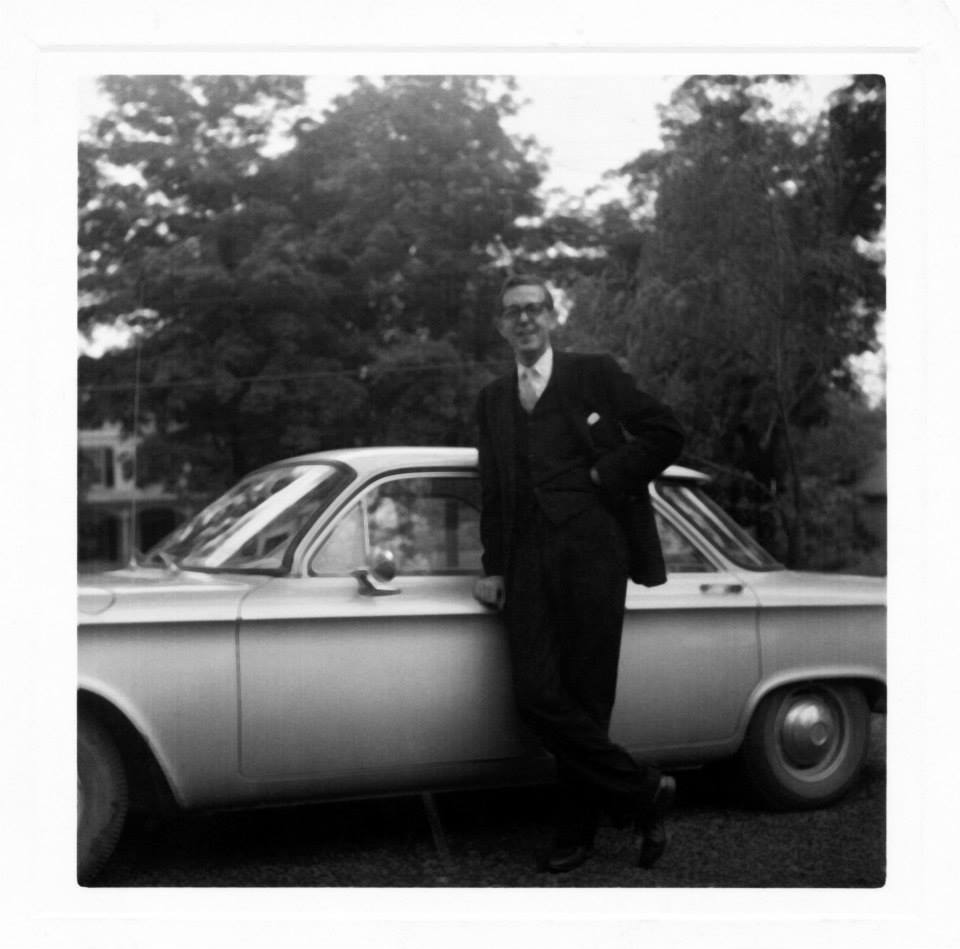
Tom Michael as a young minister in New York.

Tom Michael as a young minister in New York.

The March to Montgomery, 1965

by Tom Michael

A memorable experience I want to relate to you happened in 1965, when I was a 32-year-old co-pastor of a tall steeple church, First Westminster Presbyterian Church in Yonkers, New York. The United Presbyterian denomination was committed to the civil rights struggle, even though, as Martin Luther King said, the most segregated hour in the week was 11 o’clock on Sunday morning.

The call had come out from our denominational national committee on religion and race to ask clergy and laymen to participate in demonstrations throughout the South supporting voting rights for Black citizens. Small groups of ministers were asked to march around the courthouse in Philadelphia, Mississippi. My colleague and I flipped a coin and my colleague went down there. It was a potentially dangerous task, but he was able to return home safely.
First Presbyterian Church of Yonkers NY, 1964

First Westminster Presbyterian Church of Yonkers NY, 1964

After the first march from Selma was halted by police on the Pettus Bridge, they asked for volunteers to join the Freedom Marchers who had started out from Selma, Alabama on the way to the State capitol in Montgomery. It was my turn to go. So I had the rare privilege of participating in the March on Montgomery for voting rights. While I had very little influence on what happened there, it had an enormous influence on me. It was both an exciting and learning experience for me.

I first had to raise the money to go, so I asked members of the congregation to contribute to my trip. One member, a president of a savings and loan bank, disapproved and spent a long time on the telephone angrily telling Bonnie that I should not go. His wife quietly slipped me some money. That was something I learned about my congregation.

I carried along a change of underwear and some toiletries in an overnight case. That was the second thing I learned: don’t carry a suitcase on a civil rights march. This March I suspect that you will see newsreels of that event as we commemorate the fiftieth anniversary of the march. If you spot a skinny young man with big ears carrying a small suitcase, that will be me.

I don’t recall much of how I managed to get on an airplane, but soon I found myself on Delta Airlines. The stewardesses (remember when there were stewardesses in airplanes?) were lovely young women with southern accents. The pilot came on the intercom to tell us about the flight. He also had a southern accent. I thought, “Thank heavens, the pilot is in the plane.”

When we reached Montgomery we were taken to the campus of a school for colored girls on the East side of the city. There were, I’m told, twenty-five thousand of us milling about. Darkness came. There were two points of light: one, to my right, was a communications stand manned by Gary Collins, a movie actor who at that time was married to Lucille Ball. The other, directly in front, was a stage. We were entertained through the night by an all-star cast: Harry Belafonte, Tony Bennett, Frankie Laine (he sang “Mule Train,” “clippety clopping through the wind and rain,”), Sammy Davis, Jr., Joan Baez, Nina Simone; and we sang, with Peter, Paul, and Mary, “We shall overcome, we shall overcome, we shall overcome some day.”

Late at night we were assigned places to sleep. Mine was in the balcony of a one-room Baptist Church. At the other end of the pew was a man who snored all night long. In the morning I sat up and waited my turn to use the single bathroom. As I waited, I watched in fascination from my balcony perch as a coed with a Purdue University sweatshirt combed her blond hair into a beehive hairdo. That was the third thing I learned, though I don’t believe it has done me much good.

After breakfast we waited around the grounds for the march to begin. I happened to meet up with Dr. Gayraud Wilmore, whom I had met when he attended a Presbytery meeting to inform us of his work as executive secretary of the United Presbyterian Commission on Religion and Race. He was accompanied by the Rev. Metz Rollins, who was a field director for the United Presbyterian Board of Christian Education. As we were chatting, a white southerner walked up and was greeted by these two. They introduced me to him. His name was Myles Horton, founder of the Highlander Folk School in Tennessee. This school was responsible for training Rosa Parks, James Abernathy, John Lewis, Martin Luther King, Jr. and many others in the skills and tactics of non-violent resistance. While we were talking, a man joined us, and he was introduced to me as Charles Evers, brother of the slain civil rights worker Medgar Evers. As I shook his hand I said, “It is an honor to meet you.” He acted as if he didn’t believe he deserved that, and I learned later that he had spent time in Chicago engaging in criminal activities. Then a Union Theological Seminary classmate of mine, who was there from his home in Minneapolis, came by.
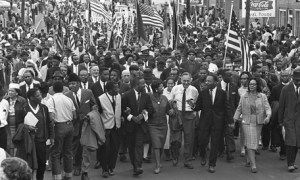
AP photo 1965

AP photo 1965

At long last the march began. We walked into the city on a main street that was lined with houses. Many of the locals were sitting on their front porches looking rather grim as thousands of us so-called outside agitators filed past. I caught the eye of one woman on her front porch and motioned to her to join us. I received a most hateful response.

My seminary classmate had offered to write dispatches for his local newspaper, so as we marched along we caught up with a slightly built older man. My friend decided to interview him. When he asked his name, he replied “Willard Uphaus.” Uphaus, a Methodist lay preacher, led a social action group with summer headquarters at Conway, NH. The New Hampshire Attorney General, empowered by the State Legislature to investigate subversive communists, demanded that he turn over the names of guests at the World Fellowship of Faiths. Dr. Uphaus freely testified about his own activities but refused to provide the names of others. In 1956, he was found in contempt by the Superior Court in Concord, NH. After the conviction was upheld by the United States Supreme Court in a 5-to-4 vote in 1959, Dr. Uphaus spent nearly a year in jail.

I began to think I was in Bunyan’s “Pilgrim’s Progress,” meeting up with stalwarts of the faith as we made our progress toward the Alabama State House. When we arrived there I took up a position in the center of the street in front of the statehouse. At the far end on the right side was an American flag. On the left side near us was the Confederate flag. I found myself resenting that flag. It was a slap in the face of all the descendents of slaves who had been oppressed and humiliated.

It was a hot day. I sat on my little suitcase. I had a headache. I thought “I am here. I am nowhere else.” There were several speeches, of course.

Then Martin Luther King gave the final speech, ending with the stirring words, “When will the radiant star of hope be plunged against the nocturnal bosom of this lonely night, plucked from weary souls with chains of fear and the manacles of death? How long will justice be crucified, and truth bear it?…I come to say to you this afternoon, however difficult the moment, however frustrating the hour, it will not be long, because ‘truth crushed to earth will rise again.’ How long? Not long, because no lie can live forever. How long? Not long, because ‘you shall reap what you sow.’ How long? Not long, because the arc of the moral universe is long, but it bends toward justice.”

Then we began the trek to return to our homes. We were told to go to what they called the colored section of the city, to the right of the statehouse. I was struck by the irony that I, a white man, should feel a sense of relief when I crossed into the ghetto. I found Gay Wilmore. He had rented a full sized Buick sedan and was planning to drive to the Atlanta airport with Metz Rollins. I figured that the airport in Montgomery would be chaotic, so I asked to ride with him. My seminary classmate joined us, and a young man from the Student Non Violent Coordinating Committee. He looked fierce with a black beard and dreadlocks, but he was in fact a most gentle young man.

So there we were, three Black men and two white men. We struck out on Interstate 85 toward Atlanta. After a while we needed to get gas and make a pit stop. Gay and Metz peered intently at each service station, asking, “Is that one?” This was another thing I learned. It is one thing to hear about segregated facilities in the South, and it was another to actually experience it. Here were two prominent, highly educated clergy reduced to the humiliation of having to bypass facilities that would refuse to serve them because of their race.

Finally, we found a station that would serve us. For my part, I was not able to tell the difference, but they had lived a lifetime of picking up the subtle clues about where they could be served. After we had finished, Gay Wilmore announced that he was sleepy, and would someone else drive. I was the only one who had my driver’s license, so I took the wheel. At that time the speed limit on highways was 55 miles an hour, and I was observing the speed limit. As I drove along, a string of cars passed us by traveling faster. Then an unmarked state trooper whizzed past and pulled over eight or ten speeders. I drove carefully on the outside lane at 55.

Gay Wilmore said to me, “OK, Tom, if a trooper pulls you over for speeding, just tell him ‘I’m just trying to get these (he used the N word) out of here as fast as I can.’” I guess it was a form of gallows humor. After we left the interstate we traveled in the darkness through small towns in Georgia.*

I carefully observed every speed limit sign, I came to full stops at stop signs, and if a traffic light even hinted that it was turning red, I stopped. Since that time I have observed speed limits and stop signs. You will never catch me traveling more than the speed limit anywhere.

At long last, late in the night, we saw the towers of Atlanta glowing in the distance. It reminded me of the experience when Dorothy and her friends first caught sight of the Emerald City of Oz.

At the airport we took our leave of one another as we boarded our airplanes. Gay Wilmore saluted me in the manner of a French general, kissing me on both cheeks. I boarded the plane and sat next to a man who looked very familiar. I believe he was Ralph Bunche, Nobel Peace Prize winner when he was assistant secretary general of the U.N. I did not ask him who he was, since I believe that famous people should be allowed some privacy; and besides, he immediately fell asleep.

When we arrived in New York I shared a taxicab with an editor of Time Magazine. The taxi driver, an African American, asked us where we had come from, and when we told him that we had been on the March on Montgomery, he said he had been watching it on TV. My companion gave the cabby an address on the upper West Side of Manhattan. I said that I wanted to go to Grand Central Station so I could wait there a couple of hours until a train could take me to Yonkers. The cabby said, “I could take you there.” “But,” I said, “I only have five dollars on me,” and I knew that the fare from midtown to Yonkers was at least three or four times that amount.

“Well,” he said, “You did something for me today, so I will do something for you.” And with that he took me all the way to my front door.

=

*Civil rights activist Viola Liuzzo was murdered by Klansmen the same day, also while driving African American protesters to the airport and bus stations.

~

For another story of the march and some pictures, see this lovely interview with photographer James Barker (on the Smithsonian’s website).

Poetry, history, connectivity

We are connected, perhaps too closely, too immediately. With Nigeria and Boko Haram. With Paris and Charlie Hebdo. Ferguson, MO. Eric Garner in New York. George Zimmerman. Iraq. Syria. It’s easy to continue this list–too easy.

What we tend to want are simple solutions, dichotomies, dualities, one choice or another–not complexities and subtleties. But the human brain, the human culture, the human genome, the human body and the systems in and through which we operate are damned complicated.

~

Former US Poet Laureate Billy Collins gets a great deal of press, and sometimes he gets criticism for his popularity; but in a recent interview he states in apparently simple terms how complex the human condition is, and why we need compassion, and poetry:

The poem shows us that these emotions, love and grief, have been going on through the centuries; and that the emotion we’re feeling today is not just our emotion, it’s the human emotion.

Poetry is the only history we have of human emotions. Most history books, what we call history books, are stories of battles and treaties, negotiations and beheadings and coronations. But poetry is the only reminder of this very essential part of being human, which is one’s emotional life and all the dimensions it entails.

The history books will leave out many of the crimes, massacres, terrorist acts, and bloody little belligerent actions of people and their governments and cultures and belief systems. History cannot help but be compromised by point of view–it is always, as Churchill noted, “written by the victors,” even when they are trying to be even-handed and objective. But poetry is all about point of view. The “tell it slant” of Dickinson, ambiguity and mixed feelings, individual imaginations and individual interpretations. As Collins puts it:

I think writing and creating are expressions of an epistemological position — that is, how you look at the world, that slant you look at it from. And that’s all I feel I am in a palpable way responsible to: using that slant to get at some truth or a little smidgen of beauty.

It’s a matter of being true to your imagination, and being true to your vision, and true to the material you’re working with, whether it’s a violin or the dictionary of the English language. You have to listen to all the other violinists who have ever played, and read all of the poetry you can consume. That’s my sense of responsibility. It’s an artistic responsibility, not so much a political one, not so much a financial one or a responsibility based on commodity. It can’t be commodified.

As a teacher myself, I love the anecdote in this interview about a past student who, years later, could recall a poem he’d memorized for Collins’ class. Collins says:

[T]eaching is a very mysterious process. You’re throwing information, in a sense, into the dark. I mean, you spend an hour talking to this group of increasingly younger people and you walk out of there and you think sometimes you’ve had a good class, and other times it’s not been that great. But no matter what it is to you, you’re not sure how it’s being taken or what effect you’ve had.

The story reminds me of one time when I was getting my teeth examined; my dentist (knowing I teach poetry) said to me, “You know, in college and dental school, I took Chemistry. I had five classes in Chemistry. And I never, hardly ever, in my current job, use that information. I almost never think about chemistry. But I took a class on Milton’s Paradise Lost. A poetry class, really. And  you know, to this day–sometimes I find myself thinking about that poem. And that class, and those lines. Really. It’s stayed with me much longer, and more significantly, than any of the chemistry courses I took.”

Billy Collins would surely smile and nod if I were to tell him this story. Those connections are the invaluable sort: beyond information and into the mystery of what makes us human beings. Teachers learn from this sort of experience. It stays with us.

~

We may not be able to resolve the wars, prejudices, pride and anger and sense of  injustice that cause people to murder one another for revenge, honor, religious feeling, economic or territorial needs, or fears so deep we may not even be able to name them. Even tolerance has its downside: a tendency to refrain or excuse when speaking up might be necessary, if dangerous. Not all of us enjoy the learning we can gain from adversity or from trying to understand our enemies, who may not respect a willingness to listen. Not all of us learn from great literature, or have the patience to live with art that discomfits or challenges us. It is easier to paint Satan with the broad brush of evil, when Milton’s character possesses nuance and depth. The same with Mohammed or Jesus, the Pope or Buddha, Putin, Obama, or any world leader or financial oligarch.

We are all people in the world, flesh and bone, loved by someone, suffering and gratified by daily life, under the same sun and moon. The sun and moon that have appeared in poems from time immemorial. The biosphere that connects us whether we like it or not.

Continuing the discussion

The semester is almost over, and my students and I have spent a few weeks doing writing that relates to Cass Sunstein’s book Why Societies Need Dissent. As it turns out, this semester coincides with considerable current-event attention on protest, conformity, stereotyping, and other issues Sunstein explores in that text. Social media pushes the herd mentality, the “troll” mentality, and the ease of using shortcuts in thinking: justification through bad analogies, irrational responses, barely-considered ideas, culturally-entrenched concepts, knee-jerk reactions.

In other words, the gamut of human social psychology in 140 characters or thereabouts, with links, memes, and dudgeon.

A case in point that appeared on social media last week is a photo of a black man holding a sign that reads, “No mother should have to fear for her son’s life every time he robs a store.”

That was a photoshopped “joke” in which someone altered the last line of the protester’s poster. The intent was to assert that Michael Brown had robbed a store before walking down the middle of a Ferguson street, and the intent was clearly meant to suggest that Brown deserved to be shot by police–or, at any rate, to suggest that he was not “innocent.” I agree with the poster even in its altered state because I propose that none of us are innocent, and that none of us deserves to be killed. A suspected robber should be tried by jury and should be considered innocent until proven guilty because that is the way US law reads.

I do not claim that “It’s that simple.” Indeed, the situation is far from simple, which is why it feels so fraught and inflames such exertions of logic, law, and character defamation, and so many conflicting opinions–not to mention Facebook “purges” and irate newspaper columns and public protests. These are reasons that discussion can be useful. We need to continue the discussion, even though it is awfully difficult to do so.

~

If only we could listen to other perspectives. If only we could engage in discussion. I listened to two of my male students talking about being stereotyped. One claimed he was seldom troubled by harassment and not really bothered when people tried to stereotype him. “You’re not black,” his friend responded, “You’re Latino, or whatever.” The first man held up his arm: “Hey, man, I’m darker than you. What makes you black and me not?”

“Neighborhood. Money.”

“Look at you, bro! You’re wearing $185 shoes and new jeans. Dollars to donuts your family has more money than mine.”

They continued in this fashion awhile, sometimes asking me what I thought. If it was history that made them different, couldn’t the black man put it behind him? And he didn’t even really know much about “his” history, it turns out. If it wasn’t skin color that made one man feel less sure of himself on the street, warier, even in a “good” neighborhood, to what could it be ascribed? Was it just a personal issue? A neurosis? Was the Latino man clueless, or oblivious? Or just lucky up to now? Are these issues of confidence, self-esteem, bravado, or fear? Social issues or private ones? All of the foregoing?

And how does all of this relate to how young people of any background, religion, or color comport themselves in the world, deal with society and its assumptions, codes, expectations?

~

I teach writing. My job consists in instructing students in the perhaps arcane code that clear, concise, informational, and persuasive writing requires if they are to succeed in writing for academia and, later, the world of business information. I tell them: “This is what you should expect others/authorities to expect of you. It’s your choice to follow the conventions or not to follow the conventions, but you need to at least know what the conventions are.”

Meanwhile, I hope they recognize that they should follow the conventions of the rule of law; and if they choose to oppose the law, they should do so with forethought and initially, at least, within the structure of the law. But bad laws do need to be changed, and bad protocols need to be changed, and unarmed people should not be killed for brooking authority; and stereotyping–a very natural and automatic human behavior though it is–should be consciously questioned, even though yes, that can make the discussion difficult.

Online workshops

For the month of October, I participated in an online poetry workshop with Daisy Fried (see this post). I enjoyed the workshop and gained a great deal from it; I wish I had had a little more time to put into the writing, however. As is often the case, “life intervened” and I did not find quite as much creative writing time in the month as I had hoped.

Then again, all writers have to juggle. Life intervenes, always. How dedicated are we to making art? We have to ask ourselves that now and then. If distractions too readily remove us from the genuine work, maybe we’re dilettantes. On the other hand, not all of us choose to devote 100% of ourselves to the work. That does not make us less serious about the hours it takes to compose art.

One thing I learned from the online workshop experience is that, with the right participants (our group seemed well-chosen), you can get to know one anothers’ work and topic concerns fairly quickly, and even glean things about personality, cultural background, and literary influences of the people in the group. This may be more true for writers than for other artists, perhaps, as writers are experienced at…well, writing…which is how the critique and feedback exchanges operate on these forums (via comments). The exchanges were interesting and useful because the perspectives varied greatly; and instead of talking together in a room real-time, and perhaps feeling inhibited by face-to-face shyness or fear of interrupting one another, the participants had time to write our thoughts and think a bit before posting feedback.

The downside of an online workshop, for me, mostly entails the quantity of on-screen reading necessary for full participation. I suppose I could have printed the lectures and comments, but that seemed a waste of paper and was not simple because of the Blogger-framework, the format of which does not play well with my printer defaults. Ah, technology! How I love and hate it! And the beauty of a face-to-face workshop is the beauty of human beings, faces, flesh, vocal tones, body language, gesture–subtleties lost in a virtual forum. When I was enrolled in my MFA program at Goddard, the intensity of the low-residency on-campus workshops and lectures were crucial (and irreplaceable).

Nonetheless, I found the workshop online this past month to be a valuable learning experience that expanded my thinking about poems and narrative, about revision and experimentation, and about the various modes of teaching or critiquing. I recognized, for example, how much preparation Daisy had to do to organize a one-month online workshop, how much organization, and how much thought as to purpose and guidance and feedback, let alone figuring out which low-cost method to employ to deliver the lecture, set the context, and permit easy and rapid feedback on the part of both teacher and students. Not an easy task, and she did a yeoman’s job of it. One thing I deeply appreciated was Fried’s devotion to the value of deep revision rather than just to tweaking the draft. I had forgotten how I used to wildly and almost randomly revise drafts “just to see” what might happen if I made radical changes. Often I would return to the earlier draft with renewed focus, and sometimes the radical revision took the poems to much more interesting places. These days, when I have less time to mull and experiment, I tend to stay on the safe side and take fewer risks with revision. Risk is worth it, though. I need to get back to that approach.

All in all, a positive workshop experience, and one which yielded a couple of poems worth revising and some poetry colleagues whose work I like and whose feedback I value and may tap in future (who knows?). Without leaving home.

home-window

Dewey & education

I have taken it upon myself to read Dewey after many years’ hiatus from his remarkably clear prose and his fervent support of free, equal, and accessible education for all. The essays in his Philosophy of Education (Problems of Men) were written between 1935 and 1945 and yet in many ways are relevant to 2014: In his era, technology has led to enormous social changes, as have global conflicts; school districts are under pressure to conform to top-down management and are feeling the pinch as politicians cry for school-tax cuts; more young people than ever graduate from high school and college, only to find that jobs are not available for them; an economically-advantaged elite dis-empowers the middle- and working-classes by using class, money, and networking to subvert or gut the democratic system. What is the philosophical, patriotic pragmatist of 1940 to do? Urge people to exert themselves into action, of course.

Dewey’s passion for education and his pragmatism appeal to me even when I do not wholeheartedly agree with his premises, proposals, or–alas–his optimism. Right from the introduction of this series of essays, he sets out such sensible observations about culture, society, and government that it is hard to disagree with him; his works always begin with a straightforward clarity that is refreshing among philosophers. One of the most trenchant observations he makes, over and again, is that the education of the citizenry must change as social developments occur; education must not remain in stasis and, he insists, democracy must also be flexible and living, always moving with the current times:

“I find myself resentful and really feeling sad when, in relation to present social, economic and political problems, people point simply backward as if somewhere in the past there were a model for what we should do today…We have a great and precious heritage from the past, but to be realized, to be translated from an idea and an emotion, this tradition has to be embodied by active effort into social relations…It is because conditions of life change that the problem of maintaining a democracy becomes new, and the burden that is put upon the school, upon the educational system is not that of merely stating the ideas of the men who made this country…but of teaching what a democratic society means under existing conditions.”

My italics in the passage above are there to indicate what I feel is Dewey’s most enduringly important recognition–that social conditions change, and, to stay vital, the foundations of a society need to be resilient enough to be adapted to existing conditions. Tradition has considerable value, but a too-conservative approach to law or education or any other abstract, social construct will fail in time, Dewey says. There is “an inherent, vital and organic relation” between democracy and education that reflects democracy’s recognition of “dignity and the worth of the individual.” As a person who engages in the task of educating others, and who finds she frequently has to change the curriculum to keep up with the technology and the changing mood and environment surrounding her students, I’m glad to be reminded of that organic relationship. It’s important to me that each individual I instruct, advise, and (in turn) learn from feels that he or she embodies dignity and worthiness.

Much as I enjoy reading and thinking about philosophy, it seldom gives me a “warm feeling” the way Dewey’s well-considered, thoughtful words do. He saw the need for balance and for growth–human growth, interpersonal and social growth–which he posited could be achieved through the conscious, considered, informed actions of well-meaning people in community. Educators are, by such lights, among the foremost in the endeavor. Certainly Dewey thought they were.

larch cones by Ann E. Michael