Prompts

Teachers of creative writing have mixed views about the use of prompts (a prompt is an image, phrase, visual, question, or anything else meant to get a poet started in lieu of–or in addition to–“inspiration”). I have found them useful for practice; in my experience, occasionally a random prompt does result in a serviceable, or even good, poem. But I do not tend to use them regularly.

During this month of writing and posting a poem draft each and every day, I haven’t turned to prompts. I notice, though, that the drafts are perhaps more personal than I expected them to be.

This one doesn’t have a title yet:

~

Today there’s pain
opening with every blossom,
the pain of others
far from you, and also
those nearby. Even yours.
You see the world
as it is, how each bloom
attracts tiny ants
and the industrious bee,
later transforming
into hard green fruit.

Today you suffer the way
all things suffer
although you breathe
sweet air, although you
see the constant sun
now and then appearing
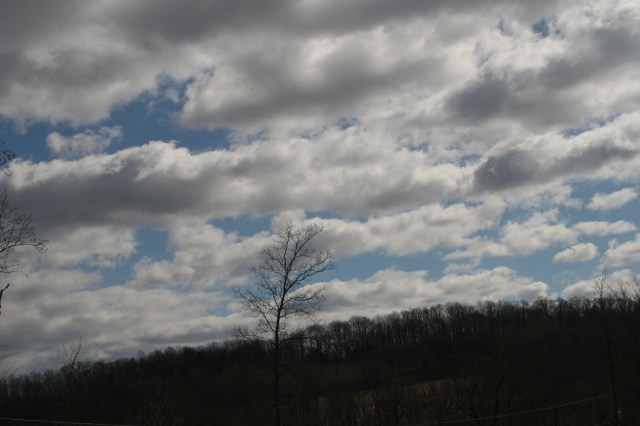
between dense, mobile clouds–
joy, flickering, brief,
but always possible.
Isn’t that also how
the world is? The cat’s
fur, soft beneath your
stroking thumb. Thrushes
uttering melodies for
anyone who will hear.

IMG_5953

Lustratio*

Another day, another draft!

This challenge has not gotten easier yet. Sometimes, disciplined practice leads to a certain ease or confidence–that’s always the hope, anyway, that I might find amid the drafts something wonderful. My model here would be someone like William Stafford, who sat down every morning to draft at least one poem (and sometimes they were wonderful). The Poetry Foundation’s site says:

Stafford reports that he sits alone in the early morning and writes down whatever occurs to him, following his impulses. “It is like fishing,” he says, and he must be receptive and “willing to fail. If I am to keep writing, I cannot bother to insist on high standards…. I am following a process that leads so wildly and originally into new territory that no judgment can at the moment be made about values, significance, and so on…. I am headlong to discover.”

At the end of this National Poetry Month, I will give myself a reckoning as to whether the NaPoWriMo process has been at all helpful to me as a poet. It may be it proves beneficial in some other way…

~

Lustratio

Her friends died young when she herself
was young and unbaptized in the realm of dying

Yet you would think her better prepared–for there were
car crashes, suicides, fires, the blood plague taking
its long and steady toll

There were the risk-takers certain of their immortality
who drowned or fell from cliffs or grace
through the needle or the drug or drink and those
whose hearts took upon themselves
a need to hurry beyond the body’s balance and
whose breastbones could not contain them

You would think her ready for the news that someone
loved or once loved or otherwise connected
(Milgram’s six degrees of separation theory)
had died however people do when they are young–
embolism, cancer, accident, murder

Slow or sudden–it’s not as if the difference
though there is one, matters
because you’d think, by now, when she is no longer young
the facts of gone and after and remembering
the evidence of dying and grief’s enormous cosmos
would have carved for her a familiar space

A kind of purifying trauma–as if the bulla and procession
could protect her or her community from harm
when harm is what the world offers now and then
and we must bid it enter even if we are young

Even when it is unwelcome.

~

NOTE:

* Lustratio was an ancient Greek purification and protection ritual for children or for cities, farms, and other precious items; in the case of a male child, sometimes it was a naming ceremony at which the baby would receive a small, gold bulla (charm in the shape of a bull’s head) as a blessing or for protection. Ancient historians describe it in several ways, but most frequently mention a procession and animal sacrifice.

Rhyme

Rhyme comes easily to some people. For me, rhyme presents no problem as far as lighter verse, parodies, ditties–which have their place in literature and in culture. In more introspective or reflective verse, though, rhyme tends to elude me and often seems not to mesh with the poem’s mood. Revising toward rhyme often succeeds in assisting the metaphors, imagery, or tone, however. Usually assisted by some sort of metrical strategy.

Today my poem-draft-a-day offers evidence of how rhyme can appear spontaneously in a poem’s first version.

If you are interested, here’s an excellent book on rhyme in poetry: Rhyme’s Reason, by John Hollander & Richard Wilbur–welcome authorities on the subject.

Quite long ago now, I dwelt in cities for a few years. The contrast to my current environment startles me now and then, makes me remember those years.

~

Outmoded

His back aches. It hurts to move.
How did he ever get so old?
The work it takes to walk a block
to buy a paper! Then he’s told
the news is found online, where he
can read it on a mobile phone.

He hates the sound of that idea–
the text so small–and, when alone,
he likes the paper’s rustling noise.
It’s domestic. One of life’s joys.
The work and pain are thus worthwhile.
That, and the newsstand vendor’s smile.

~

man sitting reading newspaper

Photo by Daria Obymaha on Pexels.com

Drafty

I have to keep reminding myself that these poems are drafts and just get over their weakness and rough spots and recall that the drafting aspect is part of my April experiment–pushing the envelope, as the saying goes, and allowing the imperfections to go public. Then readers will perhaps recognize that every poem has to start somewhere, and it is not always from inspiration or native talent.

Any of the poems I draft this month that I consider worth keeping around for further work will move into my revision-worthy pile. For me, the revision process engages creativity in a form very different from the initial draft. Just as an example, few of my drafts use rhyme; sometimes I employ a basic metrical strategy (but not always)–and stanza structure almost always occurs during my revision process. Yet my finished poems often contain such components.

This one’s a less-plausible lyrical narrative, and I have no idea why I drafted it.

http://www.thisisnotacraft.com/

“Observatory Box,” Joseph Cornell

~

Experience of the Disembodied

What happened was a bounce
or peak in the field,
a shiver in the multiverse
tearing through cosmic shift

although maybe that is not
what happened because I was
not observing the rift,

I was entering into it with my
physical body per se

although I could not call the action
“flying” yet I did feel earth’s
gravity, that weakest of forces,
loosening until church spires
and pine trees, tall city buildings
shrank beneath me–

and my skin emptied,
a frosty altitude, a gutted sensation,
numbed spine and brain: Where am I?

In this supra-cosmos no light
of the sort my eyes can translate.
Energy vibrating. Loss of myself
while I watch myself,

fascinated, undone. Waiting
for the next shoe to drop.

~~

Re: National Poetry Month –here’s a thoughtful blog post on continuing the conversation through millennia.

Lyric, narrative

I love hearing stories. Telling stories. Inventing stories. Often I choose to create a story using the first person perspective, whether the story is my own, someone else’s, or totally invented. In poetry this gets called the lyrical narrative.

~

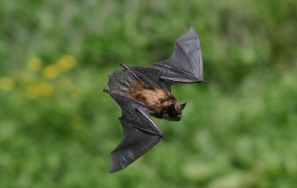
A Toast to the Brown Bat

We are on the porch, drinking wine
late in the long summer day, dusk hovering
the way small storms of insects do
the day after a hard rain, and we’re talking
about something not especially dear to us,
no deep discourse, past that, watching
candles glow and the first wink of fireflies
when a brown bat flutters over like
an autumn leaf and my friend asks, “what
is it like to be a bat?” And as I’m somewhat
versed in philosophy I mention Thomas
Nagel, whose essay with that title is
justly famous but who does not really answer
the question; and she responds, “it must be
alternately stifling and soaring.” I think she
means that every flight’s like Christmas—
freedom and feasting—and every day an
imprisonment in the tightly-packed dark.
“But what if colony life is cozy?” I ask, imagining
small bodies light as sparrows breathing
together softly, fur-lined and snuggled,
fingers folded over the bellies, a generous
communion of sleep. “I can’t quite get over,
though,” she says, “that they sleep upside-
down.” “It might cure your migraines,” I say,
and we devote our next toast to the bat.

~

Letters

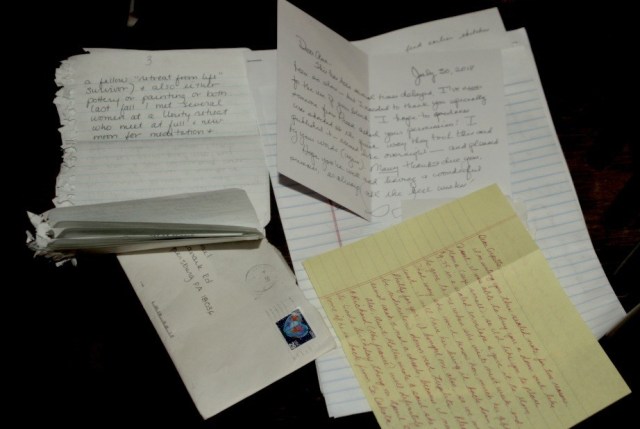
I have been reflecting on the practice of letter writing and how it improves writing skills because it is, essentially, practice in written composition.

I teach writing, and one thing I notice among students who ‘don’t write well’ (in their words) is that they struggle to develop a voice in their written essays. In the hundreds of years before telephones and tablet devices, literate people learned a voice and style not through school essays but through frequent letter-writing practice. If a total stranger were to read aloud to me letters from my two grandmothers, I could identify which grandma penned which letter by style alone.

The adventurous 19th-c. traveler Isabella Bird, to take another example, once wrote a 116-page letter to her sister, Henrietta! Bird’s letters form the basis of her many travel books, which are entertainingly told with an eye for humor and for accurate, sense-based description–her voice remains intact in her work, long after her death.

Today’s poem draft is a prose poem in the epistolary mode.

~

Entanglement

I think of you so often, especially when weeding the perennials, a task
we have so often done side by side and in so many seasons, you and I knee-deep
in goldenrod and wild aster that invades the irises and wild indigo each June,
or earlier in the season, on chill and drizzling April days, clearing shot-
weed, ground ivy and chickweed from the creeping phlox and daffodils.
You’d be dismayed at the state of my ornamentals this year, your perfectionist
streak critical of the stray wanderers, stands of sedum that need dividing,
the dust on my piano, ottoman replete with cat hair, my cupboards in disarray.
I miss your diligence and vivaciousness, the way you take your coffee scalding
hot, your eye for color, your bold opinions I have so studiously ignored.
Today it is raining and the book I’m reading describes quantum entanglement
theory, “a physical phenomenon that occurs when pairs or groups of particles
are generated, interact, or share spatial proximity in ways such that the
quantum state of each particle cannot be described independently of the state
of the others, even when the particles are separated by a large distance.”

I miss you.


~

IMG_5768


Kisses & Bees

Today, I have opted to use an Osip Mandelstam poem as a prompt. I apologize in advance to his memory and to his lovely poem, translations of which are here, here, and here.

In a blog post some time ago, I discussed this poem and the problems of translation.

~

Kisses Tattered as Bees
-after Osip Mandelstam

Your claim asserts that kisses
can be tattered
and bees emerge from
floral tussles or hive dances
in a disordered raggedness
so the two are as like
simile disperses into breeze:
loose petals and torn wings
fail to impress upon your lips
any tactile memory.

But oh, there were kisses once
so fevered they evaporated
on meeting your cool skin
while you traversed the woods
beguiled by honey’s scent–
and kisses that stung,
leaving a trail of the dead,
soft, gold-and-black bodies
in each of your footprints,
beads strung along your path.

~

be-quince

~

Three days, three poems, one tenth of National Poetry Month having passed; I can do this, right? NaPoWriMo has a site that includes daily poetry prompts, if you happen to be interested. It is worth trying even if you do not plan to write a poem a day.


Tanka

The second day of my daily poem challenge won’t give me much time to compose. A tanka poem may be in order.

These 5-line poems pose considerable constraints on the writer and, in my experience trying to write them, require frequent revision to get the moment vivid enough. So this one will be a rough draft. An experienced tanka poet may be able to compose tanka rapidly; my attempts usually need eight or ten revisions…well, here goes.

~
Past midnight, silence
4 am, flying squirrels chirp–
maple buds redden at dawn

how sleep eludes
those who mourn

~


Other poets working on daily-writing include Michael Czarnecki of FootHills Publishing, who posts a daily poem (usually haiku) on his Facebook page here.

paintdaub copy


April experiment

It is National Poetry Month once again. I usually do not take part in poetry month writing challenges, but I thought this year I might try something out of my comfort zone.

My plan: post a poem draft a day for this month. I have never blogged daily before, and I have never tried to compose a poem a day as Luisa Igloria has been doing on the via negativa blog for, I think, more than three years!!

This concept–er, this practice–will be super-challenging for me and scary on several levels, mostly on the level of posting unrevised, often unfinished or awkward material publicly. But I have just about 3,000 followers and only a minuscule percentage of them read my blog regularly, so I have to think of this as reading to a small room.

I can deal with that. At least–I think I can.

We’ll have to see how the month goes. Meanwhile, welcome to my month-long experiment in immediacy.

~

Tom’s Green Field

In your landscape
light exists as waves, not particles

active, roiling
over the placid horizontal planes: sky, treeline,

cropland in wind.
For there must be currents of air, speedy thrill

storm can assume
chopping at clouds miles distant, changing hue

illuminating
the dense grove’s surface so it shines

and no rain’s fallen
and perhaps no rain will dampen the field today–

only luminescence
pigment trapped in layers of oil, bouncing

cobalt, cadmium
iron oxide through your swirling glaze

that gazed once
on energy in patterns, an hour’s moment, waving green.

~

agriculture clouds countryside crop

Photo by Pixabay on Pexels.com

Deer metaphor

I think the best poem about a car-struck deer is Stafford’s “Traveling through the Dark.

Like Hayden Carruth’s “Mother,” (see my last post) Stafford’s poem is, for me, a kind of zenith–something to which I might aspire, but look, it’s already been done. So why pen my versions of the experience? Especially when I am not the writer Stafford was.

And might a reader accuse me of hijacking Stafford’s imagery when I write about similar incidents? I suppose I do run that risk. Nonetheless, the whitetails occur often in my poems from the past 20 years because I live in eastern Pennsylvania. Pennsylvania has an estimated 1.5 million deer—about 30 deer per square mile–and I suspect that in the suburban-rural zones such as the region where I reside, the number is higher. ann e michael

As a writer, my inclination has pretty much ever been to write about environment and place and to supply anecdote or lyrical narrative. Deer abound in my environment and in my work; and deer get killed on the roads here. The imagery lodges in my consciousness. After so many years observing them, deer have become both subject and metaphor. I may swerve, but I cannot always avoid them.

The following poem is from my collection Water-Rites, and here it is the speaker’s husband who pushes the doe’s body off to the side of the road. The presence of children changes the perspective considerably, despite other similarities to the Stafford poem. Maybe that is all I can offer: a slightly changed perspective, a different closure. I cannot un-moor myself from the images and places that inhabit me.

~

Yellow Forsythia

We glimpsed the doe
trying to rise, and failing,
in the roadside darkness.

“Stay here,” my husband said—
and a moment later,
“She’s hit.” I nodded. I’d seen
skidmarks on macadam.

The doe lay on her side and thrashed
while our engine idled,
thrashed, shuddered;
my husband placed his hand
on her neck.

In the car, our son stared
at the darkness. Our daughter wept:
“He’s frightened the deer.
She’s kicking to get away.”

The doe jerked, paused. “No,”
I said, “Your father is touching it.
Soothing it, so it will not die alone.”

He knelt by the quieting body.
Blood ran from the muzzle.
One ear twitched, I could see it
in the headlights. Death
closed in, a gentle exhalation.

My husband eased the carcass
off the road shoulder. He said,
“She must have suffered awhile.”

“Stupid cars,” my daughter muttered.
Her outrage engulfed our station wagon.

My son watched the white-
throated body, the yellow
forsythia lit by car lights.
He said, “Close the windows, please.”

~~

Poet and blogger Molly Spencer recently posted a lively consideration about recurring and repeating images here: https://mollyspencer.wordpress.com/2019/03/07/the-spider-why-the-spider-or-a-defense-of-recurring-images/

Worth a read, and worth discussion, too.