Illusions, connections

Reading Proust again returned me to some of my own past reflections on memory and self, the capital-S Self. A decade or so ago I spent considerable time reading in philosophy, physics, and neuroscience in an endeavor to get a grip on human consciousness and, perhaps, behavior. I posted about some of these texts on this here blog, in between writing about poetry, the garden, and my teaching job. Recent coincidences of reading returned me to this topic, “the hard problem of consciousness,” and made me consider how our embodied selves/minds/awareness: use shortcuts to manage the overwhelming inputs of our environments; define who we are using subjective if physically-based perceptions; and fail to see the obvious because of habituation and the apparent need to confirm what we believe we know. Illusions! The Vedic concept of Māyā, Plato’s Theory of Forms…propaganda, Penn & Teller, quantum physics, complexity theory, Marcel Proust, complementarity. I have a lot on my mind.

If it IS on (or in) “my” “mind.” For there’s even some question about that, as proposed by Neil Theise in his book Notes on Complexity. Just as light can be a wave or a particle, depending upon perspective and viewer (see: complementarity), it’s possible that our minds or selves can be individual and separate but also connected and boundary-less. The subtitle of this text is what appealed to me: “A Scientific Theory of Connection, Consciousness, and Being;” so far, I’m enjoying it and finding inspiration.

It’s needed, inspiration. Despite a few plunges into new drafts (see here), I have not been writing much for at least two months, and I miss it. The ideas from physics and neuroscience that intrigue me include potential metaphors and terms such as quenched disorder, endosymbiosis theory, and holarchy. These–along with the hard problem of consciousness–all have some relationship to complexity theory, and Theise does an elegant job of writing about complicated science concepts for the non-expert.

I ran across Notes on Complexity right after finishing Sleights of Mind, a book about the neuroscience behind the sort of illusion we call entertainment magic: sleight of hand, sawing people in two, mentalist “mind-reading,” and other performances; the authors, Susana Martinez-Conde, Stephen Macknik, and Sandra Blakeslee, are trying to discover more about how brains work (or filter, and sometimes don’t work so well) by studying how we get fooled by illusionists. This is a fun book, even more fun for me because one of my Best Beloveds has long been an enthusiast of magic shows and magicians. Martinez-Conde and Macknik are neurologists, so–unlike Theise’s text–this book is very body-mechanics in its basis. Their work reminded me of how amazing the human physiological system is. And it’s entertaining.

Before these non-fiction reads, I was finishing up with Proust who, in his own creative way, was exploring the interiority of the human self and carefully observing human interactions, behaviors, assumptions, prejudices, and aesthetics. Not neuroscience, because there is no science to it, but definitely related to how our brains and bodies process experience. My sense is that poetry works that that way for me: it’s not an abstract stream of thought but something inextricable from bodily experience, maybe even, through the environment in which we exist, something deeply connected to everything, a global being-there.

The way we process experience (and is this consciousness?) is largely what leads us to the arts, to make art or to appreciate it, and to decide what feels compelling, important, beautiful. And it’s not all in our heads.

Artistry, art

Wednesday evening I participated in a lovely (if under-attended) event at a local listening room, Godfrey Daniels Coffeehouse. The venue’s been in existence nearly half a century and hosts many a folk, blues, and folk-rock band/singer-songwriter, as well as the occasional puppet show, jam, open mike, children’s event, and poetry reading. Quite a storied place. Dave Fry, one of the co-founders, offers a monthly “Dave’s Night Out” during which he invites songsters, singers, lyricists, musicians, and poets to take the small stage and present their work as well as discuss their working process–with Dave himself and with the audience. It’s a wonderful opportunity to exchange creative and artistic ideas in public. The poets were me, Danielle Notaro, and Cleveland Wall. Dave’s take on the evening is here.

On the way home, my beloved and I had a discussion about artistry and “being an artist.” As he is from an artisan/craftsman background, he does not think of himself as an artist. The term seems a bit “elevated” to him. And while he is a creative problem solver–crucial to being an artist–I see why he does not consider himself an artist.

Some of that thinking is simply semantic, however, a perception based on someone else’s definition of an artist. Beloved asked me, “Do dancers or musicians consider themselves artists? Do you consider yourself an artist?” Good question, and the answer’s probably individual (i.e., it depends).

I mean–do I consider myself a poet? A writer? Let alone an artist. I immediately thought of a Substack post by my friend, journalist (journalists are writers!) Peter Moore, in which he publishes an excerpt from his post-college diary. Brave man.

“On the ferry from France to Folkestone I floated on a rising tide of words words words: “I must enter into the intense feeling I had while riding the Tube this morning,” I wrote, “that I honestly feel like a writer, that it was just a matter of time and effort before I am recognized as one. I hope and trust that this is prophetic.”

https://petermoore.substack.com/p/r2e-excerpt-46-the-rising-tide-of

Yeah, I remember feeling those particular 22-year-old feels and the questioning that accompanies them. I am certain that similar enquiries appear in my old journals, though I may have been more cynical and less trusting than Peter was. He closes this post by saying: “Meanwhile, all those blank pages were screaming at me. Fill them with what, aside from intense living?

“Pretensions to artistry!”

~

Which is not to say that poets and writers and dancers and songwriters are not artists. It’s just that some of these folks think of themselves as artists, and others think of themselves as artisans, or craftspeople, or creative innovators, or…name it what you will. Poetry is a form of creative expression, and if you (dear reader) categorize that as art, then it is. If my poet colleagues think of themselves as artists, I respect that and will not argue. Perspectives, right? Not the same as pretensions, although I will admit that in my opinion, there are some people who write poems, and other things, a bit pretentiously. I have been guilty of the same, especially when I was young and getting the practice underway. Pretentiousness may even be a kind of motivation. We learn humility as we practice our missteps.

Contemporary Western society casts a great deal of gravitas and status on the word “artist.” So to answer my spouse, I replied that well…I do consider myself a writer and a poet, but I seldom think of myself as an artist. However, if you think poets are artists, I am an artist. Because I do indeed think of myself as a poet. I cannot get away from that urgent need to observe, imagine, interpret, restate, turn into metaphor, reflect, create into form, and otherwise do the making (Poiesis) of word play.

Surely compelled

Ann Lauterbach from her book The Night Sky: Writings on the Poetic Experience

We make music, painting, sculpture, films, novels in order to mediate our mortal visiting rights: a specifically human wish to intercede, to punctuate the ongoingness of time and the seemingly random distributions of nature. This punctuation is called history or, more precisely, culture, or, more precisely still, history of culture…

The phrase “to mediate our mortal visiting rights” feels particularly resonant these days, as some of my elderly best-beloveds appear to be navigating that region–mediating it–at present; [to mediate: “divide in two equal parts,” probably a back-formation from mediation or mediator, or else from Latin mediatus, past participle of mediare “to halve,” later, “be in the middle,” from Latin medius “middle”).  –thank you Online Etymology Dictionary]. The two halves, between one world of what we call the living and another which is the end of life, there is really more of a continuum, however. The “gray area” can be quite enriching and lively. Or not. These are ways we create, or punctuate, our personal histories: the year grandmother broke her hip, the year Susan entered school, the year the Twin Towers were destroyed. These, among other “random distributions of nature.”

I think it is true that the arts help us with the wish to intercede somehow, and also–a different sort of wish, it seems to me–the wish to mediate. Lauterbach seems to conflate these wishes. I see her point, but I am not sure I agree wholly.

~~~

Intercession. Isn’t that also a form of prayer?

[“intercessory prayer, a pleading on behalf of oneself or another,” from Latin intercessionem (nominative intercessio) “a going between, coming between, mediation,” noun of action from past participle stem of intercedere “intervene, come between, be between” (in Medieval Latin “to interpose on someone’s behalf;”]

~~~

…the way words make sentences and sentences paragraphs is also a kind of constellating, where imagined structures are drawn from an apparently infinite fund: words, stars….these acts of narrative and imagistic invention were surely compelled by the inexhaustible human desire to transfigure the incomprehensible into intelligible form.

Lovely–and here, I agree completely: “surely compelled.”

~~~

Writing for me is associative, meditative, and digressive.  ~ Ann Lauterbach

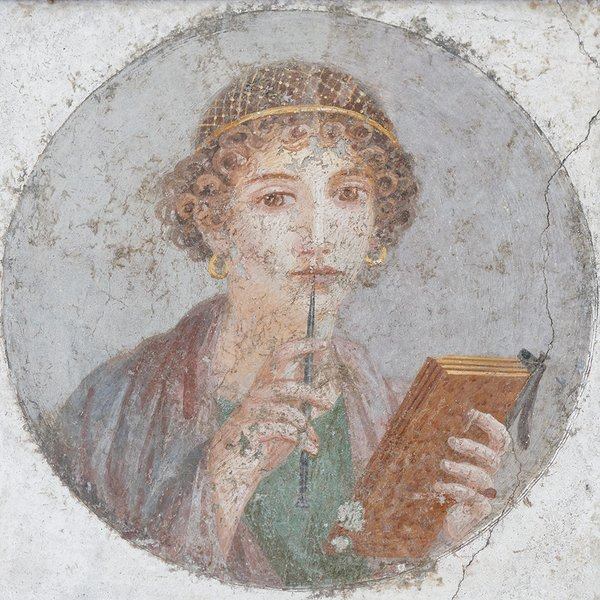
images                                        pompeiian woman-writer


Thanks to art critic and blogger Sigrun of sub rosa for alerting me to the existence of this book.

Brains on literature

Here’s a brief article that references a small study of how the human brain responds to reading poetry:

http://www.exeter.ac.uk/news/featurednews/title_324631_en.html

“Some people say it is impossible to reconcile science and art, but new brain imaging technology means we are now seeing a growing body of evidence about how the brain responds to the experience of art. This was a preliminary study, but it is all part of work that is helping us to make psychological, biological, anatomical sense of art.”

Here’s another short write-up from The New York Times on a somewhat similar topic, research into how reading literary work (specifically fiction, in this experiment) improves social skills–empathy and the ability to interpret other people’s feelings in particular.

http://well.blogs.nytimes.com/2013/10/03/i-know-how-youre-feeling-i-read-chekhov/?_r=2&

The article says that “after reading literary fiction, as opposed to popular fiction or serious nonfiction, people performed better on tests measuring empathy, social perception and emotional intelligence.” The psychologist researchers are from my alma mater, The New School for Social Research, and their work connects intriguingly with theory of mind studies.

What makes literary fiction challenging to read is the same thing that makes it so richly rewarding to the human brain: critical thinking is required, inference, active engagement with the text, the need to recognize and validate other points of view than one’s own and, often, to speculate on motives and meanings:

In literary fiction, like Dostoyevsky, “there is no single, overarching authorial voice,” [David Comer Kidd] said. “Each character presents a different version of reality, and they aren’t necessarily reliable. You have to participate as a reader in this dialectic, which is really something you have to do in real life.”

Interdisciplinary understanding of the importance of the arts to human consciousness, learning, and compassion: Am I surprised?

New look!

I am rolling out a new professional website! At some point, this blog will probably “move” to the new site; for the time being, though, I’m continuing to occupy two zones of the internet’s vast web. However, please consider clicking on the link below to take a look at the redesign.

One reason I am so excited about this new site is that I worked closely with the young digital-graphics designer to try to compose a site that reflects a little better my public-professional-poet persona. I wanted easy navigation, an uncluttered look, informational text, and links to my books’ publishers. I also wanted the page to convey my interest in the environment and to focus a bit more on my books’ themes and styles. The site is still a bit under construction, but it is “live.”

Did I mention that the designer is my son? He graduates January 19th with a degree in computer science/digital graphics. He is initiating his way into the professional world, following his sister, who has been on her own and working since May of last year. I graduated from college during an economic recession in the 1970s, and I can empathize with the frustration my college students and my grown children are experiencing as they start to make their adult ways into the world of work. But I know they will find their paths at some point (heavens, my own path took long enough!)

Here it is. Please take a look: www.annemichael.com