Blackberries

[note] *Hmmm. Somehow, I backposted this post. It was written June 23rd, post-solstice!

Actually, they’re wild black raspberries, someone informed me. They usually ripen around the end of June, and everything eats them–orioles, robins, catbirds, deer, possums, raccoons, possibly even foxes. Black bears, if they’re in the vicinity, though we haven’t seen one here.
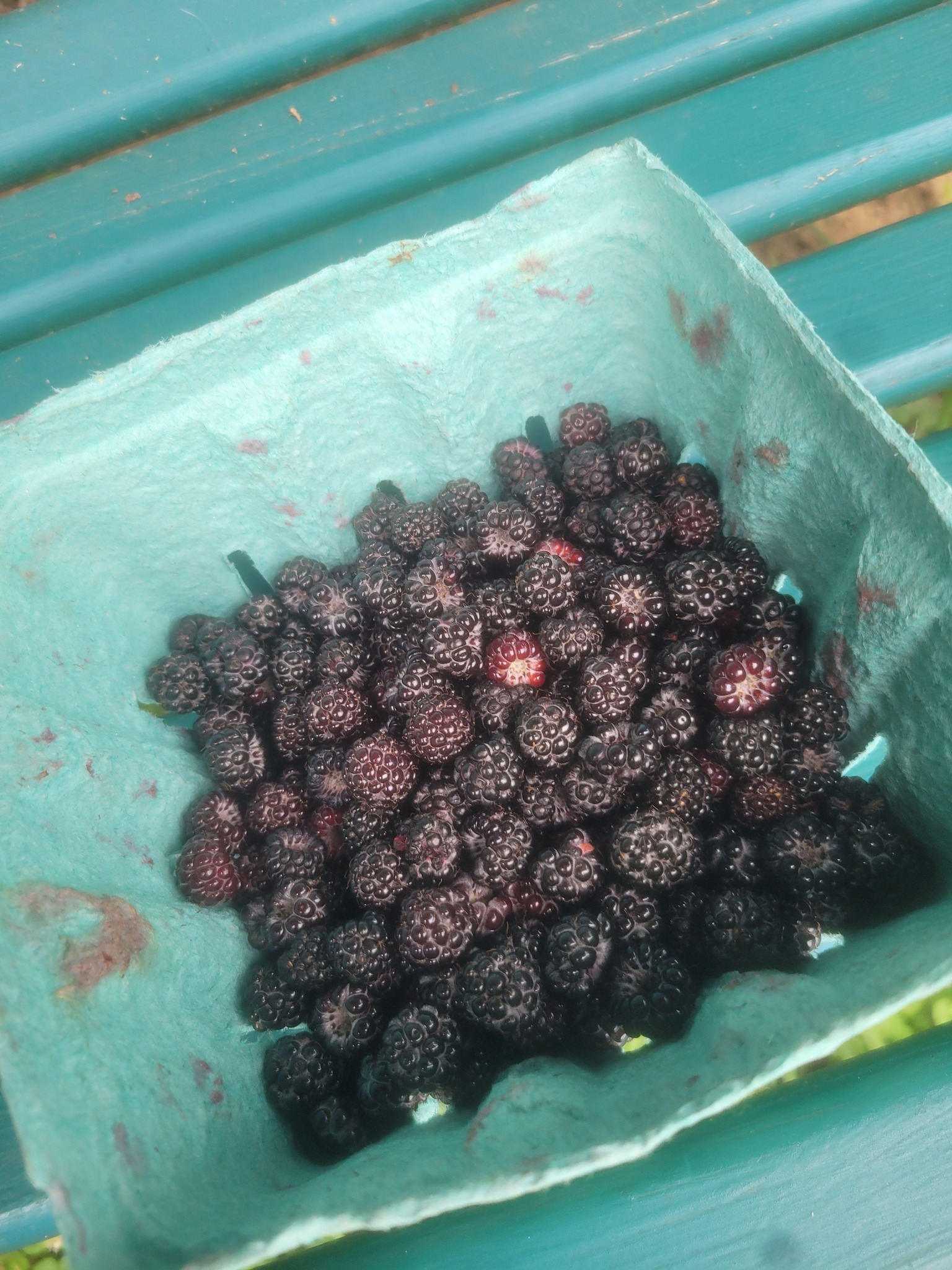
Humans enjoy eating them, too. Usually I don’t get more than a few for yogurt or ice cream toppings, but this year–a bonanza. Maybe the canes liked all that rain. Harvesting them is quite a task, because the canes are in the hedgerow thicket and twined about with poison ivy and cat’s-claw and other spiky and rashy flora, not to mention the thorns of the berry canes themselves. And harvesting comes as the hot, humid weather descends on this valley, making the effort a sweaty and uncomfortable one. I always think of farm workers, almost all of them immigrants, who get hired to do this sort of work–the vital work no one else wants to do. They deserve better pay and considerably more compassion than they generally receive. Half a quart of blackberries cost me half an hour of sweat, many scratches, and a swath of dermatitis; but, like Flopsy, Mopsy, and Cottontail, I had bread and milk and blackberries, (for breakfast).

Current mood: harrowing. Aghast. These two poems, though I wrote them many years ago, seem apropos to the moment.

~

Like Thumbelina

Where there’s green foliage
so dense my eyes ache
I spend an hour in shade
snacking on blackberries
the birds haven’t found.
My head hurts from the agonies
of money. The cell phone rings.
Ferns and five-leaf vines
muffle street sounds,
a little colony of feathery mosses
sits under a tree-burl shelf.
I find a hole pressed snugly
against old roots and leaf-mulch.
Like Thumbelina,
I want to curl myself inside
a sassafras leaf, sleep
beneath a toadstool
undiscovered,
unmolested,
temporarily free.

~~
Thicket

Behold the thicket:
it is deep with brambles.
It is blackberries in July,
wineberries in August.
Move, and the thicket
impedes you, catches
your sleeve,
plucks you awake.
The bee is here. The spider.
The thicket is alive, and crawling.
Green with jewelweed to salve
rashes from the thicket’s
poison ivy. Green with prickly
horsenettle, coarse pokeberry,
the brilliant, twining nightshade:
thickets sweat poisons
as well as fruits.
I have brought you here to show
that you can never get through,
not unscathed, not without
brutality of some kind,
the saw, machete, knife.
This tangle no amount of patience
will ever undo—
it will overtake you,
grow into your hair,
invite warblers in to nest,
spiders to unfurl their orbs.
You must learn not to hate
before entering the thicket;
you must acknowledge all its ways
to understand its wild embrace.



Citizen scientist

From as far back as quite early childhood, I have been interested in science: zoology, botany, biology, entomology, physics–if I had been mentored differently, I might have become a researcher instead of a poet. I possess that quality of curiosity that pushes for details, a trait that people refer to as ‘geeky.’ For me, it is fun to contribute my backyard observations to The Dragonfly Woman’s research or to the Eastern Pennsylvania Phenology Project, which asks for assistance from ‘citizen scientists.’ This evening, I am taking some elderly best beloveds to a fundraiser concert for March for Science.

17498711_10158425599030261_5744494573695525358_n

March for Science logo. The March is April 22, 2017.

~

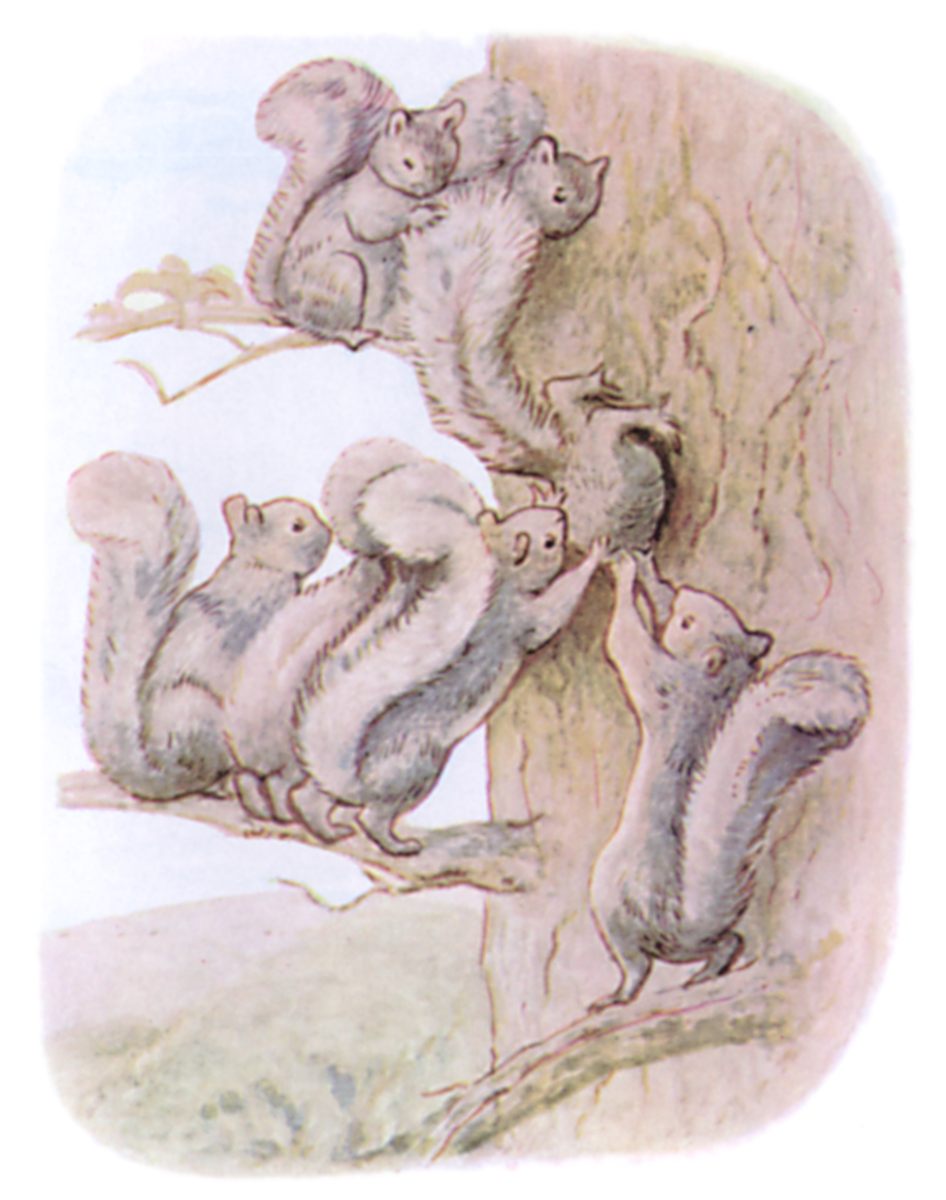
Empiricists have to begin as observers, and here’s where my science and poetry passions twine. Today’s backyard notes involve gray squirrels and the hypothesis that they learn behavior swiftly through their (many) generations.

My backyard is essentially a lawn and meadow, quite open, with two pear trees and a quince almost halfway between the property lines, both of which feature narrow woodlots and brush hedgerows. For 16 years, we had a dog; between the dog’s presence and the fact of hawks–of which there are many–gray squirrels seldom ventured from one side of the property to the other. Both woodlots are replete with walnuts and sumac and wild cherries, so squirrels really did not need to get across the meadow.

As of last year, though, they have learned they can cross the lawn in relative safety, as long as they exert haste and stop nowhere along the way. The dog died, but the hawks are still around.

27

Gray squirrels by Beatrix Potter, “The Tale of Timmy Tiptoes.”

They may have learned this behavior last summer, when a mid-season drought led to very thirsty squirrels who were brave enough (no dog!) to dash to the pear trees and harvest pears. Juicy!

So now, they race across the lawn…to have sex. Squirrel sex is a frolic of prinking, rolling, tumbling–a bundle of tails and feet, a flurry of gray and white fur at the foot of a tree, dry leaves scattered by the wrestling. Then the pair scurries off side by side. Today is actually the first time I have witnessed squirrel mating, though clearly it occurs frequently to judge by the numbers of these creatures in our yard.

~

19

From Potter’s “The Tale of Timmy Tiptoes”

I think of Beatrix Potter as an excellent example of the citizen scientist. While her paper on mycology concerning the reproduction of fungi via spores [“On the Germination of the Spores of Agaricineae“] was not accepted as science at the time she wrote it, her observations were correct.

Her drawings of animals are marvelously accurate, even when she puts them into dresses, jackets, bonnets, and tiny slippers. Though she personifies them, she chooses human attributes that suit animal behavior rather than the other way around.

~

Science, then, is close reading of the world’s phenomena, not really so different from literary scholars with their close reading of texts. Poets also view the world with close reading–observation, curiosity, changing perspective–asking questions about what we think we know. And revelations sometimes occur. Like squirrel behaviors, including squirrel sex; like spores, and the life cycle of salamanders, and dragonfly swarms.

Beatrix Potter, interdisciplinary artist

Beatrix Potter came to mind yesterday when I watched a young rabbit struggle into a fix as it tried to escape from me through the newly-reinforced fencing. It had gotten in at a spot we left open after some hours of work on a hot day yesterday, but it could not locate the open span when I cornered it among my beans.rabbit-014

In “The Tale of Peter Rabbit,” Potter writes: “Peter was most dreadfully frightened; he rushed all over the garden, for he had forgotten the way back to the gate…he ran on four legs and went faster, so that I think he might have got away altogether if he had not unfortunately run into a gooseberry net…”

Very observant description of cornered-bunny behavior. I felt rather sorry for the bunny in my vegetable patch. It had squeezed itself between a gap and then found itself impressed against chicken wire, and for a few seconds there was a mash-up of fur, feet, and fencing in a whir of sheer panic. The rabbit freed itself, however, with an acrobatic twist through a gap, ran back into the garden; and after a few false tries, finally located an unreinforced section of the garden fence and escaped toward the hedgerow.

~

Potter was an admirable writer of engaging prose, a terrific watercolorist and an amateur mycologist whose careful observations of the plants and animals in her Lakes District farm environs still draw admirers to her work. I think of her as a kind of turn-of-the-century interdisciplinary artist, though I cannot imagine she would ever perceive of herself in that light. She might agree that she was an excellent observer of the world–a quality that benefits scientists, artists, writers, journalists, and farmers. If all you think of when you see her name is “children’s books,” go to the Beatrix Potter Society’s website and learn how much you did not know about her.