The weather here has been hot and somewhat humid, though it continues to be dry–much drier than autumns used to be. Drought extending past August into October is becoming a more usual thing, according to my garden journal. One plant that thrives this time of year is tithonia (Mexican sunflower), and it attracts monarch butterflies like crazy. These are the monarchs that go adventuring: the super-generation of these insects that makes the 3,000-mile trip to Mexico. Here’s a brief blog from the Xerxes Society that has some quick facts. The monarchs I see in my garden may, if they are lucky enough to survive the trip, live up to 9 months, which is well past the life span of spring and early summer generations.
They are not even returning to a place they know or have ever been. Human science has never yet determined how monarch butterflies of the last summer generation find their way to Mexico. They just go adventuring, floating on air currents, supping on flowers as they travel.
I’m about to go adventuring, as well, traveling further east than I’ve ever been, in the company of one of my favorite persons in the world–my daughter. She and I had long talked about taking a mother-daughter trip together once I retired, and sooner is better than later! She found an environmentally-conscious adventure tour business that offers some really intriguing historical/archeological/environmental hike-and-bus options. We’ll find out whether the company is worth recommending & I’ll report back here, meanwhile keeping our destination unrevealed for now. A little mystery is fun.
While I am taking this trip for reasons beyond writing inspiration, I can’t help hoping it will act as a prompt and opportunity for drafting new poems. I’ve been working on new drafts, and revising older ones; but I have to admit that for awhile my creative mojo has been a bit off. Yes, this happens to any so-called “creative” occasionally, but it never feels terrific. One prefers the juicy, challenging urgency of creative flow. Wish me luck (and traveling mercies).
This evening, a steady rain at last, one I hope continues for hours. It is too late to save my vegetable garden but will help trees, shrubs, flowers as they set seeds, birds as they migrate.
Earlier today, I harvested a few remaining veggies. I cut some zinnias for bouquets and watched as a newly-emerged monarch butterfly unfurled its antennae and proboscis and dried its new wings. As often happens in the late-summer weeks, I pondered what to do for the next year’s garden. A surprising thought took shape: letting the garden go fallow for a year. After all, the patch has been working hard for over two decades now–shouldn’t it get a break?
My thought process then admonished me about weeds. The majority of the weeds that would crop up in a fallow patch well-composted over the years will be non-native plants. Those are what mostly come up in our meadow, though we do have many natives as well. But the meadow isn’t rich soil like the garden is. True, I have nurtured some natives even in the vegetable garden. I grow three varieties of milkweed as well as native asters, rudbeckia, and goldenrod (not to mention the native vine poison ivy, despite my best efforts to eradicate it). The milkweed was, this year, much appreciated and eagerly consumed by monarch caterpillars. Still, if I do nothing in spring but let the patch go fallow, I’m likely to find it has been claimed by white clover, dandelion, purslane, Canadian thistle, mugwort, garlic mustard, Japanese knotweed, Amur honeysuckle, and other common weeds that originated in Europe, the Caucasus, or Asia.
Okay, but I’m a champion at weeding in the springtime. I could pull out many of the invaders just as they are getting started. What if, however, I allowed some sprouts to grow? The volunteers, as gardeners call them, that come up on their own after wintering as seeds in the ground or in the compost–I could let them stay wherever they popped up. In this way, the garden would design itself, instead of me being the designer. It would be a year of surprises! I like that idea. I love a good experiment…why not find out what my garden wants to do, after 25 years of me trying to tell it what to do?
Hasn’t yet taken its first flight!
I can make some good guesses as to what I might find: morning glories, zinnias, some variety of squash, tomatoes of mixed parentage, nicotiana, sunflowers. Basil, possibly; chives and cilantro and dill, almost certainly.
Anything else really would be surprising, but this year I had a cantaloupe volunteer, and its fruit was quite tasty. It gets below freezing here for months in winter, and I have never had lettuce volunteer; however, I haven’t let it go to seed, either. It might survive, as the radishes seem to do.
The more I mull it over, the more I like the idea. I like the experimental aspect of it, and the speculation and the surprise. It means that instead of preparing the soil in spring, all I’ll do is spread the compost out as usual–but not dig it in. I’ll water if the spring is dry, but mostly pay attention to the things that sprout and determine as early as possible whether those are edible or ornamental, or just weedy. The downside is that I’ll get all those marvelous seed catalogs and…will I be able to resist? Also, my spouse will complain. He likes a well-laid-out, well-delineated garden so he knows where he can step and where he shouldn’t, what to water, and what to pull out. He may also object initially to the aesthetics of an unplanned truck patch. But around mid-June, I will be admiring my volunteers. It will be beautiful.
~
Always I find metaphors and analogies between the gardening process and the writing process. The way I put my recent chapbook (Strange Ladies) together was similar to the theory of an all-volunteer garden. I drafted those poems at different times over many years and let them sprout even though they did not seem to fit in with my other writing projects or plans. After awhile, I realized they made their own kind of peculiar and surprising design.
I recognize that experimentation is a big part of my writing process. I love just playing around with words and ideas; when I first started writing more purposefully, my poems were often a bit surreal and strange. Over the decades, I’ve experimented with craft, prompts, natural world imagery, poetic form, philosophical and speculative concepts, and memory. It’s hard for me to say where my style or genre of poetry fits. I experiment, but most of my poems are not “experimental.” Much of my work uses observations of the natural world as major image and motivation, but I am not quite a “nature poet.” It doesn’t really matter how or whether my poetry fits an identifiable description. I weed as I go along, and I let anything that looks interesting (or familiar) show me its stuff.
That’s a natural process that reflects the way I think, the way I experience the world, and the various ways I find to express myself to readers. [Crafting and revising–that’s less spontaneous, though it can have outcomes just as surprising.]
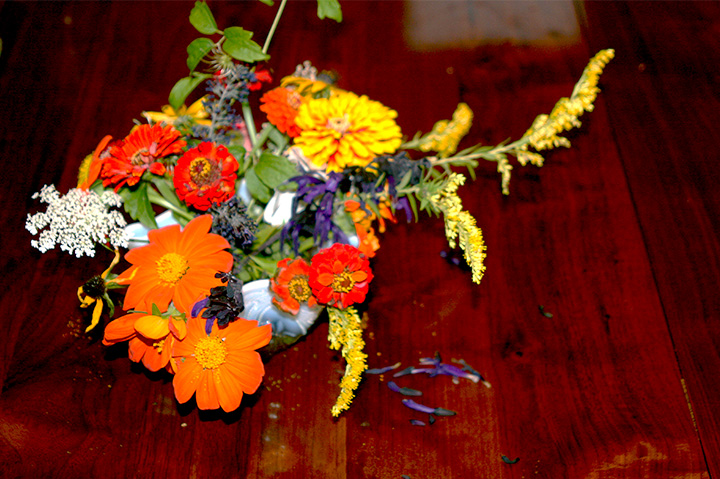
Late summer bouquet five days past its first blush…
~
The crickets are raising their “voices” each night; the darkness lasts a little longer, and the color orange emerges from the green of midsummer to remind us of all that is beautiful in the world, despite __________________________ [insert your list of unpleasant, tragic, disheartening things].
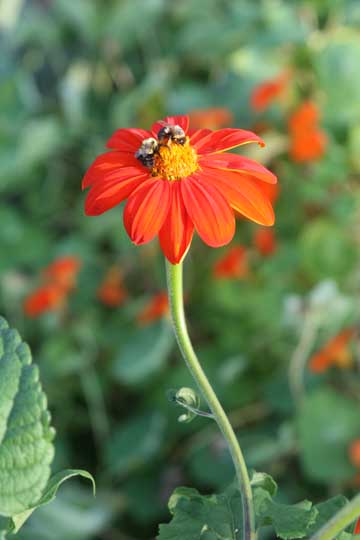
Here is my encomium to the Mexican sunflower, tithonia rotundifolia, a favorite of bees and monarch butterflies and also a favorite of my daughter’s, so it has special aesthetic-emotional appeal for me. The poem I’d like to write to the sunflower has not yet materialized, so praise in prose will have to do for now.
Autumn approaches. I like autumn, though some of my dear ones do not–but one thing universally salvages the early weeks of the season, no matter how a person feels about the encroaching cooler weather: orange. Even people who don’t care for the color in clothing or decor admit that, in nature, the color orange attracts the eye, enlivens a scene, brightens the dullest corner.
Nasturtiums, zinnias, the last hurrah of daylilies, butterflyweed, and early-turning foliage such as sumac and sassafras sport the color well. There are also pumpkins and squashes warming up fields; and in some areas, there are butterflies wearing the hue: monarchs, viceroys, fritillaries.
But nothing delights in a bright red-orange so well as the Mexican sunflower, which evokes the warm climate of its designation and likely origin (I haven’t done a great deal of research on the plant. I know that tithonia diversifolia is native to the region of Central Mexico and am merely guessing that the rotundifolia variety has its roots there, too–excuse the pun).
It sports well with one of its showiest pollinators, the gorgeous, orange, monarch butterfly.
Tithonia likes full sun and does not mind a bit of drought–all reasons it managed well in Mexico. It’s also ridiculously happy in the American Northeast, at least in the Mid-Atlantic region where I garden. The plants grow 6-9 feet tall and are veritable fountains of pleasing, brilliant points in the late-summer garden. They attract bees, butterflies, hummingbirds, and small songbirds and have few pests. Deer dislike their “hairy” leaves, and slugs and beetles seem also unimpressed with their food qualities.
Or perhaps the “pests” appreciate the blooms’ aesthetic value, as I do. [Okay, too much anthropomorphism there, I admit.]
Furthermore, as long as I get out to the garden and dead-head the plants regularly, they bloom right up until the first hard frost.
And they cut well for bouquets (see the not-excellent photo above).
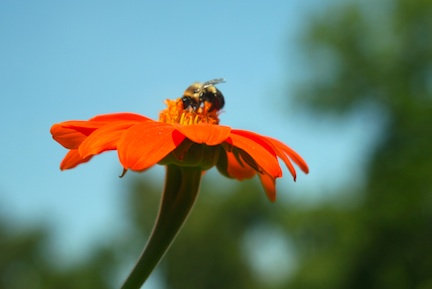
When there is so much sorrow going on in the world, it may seem odd that a flowering plant can offer respite–a moment or two of awe, of joy, the discovery of a bumblebee with its legs pollen-yellow or a monarch’s slim proboscis coiled just above brilliantly golden stamens amid a red-hot orange daisy-shaped blossom…and maybe, above, an autumn-blue sky.
Not art, but nature. Both valuable to human creatures.
Earth Day. March for Science. Global weirding. Polar ice caps. Phenology, biology, meteorology, chemistry, zoology, entomology, geology…all the ologies: “The study of.”
Ways we learn about who and where we are and how to live where we are and with those who have been there before us and on whom we–usually without realizing it–depend.
Scientists tend to justify their work by citing how factual it is. They believe it is necessary to have facts. But there are people who question these facts and who peg scientists as dry, heartless unbelievers. How wrong that concept is. Let’s look at scientists as people who study. Observers. Curious, inventive people. People who push the envelope of the “known” and who inquire into assumptions. Science evolved from philosophy, after all.
And there is so much at stake. We are all stakeholders in this environment, in this universe that extends–as far as we mortals know–infinitely. But scientists are working on that.
June brought much-needed rain, a little late for the peas, which were sparse and small this year, but in time to nourish the later-bearing vegetables. Zucchini and beans abound. It is still too early for the zinnias, sunflowers, and cosmos to bloom; but the butterflies have arrived to check out the buddleia. I recognize that buddleia has become an aggressive invader and is overused in US landscaping–and may not even be a good host for certain varieties of lepidoptera–yet I confess I love the huge purple blooms that draw so many winged creatures to sport where I can watch them from my kitchen window.
~
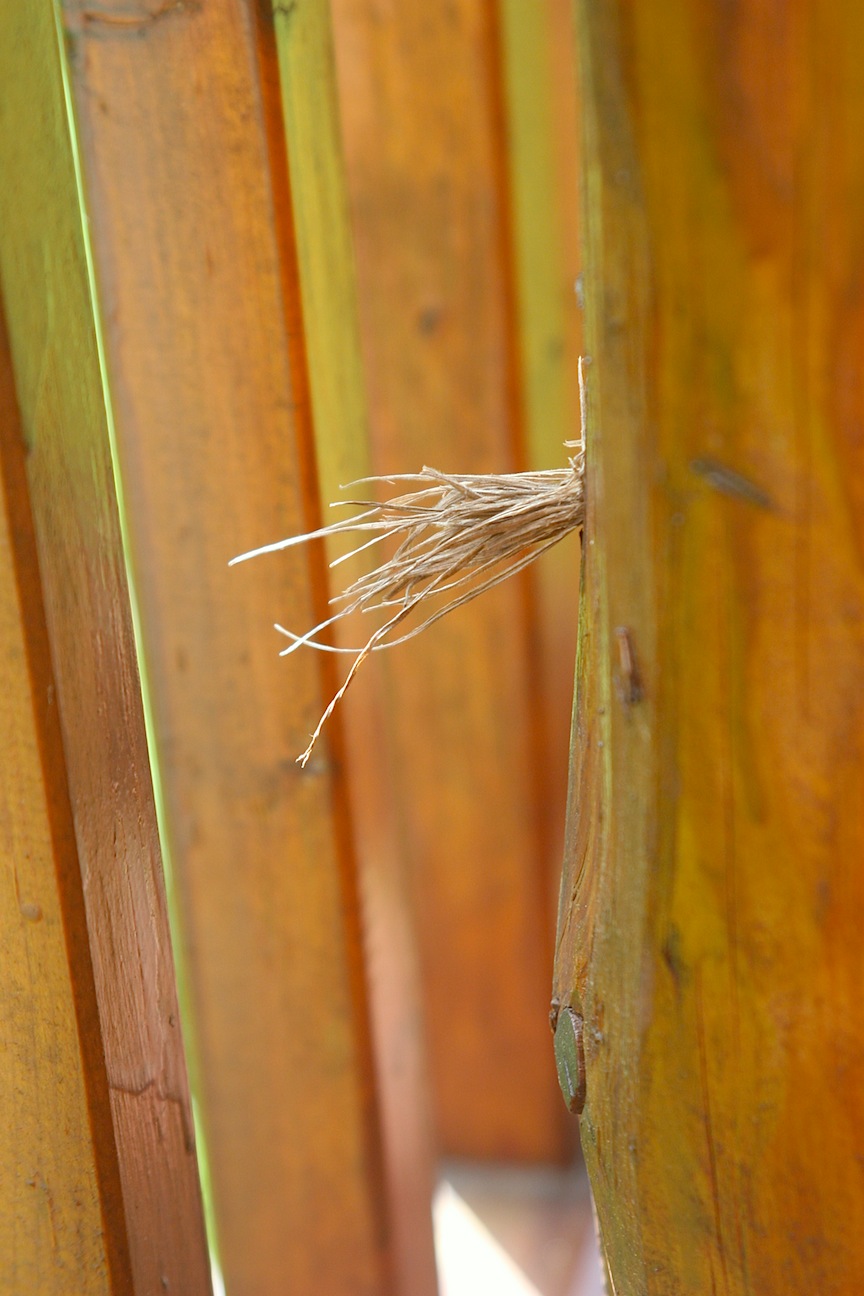
Speaking of winged garden creatures, I have encountered a new one. New to me, that is. While sitting on my porch, I watched with fascination as a large wasp, carrying a blade of straw in its legs, poked at a hole in the wooden post. The wasp pushed the straw into the hole, then crawled in after it, stayed a few seconds, then flew out. Some minutes later, it returned with a piece of grass and proceeded to repeat the process.
nest of the wasp
Isodontia, apparently: the appropriately-named grass-carrying wasp. I imagine this insect will eventually crawl its way into a future poem.
Here’s a video of grass-carrying wasps at work from Dick Walton’s Natural History Services site (a terrific resource, by the way). And thank you, Google. It’s this sort of thing that I can celebrate about the internet…my library for all things weird and natural, paradoxical as that sometimes seems.
~
My walkway garden
~
Meanwhile, my perennial beds flourish (with a few too many weeds, ferns, and hostas–but oh well!!). I plan to make pilgrimages to a few gardens further afield later in July. We shall see if the planets align.
And a nod to Joni Mitchell; when I hear the words “back to the garden,” I can’t help but think of her song “Woodstock.”





 ann e michael