Correspondences

Dear Beejay,

Remember how we used to correspond by email every week? Sometimes more often. You, the best correspondent ever, though we never wrote paper letters–in those pre-internet years, we’d lost touch, moved too often; no postal mail from you until, once we were connected again, you sent me a birthday card. And tomorrow is your birthday. So here’s your birthday email. You see? I didn’t forget.

It remains dry here. That spate of rainy days in early April? Over with and barely a half an inch since then. I’m watering my veg garden daily. Today I sowed another row of spinach. The first and third sowings are doing well, but the second sowing didn’t germinate–can’t figure out why not. The lettuces and other greens are looking good, and the strawberry plants are in bloom. I even took a chance and planted some zucchini seeds. The task of thinning lettuce and carrots is indeed tedious, but it is a lovely day and the air is mild; and frankly, thinning carrots is less tedious than sending poems out to literary journals, I know you’d agree.

I’ve been reading a lot of contemporary poetry. It comforts me somehow, even when the poems are sad or angry poems (that seems to reflect the times, which poetry can do). Your own writing, who has it? Does it exist on some hard drive somewhere? You always were excellent at organizing things. A talent I envy and do not possess.

Anyway, I did a bit of weeding to prep for the tomatoes and peppers when the seedlings are ready to transplant, but I got a late start on them and may not even move them to the garden until after my trip to New Mexico. Right now we’re getting pollen blow here. I expect your pollen blow was over two or three weeks ago, and that the azaleas are past their showy bloom time down there. I know how you love azalea season. And the beach–I guess you won’t get there this year.

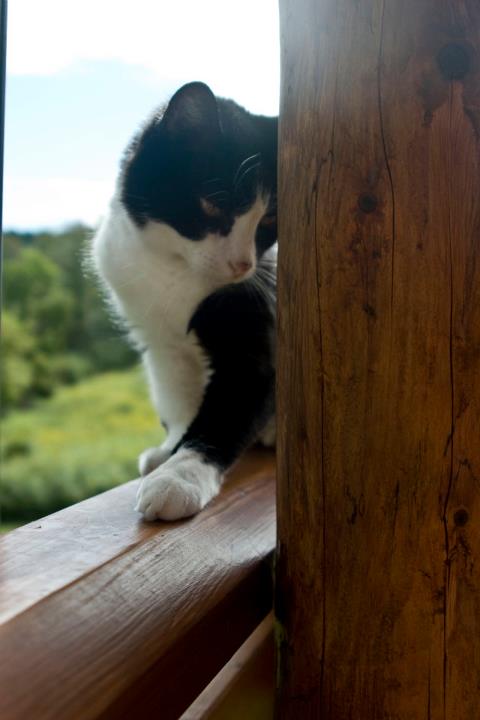
I do find myself, at odd moments, wondering about your cats. When our lives were routine and there was nothing of interest to write about, we could always turn to cat anecdotes. Today, my Nessie joined me in the garden while I was working on the carrot patch. The catnip plant in the herb bed has leafed out quite early, and Nessie stretched his whole lean body over it and lolled himself into a snooze-fest, exposing his white belly. You would have laughed. You always called tuxedo cats “Holsteins.” I’m insulted on Nessie’s behalf.

When a person we love dies, I guess there’s an impulse–almost an instinct–to memorialize them, at least among those of us in “Western societies.” Or maybe it is a human impulse, I can’t say. I have written too many poems of elegy, and there will be more; but sometimes, it takes awhile before I feel I have the right perspective or frame of mind to write about them, or about my feelings of loss. Today, so much reminded me of you, Beejay, that I had to write something. If not a poem, then an epistle–the way I used to write to you, of ordinary things, the garden, cats, seasons, poetry.

Happy birthday, wherever you are.

Acclimating

A few weeks back, a black and white cat appeared in our yard and took up residence behind the garage, near the compost pile. He’s neutered and acclimated to human beings, friendly, not feral by any means–but a hunter. I didn’t mind having him there to keep mice and voles out of the compost, but let’s face it: outdoor cats are a menace to wildlife. And we live in a semi-rural area of former fields and old barns, which certain unethical folks deem “good places” to drop off unwanted kitties.

We have kept cats as family companions for years, but over time have altered our feelings about cats being outside; our current pair stay indoors. Our previous cats have killed bats, birds, snakes, toads, cicadas, voles (okay, I have mixed feelings about the voles). This interloper has already killed a small garden snake and is harassing the wrens and a pair of nesting catbirds. After hearing a series of alarm calls from the catbirds, I caught him in the burning bush where they reside and gave him a dousing with the hose; but now he knows where they are and that he can climb up and reach them. I don’t see this ending well for the birds. We have several options here, one of which is to catch him–once he trusts us enough–and take him to a cat rescue center, though in our region the no-kill places are filled to the max already. Or we can catch him and adopt him, which means vet bills and the challenging period of introducing him to our cats, and then acclimating him to staying inside. Other options are less humane.

Cats are cats, and he merely does what cats do. I can’t blame him (though I want to!). The real problem, as usual, comes down to humans altering the environment and being careless about spay/neuter. Plus we could be more responsible cat owners: I have a friend who keeps her cats indoors during nesting season, for example. That’s a good start. It means becoming more “mindful”–by which I mean not doing so many things without even thinking first–and recognizing that even fairly small changes in habits can, cumulatively, make a difference.

Two simple examples. A second or two of thinking first, and caring a little, would have stopped dozens of cigarette-, firework-, and campfire-caused wildfires over the past decades. Would have meant fewer people killed or injured by humans driving while intoxicated. We have brains and can acclimate ourselves to using them by developing less harmful habits.

I hear many birds making their alarm cries this time of year when I take walks. Today, I saw a doe and heard her alarm noise, which sounds very like a person sneezing (she probably had a fawn hiding nearby). These creatures don’t believe my assurances that I am not a threat; I’m human. Inherently threatening.

Journals

While re-reading May Sarton’s At Seventy: A Journal, I recalled reading this essay about the book, by Jeffrey Levine, in June. I first read At Seventy when I was, I think, 40 years old…I recommended it to my mother-in-law, who–like Sarton–lived alone and loved to garden. I now recognize in Sarton’s journal aspects of life and aging and creativity that I had not thought much of when I was younger–at 40, I felt envious of her freedom as a single woman. I was raising young teens, managing a busy household, working on a master’s degree, feeling I had no time to myself.

One thing that interests me about Sarton is her decision to keep journals intended for publication, beginning I think with her journal about recovering from cancer, though she had written at least one memoir before that journal.

Another poet who wrote journals intended for publication was the Japanese writer Masaoka Shiki. Perhaps his most famous diary (in the West, at least) is “The Verse Record of My Peonies,” thanks to a translation by Earl Miner. Shiki kept writing haiku and haibun, as well as reviews, for the newspaper even as he was slowly dying of tuberculosis. His journal entries (there are others) were intended for readers.

My journals (and I have kept one ever since I was ten and read Harriet the Spy), however, would not make good reading; I would be embarrassed if they were published, especially unedited and unrevised, and no one would feel inspired, delighted, or edified by them. The concept of writing a daily journal intended to be read seems either brave or a bit dishonest, like a persona. Then again–many early weblogs were exactly that: daily public journals read by whatever online audience stumbled upon them. And perhaps this blog acts as my public journal, mostly about what I read, what’s in the garden, and what I’m teaching. Those pursuits, made public, do not mask who I am. They are the things I choose to reveal.

I don’t know if that’s different from a social media persona. But here’s a sleeping cat to look at while I ponder.

IMG_6587

Reasons and felines

“Like my cat, I often simply do what I want to do.”

This sentence begins Derek Parfit’s book Reasons and Persons, a lengthy series of philosophical arguments examining the validity of the self-interest theory, examinations of hedonistic and altruistic behavior, among others,  as rational responses to life, and why people choose to do what is against their own or their community’s best interests (i.e., behave “irrationally”)–as well as whether irrational behavior is ever justified and why.

At right, my favorite cat, Topsy. He does what he wants to do.

Parfit’s book has been a good refresher course for me in how philosophers actually work, devise their analogies, create and endeavor to solve dilemmas, clarify and limit their claims, etc.

But frankly, my brain hurts. (See Monty Python skit, below).

There are times one simply wants to think less about the things that matter, and that desire may not be rational but is certainly human. So while humans do have the opportunity to be reasoning creatures, they also have the opportunity to be like cats: to do what they want to do.

Or not to do, as the case may be.

At present, I’m assessing student work for final grades. This work is rational and should be carried out as objectively as possible against specific criteria. This work is one of the jobs teachers do, besides the job of endeavoring to impart information and to encourage critical thinking on the part of the students. It’s my job, I get paid to do it, and I take it seriously. Nevertheless, today I find myself tired of being the reasoning person.

And so, because I cannot slink over to the sofa and curl up on a pile of blankets, I am posting this: