Post-exertion malaise

This year, my holiday plans are less busy than usual. I don’t have to cook a large meal, wrap a lot of gifts, travel much (or far), or attend a bunch of parties or festivities. There is a quiet joy in this low-key schedule, though it means the season possesses a slightly different character. I thought that the lack of holiday stress would mean I had more time to write, revise, maybe even to submit work to literary journals. The rain and chilly humidity have enervated me more than I expected, though, and some days even an hour of serious concentration seems to wipe me out.

I believe this weird exhaustion for no apparent reason is a kind of post-exertion malaise.

Post-exertion malaise (PEM) is not uncommon among people with chronic conditions such as chronic fatigue syndrome, Epstein-Barr, long covid, fibromyalgia and the like. Its key features are that the fatigue seems far out of proportion to the exercise or other exertion that preceded it, and that it is delayed–the exhaustion may set in two hours or even two days after the experience. I have had PEM, for example, after spending a lovely and high-energy day of hiking or wandering for hours around a city or museum and suddenly, without warning, “crashing” into bone weariness two hours later, or a day later (I have fibromyalgia). I’ve learned to manage the physical aspects of PEM, however. It does not happen all the time, and often I can plan for it.

Post-exertion malaise: it sounds like the title of a contemporary novel.

I’ve read studies that speculate PEM results from a sort of communications snafu among the many complex body systems: nerves, synapses, gut microbes, spine, brain, and probably processes science has yet to discover. What I wasn’t aware of until recently is that PEM can appear after mental or social “exertions” as well. Mental exertion such as submitting to journals; social exertion such as attending poetry readings, parties, family gatherings. It explains why I had to lie down for a nap at 5 pm every day the last few years I was working full-time, even though my job was a desk job. And why shopping has become such a tiring task for me.

Shopping, when you think about it, involves: 1) being in a public or social space; 2) attention to details; 3) frequent decision-making; 4) stress about finances, parking, and whether said decisions were the right ones; 5) unexpected stuff like long lines, a credit card that refuses to work, bad weather, and not finding what you were shopping for. Even if you shop online, some of these processes are involved. Yes, our brains are bombarded; and our brains are designed to filter and make efficient work of the bombarding, but perhaps that’s part of what goes awry with long covid and chronic fatigue. The filter may clog, so to speak. Brain fog and fatigue.

Similar micro-decisions go on when I send out poems to journals. Should this poem be sent to that publication? Do I like the other poems in this magazine, the editorial bent? Is this poem finished, and is it any good? Do they require a fee? Do I want to pay the fee? Are they okay with simultaneous submissions? Do they use Submittable, email, or some other method? Such analysis goes on constantly, as well as lots of even smaller decisions. I have to read the submissions guidelines carefully and, sometimes, re-format my work to suit. And then there’s the cover letter if required, and the bio–though I have a “boilerplate bio,” often it seems wrong for the journal; if they’ve asked for a personal touch or want me to stress place or background, I have to tweak the bio…and on and on. The task was never my favorite, but it didn’t exhaust me.

Because my PEM is intermittent, often I can send out a good deal of work in one sitting with no fallout, just as sometimes I can hike or walk for hours without pain or fatigue. I had almost no trouble when I was in Spain earlier this year. But this week in drizzly-snowy eastern Pennsylvania, I’m having to take too many rests after doing what seems like almost no real work. Frankly, it’s disheartening. So I’ve decided not to expect to get much done during the next two weeks and to appreciate the time I can spend reading a novel, decorating the tree, sitting by the fire, talking to loved ones by phone. No need to be disheartened.

Depth perception

In second grade, I could not see the blackboard from my desk. My teacher noticed; I went to the optometrist, and thereafter began my worsening nearsightedness. New specs annually for many years, broken frames, ugly frames, though–unlike many of my friends–I never lost my glasses because I could not see at all without them. Somewhere along the way, astigmatism kicked in. In high school, I blamed my ineptness at any sport involving a ball on my astigmatism (contact lenses corrected my nearsightedness but weren’t as effective on the misshapen cornea). But my ineptness was largely due to lack of interest in sports.

And now, encroaching cataract formations mean that I’m getting surgical procedures for the removal of those thickened “cascades” that make it hard to drive at night, read street signs, or discern a cat from a fox in the back meadow. I had my left eye operated on this past week, with the insertion of a medium-length lens that gives me 20/40 vision in that eye: a miracle to me after so many years of blur. I have to wait two weeks before the surgeon does the right eye, and in the meantime I’m discovering the true challenges of poor depth perception. My brain hasn’t adjusted to the changes in my eye, and simple things like walking downstairs or pouring tea into a cup pose unexpected difficulties.

Topping things off, I’ve contracted covid for the first time ever. So I am being extra careful as I walk through my house and into my yard–taking a fall due to bad depth perception would be one more problem I just don’t need.

So I have been considering vision lately, and what it means to perceive, to have differences in perspective, focus, framing. Or different cultural and social “lenses,” as we refer to them when we are teaching students to write compositions in college. It is as easy to trip oneself up metaphorically as physically if one pays no attention to such perceptions.

Today, I feel to ill to spend much time pondering. But I have enjoyed looking at the photos–taken from different vantage points and times of day–of the lovely tree on the other side of the riverbed from Joya. Very healing, as trees can be.

Shy

When I was in elementary school, my teachers described me as “shy.” A few of them commented that I was “creative” and “smart.” It’s strange how these adjectives for character traits came to shape how I perceived and pegged myself, and I suppose I’m not alone in this. I considered creativity to be something positive and smartness a little daunting, but I felt ambivalence around the term shy. In the 1960s, shyness could be an admired trait among girls because it meant we were not disruptive. But I didn’t think that was all so wonderful, when the children I admired were often loud and funny. While teachers might have appreciated shyness in a pupil, children tended to think me nerdy or, worse, standoffish and snobby. Shy was not much of a compliment.

shy (adj.) late Old English sceoh “timid, easily startled, shrinking from contact with others,” from Proto-Germanic *skeukh(w)az “afraid” (source also of Middle Low German schüwe, Dutch schuw, German scheu “shy;” Old High German sciuhen, German scheuchen “to scare away”).

Online Etymology Dictionary

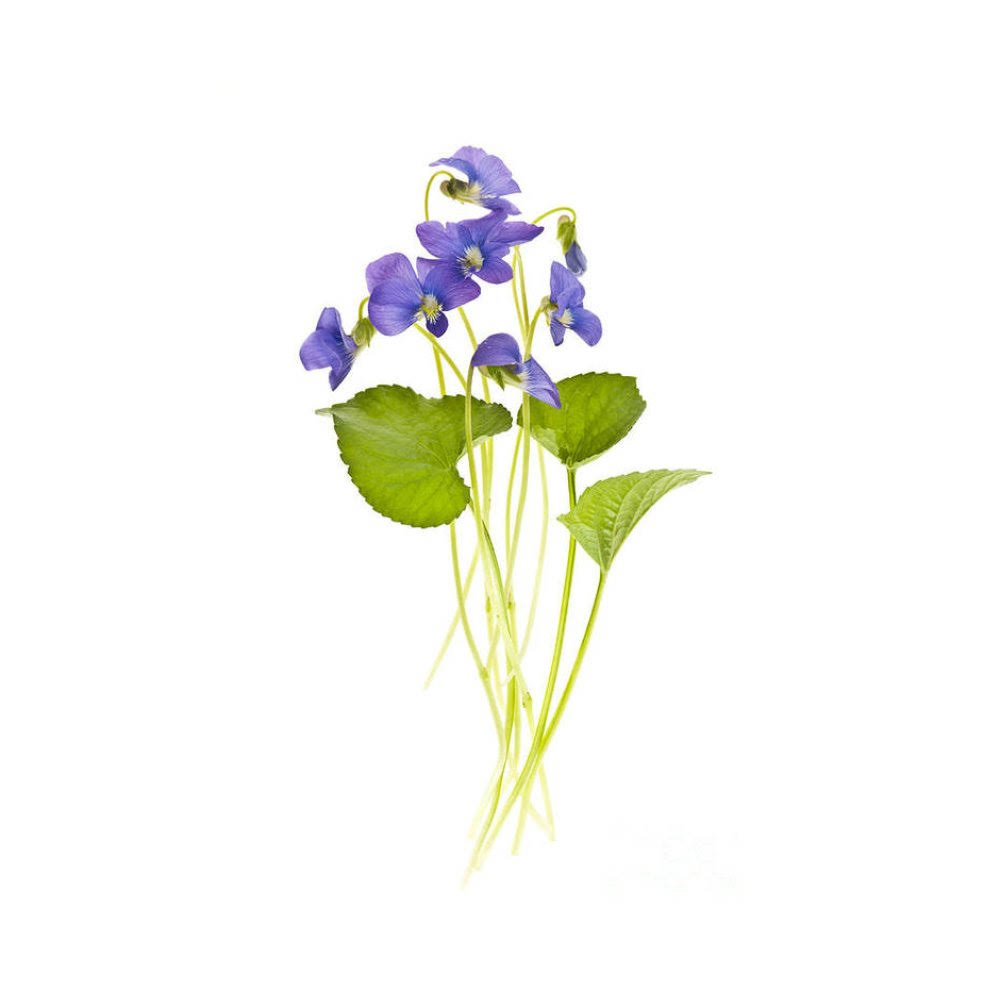
Hence the metaphor of the shrinking violet, the wallflower. I was fond of plants, but I did not necessarily want to be one. The introverted, reflective young person is seldom socially popular in the USA, and my budding self-confidence took a hit in the public school environment. Was I really timid and easily frightened–or was I just dreamy, bookish, unconventionally funny, skinny, tall, bespectacled, and not particularly socially adept?

Elena Elisseeva, Spring Violets @ fineartamerica.com

One trait I developed as a shy child was a capacity to listen to others. I wanted to hear their stories, their points of view, their silly songs, their big ideas. What I regret is that later on, when I gained some self-confidence and began telling my own tales or dispersing acquired knowledge and advice, I lost some of my listening ability. It took hard work and practice on my part to feel secure when speaking to groups, and I started with the hardest practice: reading my own poetry aloud to other people. Eventually the shyness wore off, for the most part.

Then I had to get the listening back. Raising children was a tough balance between saying and listening. I fault myself for not listening quite enough. As an instructor, I found it difficult to listen to a group of students: too much cacophony, too many distractions, hard to gauge where the conversation was headed. I’ve always felt more comfortable with one-to-one tutoring, which makes listening so much easier. As this semester has wrapped, I find I am already dwelling on the fall. What did covid-protocol instruction teach me? Mostly that the listening is even more important than I thought. The students still feel freaked out; overwhelmed by, more than excited about, their futures. I can’t blame them and want to make room for their stories…not to shy away from them, especially if any of them are feeling “timid, easily startled, shrinking from contact with others.”

Emergent

emergent (adj.) late 14c., “rising from what surrounds it, coming into view,” from Latin emergentem (nominative emergens), present participle of emergere “to rise out or up” (see emerge).

etymologyonline: etymonline.com

~

Spring equinox.

Very soon–perhaps days from now–the vernal ephemerals will appear. The vernal ephemerals are early spring flowers that thrive low to earth before the trees leaf out: spring beauties, dogtooth violet, squirrel corn, bloodroot, hepatica, and others that look delicate but are, in fact, tough little survivors who have found their ecological niche in the cool days and weak sunlight just post-equinox. We could consider their resilience an inspiration.

Vernal ephemerals sounds to me like a term for sprites, will o’ the wisps, or angels, but it’s a scientific term. I learned it from Tom Wessels (here’s one of his videos on coevolution https://www.youtube.com/watch?v=hCAvBmY7ZgA),* but I have been fascinated by these plants for decades. I have always been the sort of person who walked around with my head either facing the clouds or scanning the earth beneath my feet. Hence, a reason so much of my poetry uses images from nature even when I am not writing about the garden, the meadow, the woods, the sea. My clumsiness a byproduct of my peculiar need to observe the natural environment.

Anyway, hepatica is about as close to a sprite as any blossom I know of.

They aren’t common where I now live. Here, the vernal ephemerals I see most often are trout lily, bloodroot, spring beauty, violets, coltsfoot, trillium. Probably a few others that I’m forgetting because the ephemerals haven’t popped up yet. Still far too cold and a bit dry after a month of snow cover. The emergent greens in my gardens consist mainly of winter weeds, and I’m happy even to see those. Because: green.

“Just a little green like the color when the spring is born” says a line in Joni Mitchell’s song. The green things rise up or out of what surrounds them, coming into view.

I have been keeping under the standing snow, leaf litter, and dross for three months, processing (as the jargon terms it) my father’s death and a new manuscript and a backlog of poem drafts and covid-19 with its attendant disruptions, limitations, and opportunities. But the snow has subsided from all but a few gullies on the north sides of hills; iris reticulata and snowdrops are in bloom, along with the winter-blooming witch hazel. There’s work to do in the garden. Poems to revise. National Poetry Month ahead (April!). It’s the 25th year for this literary celebration.

Time for me, like the skunks and the skunk cabbage and the little ephemerals, to rise out of my surroundings. And take up this blog again? It’s a start. A little green shoot emerging in the chilly sunlight. Hello.

* Thanks to Dave Bonta for the video recommendation

Until…

We are at the end of an arbitrary, chronological year but still in the midst of a pandemic that will not be going away miraculously when the new calendar begins.

To what must we devote ourselves? I think, for now, just getting by and living through; we can learn much from solving the everyday puzzles life pitches at us. A friend counsels that having a project to do can help–something a bit thorny that offers a challenge but that is not a priority. For now, I am cutting vines–the ones that threaten to strangle the remaining trees in the windbreaks on either side of our narrow property.

Trees that have been weakened by too little and then too much rain, by warmer temperatures and crown die-back that encourage lichen, by insects and the viruses they carry, and by a lack of native undergrowth. The ash trees that ringed the meadow are all dead now, victims of fungus and stress-related illnesses caused by infestations of emerald ash borers.

It’s an ongoing effort for which there won’t be much reward, but it feels a bit like tending something in the dead of winter.

I will cease tending this blog for awhile. My deeper concerns lie elsewhere at the moment. If my next collection is indeed published this year as originally intended (covid protocols have affected almost every endeavor, even publishing, and certainly book launches), then I will likely resume a more noticeable social media presence! Maybe I will have resupplied my energy reserves that have been depleted during the past few months.

Until we meet again, and hoping that we can meet in person down the road…

photo by David Sloan

How can it be

Another book about how to die, or how to think about dying: Roshi Joan Halifax’s Being with Dying–the subtitle includes compassion and fearlessness, two qualities Halifax explores using Buddhist approaches, such as meditations. While I like to read about meditations, meditation itself eludes me; I am “bad” at practicing, but authors like Halifax and Kabat-Zinn give me hope that even poor attempts at meditation can be useful in dealing with grief, stress, and anxiety. Death is the most normal thing in the world. How odd that we must teach ourselves how to “be with” it. How to keep from worrying ourselves to death about the most normal thing in the world. Worrying accomplishes so little.

When I was a college freshman, I interviewed my great-grandmother (born in 1884) for a cultural anthropology project. She talked about living on a small farm, nursing her 12-year-old son through the Spanish flu, baking and slaughtering and canning and drawing water–life before rural electrification. She said:

Times was hard, but times is always hard, and our lives were no harder than anybody else’s.

Orpha Ann Parrish Smith

Good to keep that in mind at present.

My temperament has always tended more melancholic than anxious; but in these days of covid, flu, and concerns about my bereaved and elderly mother, worried thoughts arrive, especially in the wee hours, especially as cases climb upward in my region and my mother’s assisted living center starts yet another lockdown. I try to imagine the changes the extreme elderly experience…I imagine her being ‘assisted’ by caring, gentle people she does not really know and with whom she can barely communicate due to anomia and aphasia, which makes her grief for my father truly inexpressible.

“I can’t say anymore what I say,” she tells me by phone. “On the wall, it says, what is it? Now?”

“The calendar? It’s Tuesday, Mom.”

“No, the other. The…weather. Season.”

“Oh. October. It’s October.”

“How is it? And I am trying…when was it? That he died?”

“August, Mom. August 25th.”

“Has it been since August? Was it August? Already? So many now. Many…pills. No, ice. Ices gone by. I don’t mean that. I said–“

“Many days, I know. Can it really be October already? And he’s been gone since the end of August. Summer.”

“25. 25 days, August, October. How can it be?” she asks; and I can tell, over the phone, that she is shaking her head slowly the way she does, wondering, surprised, how can it be…

There are times she says exactly the right thing.

How can it be? Something I might want to meditate upon.

Isolated

Isolation: it’s not the same as solitude.

I miss my students. I get to meet with a few of them each day through an online platform, but it is not the same as seeing them in the hallways, seated across from me in my office, at the cafeteria, in the library, and wandering around campus. I miss their youth, their various fashion statements, their conversation, their energy.

I know, as well, that they long for one another. The seniors are deeply disappointed that they are missing senior events–dances, dinners, parties, commencement exercises–once-in-a-lifetime college experiences. They are losing out on internships and international travel, club activities and sports events. The freshmen are anxious and confused–online classes? Living at home again? This is not what they thought they were signing up for! Students who major in the performing arts feel devastated that their chance to shine on stage in theater or dance will not happen this semester. It hurts.

Friends who are at high risk are “self-isolating” and hyper-alert, and I worry for them. My best-beloveds are all on various forms of lockdown, but we have worked out communication methods so we can stay in touch. Well– “in touch.” Because touching is discouraged, but communicating matters so much right now. Examples:

My tai chi instructor sends out messages of encouragement, ideas for practice at home, reliable COVID-19 information, and reminders to stay grounded and balanced.

The distance-education IT/software platform department at my college has a staff working overtime and under considerable pressure to assist instructors in the rapid move to online instruction. They send out cheerful and informative emails, encouragement, jokes–and are hosting a 3 pm Friday ‘cocktail hour’ meeting we can log into so we can complain, ask questions, joke around, and visit virtually.

The staff at my parents’ assisted living campus has two employees working (extremely patiently!) with residents who need assistance communicating with loved ones who can no longer visit them. The residents have hearing loss, vision loss, neuropathy in their fingers, arthritis, and often, some cognitive losses. Staff members sit with residents and work out methods of staying in touch. Elderly people are already isolated; they truly need connections with others, need to know that their lives are valued.

A friend whose church group sponsors a free meal for all every Tuesday night in Philadelphia continues to serve the at-risk community by packing up the dinners for takeout instead of serving at communal tables.

We are fortunate. I am trying not to forget how fortunate such inconvenience is. For many other human beings, the inconvenience is compounded by danger.

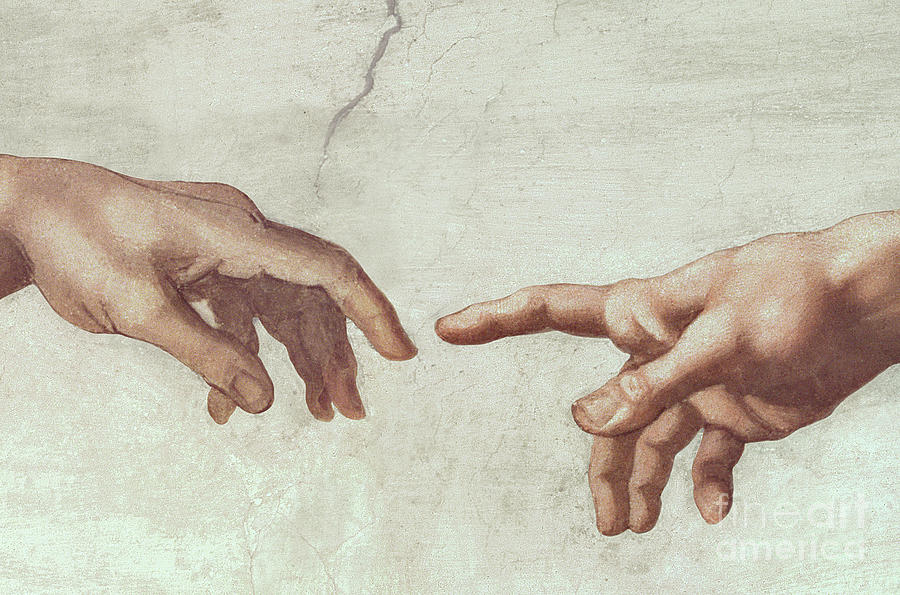
In Wuhan, China, authorities report that there have been no new cases of the illness in the past week. There’s hope. When we touch again, let us rejoice more mindfully, recognizing how powerful touch can be.

hands-of-god-and-adam-by-michelangelo-michelangelo-buonarroti

Michelangelo Buonorotti, Sistine Chapel

~

UPDATE, here’s a thoughtful and thought-provoking piece by Andrew Sullivan–well worth reading. (click link)