Jewel

Joya’s curator/founder Simon Beckman requests an artist’s statement from the residents, and mine is below. Compared to many of the resident artist statements, mine seems quite brief–artists often have complex conceptual ideas to describe and rely more on images, so their statements (words!) are often lengthier. I’m a writer, but I’m a poet; concise use of words ought to be my metier.

La jolla, and la joya, mean “the jewel” but also–especially the latter spelling–refer (geologically) to a bowl-like valley. The description is both physically and metaphorically apt, and provides context for the poem below my statement.

~~

In wild places, some part of me that’s not domestic surfaces. I experience a rise in my level of awareness regarding my surroundings, an apprehension in the etymological sense of “a seizing upon, laying hold of; understanding” (Etymology Online). In canyons, caverns, riverbeds, forests—yes, in the desert, too—I respond wholly differently from the way I encounter unfamiliar human-made spaces. While at Joya-AiR, I encountered both: new environments that I’m integrating into my inner ecology. New forms of art. That process of integration, an exciting one, will continue long after my residency here has ended.

It has been such a pleasure to interact with artists whose mediums vary from my own. I was the only poet in this group, and the opportunities I’ve had to learn more about the visual arts have been amazing and useful. My first loves were sketching and painting, and although my longtime practice has been writing, imagery has ever been vital to my creative work. I thank them for their generosity of spirit. What artists can offer to one another is an aspect of themselves through their perspectives as well as their mediums and works. This kind of giving and exchange strikes me as quite personal and enriching. It is something we can do for the world, too.

The extensive work that Simon and Donna have been doing here to make the place both welcoming and ecologically sustainable impresses me and confirms my conviction that with creativity, open minds, and persistence, humans can manage to live more cooperatively with the planet and damage it less—even, perhaps, help it to heal itself.

I will keep the images of Cortijada Los Gázquez with me for a long time.

~~

Jewel

…implies what is small, exquisite, bright.
At even higher altitudes, glassy glacial pools
shine at the caldera’s ridges.
Here, the hills’ aridity offers nothing
but shallow canyons where once
a river coursed, twisting around a cavity
anchored by holm oak and Aleppo pines.
The pinsapos sway in late afternoon,
their cones studded with hardy seeds.

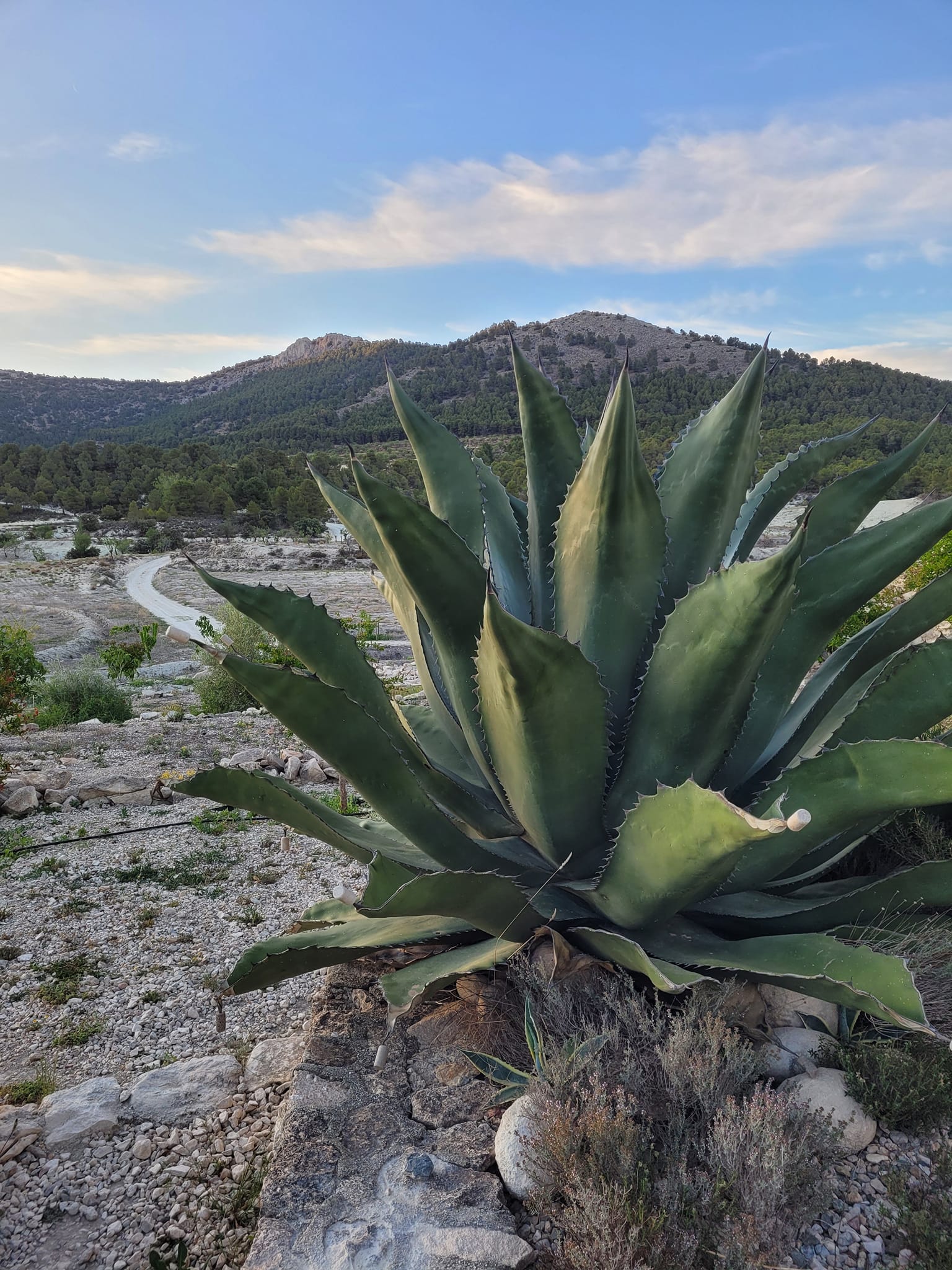
Almond and olive trees dot pale clay soil.
No desert is ever gentle—what survives
must be temperamentally suited to the climate—
but what’s cradled in these ancient mountains
seems gentler than most. Night’s stars,
exquisite. Evenings of ruby, amber, amethyst.
Days that define bright. And when rain descends,
however briefly: everything gleams.


[Cortijada Los Gázquez, Vélez Blanco, Spain]


What are we doing here?

What is a self-directed, multi-disciplinary, eco/environmental artists’ residency? Why are we here? Or, since I can only truly speak for myself, why did I choose to participate in this experience, off the grid in the only true desert in Europe, with people I had never met? Several of my friends have been asking me these questions. I couldn’t really answer in advance because I had no data! I chose to come here partly to get some time alone, partly to visit the land where Lorca lived, and partly because everything would seem new to me.

Not everything seems new to me, as it turns out. Which is also something I expected. For example, my college experiences, both undergrad and graduate, were largely self-directed and multi-disciplinary; what’s changed is that now art disciplines include things like 3-D imaging, computer videos, podcasts, software-as-medium, and the like. Even blogging (here I am, composing creative work for humans to read through a computer screen). For example number two, the artists here are not so different from artists I have met in many circumstances and places over the years: they are curious, intelligent, creative, willing to take risks, and often quite mindful. Another example of things not so new is that, having spent a bit of time in the Albuquerque NM region recently, the lay of the land here and its exceptional flora, fauna, and aridity are not completely alien to my sensibilities.

I’m seeing a number of ideas about xeriscaping, creating fire-breaks, and about stopping erosion and saving water–such as environmental water systems that include basins, ponds, and plants as filters–in process or already in use here at the cortijo. We watered seedlings using water from an in-progress swimming pool near a small natural pond (one of only a very few up in this region) where the natterjack toads were croaking contentedly. The orchard is not producing much, as the trees are still small; but in a few years the farm should be able to get much of its fruit on site.

I’ve learned about the environmental history of this region, too, and how it has changed as the ecological ravages of humans have both worsened it and tried to revive it over centuries. In the Neolithic era, there was more rain. Bison roamed here, and people set up hunting camps in caves. Millenniums later, the Moors settled in the 11th c, built fortresses and small castles up in the hills. The close of the 15th century signaled the rise of noblemen, haciendas, bustling towns and small farms (cortijos)…and major deforestation. During the 19th c, the imperial government instituted a plan to reforest areas of what is now the park, and the economy grew, with more small farmholders; then the economy and population shrank in the 1950s and 60s when the climate became harder to deal with and infrastructure available elsewhere (electricity, paved roads, etc.) hadn’t gotten up to the mountains. People left for the cities. There are many abandoned houses/farm structures here.

Joya-Air explores and promotes sustainability, through mindful conservation and technology that uses fewer resources, along with creativity: art and ecology. The organization is “an advocacy association for ecosystem restoration / rural culture and residency for international contemporary artists and writers.” Simon Beckman is the curator/founder.

People volunteer at and attend or participate in these sorts of residencies and experiences for a host of reasons. For me, it’s a chance to switch perspective, view things from a place far from home, compose poems in a quiet space meant for just that–creative thinking and reflection. To inhabit, however briefly, a place intended to coexist with the flora and fauna, to find out what “off the grid” is like. And to learn new things, all of which contribute to the art of poetry.