AWP conference 2013

I am heading up to Boston next week with about nine thousand other writers, writer-educators, writer-publishers, academics, and business people. The annual Associated Writing Programs conference will be in session March 6-10. I posted about the conference briefly last year...and last year’s conference introduced me to Brian Boyd’s work on cognition and storytelling. So I am hopeful that this year’s programs and panels will prove equally enlightening.

The conference offers a chance to meet or at least hear some of my favorite writers and to talk with interesting colleagues. Best of all, there are thousands upon thousands of books and literary magazines to browse. If I feel shy, I can interact with books at the Bookfair and “meet” my fellow writers through their polished texts instead of face-to-face (or body-to-body in the packed bar). The main problem with any event of this kind is the lack of places for introverts to regain equilibrium. At AWP, there are quite a few introverts; and people tend to claim a spot by a window, balcony, or corner somewhere in the conference area and send out “don’t disturb me, I’m recharging” body-language signals. Or they eat alone in the restaurant without looking too uncomfortable about the status of solo diner.

Writers understand.

~

Lori A. May offers her insights on the conference here, with a focus on people who are considering graduate school programs. I will be participating in a panel on that topic: the Low-Residency MFA. My main interests, however, remain bibliophile-oriented: discovering poets whose work I haven’t encountered before, finding new books by favorite poets, learning who is editing which long-running journals, and finding new journals to peruse.

By contrast, here’s a lovely, very funny article by Kay Ryan that appeared in Poetry magazine in 2005. The second paragraph sets the tone:

Once, when I was about twenty-five and not yet entirely aware of the extremity of my unclubbability, I did try to go to a writers conference. Thirty minutes into the keynote address I had a migraine. It turns out I have an aversion to cooperative endeavors of all sorts. I couldn’t imagine making a play or movie, for instance; so many people involved. I don’t like orchestral music. I don’t like team sports. I love the solitary, the hermetic, the cranky self-taught. Make mine the desert saints, the pole-sitters, the endurance cyclists, the artist who paints rocks cast from bronze so that they look exactly like the rocks they were cast from; you can’t tell the difference when they’re side by side. It took her years to do a pocketful. You just know she doesn’t go to art conferences. Certainly not zillion-strong international ones, giant wheeling circuses of panel discussions.

How, then, one wonders, can it be that I have just come back from AWP’s annual conference in Vancouver, treading upon a lifetime of preferring not to?

I fear I am rather in her camp. I do like orchestral music, but I prefer chamber ensembles. I don’t care for team sports. I love the solitaries, the St. Simeon Stylites of the world; there’s a bit of the hermit in me. Crowds–shudder! Yet a conference of writers at least offers the promise that I will be among others who understand how I feel and who feel that way themselves now and then.

St. Simeon Stylites

St. Simeon Stylites

Another advantageous aspect to this event is that I get a chance to talk about poetry and creative writing with people who are as passionate about it as I am. I can discuss the logic and music behind free verse line breaks and learn contemporary writers’ opinions about the sonnet. Is the metaphor dead? Does symbolism have any place in modern writing? Is hypertext the new L=A=N=G=U=A=G=E poetry? Does anyone understand the significance of the tattoo that says “December 10, 1830” on that young woman’s arm? (It’s Emily Dickinson’s birthday). I can talk about my book Water-Rites with people who are working on getting their own poems published and discuss current projects with folks who are sure to have ideas and advice to share.

So the event is worth a bit of discomfort on my part. If I get too overwhelmed, I can go back to my room or walk the chilly Boston streets or have a chat over coffee with just one person at a time.

Or maybe find a pillar in a park somewhere. I think I recall one at Bunker Hill….
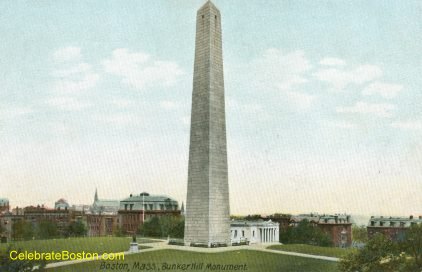
bunker-hill-monument

Associating with allusions

Human beings use the power of association to create art; indeed, without association, it would be difficult to create or even to learn anything at all. Paolo Friere observed that all true learning is based on previous experiences and associations; Pavlov, in a different field, established the same thing while experimenting with instinctual responses. In literature, in the poem especially, the art of the work depends upon associations. The writer makes cultural, historical, linguistic and personal references and allusions, establishing imagery based upon place, time, art, experience, event. How would metaphor, or simile, operate without prior knowledge and associative power? Allusion’s a crucial tool for poets.

In his textbook/anthology To Read a Poem, Donald Hall notes that allusions can, however, be problematic in poems and may “act as a barrier to understanding.” Indeed, a common criticism in poetry workshops is that an image, word, or allusion is obscure. Such critiques often center around an indirect reference that readers “don’t get.” A poem no one can understand or appreciate is certainly a failed poem, but what if the failure is the fault of the reader’s lack of experience or education? Is the poet to blame for being elitist, or is the reader to blame for his or her innocence? What if the allusion is based on something integral to the author’s perception of life and is meant to further the understanding of the piece, not to build barriers? How is a writer to judge whether or not an allusion is working in the poem?

Let’s back up a bit and start with a definition: an allusion is simply an indirect, but meaningful, reference. It is not the same as writing a poem based on a quote or news article; not the same as direct referencing in a line, stanza or epigraph. It is not a symbol—it does not stand in for anything, merely points indirectly at an experience. Because of its indirectness, allusion operates on a more complex level than does other imagery; and because of that complexity, allusions deepen meaning. A good allusion works on several levels, dependently and independently.

But an allusion is also meant to be understood. Robert K. Miller, in his textbook The Informed Argument, defines allusion as “an unexplained reference that members of an audience are expected to understand because of their education or the culture in which they live.” That expectation—and the assumptions that go with it regarding culture and education—has the potential to make an allusion into a sandpit of obscurity. Yet great poems avoid getting mired. Great poems work even when history has intervened and allusions have been lost: one can read The Inferno with notes and explanations about politics in the city-states of medieval Italy and Biblical references; or one can read it naively uninitiated and still find it to be a fabulous, weird narrative, a guided anti-quest. The uninformed reader has lost some aspects of the poem (perhaps its irony, its parodies of important men, etc.). The uninformed reader has not lost everything in the text, however. He or she does not return impoverished from a reading of Dante by any means. The art is still in the poem, the narrative, the craft, the intention. In a good poem, the poet’s point of view and range of experience can transform the reader’s experience.

il_fullxfull.369385736_ddho

What if the contemporary writer’s experience includes a love of Ovid, a familiarity with Hindu cosmology, or twenty years as a coroner? Educated readers of a century ago would have caught allusions to Greek and Roman classics, but that’s less true today (a fact that has not stopped Billy Collins or Anthony Hecht from employing classical allusions or references, however). I’ve recently had students who were not able to recognize allusions that referenced Shakespeare, Wordsworth or the Bible. While this is dismaying to me as a teacher, it has not interfered with these students’ ability to enjoy—and understand—poems by such writers as Collins, Glück, Pastan and others: poems containing allusions to literature, history, art, and experiences beyond these readers’ ken. A good poem alluding to a coroner’s working knowledge of the body and its various means of demise (without directly referencing or explaining this knowledge) would certainly pique my curiosity, and that of my students. Maybe it is difficult to get the news from poems, but through poetry we can expand in other ways.

Besides, people read to learn, and each unfamiliar reference or allusion offers the chance to further that learning. Why bother to tell people what they already know? In my own experience, poems have led to the dictionary, the encyclopedia, to libraries, art museums, philosophers, scientific theories, and to other poems. Granted, I am the sort of reader willing to do that extra work; and this points out that deciding whether or not to use an allusion entails a couple of decisions. Who makes up the audience for a poet or poem? That’s the issue Miller addresses in his definition of allusion—who’s reading, and what experiences and education these people have access to. The recent interpretations of Wordsworth’s language of the “common man” have on the one hand encouraged accessibility in contemporary poetry but have also led to some ridiculous directives in poetry seminars. (Example: A student of mine was told by a conference instructor never to use the word “vermillion” in a poem because “people won’t know what it means.” While there are poems in which “red” is a better choice than “vermillion,” there are certain styles and subjects in poetry that benefit by the use of the “more obscure” word). The second question a writer must ask is: does the poem work even if the reader misses the allusion?

The first question is intellectual and is less important than the second one—but it can help the writer decide whether to keep the allusive image/phrase or to direct-reference, clarify, footnote, or delete it. In a culture as overwhelmed with media as our own, even contemporary allusions can be missed (what if your readers don’t watch commercial television? or keep up with CNN? or know what blogging is?), let alone well-considered indirect references to, say, American life in the 1950s, composers other than Beethoven and Mozart, or most writers once considered essential to the “classic canon.” So it does help to know who your audience is. This is as true for allusion as it is for vocabulary choice in the poem.

The second question is absolutely necessary for the poet to ask, for allusion often arises spontaneously if it is deeply grounded in a writer’s experience. Because the poet’s experience drives the poem, a writer who is dissuaded from, or afraid to harness and use her experience, risks losing her investment in the work. While obscurity is also a risk, too much concern over being democratically accessible may result in what one of my students called “the dumbing-down of the poem” (a phrase which is itself a contemporary, political allusion). The condensed complexity of poetry is possible thanks in large part to the associative powers of allusion. Strange and surprising associations and metaphors and multiple, list-built associations evoke fresh responses from the reader through transformative acts within the poem. If no one “gets” the allusion, but readers still “get” the poem—if they do not stumble over the language or the images, do not lose the narrative or miss the overall meaning of the piece—the poem has surely succeeded: some kind of transforming language, some synthesized meaning that leaps out of and past the accepted denotations of words, has occurred.

If a reader comes along who does catch the allusion, that reader will have an enriched perception of the poem, a deeper insight into the writer’s inspiration and purpose. That’s how a reader can tell the chosen allusion works. And that’s how the poet can tell, too.

Freedom above utility

S. Polgar is mentioned in Tough's book. Her website is here: http://susanpolgar.blogspot.com/

Susan Polgar is mentioned in Tough’s book. Her website is here: http://susanpolgar.blogspot.com/

One of the gifts I received this year is the book How Children Succeed, by Paul Tough. It’s a quick read that dovetails many of my interests: education, psychology, character, motivation, philosophy, & childraising, among others. There are several aspects of the book I could write about here; but today my frame of mind has wrapped around one particular passage having to do–well, in the book, with chess–but metaphorically and personally, with why I bother to write poetry.

In the chapter titled “How to Think,” Tough offers the stories of several chess-for-children programs and connects these endeavors with education, as well as with traits of persistence, grit, and critical thinking skills. He cites examples of chess masters the world over, of child prodigies, and of chess teaching methods; then, he connects these strands with the notion of learning “character.” That’s one of the book’s arguments: that character is learned, made up of other habitual traits, that it is not the same as temperament. One skill that good chess players learn is how to fail, how to overcome confirmation bias in decision-making, and how to immerse themselves through the habit of study (persistence). This does not mean that chess players naturally extend these abilities to other areas of their lives, but they could do so since they do possess these abilities. Tough finds it fascinating that many chess players still manage to screw up other areas of their lives…they do not choose to extend, or apply, their chess traits to things like academics, career, or personal relationships.

So choice (“volition” as he terms it, though he defines volition as closer to willpower) interferes with our application of learned ‘good’ habits. Ah, the old ‘free will’ trap…

~

But I digress.

The part of this chapter that grabbed me is a quote from chess master Jonathan Rowson. He says: “the question of chess being an essentially futile activity has a nagging persistence for me…I occasionally think that the thousands of hours I’ve spent on chess, however much they have developed me personally, could have been better spent…[yet] chess is a creative and beautiful pursuit, which allows us to experience a wide range of uniquely human characteristics.”

Sounds familiar to me. People say the same sort of thing about writing poetry. Then Rowson says chess is “a celebration of existential freedom, in the sense that we are blessed with the opportunity to create ourselves through our actions. In choosing to play chess, we are celebrating freedom above utility.”

Oh, that says it so well. Freedom above utility–choosing to create myself through my actions, which allows me, as poet and as sentient being, to experience all of those messy and sorrowful and complex and delightful human characteristics.

~

I have spent my 10,000 hours writing and am “expert” at it, yet it has brought me not money nor favor nor fame. So why pursue the path? Because it is beautiful and freeing. Because it is my form of gift–I have a small talent that I have labored at, but I am not “gifted” as a writer…yet I can see my way to thinking of my poetry as part of the gift economy Lewis Hyde elaborates upon in his book The Gift (which I’ve mentioned in a previous post). Ambition is not the same as willpower, and I do not have single-minded willpower in the task of promoting my work or my persona as a poet–no “poetry diva” am I. But I do have persistence in this one area: the writing practice and all it entails; and I do have experience with it, and I possess deep and abiding curiosity about poetry and gratitude that it exists and that I can continue to try my hand at it.

Even if it seems futile or pointless or non-productive to some people.

~

As an aside, I note that David Orr’s recent book Beautiful & Pointless: A Guide to Modern Poetry has been both enthusiastically and scathingly reviewed, so I must get to it soon. Perhaps Orr’s work will clarify my thinking on the non-remunerative, generally unacknowledged occupation that chose me long ago.

Or perhaps it does not need clarifying. Perhaps celebration is enough.

Learning the literary analysis

It’s end-of-semester time when I meet with students to coach them through revisions of their final papers. A fair number of those assignments are literary analysis papers, and the students I tutor tend to view these essays with dread stemming from confusion. I have learned a few methods of deconstructing and demystifying the literary analysis, but I understand these students’ frustrations. I felt them myself many years ago, as I learned literary analysis the hard way, under the tutelage of a formidable and exacting professor.

Actually, I had not thought much about learning literary analysis until a few days ago, when I had the chance to read some of my own early essays. In the bag of ephemera that contained my father’s essay on Martin Luther (see this post), there are also a few of my letters and college papers that my mother saved for some reason. How revealing it was to read my early forays into fiction analysis–and to see the comments my professor made on my work. Very astute, critical comments that confronted me, a naive 17-year-old who was accustomed to getting high grades on English papers, with all that I was assuming, leaving out, or asserting with faulty logic or lack of evidence.

It’s interesting that I rose to the challenge. I was shy and easily intimidated, and very young. The reason I did not feel utterly crushed by the professor’s comments is that this was a seminar class, discussion-based, with a great deal of face-to-face conversation among teacher and students. My professor was the most assertive, self-confident, and supremely logical woman I had ever encountered; I was intrigued by her. How on earth had she gotten that way? Was she born into it? Had her family encouraged her to be so direct, forthright, critically observant? Her vocabulary was precise. Her expectations were high; yet she insisted we teenagers had ideas that we were capable of expressing verbally and on paper.

Many students disliked her intensely, considered her too blunt, wounding, hypercritical. I respected her acuity and her breadth of knowledge. I didn’t want to emulate her, but I wanted to read what she had read and understand it as intently as she did.

I don’t think she would mind my revealing her identity, as she’s well-known for her passionate learnedness and her controversial ideas about education. You can find her on a TEDtalk on YouTube: Liz Coleman, long-time president of Bennington College. When I was a freshman at the experimental Freshman Year Program at The New School for Social Research, she was the program dean and my Art of Fiction teacher.

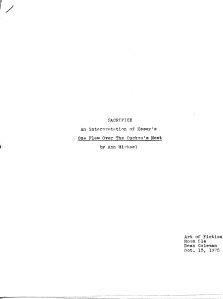
The title page of a much-lacking freshman attempt.

The title page of a much-lacking freshman attempt.

She did not coach us on thesis statements or methods of breaking the analysis into chunks of ideas supported by evidence from the text. Instead, she quarreled with our assertions, asked probing questions of our thin but possibly promising claims, and confronted us with the obvious. I was astounded by this approach to education, 180 degrees different from what I had encountered in high school. After Liz made her comments on my One Flew over the Cuckoo’s Nest essay, I picked up the book and immediately read it again–something I had never done before.

I had drawn parallels to the Christ narrative, a rather obvious way for a beginner to explore Kesey’s novel, but had completely failed to recognize that if you’re going to draw such parallels there comes a point where you need to recognize what the novelist does with the idea of “sacrifice”–what is gained (if anything) by it, and what purposeful and ironic twists the writer does to that narrative, and to what end(s). I was onto something when I wrote about the ‘earthly’ aspects of the characters but lost that thread in my allegorical pursuit.

My professor pointed out that I had “seriously limited the impact” of my paper’s argument–at that time, I had no idea that a literary analysis actually a form of argument–by transforming the novel into something it wasn’t, ie, a retelling of the Christ narrative. I love what she next wrote:

“That’s just not adequate to one’s experience of a novel in which earthly pleasures (the more earthly the better, it seems) are so unequivocally celebrated…[Kesey’s] vision of triumph has very much to do with being alive–his communion is with the juices of life.”

The communion with the juices of life! She wrote that to a 17-year-old. I’m not sure I got the full impact then, but I sure learned a great deal from her feedback both on the page and in class. And I did begin to write better, more argumentative, more logical papers. It wasn’t the simplest way to learn how to do a close read; but then, a close read of classic literature should reveal complex insights. I had to fight my way through my own assumptions and bad logic. I had to learn to read again, and at first I felt that analysis would destroy the joy I took in reading; but that’s only true if you are unlucky enough to have a professor who insists that the students’ interpretations align with the teacher’s opinions.paper002

Dr. Coleman has strong opinions about literature–and education, and political engagement, and many many other subjects. Yet I never felt she was pushing her interpretations onto us students; it seemed to me she was pushing me to do better work, to think more clearly, to read with more enthusiasm, with an alert mind. My engagement with literature, art, and much more owes a lot to her…I had always loved to read but had been in many ways a lazy reader.

I’m pretty much cured of that now!

Rights & responsibilities

I recently assigned a short reflection essay to my freshman college students. The topic was the rights and responsibilities of voting; I asked which mattered more to the student: the right to vote, or the responsibility to vote (or if they were equal in importance). I then requested that they explain their reasoning.

Let’s just say that I didn’t get too many deeply-considered responses, and I could mention that more than one student wrote about ballets instead of ballots.

But before I sigh too deeply or launch into a rant about the lack of interest young people show about governing the country, I must stop myself. After all, these students are 17 and 18 years old. They have not felt engaged in the process of self-governance of any kind–with a few exceptions–including the responsibilities of adulthood in most of its forms. They are still being financially supported by their families. They have meal plans, so they seldom have to go food shopping, budget their dollars and their nutritional needs, or worry about going hungry. They are emerging from the narcissistic and peer-driven teen years and haven’t had much reason to examine public policy or how it affects them. They haven’t learned yet about fallacies, straw men, slippery slope reasoning, ad hominem attacks, circular arguments, and the ways certain uses of rhetoric can persuade us from rational paths.

They do not usually even understand rationality. They are all emotion and denial, but there is an underlying current of curiosity beginning to stir in their souls. Usually.

At least a few of my students, all of whom are “beginning” writers who lack confidence in written expression, produced brief reflections on what rights are and how they differ from personal, cultural, community, or social responsibilities. Even the least reflective students recognized that the Constitutional right to vote is crucial to a democracy; the more adventurous students argued with themselves about how important it is to “vote well” (ie, to be an informed citizen when one casts a vote). A few decided that if a person votes based on looks or culture or without an understanding of the issues or of how our government operates, that citizen is irresponsible, and it would be better if such citizens refrained from voting.

Then, most of these students added that they would not be voting this November, because they are uninformed.

If my classroom is representative, the US presidential candidates have not been effective among the youth vote. There were a number of students, however, who felt that the privilege of voting is so significant that they fully intend to vote in this election (their first ever); and they say they intend to inform themselves of the issues that matter both to themselves individually and to the nation as a whole.

One-fifth of my class plans to vote. Voting turnout usually runs from 36% to 55% nationally–I have looked at several sites and gotten conflicting numbers–so my students indicate a lower-than-average turnout rate. I hope that after they’ve spent four years in college and taken philosophy and marketing and communication and history and criminal justice courses, they will be more likely to participate in the “responsible” part of being a citizen who has the right to vote.

Here’s an amusing interactive site where anyone can learn a thumbnail definition of logical fallacies: http://yourlogicalfallacyis.com/

Libraries & book love

In my last post, I drifted onto the topic of libraries–and stirred up images of favorite places. Libraries have certainly been among my favorite places and loom large in my childhood memories. Two of those libraries were new when I entered their doors: the Grinton I. Will Library in Yonkers, NY, which opened in 1962 (I first visited in 1964) and the W. Leslie Rogers Library in Pennsauken, NJ, which opened its doors in 1971. I recall a few distinct discoveries even from my first-grade forays to the Yonkers library. It was there I discovered Richard Wilbur’s Digging for China, a book I adored.

Free public libraries represent one of the best uses and most noble purposes of the tax dollars and philanthropic gestures of citizens in a democratic society. These buildings, some grand and some exceedingly modest, harbor banned books and out-of-print books and sections devoted especially to children’s books; a library admits of free speech and liberated thinking for people of all ages. A library, by its very existence, reminds citizens that education matters and that information can be free, can be borrowed, can be disseminated and shared.

When I was a child, libraries were safe places to hide, to explore, and to pursue my own interests–which often varied quite a bit from the interests of my peers. The library in Pennsauken offered me an early education on visual art. I probably borrowed every book in the place that had anything to do with art or artists, from Aesthetic Inquiry; Essays on Art Criticism and the Philosophy of Art to The Agony and the Ecstasy. The library stocked a book chronicling  the letters of Theo and Vincent van Gogh as well as huge, heavy, hard-cover museum books with color plates of famous artwork. Some of these were stamped more than a few times with my library card’s number.

I also borrowed, and read–enthusiastically and, occasionally, dutifully–classic novels that I had somehow learned I “ought” to read. I read a fair number of junky novels, too, and young adult fiction, and children’s books. Even though I was nearly ten when Leo Lionni’s Frederick was published, I loved it and never considered it a “little kid’s book.” Interestingly, Frederick the mouse gathers images and turns them into words. He is a poet. (A word-artist).

Books: Anything, everything, as bibliophile overlaps with autodidact.

Books were my first and often my best teachers, though I have been fortunate enough to have had some wonderful teachers (formal and informal) in my life. One of them, my grandmother Edna Michael, will always be closely associated with libraries in my heart and memory. She was the Story Lady at her small-town library in South Whitley, IN; and my siblings and I spent many hours in the small white building that housed South Whitley’s free circulating books. We read, and we listened to her read. She would don “an olden-times dress” she’d designed and sewn herself, tie on a large matching bonnet, and gather the town’s youngsters in a circle on the library floor for story time.

She always left the library with at least a couple of grownup books for her own reading material. I was proud to be like her.

A few years ago, the town enlarged its library, added a new children’s wing, and dedicated it in my grandmother’s name. Edna Michael, the Story Lady.

I’m pretty proud of that, too.

ann e michael

The South Whitley Library as it was in 1967, with my grandmother in her Story Lady attire.

Autodidacts & higher education

An early-morning drive to work, low sun gleaming through the remnants of fog, Vivaldi on the radio: Concerto for Two Cellos, a deeply mellow, haunting work of music…and I tried to recall my first encounter with Vivaldi’s music. I am quite sure it was an old Angel Records LP of The Four Seasons in my parents’ modest record collection. When I was old enough to read, I was curious enough about the music to study the record cover, where I learned that Vivaldi was born in 1678 in Italy and had red hair. Our ancient set of encyclopedias (The Book of Knowledge) said he taught music to little girls in convent school. These details, which taught me little about baroque music itself, nonetheless appealed to me as a child who wanted stories. The music seemed to tell me stories, as well–thunderstorms, blizzards, birds at daybreak, mountain streams, slow rivers in the summer sun.

Because I wanted stories, because I sought information and details, I turned to what seemed to me the most obvious place: the library. For three years of my early reading life, that was the Yonkers Public Library’s “new” branch, which seemed impressively modern at the time and which had a fabulous children’s area.

Why I associate Vivaldi with colored light filtering through the clerestories of the library, I don’t know. That’s just how memory works. I also associate my visits to the children’s room at the library with the beginnings of a lifetime of self-teaching through books, music, museum-going, travel, art, conversation, observation, research, and writing. That connection is a little easier to make. Because I was an introverted child, I watched more than participated in the events going on around me. When I wanted to know more, I was often too shy to ask–so I tried to find the answers myself in the place I imagined to be the best repository of stories and information. It was also the only place I knew that could offer such knowledge.

This brief explanation suggests that I became an autodidact because I was socially maladaptive. Or maybe because I was passionately curious about the world. Or because the library room was so magical.

Any of which may be at least partially true. But what I want to say in this post–far too briefly because the idea deserves further reflection–is that while I work in an institution of higher learning and while I believe in the value of higher education, I also believe we can educate ourselves exceedingly well without college degrees. Lack of a degree can limit people in the job market, no doubt; yet some of the most intelligent, interesting, best-educated people I know happen to be largely self-educated. The autodidact has the motivation of personal passion and the ability to be directed by chance and interest, not just to be guided through coursework considered culturally or economically valuable. Most of my older friends have become wise and clever by attending the school of hard knocks and through their personal curiosity and inventiveness; they are true autodidacts, even the ones who actually do have PhDs…but especially the ones who don’t.

Can I go so far as to suggest that we need our libraries more than we need our universities? Why not? I think I started my “college education” when I was six or seven years old because I had the desire to know, the curiosity, the interest. My parents encouraged me, which helped. (For one thing, I could not have gotten to the library if my mother hadn’t taken me there!) Some of my school teachers were also encouraging, but their encouragement mattered surprisingly little. What made the difference was the reward of finding something new, learning a new story, adding details to a foundation of things that interested me.

One of my tasks as a teacher, a poet, and as a mother is to foster that element of excitement when I sense it in someone and to encourage self-directness in each person’s education. Delight: a crucial ingredient in learning that can take awhile to locate but that will motivate a lifetime of knowledge-gathering. Maybe you can find it at the library, too.

Language & teaching

I’ll be teaching a new crop of freshman writing students tomorrow morning. A thought lingering in my mind as I prepare myself mentally for the first classroom contact with these 17- to 19-year-olds concerns language, and an ongoing argument about its uses and origins. The argument is part semiotics, part linguistics, part sociological, part neurological, part cultural, part philosophical: what is the relationship between language and the human thought process? It’s sort of a chicken-and-egg question. Bruner, Goodnow & Austin, in 1956, characterized the two main theories at that time as “mould theories” in which language is “a mould in terms of which thought categories are cast” and “cloak theories” that hypothesize language is “a cloak conforming to the customary categories of thought of its speakers.”

In other words, does the language make us who we are/how we think (culturally), or does our culture make our languages reflect the cultures in which we live?

The famous Sapir-Whorf hypothesis theorizes that we experience the things we do, and speak about them to others in our community, because our language habits incline us towards certain interpretations. It is therefore a mold theory. Whorf wrote, in 1940, that “We dissect nature along lines laid down by our native languages.” Ie, if our culture values, say, coloration, our metaphors and cliches and descriptions would be largely based on color-values. In a more recent essay by David Chandler,* the author points out that this sort of interpretation of what language is can be interpreted in so relative a fashion that every form of linguistic communication, even with in a culture, becomes a kind of translation. Chandler finds this situation “problematic.”

Problematic, perhaps. But incorrect? I’m not so sure. It seems to me that our very individualist U.S. culture offers so many personal and sub-cultural perspectives that even everyday commerce and chit-chat involve constant translation. One of the most challenging things I have to teach to my students is how to understand what their college professors want from them, which is largely demanded in terms of a vocabulary that is not necessarily academic jargon but which is connotative in ways most incoming freshmen cannot know; they have seldom or never been exposed to that perspective. It is not part of their culture.

So does that make language a cloak or a mold?

Probably–as in most things–moderation serves best. The answer is not either-or, but a bit of both, because the human brain–and human culture–is so commodious and adaptable and complex. Chandler promotes “moderate Whorfianism.” That’s another one of those rather irritating academic –isms, but what he means is: “Meaning does not reside in a text but arises in its interpretation, and interpretation is shaped by sociocultural contexts.” This theory affects my role as educator even when I am teaching the introduction to academic writing and rhetoric class rather than some higher-level analysis course. More so, in some ways, because the introductory course is where students learn to question their socio-cultural assumptions as they read and write. I have to learn their slang, their habits, their leisure activities and distractions in order to make compelling analogies that work for them. They have to learn to transition into academic and business-world conventions from their peer-oriented and narcissistic teen environments.

It is a form of translation.

It is also an opportunity for new perspectives, for my students and for me. Wish us luck!

~

*David Chandler, “The Sapir-Whorf Hypothesis” UWA 1994 (from The Act of Writing)

Ambition & failure

Some of my non-writer friends are surprised to learn that I am in the process of trying to get a new book into print. After all, Water-Rites just came out! So shouldn’t I be concentrating on selling that book and resting on my laurels awhile? To be sure this collection is a “success” before continuing on?

Those who write poetry or literary fiction, however, recognize that by the time a book finally gets published, the work in it is “old.” We are already well into new projects, working on new ideas, using new styles to express ourselves, addressing different topics. If I were to wait to write new poetry until after my book got into print, I’d probably never write another collection. The economics of the poetry world are too close to what Lewis Hyde calls the “gift economy” to imagine we can stop writing, sell a book, live off of the income and then write another one. Even many best-selling authors cannot do that. Poets are lucky to sell 500 copies of a book. We write for other reasons. Need. Love. Ambitions of a non-monetary kind.

Like all artists, poets take risks. Sometimes the changes we make in our work are not well-received. Sometimes they aren’t any good. Failure, however, can be a most excellent instructor. Sometimes, to shake myself up when the writing seems stuck, I attempt a completely different activity. Gardening clears my mind, and gardening offers many chances to fail at what I do. I’ve also tried watercolor painting, sumi ink calligraphy, modeling clay, embroidery, dancing, piano, and many other endeavors. I cannot claim to be remotely good at any of them yet each of these pursuits has taught me much…often through my lousiness.

janis ian

Janis Ian, 2012. Photo by David Sloan.

Recently, Janis Ian–singer, songwriter, science fiction author, and philanthropist–offered the commencement address at Warren Wilson College in Asheville, NC. In her speech, Ian talked about being self-taught; being a self-taught success. And she had important things to say about failing, as well. She said, “We are rarely asked what success really represents to us, or why failure is so demeaning.” Then, she admitted that she herself had always avoided failure but that at a point in her life when she felt unhappy with everything she was producing, “I had to learn to fail before I could find my way again.”

Her approach was to take ballet lessons! At age 33. And she was awful at it, but she enjoyed doing it. Then she attempted other things at which she was terrible, and she learned to overcome some of her fear of failing.

An autodidact myself, even though I do have academic degrees, I found I could easily relate to Ian’s experiences. The part of her speech that spoke to me most was this section:

“You see, I am an artist. I believe that art saves. I believe it is often the only thing that stands between us and chaos. I have faith that while the world is crumbling, art survives. So to feel like my work was a mockery of what I could do, that I was not living up to my talent…well, it was killing me.”

Art requires us to do our best, to be ambitious and strong, to take risks and –occasionally– to fail. To fail spectacularly perhaps, or just to produce a bunch of small, humiliating, stupid failures…like dancing badly in your own room where no one can see you.

But dancing can feel so wonderful, so freeing, so different from writing! It’s worth doing badly. Sometimes when we have less at stake, we find new methods of expression and new ways to keep our fears, including the fear of failure, at bay.

~~

The full speech is available on Warren Wilson’s site here.

Just-so

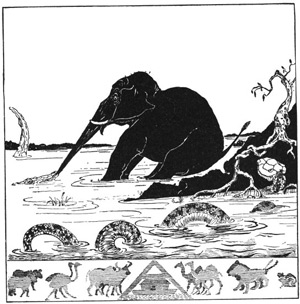
This classic illustration was posted here: http://www.jwoolfden.com/classics.html

OKAY, cynics, I know this may be a bit of a gloss; but here is another older post which is the keynote speech I gave for DeSales’ Sigma Tau Delta induction (Honors society of English majors), April 2010.

~

Why the English Major Is So Adaptable: A ‘Just-So’ Story

When I was an undergraduate, Oh Best Beloved, I was not at all certain of my life path. I attended an alternative, seminar-college program that—gasp—did not require me to proclaim an academic major. In my first two years of college, I wandered through classes in studio art, Renaissance history, feminist literature, social anthropology, psych, physics, dance, and philosophy. Then, I began reading in earnest. Previously, reading had been merely an obsessively entertaining hobby; as a junior, I wanted to learn the “how” of writing. I graduated with enough credits in both English and Philosophy to have been a double-major, if my institution had required majors, or to have received an undergraduate creative writing degree, if such a thing had existed in days of yore.

And then, I was out in the world. The world was in a terrible recession. Jobs were scarce. Inflation was in the double digits. Gas prices were skyrocketing. The sky was falling, and I was a newly-minted English major.

All my Wise Elders advised me to specialize. That meant going to graduate school, which I probably should have done a little sooner, or learning a trade. I thought I could survive outside of academia despite the economic woes, the scarce want-ads. My reasoning was that I had four years of humanities training in critical thinking, research, and problem-solving and that at 21 years old it was time to put those theories into application. I thought I had learned to be adaptable.

And what do you think, O My Children?

I was right.

You are likewise English majors, and you are also facing a time of recession and a paucity of careers in your chosen area of interest. This will not hinder your success, though it may make your career journey a little more…circuitous. Or shall we say: intriguing. But you like a challenge, don’t you? That’s the most terrific thing about choosing creative writing, or English, or rhetoric, or literature—the more you study them, the more intricate and complex and revealing these subjects are. I have never met an English major who wasn’t also a dedicated life-long learner. But I have met English majors who are lawyers, and psychologists, and social workers, and business executives, and filmmakers, and visual artists, and physicians, and ecologists, and diplomats, even computer geeks, not to mention those other careers: screenwriters, playwrights, poets, novelists, journalists, bloggers, teachers…

So, Best Beloved, do not sell yourself short. Furthermore, do not expect a “Reader, I married him” moment with your career. Allow yourself room to transform. Carpe diem.

What that meant for me back in 1979 was a temp job for the legal discovery department of a large law firm. From there, I signed on as a member of the International Union of Typographers No. 6 and learned a specialty: typographical proofreading. That field went extinct with the advent of desktop publishing. But by then, I’d jumped to advertising, which I hated, and into magazine work, which wasn’t so bad. There’s a Darwinian term for this: co-adaptation. I was finally getting close to a more specialist use of my English major background as the economy improved; and I married and had children and, in time, went to graduate school for the scholarly pursuits I’d missed so much.

I didn’t starve. Neither will you. You can do research. You can make yourself clear. You know your audiences may require different modes or styles of you, and you’ve learned how to adapt yourself and your arguments to those audiences. You can be persuasive. That’s how I got my first job after the temp work wound down; I was inexperienced but convincing. Even in a tight job market, employers are seeking people like you—adaptable, well-educated people. My husband recently directed me to an article in the New York Times that stated today’s businesspeople want employees who are clear communicators, especially in writing. This is partly because executives do their own writing nowadays. Fewer secretaries to rely on; each person’s expected to make herself clear—on her own written merits. Even if it’s email instead of the paper memos of my day.

English majors can write.

The jobs I’ve briefly mentioned paid my bills and got me medical insurance but did not satisfy my urge to practice the how and why of writing, so I did what writers generally do: I wrote. I cannot emphasize enough the role that constant practice of craft plays in the development of a writer. It doesn’t matter if no one sees your work—though I encourage you to share it with others and get feedback and critique—what matters is that you continually practice what you’ve learned in college and extend your education through application and extension of those principles.

If you find yourself in a day job that has little, apparently, to do with your major, don’t despair. Because writing is portable. I still write most of my drafts with pen or pencil in a small notebook, and laptops are pretty easy to transport—you can, with a little self-discipline, write anywhere. In my day, I have written in small dingy office warrens, in the waiting rooms of doctors and music teachers, in the parking lot while the high school band wrapped up its practice, in the sun beside the dressage ring at the horse farm, while my babies were napping, while the laundry was cycling, in the wee hours of the morning before anyone else wakens. The poems and essays I drafted under these circumstances sometimes reflected the places of their composition—but not always. I have waxed metaphysical in playgrounds. Another example of becoming adaptable out of necessity, Best Beloved, when the Great Magician or the Djinn of All Deserts or the small god Nqa tried me with obstacles to test my persistence.

Make the time to write, because writers can get rusty. Above all, make the time to read, because after you graduate, reading is the best way to continue your literary education.

But you knew that.

Of course, there is graduate school. And there are writing seminars and getaways and retreats and conferences. If you haven’t got the time or money to get to writers’ conferences or workshops, you can adapt by exchanging literary emails with a few like-minded friends or gathering in a library or coffee shop to exchange work or discuss books that excite you. Scholarship may seem like a solitary pursuit, but it benefits from lively interactions with other human beings.

Yes, Oh Best Beloved, do remember other human beings. We do not, after all, write only for ourselves; we write in and of and for a community of people. If our work is obscure, obtuse, or unclear, we are not taking part in this communication. The most fundamental purpose of language is to make clear our intent to another person who is, after all, not inside our brain but functioning under his or her own neurological system. Language—in our case, English—is the most formidable tool for demanding, commanding, sharing, expressing. Those in this room are understandably passionate about it. I am pleased to be among you. The world badly needs your talents, enthusiasm, and the abilities you possess to analyze the facts and transform yourselves and others because, My Children, the English Major somehow became adaptable, and that is all to the good.