Equinoctal

Torrents. We had rain in torrents, and it went on for days from February into March and then on…and on. Constant alerts on the cell phones: “Flash flooding.” Doldrums set in. In an effort to accomplish anything at all, I even started to sort through and organize my attic.

Talk about desperation!

The attic project isn’t finished–the weather turned mild and clear two days ago, so I ran to the garden to get to work out there–but it turned out to be a more rewarding task than I expected. I started by tackling the Christmas stuff, then the books (SO many books), children’s toys (the kids are in their 30s and there are no grandchildren), and moved on to paper correspondence. Letters! Postal mail. Epistles. Why I have saved so much of my correspondence from 1975 to the present, I cannot explain. Maybe that’s a thing that people who love words just naturally do, the same reason I have kept so many books. I certainly don’t need all of it; but that was part of the task, sorting what I want to keep and agreeing to recycle the rest. I also found odd ephemera, such as photocopied posters for long-ago poetry readings, broadsides of poems, xerox-zines from the early 1980s, and ancient mixtapes on cassette.

~

There’s some sorrow with this project. So many of my former correspondents have died. I find my grandmother’s looping script, my dad’s distinctive handwriting, my dear friend David Dunn’s nearly-illegible scrawl. Reminders of times past. Maybe that is why we keep ephemera: to remember what we thought, at the time, was important.

Maybe it is, maybe it isn’t, by the time we reach our later decades–if we’re fortunate enough to reach them.

I keep gardens for different reasons. Not to remember the past but to see what the present can bring.

~speaking of the present~

My new book can now be ordered from the publisher, if you find Amazon problematic (and there are good reasons for that). The link is here.

Flame and ash

I have often imagined what it feels like to lose everything in a fire. Particularly if you are a writer or painter, and you work with easily consumable tools–paper, for example. Maxine Hong Kingston has been articulate and interesting on this situation; perhaps it was her well-reported experience that first got me thinking about how terribly affecting such a loss would be. In 1999, a friend of ours whose business is woodworking lost his shop, tools, work, and wood in a workshop fire. The shock was the worst part–like Hong Kingston, our friends had been away from home and returned to find cinders where their livelihood had been.

Last week, Michael Czarnecki, publisher and sole proprietor of FootHills Publishing, was vacationing in Maine when he learned his house and business had burned to the ground. I have heard that phrase before–but it was literally the case: to the ground. With the loss of clothing, memorabilia, musical instruments, furniture, etc. came the loss of livelihood and the loss of FootHills’ archive of 20+ years of small-press publishing. Many, many books went up in flames, a life’s work.

Paul Martin's chapbook

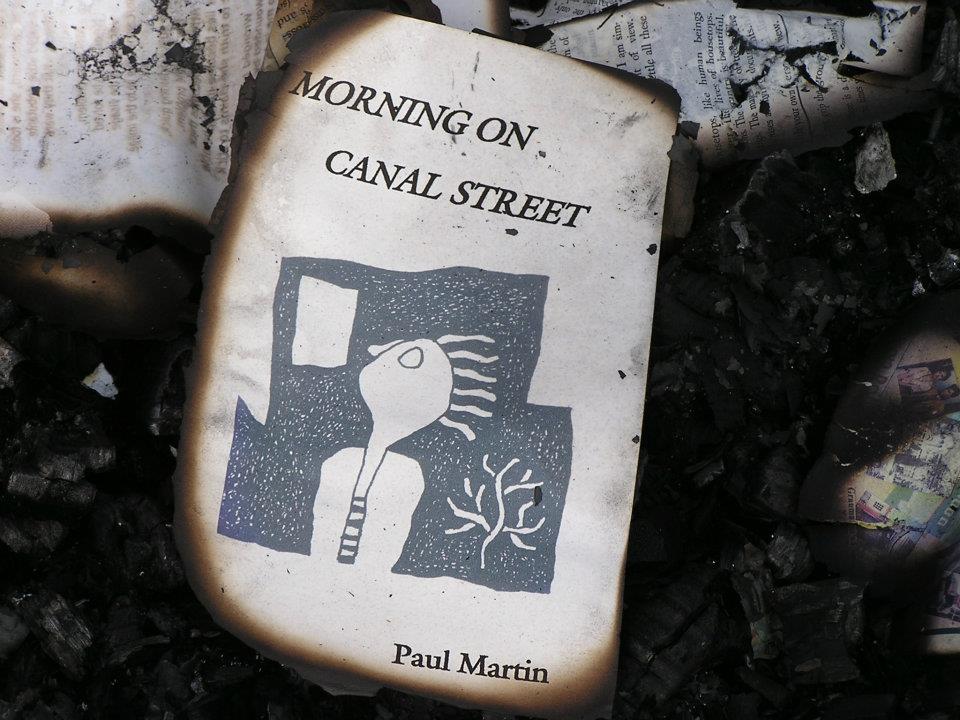
Paul Martin’s lovely chapbook Morning on Canal Street, FootHills Publishing.

Michael has been documenting the remains and posting images on his Facebook Page. Pictured here, what’s left of a copy of Paul Martin’s chapbook, one of the few that were still recognizable after the tragedy. Paul is a colleague of mine, and this photo makes me sad.

I am sure Michael has not yet done a full accounting of his destroyed inventory. The two books of mine he published are certainly among the casualties, and I feel a selfish pang over that. If he gets the press up and running again–and he plans to (he is an optimist and a hard worker)–he’ll probably try to reprint at least some of the 300 or so books FootHills has produced over the years. The more recent books will be easier to reprint, as he had his computer with him and it was not lost in the fire…pdf files of some of the books are intact. But the “history” of the press…its archival, early chapbooks, may be gone for good.

Once again, I reflect on ephemera. One of the most moving photos Michael took is one of his sons’ birth certificates, charred, the edges the same color as the tiny footprints that are still visible. We are so vulnerable.

And we endure, too. Our art helps us to manage these difficult passages. Love helps us navigate the ashes.

If you are interested in and financially able to help FootHills Publishing recover and rise, phoenix-like, from the ashes, you can go to the FootHills website and donate through PayPal or send a check to

FootHills Publishing
PO Box 68
Kanona, NY 14856

Thanks very much. As Michael Czarnecki says, “Never stop asking for poems.”

Ephemera

My collection Water-Rites was begun in response to a drought and a death. Interesting that the book’s release appears during an unusually wet spring here in my valley. On my morning walk through the meadow today, I saw quite a few species of dragonflies, generally a sign of a damp period in my region. Two days ago, mantis cases hatched; now there are tiny praying mantises on the patio slates, in the lawn, and among the grassy flora where we seldom mow.

The bees are out; the cabbage moths and early butterflies busy themselves with knapweed, eupatoria, penstemon, golden alexanders, honeysuckle, milkweed. The fragrance settles above the dewy grasses.

Most people are aware of honeysuckle’s scent. Few people know how lovely the aroma of milkweed blossom is. You have to time it just right–there’s no perceptible scent when the buds are furled, and the blooms are open only briefly. Almost at once, the blossoms ripen into pale knobs that will produce the familiar pods full of seeds packed cone-like into the pointed cases, silks battened tightly until autumn dries the pods and they burst.

But in early or mid-June, when the butterflies begin to arrive, those blooms are pale purple clusters of fragrance on a stem.

milkweed bloom

~

Ephemera intrigues me. Human ephemera usually is just that: brief, transitory, “lasting a day” (the Latin name for daylily, hemerocallis, comes from the same root: ἐφήμερα). Our letters, our emails, our YouTube videos and Hallmark greeting cards and shopping receipts.

Biological ephemera, however, is part and parcel of the cycle of life.

And poetry? Perhaps it’s an effort on the part of human beings to contribute to the lasting sort of ephemera.


~


milkweed in autumn Ann E. Michael