Heaven, hell, & halos

After 30 years, my husband and I still take part in the Goschenhoppen Festival each August. You will find I have mentioned it in many an August blog.
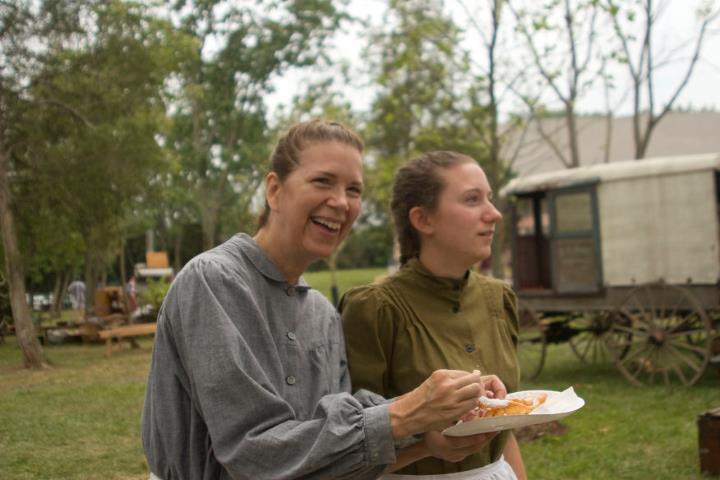
The photo at left is from 2010 or thereabouts, when the festival had newly moved to the park in Perkiomenville, PA, which is where the beautiful Antes House (ca. 1736) is located. My daughter and I were enjoying funnel cake. The park’s trees have grown considerably since then, and there’s more shade for demonstrators (and visitors). We were grateful this past weekend that the sunny days were not as humid as some years and that there haven’t been downpours to churn the parking areas into mud. And though neither of my own offspring could participate this year, it was lovely to see their festival-friends now grown, married–some having kids of their own–and still showing up to volunteer at the two-day reenactment of Pennsylvania German folk life of the 18th & 19th centuries.

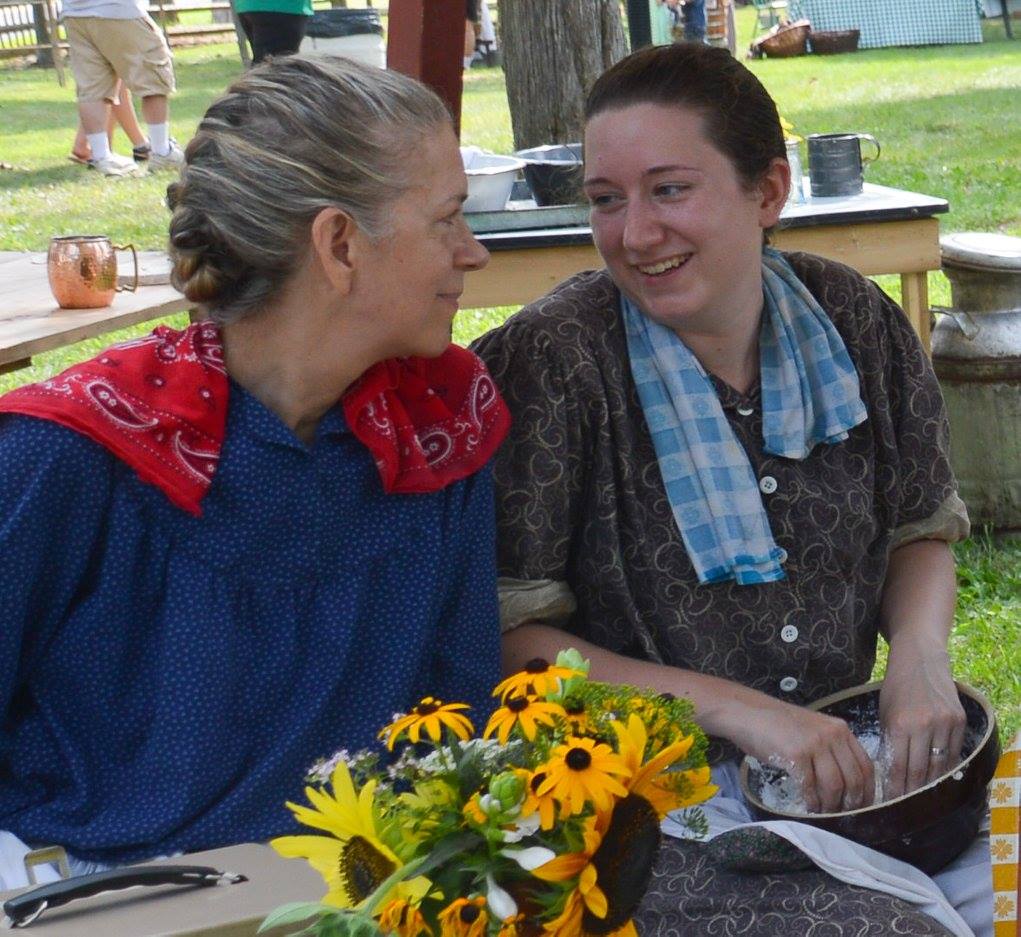
My demonstration is in the 19th-c household and foods area, and each year I am assigned a couple of young “apprentices,” girls ages from 12-17 in gingham work-dresses. This year a friend’s daughter was thrilled to be old enough to officially participate. She is full of wondering about life and is the sort of child who poses her questions and speculations aloud. She’s also at the age when she’s taking church classes for confirmation, and she’s interesting to talk with when she wades into her thoughts about Big Subjects. I often find myself telling her that the things she wonders about are puzzling even to grownups. Because it’s true.

Yesterday she asked about someone we knew who had died: “Do you suppose they went to heaven?” Yikes. While it might have been a good opportunity to throw a wrench into religious indoctrination, I felt her parents might not appreciate that. I merely responded that I didn’t see why not. But this little exchange reminded me of my own wrestling with the idea of heaven and hell when I was her age. From fairly early on, I just couldn’t imagine that the cartoonish heaven of winged souls wearing halos was in any way real; and though hell was also mentioned frequently in church liturgy, prayers, and hymns, my dad’s belief in a god who was forgiving made hell seem unlikely. So the information I took in was confusing.

It is no less confusing to me now, but I no longer sweat over it the way I did as a child. Anyway, the conversation with my little friend called to mind a poem I’d drafted after returning from a visit to the Metropolitan Museum of Art’s exhibit “Siena: The Rise of Painting, 1300-1350” which reminded me of how I loved Medieval and early Renaissance art when I was a youngster. All those saints and crucifixions. All that gold and iconography. I must have had a gothic tendency!

This draft may be more about art than about heaven, and more about envisioning than about anything else. It's not a finished poem, but who cares on this bright, late-summer morning?
~


Halos

What interested me most about
paintings of Jesus was
the glow around his head
because I saw such auras everywhere
when sun silhouetted our cat
in the dining room window
or lit up dew on tall grasses.

In later years I studied art
and learned the problem of cheating
light from solid pigments
the paradox of density layered
so some artists applied gold dust
to depict the nimbus gleam.

Yet even my little sister’s
fine blonde curls or the hairs
on my own skin could shine
that way illuminated like crowns
of hickory trees some autumn
morning long in brightness
no art to it at all.

Alien

Last week I attended a local book festival that offered a day of independent and small press books (Easton Book Festival) and came away with Lanternfly August by Robin Gow. The poems fascinate me on a number of levels, especially as I love poetry that interconnects with science–biology in particular–and with the diverse experiences that make up a human life.

But first, some context or references. Gow hails from eastern PA, from a rural area north of me, and now lives in Allentown. This region of Pennsylvania was port-of-entry for the spotted lanternfly, a recent scourge for gardeners and landscapers, that made its way from Asia–where it feeds on Ailanthus altissima (tree of heaven). Well, in fact, it did not “make its way” here; it was brought here, inadvertently I assume, through global trade and human intervention. It isn’t the lanternfly’s fault that it is an invasive species. It is human beings’ fault. What if we were to view the lanternfly from other perspectives? What metaphors might it offer us, particularly about being alien, the Other? This is one way to read Gow’s collection.

Gow, who is not yet 30, identifies as an “autistic bisexual genderqueer person” but says they didn’t come out until college. Life in rural Pennsylvania as a person with autism and a sense of being different in terms of mind and gender? There have to be feelings of alienation, or of feeling like an alien. Gow also writes for YA readers, where compassionate understanding of how it feels to be part of, or left out of, peer groups matters; in the lanternfly poems, readers get a sense of empathy even for this damaging leafhopper. That amazes me, and I appreciate it deeply.

When the bugs first appeared, I read as much as I could about how to discourage them from our trees, how to trap them and what their various stages (egg masses, instars) looked like. Mostly I was bent on eradication, with a bit of resignation in the mix–see this post from 2018. After we got them reasonably under control here, they began to move north and west, just as the brown marmorated stinkbugs did shortly after their arrival in 1998. Both insects feed on sap or fruit. They are foreign to our shores but find much to suck upon here and have damaged fruit crops and trees. Although some people find them beautiful–they are much prettier in flight than at rest, brightly translucent red with the sun behind their wings, and their second instar stage resembles ladybugs–they have gained the reputation of being a Bad Bug. Gow writes:

When I called you “host” I meant,
“I love you in a ruinous way.”

That’s from the poem “Third Instar.” In the poem “First Instar,” the speaker wonders how long before “this becomes wreckage? I don’t even know yet what I am.” The creature could be some type of cryptid, developing into something no one can explain or understand. Society offers solutions that don’t necessarily work–ways to eradicate the insect demonstrated on TikTok, laid out on government websites, posted on Pennsylvania Department of Agriculture’s pages. Also the inquiry, in “Home Remedies,” of totally re-imagining one’s body: “Have you tried becoming a different species? Have you really given mammals a try yet?” Wry humor, of a bleak but wildly intelligent sort, pervades many of these pieces. In “Stop the Spread” (pandemic/plague allusion definitely intended):

...I cannot stop myself
from lanterflying: verb meaning to exist ardently
despite not belonging. How did I become so contagious?
Spores, like fireworks, floated from my gills.

I’m not really writing a review here, just sharing my enthusiasm; otherwise I’d have written about the varieties of form/text/layout Gow employs and the structure of the collection, and much more. Anyway, this is the reason I love going to conferences, seminars, readings, small press, and literary events–always something new to me to explore and learn from. Gow’s poems have helped me to develop a kind of compassion for “alien invasives.” The parallels to how society treats its Others–those aliens and distraught foreigners (not colonizers) arrive almost inescapably from the collection. That those who do not fit in nonetheless have value and need appreciation and respect comes through as given. There’s deep heart in these poems.

A bit of awe from me to this poet. (I happen to be reading about awe right now, which may figure in my next post). To find out more about Robin Gow: They have a website with a daily poetry blog at https://robingow.com/dailypoetry/, definitely worth checking out, and their books are listed there.

How it’s done

The annual Goschenhoppen Folk Life Festival happens this week–Friday and Saturday–and for the first time ever, neither of our now-grown children can participate. Nonetheless, my husband and I will be at our respective craft demonstrations, showing visitors how people a century or two ago solved the requirements of living in the region before there were highways, diesel shipping lanes, power grids, electric appliances, and cars–but after Europeans displaced indigenous people and started sawing down the forests. We had a taste of pre-power grid life ourselves early this week when a fast-moving storm made us lose electricity for 24 hours.

Visitors to the festival often marvel that they “never knew that’s how it was done.” They buy pickles or jam in a jar in the supermarket and figure it’s all made in a factory somewhere (which is true, today); meat comes packaged, and who thinks about how rope is made, or flour, or candles? One part of the festival demonstration includes butchering. I won’t post a photo (though there is one here), since some people get uncomfortable about it, but if you eat meat it might be worth remembering where it originated. In the late 1990s, I wrote the following poem about it. I may as well post it today! But the image I am adding is instead a nostalgic one of my daughter and me at the potato candy stand in 2016.

~

Hog Butchering Demonstration, or Deconstructing Breakfast
 
Cleaving bone and muscle 
beneath tough hide,
the man with the knife starts his
slow disassembly,
describes cuts of meat,
holds out intestines, uncoiled:
“used for sausage casings”—
removes the bladder
to rinse and inflate—
children’s game, an old-time balloon.
 
The carcass resembles nothing
the audience usually sees
whose meat arrives in cellophane
processed—slices, nuggets.
The children, especially,
have never watched the studious
and useful taking-apart 
of a body, never witnessed
anything dead
but the flattened,
nearly unrecognizable bodies 
of road-killed opossums.
 
No comparison, this 600-pound hog, 
hooked and dangling, its interior 
opened with jigsaw precision.
The man with the knife 
is a revelation.
They stare fascinated
at the butcher’s truth
carving an exact history of
their breakfast bacon.
 
~

Festival, virtual

Coronavirus safety protocols continue to affect my teaching at the college and life in general–also, the life of the shared and diverse arts community, near and far. But arts folk are creative folks, by nature problem solvers and think-outside-the-boxers. This weekend, I have been attending the biennial Geraldine R. Dodge Poetry Festival via technological interface (my laptop); it has so far been as mixed and as enlightening an experience as teaching has been for me this semester.

It has been years since I have been at the Dodge in person. Teaching and tutoring are busy for me in October, and I have been free to travel to the festival only once since its move to Newark in 2010. Times have changed, and I have changed. I’m taking notice of what I like and do not particularly like about the virtual platform of the 2020 festival. Bear in mind that I am only marginally tech-savvy and not a person who’s wedded to the screen (television or computer or phone).

First impression, from the “opening ceremony” and an initial panel, is that I like the closeups of the poets–something I seldom had the chance to see when in the crowded auditoriums or tents of past Dodge festivals. As an older attendee, I have to admit I appreciate hearing the readers more clearly. It’s also nice not to have to wait for stumbling about on stage as presenters navigate the stairs, step over wires, chat with emcees, or shuffle through papers and books marked with post-it notes.

There’s a downside, too, of course. I cannot see the holistic figures of the poets, their attire and body language, their posture on the stage. I do not feel the attentive excitement of fellow audience members, hear appreciative murmurs, applause, or the rare but spicy snide remarks. The readings seem somewhat static and prepared (which they have been). The festival thus loses some of its remarkable spontaneity. I suppose I’m referring here to a lost physical community–but all of us should be accustomed to that feeling by now.

On the second night of the event, Pádraig Ó Tuama moderated a panel discussion on the theme “Imagine a New Way” with Martín Espada, Vievee Francis, and Carolyn Forché. The poems were intensely engaging, the readings remarkable; and the discussion among the poets and moderator managed to feel lively and immediate. Oh, notes to take, things I must read, ideas that go ‘pop’ in my head…

The takeaway after day two is that my sense of skepticism about online performance and conference events has begun to wane a bit. True, there is less chance of bumping into colleagues and making connections with fellow poets while grabbing a snack, and the bookstore browsing is not nearly as lovely an experience when the bookstore is online. True, there is much I miss about the hubbub and the buzz of past festival experiences.

Yet it turns out I rather like watching and listening to poets while sitting home in my pajamas and drinking decent, not-overpriced wine in the company of no one but my cat. In fact, at present, the scenario rather suits my mood. And I will be ‘tuning in’ tomorrow.

Arts festival

Early autumn is a lovely time for festivals. The city of Easton, PA–situated on the Delaware River–is hosting its 15 annual Riverside Festival of the Arts. There will be music, art shows, food, etc. on September 22 and 23.


At noon on the 23rd, I will be reading poetry with Diane Lockward at the amphitheater. Next to the river: a perfect site to read from my book Water-Rites.

~

The link is here. Or check the Events tab above.


100 Thousand Poets, and change.

 Reading, Pennsylvania has had its ups and downs. Recently, it made the national news for the sad distinction of being the poorest city in the USA. But like many struggling cities, it also has its share of citizens who are devoted to keeping the city not merely afloat and economically viable–a tough task in tough times–but also vibrant culturally. Where rents are cheap, artists can find studio space. Colleges can expand because there’s vacant space for parking garages and buildings ripe for re-tooling. Reading’s been host to quite a few poetry events lately, as a result of the aforesaid artist spaces and college expansions. (See GoggleWorks for one example of studio & performance space: http://www.goggleworks.org).

I spent the day at the Reading venue of the global event “100 Thousand Poets for Change.” On this overcast but mild day, there was a little disorganization at first, not uncommon for new festivals…but the  poets found one another, and before long there was a lively little crowd seated and standing near a performance space for what was billed as a series of featured readings with musical interludes but which became an open reading with music as background. And train sounds as background. And car and crowd sounds, and it didn’t matter because the audience members were paying attention to the readers.

At intervals, I wandered away and bought food from the vendors. Reading has some good ethnic food establishments, judging by the Vietnamese spring rolls and the falafel and such.

I sat on a park bench with my friend Marilyn Hazelton, a tanka poet and practitioner of haiku and haibun, and we discussed the young performance poets and the uses of structure in poetry and in life. We had a moment envying the young for simply being young and energetic, and then we spent a few more moments on what we’ve learned and the value of aging. Both of us are teachers, as are Craig Czury and Heather Thomas, two poets who were instrumental in putting the poetry aspect of today’s gathering together, so we also talked about teaching. Sometimes a quiet talk with a good friend revitalizes me. After our conversation, I felt energized enough to read a few more poems to the crowd. A man my son’s age shouted “Good stuff!”

All in all, a good way to spend the first Saturday of the autumn season.

Reading Reading

I love the wordplay inherent in presenting a poetry reading in Reading, PA: a Reading reading.

This Saturday, Reading is hosting on of the sites for a day-long, global poetry event called 100 Thousand Poets for Change. I’ll be reading around 5:30 pm (645 Penn St., if you are in the neighborhood, and you may want to bring a folding chair).

But by all means, come earlier and stay later: there will be music and poetry and other interesting goings-on all day.

Sat, September 24
100 Thousand Poets for Change and Street Music Festival
Courtyard and walking malls in the 600 block of Penn Street, Reading, PA
www.bigbridge.org/100thousandpoetsforchange/?cat=249

Sat, September 24
100Thousand Poets for Change
600 Block of Penn Street
http://iartreading.org/


The screech owls were very noisy at 5:45 am, so I couldn’t go back to sleep. Thank you, owls, for reminding me to post this notice about the reading.