Untermyer Park

~

My enthusiasm for gardens of all kinds seems inextinguishable, and my tastes are wide-ranging. I love cottage gardens, wilderness-style native gardens, garden rooms, rooftop gardens and multi-acre gardens (ah, the Biltmore Estate...), sculpture gardens, vegetable gardens, potager and herb knots and medicinal plots, historic gardens (Monticello, Bartram’s...) and my grandma’s truck patch, may my grandma rest in peace. Also Asian gardens, European gardens, alpine gardens, undersea gardens (I have yet to visit one, but I would love to do so)–and I’m intrigued by trick gardens like the one at Hellbrunn in Salzburg and themed gardens and miniature railway gardens (there’s a fun one near me at Morris Arboretum). Oh, and I adore arboretums. Or should that be arboreta?

Gardens, like art and literature, reflect unique visions and aesthetics. And they are completely process-oriented: the results, if you can call them that, are fleeting and changeable. Maybe that’s one reason they appeal to me.

~

Recently, I had a garden adventure that was part nostalgia, part history, part aesthetic–and a lovely day out with my sister, as well. We decided to return to a park that had been important to us when we were very young, for the three years we lived in Yonkers, NY (see my post on the Grinton Will Public Library).

My family lived in houses that had almost non-existent backyards, which is not uncommon in Yonkers–a city built on hills and cliffsides, dwellings crowded practically on top of one another in some parts of town. Our parents took us to nearby Untermyer Park for picnics, exploration, and play. Situated above the Hudson River, the park was like The Secret Garden, Alice in Wonderland, ancient Greece, and Narnia, all rolled up into one mysterious and lovely, part-wild, part-formal place. The walled garden and the grotto beneath the Temple of Love were favorite places.

When we lived there, the park was reasonably well-kept, though not planted with many blooming flowers: lawns mowed, shrubs and trees somewhat pruned, no graffiti, a few paths cleared. The park belongs to the City of Yonkers, deeded to the public by Samuel Untermyer–a civic-minded gentleman who for some reason did not also endow the place. As a result, maintenance of the original 150 acres quickly became untenable and the city sold off much of the land. The 1862 mansion was razed, a hospital began to expand on some of the property, and the former glory rapidly decayed, overgrown by trees and weeds.

Which made it all the more exciting to people who are very young. It was entirely possible to believe there might be lions or mountain goats or fairies in the fringes of the woodland. The columns evoked stories and myths. The long reflecting pools, though not entirely full of water, were exotic canals or dangerous rivers or chasms. There were stairs and doors in surprising places, and overhanging vines, and grand old trees.

My sister and I share happy memories of the park. We had heard that it went through ups and downs depending upon the economy, the health of the city, grants, taxes, etc. Apparently the early 70s saw considerable graffiti on the walls we loved and on the grotto rocks. We heard indigent young people liked to hang out there and get stoned. We heard the woods had become littered and full of vermin. In the 1980s, some clean-up occurred; the park had made it onto the federal Historic Register. The walled garden was kept clean, and most of the graffiti tags erased. Deer roamed the place, eating everything but the mugwort, phragmites, and Japanese knotweed. The city still had trouble funding maintenance on the park, let alone restoration.

My sister went searching for Untermyer recently and learned that the city of Yonkers has hired two full-time gardeners and has partnered with a non-profit organization in an attempt to get more serious about restoration of this special place. And last weekend, she and I went on a tour with the enthusiastic gardeners and their young and enthusiastic apprentices.

And fell in love with the park all over again.

Even in its partially-wild, partially-decayed state, Untermyer Park compels the visitor. People genuinely gasp as they enter the walled Persian-style garden through the Artemis gate (the walled garden has been largely restored and looks pretty fabulous). The website offers an overview of the amazing history behind the place and includes some photos from the Roaring 20s, when Greystone Estate was the place to attend a party.

The “Persian” garden symbolizes Eden; indeed, the word “Paradise” has its etymological roots in Persia (Iran) as a compound of the word pairi- “around” and the word diz “to make, as in a wall.” Here’s a photo I took with my sister’s phone. The snapshot doesn’t do the place justice, of course; nor can it capture the thrill we felt at returning to find an old, old friend in the full bloom of health.

Inside the walled garden, looking north at the amphitheater

Inside the walled garden, looking north at the amphitheater

Click here for Untermyer website.
Beauty & awe–briefly

I have been reading lately (currently Leonard Shlain’s Art & Physics and Donald Revell’s The Art of Attention: A Poet’s Eye), but not much inspired to write. Instead, I work in the garden or sit on the porch and listen to birdsong.

I muse upon beauty. Partly such musing falls under the pursuit of aesthetics: the world of my garden becomes especially beautiful in spring. The sounds birds make seem beautiful to my ears. Water droplets on emerging leaves appear beautiful in the morning light.

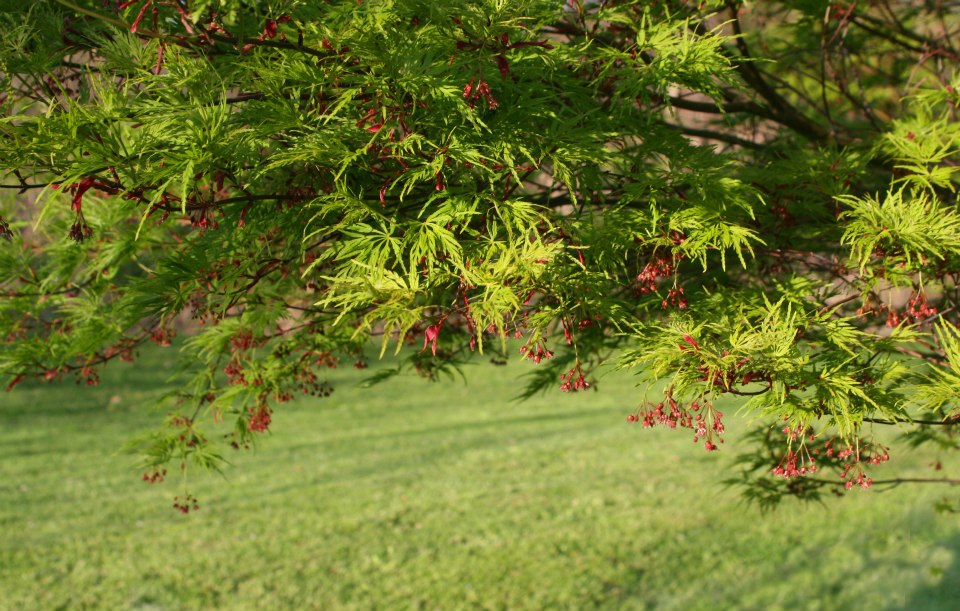
japanese mapleThese are phenomena. The world of things I can take in with my senses, process through my body and brain, and create–out of whatever “mind” may be–a concept of the beautiful. The phenomena are not physically affected by my categorization. It is I who am changed, I suppose, by virtue of my aesthetic appreciation of the beautiful.

I am reminded of Kierkegaard:

“Love does not alter the beloved, it alters itself.”

Aesthetic appreciation does not alter the thing-in-itself, it alters the person who finds beauty in the thing-in-itself. If this is so, I am altered by my love of what I deem beautiful.

~

While I was searching the web to find the quote above–I couldn’t quite recall it exactly–I found the Kierkegaard quote on the blog of pastor Jonathan Martin, whose theology I can’t completely get my mind around but whose words (below) reminded me of the Bhagavad Gita:

The most beautiful thing a person will ever see may well also be the most terrifying.

Is this not the nature of true beauty? To not just be soft and delicate, but to be so powerful, so overwhelming, so altogether other from ourselves as to threaten? Beauty does not intimidate, but it can overpower. Beauty is a coup to our senses. It holds an unruly power over us. Beauty can move us, haunt us, carry us, compel us. To feel ourselves beholden to the raw power of something beautiful is to be upended, not just inspired but assaulted.

On the lines of such thinking, we might find beauty in a tsunami, hurricane, earthquake, meteor strike the same way Arjuna feels paralyzed by the awesome beauty of the revealed godhead Krishna.

Perhaps that is why we often find ourselves fascinated by photos of natural disasters. Having lived for a couple of years along the northern end of Tornado Alley in the USA, I fear tornadoes. But they possess a kind of beauty in their awesomeness, if we can remove ourselves from the anguish we feel for people whose livelihoods, homes, and lives are destroyed by the big winds.

I wonder if human beings can ever bear that kind of awe; Martin says it transfigures us, Kierkegaard implies something similar, the Mahabharata and other sacred literature suggest that our bodies and our minds can withstand such revelation but cannot describe or truly comprehend it. It seems to me a kind of spiritual post-traumatic stress disorder! This is the “fear and trembling” of the psyche, whether the mind decides the experience is physical, mental, spiritual, or religious.

And that manner of beauty is not aesthetic.

Martin later writes, “Objectively speaking, the beauty of God is already present in our beloved, whether we recognize it or not. Rather, when we encounter beauty in another person, we are changed–we are transfigured…[those we love] do not become beautiful because we recognize their beauty; rather their beauty makes us beautiful.”

Is this experience awesome or aesthetic? Does the beauty of the azalea, the lilac, make me beautiful because I recognize it as such? Am I altered, fundamentally, in my admiration for an artist’s work, a poet’s words?

~

Enabling & stewardship

The season of seed catalogs is upon us, and I begin to fantasize about all of the vegetables and flowers I want to grow and how I will arrange my small garden area to accommodate them. I imagine having time to keep the rows cultivated and the foliage free of insect pests. Yes, I need to do some work on the fencing. And yes, some terracing might help where the garden’s taking a decidedly southeasterly dip. The asparagus patch finally played itself out, so it will need some restructuring and weeding; I’ll have an opportunity to use that area in a new way.

There’s snow on the garden now. All of this planning is purely speculative on my part. Yet–how clearly I can envision it, in my mind. One of my concerns is whether I’ll feel hale and hearty and energetic enough to get all of this work accomplished!

Ah, my garden-consciousness brings me to the mind-body problem, though perhaps in a more physical way than philosophers encounter it. My conscious mind imagines the garden that does not yet exist. Is that garden real or an illusion? What makes it possible for me to conjure it so vividly? Is it merely memory of past experience? If so, why does my imagination invent a slightly different garden–this year’s ideal? My animal self takes action, physical action (phenomenological action) in order to bring about fruition to feed the physical body that loves the taste of vine-ripe tomatoes and fresh beans and tender lettuces. Do my actions cause the plants to grow? No. I’m more of a steward or a guide. I help them get a better-than-average start.

This sort of thinking brings me around to a (2011?) post by biologist Stuart Kauffman, on the NPR philosophy blog.

Kauffman says:

We think we live in a web of cause and effect. We do. We also live in a web of enabling opportunities that may or may not be seized, and the living world, biosphere up, unfolds in a different way, creating ever new possibilities of becoming.

But these possibilities often can’t be stated ahead of time. No one foresaw Facebook when Alan Turing did his work in the first half of the 20th century. Nor can we foresee all the possibilities of the evolution of life.

Life is not a well-formulated, complex optimization problem to be solved. We do not know all the variables that may become relevant.

Science is my life, and it is wonderful. But science will not ultimately know everything.

In the world of modernity, our values have become badly deformed. Gordon Gekko’s “greed is good” has replaced “integrity, generosity, and courage” as our First World cultural ideal. Modernity does not serve our humanity well, although it does offer enhanced standards of living. We are reduced — to price tags, cogs in an economic system making often useless products in the name of forever GDP growth on a finite planet. The bankers corrupt themselves and our government. Our government does not yet realize that its better job is to enable, not command, to “garden,” to coach, to enable the creativity of its peoples, here and around the globe.

Yes, that’s it. I engage with my environment partly by enabling things to grow or flourish. The term enabling has garnered some negative connotation in recent years due to its use in psychology: we are warned not to enable alcoholics, manipulative people, or those who need to learn some grit and self-motivation. The idea of enabling is, however, essentially positive: to help, to nurture. In fact, I think I prefer to think of myself as one who enables the earth rather than as a steward–though both concepts suggest that we human beings must engage willfully with the world.

We have work to do here on earth. And I am well aware that I do not know, with my garden, “all the variables that may become relevant.” (Past complex variables have included drought, hail, flooding, and beetles.) My small part this year includes serving the land I temporarily inhabit as well as serving myself and my family our favorite foods.

31281_1488041725309_1074892_n

My favorite sources for seed include: Seeds of Change, Territorial Seed Co., Peaceful Valley Farm Supply, and–while less on the organic spectrum, the British firm of Thompson & Morgan for its amazing variety of herbs, vegetables, fruits, ornamentals and grasses from heirloom to the latest hybrids. For American gardeners interested in some truly historical strains, Thomas Jefferson’s Monticello offers quite a selection.

(Photo: a previous year’s garden in May)

Not a dry spell

October arrived in a remarkably ordinary way, considering how inconsistent the weather in my valley has been during the past year. There were a few clear days of brilliant sky, some heavy breezes with leaves beginning to drift into the lawn, a couple of glorious autumn days–mild and crisp–followed by a spate of rain and humid air (and toadstools and mushrooms cropping up everywhere), a further yellowing and reddening of foliage, and then, chilly rain.

This is “normal” weather for our area in early- to mid-October. Although the heavy skies and damp chill are not always welcomed by residents, including me, the gardener in me feels relieved. We need the rain and the coming dormancy. The birds relish the late, large insects that frequent gutters and fields, ponds and puddles, providing proteins for a trip south or for winter ahead. Seeds need the watering-in and the cooling-down. Trees need reminders to store their nutrients deep inside when the cold air really sets in.

And pretty soon, I will have bulbs to plant. I want the soil to be moist enough to dig up and the ground temperature cool enough to keep the daffodils still and quiet for several months.

Some years, I write prolifically in autumn; it’s as though the change in season effects a kind of transition within me, and creativity abounds. Other years, not so much. I do notice that when I spend a good deal of time out in the garden, I write more. This fall has not been that kind of season. I have been busy with writing tasks that do not exercise the philosophical or metaphysical side of myself–though I have been writing, most of the work has been reviews, proposals, pedagogy.  I will be posting links to the reviews and essays on the sidebar to the right, adding to the list…

Should fortune–and the Muse–smile upon me, there may be a few new links to poems, as well, in the coming weeks. In November, I’ll be giving a few readings locally. In January, I’ll be teaching Introduction to Poetry again, and I’m eager to try new texts for my students.

Perhaps the post-equinox period will have a creative harvest after all.

Confident but not certain: the garden

Recently, I listened to a radio interview with Madeleine Albright, former Secretary of State, who is promoting her latest book. The interviewer asked her what quality she thought most crucial to a good leader. Albright has met many, many leaders; she is also a brilliant person. It was a good question to ask her, and she had an excellent and thought-provoking answer: A good leader should be confident, but not certain. (If you download the mp3 file in the link above, her explanation of this idea comes near the end of the program.) Powerful people who are both confident and certain of themselves, their aims, knowledge, and ideas, are too likely to veer into autocratic dictatorship. Those who are neither certain nor confident are too easily swayed by advisors with their own agendas or are unable to make decisive moves. A person who is open-minded–and therefore not certain–but who is confident in his or her ability to make a good decision once the facts are in, leads wisely and well even when mistakes occur due to faulty information or circumstances beyond anyone’s control.

We could all benefit from becoming more confident and less certain. It strikes me that Socrates might have possessed this pair of qualities. The philosopher continues to question and is therefore not certain; but the uncertainty isn’t of the waffling, inconclusive kind. Uncertainty in Albright’s use of the word means curious, inquisitive, searching. The confident person trusts his or her values (confidence, from fidere, “to trust”) but does not let dogma or single-perspective “certainties” obscure research, facts, other perspectives.

I will grant that this approach is difficult for us humans, and that is why so few leaders possess this pair of traits. While I have no interest in becoming a world leader, I plan to keep Albright’s phrase in mind and discover whether I can become more confident and less certain in my life.

This bust resides in the Louvre, and the image was found here: http://www.humanjourney.us/greece3.html

~
Gardening is one area that relates well to confidence and uncertainty, though in a slightly different form of practice. I’ve been a gardener for over 30 years, and one thing you learn when you garden is that there are no certainties. Planning takes mental and physical effort and preparation, and then there are the endless obstacles involved in planting and overcoming soil deficiencies, insects, fungi, and weather inconsistencies just to name a few. Am I a confident gardener? Yes. Years of research, experiment, study, practice, trial and error–and successes–have made me confident. But there are always new hybrids to try, new species to plant, and there are problems that never seem to go away (why can’t I get carrots to grow here, when I have grown carrots every other place I’ve lived? How to keep certain fungi at bay using organic means?).

And one never has any sort of surety or pledge (the etymology of “certainty”) that those tomatoes will ripen without blossom end rot or fusarium wilt, that the pigweed will not take over during the gardener’s five-day vacation (well, that’s almost a certainty!), or that hail will not wreck the whole summer’s worth of plantings.

Ann E. Michael

June, 2009–after the hailstorm

This year, my vegetable garden is producing well despite overbearing heat, hard brief rains, and far too many weeds. I feel annoyed with its overgrown appearance, but one thing about gardens is you get another chance as long as you can wait a couple of seasons.

Meanwhile, with a little more thought and research, I’m confident I can plan an even better garden next year.

Control

middle island ~

Human beings crave control. We want to be the masters of our own fate or to believe that there is a master of our fates who can be entreated or persuaded, propitiated or cajoled into helping us to gain control of our lives or the lives of others. We want to change the weather so that the rain falls when the soil needs rain, wetting the seeds we’ve sown, and so that the warmth comes when our plants need warmth. We want the sea to be calm and the fog to lift when we are ready to set sail. We want fine, sunny days when we visit the beach to swim or head out for a picnic. We want just enough snow so that school’s canceled, but not so much that our power goes out. We pray. We dance. We chant. We invent little private rituals and participate in community rituals.

We want to control our health. It does not seem to be an unreasonable aim. We want to control our relationships–just enough to keep ourselves happy. We want control over our careers and  our income–not so much to ask. We want to be able to make our own decisions. We want choices so that we feel we have control over our lives.

My gardens are my analogy today. I’m still endeavoring to exert some control over my vegetable garden, but I kept my purposes modest this year; I planted fewer beans, fewer tomatoes, fewer peppers, fewer potatoes, no onions, no peas, no edamame, no radishes…the walk-through rows are wider so it is easier to weed. Beginning with the dry warm winter and some assemblies of challenges that do not pertain to the garden, the season looked “iffy.” Then came lashings of showers in May. A challenging season, but not insurmountable. I have been gardening a long time, and I have methods of adapting to things I cannot control. It comes with the territory.

The ornamental beds have presented the most difficult struggle with my need to control the space I (somewhat ridiculously) consider my own. When the beds get overgrown–as they are now–I know that I can accept their exuberant rioting with the successful weeds. I can say, “This is what nature intends. There is beauty here.”

overgrown

I do know that. But the controlling mind–the monkey mind–says, “Too much penstemon; it’s gotten aggressive. Deadhead the peonies. Pull up the plantian, the wild asters, fleabane, wild garlic, crabgrass, bermuda grass, creeping charlie, five-leaf vine. Get the seedlings out of there (mulberry, redbud, oak). Mulch. Keep the rabbits off the hostas. Move the marybells. Get the weeds out of the alchemilla…”

My head clouds with fog. The seas get rough and I despair, because I cannot control things. Not even a small garden.

Instead, I could be meditating on green. On the amazing variety of leaf-shapes, on dappledness (like G. M. Hopkins):

Pied Beauty

Glory be to God for dappled things—
For skies of couple-colour as a brinded cow;
For rose-moles all in stipple upon trout that swim;
Fresh-firecoal chestnut-falls; finches’ wings;
Landscape plotted and pieced—fold, fallow, and plough;
And áll trades, their gear and tackle and trim.

All things counter, original, spáre, strange;
Whatever is fickle, frecklèd (who knows how?)
With swíft, slów; sweet, sóur; adázzle, dím;
He fathers-forth whose beauty is pást change:

Práise hím.

~

Here is one aspect of my ornamental garden. Overgrown, yes. Lush, diverse, lovely in its unrefined way. Until I have the wherewithal to tear through and divide and move and mulch, this is not a bad view, the definition of … lack of restraint, ornamentals gone wild. Freedom, I suppose.

A little too much of some good things.

As we grow, we learn to let go. So I am told. Garden, you have a chance to go wild!

And I guess I have the opportunity to learn to live with that.

22 years ago this week

Here’s another post from some time back, one I have updated to reflect current experiences: the graduation and the 22nd birthday of the subject of this brief reflection.

azaleas by Ann E. Michael

The morning was hot, and I had not kept up with the gardening. I needed to get the zucchini seeds, etc. in the ground before the weather got too hot and dry. We were a little behind schedule with the garden because we had a 17-month-old, and I was 9 months pregnant. I was sowing and weeding as women have done since the earliest establishment of agriculture, heavy with child, my back aching, working like a woman obsessed.

You know, that “nesting” thing you hear about with mothers-to-be? I was a week overdue and sick of waiting around; and  gardens won’t wait. The weather was perfect for planting the post-frost seeds. The time was–of course–ripe. Eight hours later, I gave birth to a daughter.

A couple of years later, too busy to write much, this set of cinquain stanzas arrived in my mind (published in 2001 in June Cotner’s anthology Mothers & Daughters, A Poetry Celebration).

Now, that infant is a grown woman with a  college degree. Happy Birthday, Daughter.

To My Daughter

Early
morning I had
planted seeds, cucumber,
melon, squash—I pressed them into
warm earth.

The blood
in my body
sang and I listened for
a cry to join my own—straining
to hear.

And there
you were, all pink,
unfolding in our hands,
a blossom opening with a squall:
daughter.

© 1994 Ann E. Michael

Early blooms

photo by Ann E. Michael

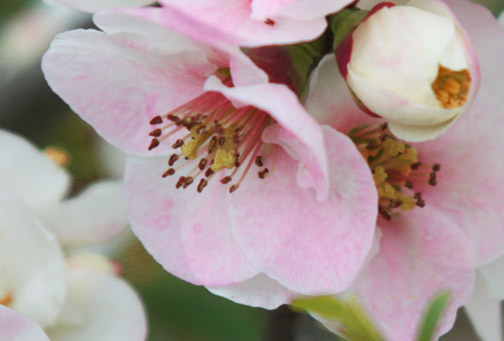
Quince blossoms.

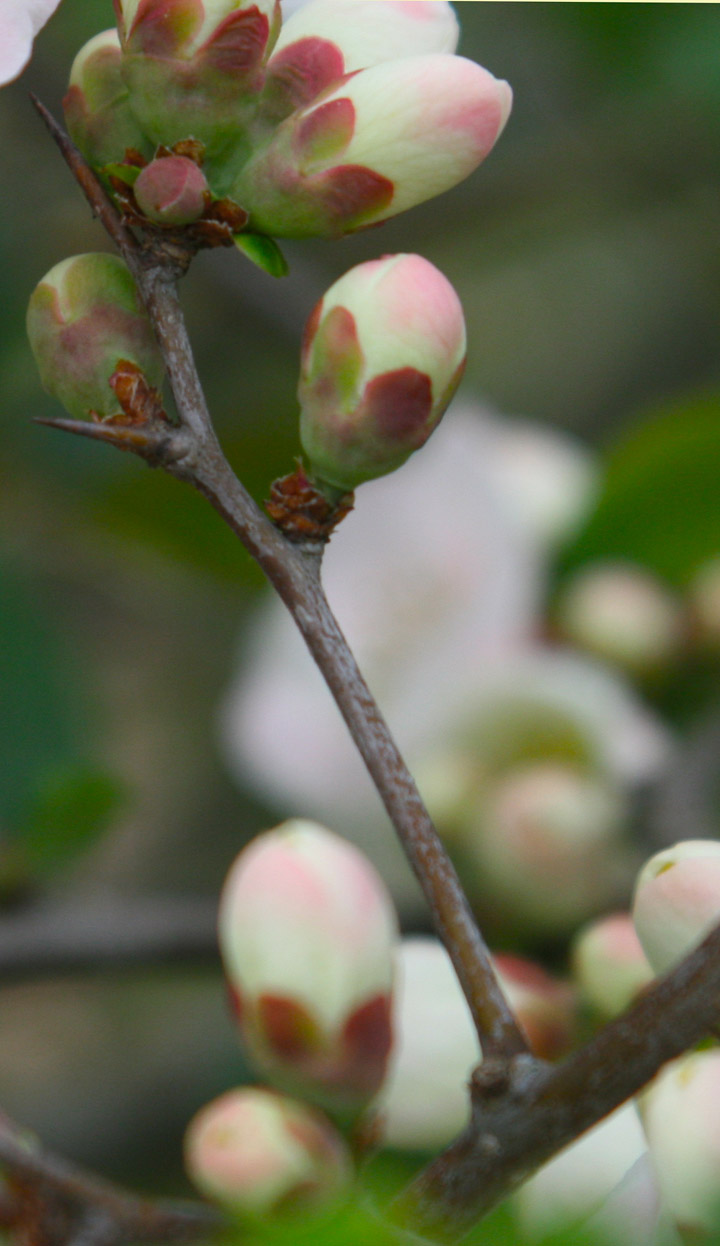
The strangely warm weather around this equinox has sped spring along. Above, one of my favorite ornamental shrubs, a quince (Chaenomeles speciosa) in the named variety “Tokyo Nishiki.” I love its pale blossoms that lack the orange-y hue of the more common varieties of chaenomeles.

While it’s lovely to see the sun, blue skies, and so many flowers, it is worrisome because an open winter requires–in our temperate region–a rainy spring to make up for the lack of snow-melt. Instead, we are three inches below the average precipitation for March. It is unusual to have to water the spinach bed; usually, I am instead dealing with sprouts that pop up far from the intended rows because heavy rains have dislodged them.

Of course, everybody talks about the weather, but nobody does anything about it, as the old saying goes. I am just going to wait and see what happens. Will we get our blackberry frost? Will it be a hard frost that kills off the redbuds and damages the early blossoms? Will we get a freak April blizzard to bookend our freak October blizzard? Or will we have a dry, too-warm spring that means the daffodils wilt early, few blossoms in May, and a tough summer for food crops?

I have some thoughts about gardening in drought years, but I am crossing my fingers that maybe we will get spring rains after all.

Anyone know a rain dance, chant, or prayer?

In the Garden

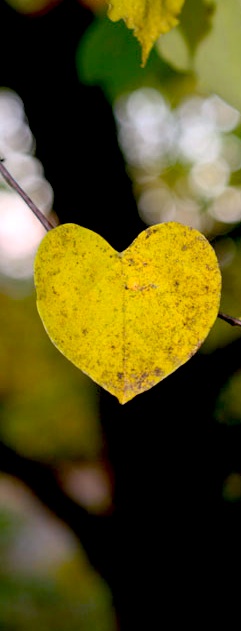
Redbud leaf in fall

“[T]o be worldly… is to be outside the gift of poetry, to be, in some measure, too human for comfort.” Peter de Bolla

A teacher of mine once defined a nature poet as a writer whose subjects and metaphor are nature-based. The majority of my work does fall under that definition, though not all of it. At a recent meeting of my writing group, one member who considers herself a beginning poet asked me, “What do you do if an idea for a poem comes to you while you are gardening?”

As in my work, her poetry often centers on images and inspirations that visit while walking, weeding, sowing, and so forth. So it was a simple and sensible question. Generally, I keep a small journal and a pen nearby when I work. There’s a porch swing near my garden gate, and often I keep my writing tools as well as my gardening tools on the swing.

But today I forgot. I was drawn to the vegetable garden by a break in the soggy weather, a glorious day before first frost, zinnias and marigolds still in bloom and all the weeds going riotously to seed. I pulled up undesirable annual grasses, polygonum, crabgrass and queen-anne’s-lace, wild asters, elderberry stalks, and vines along the edge of the fence. I’m fond of goldenrod and chicory in the meadow, but they make poor companions for asparagus; out they went. A northern mockingbird heading south stopped to perch among the walnuts trees and trilled as cheerily as it would have done in spring.

And I had ideas. And I forgot to write them down.

I cannot recreate that pleasant hour now, but the time spent among the weeds and the late bees and the big spiders catching their last prey and hanging their egg sacs in possibly-safe places while the hawks cry high overhead is comforting and inexpressibly valuable to me. But being in the world—what we tend to call “the natural world”—keeps me from becoming too worldly. Keeps me attuned to the gift of poetry, and keeps me from becoming too human (too rational) for comfort.

Aerial Roots

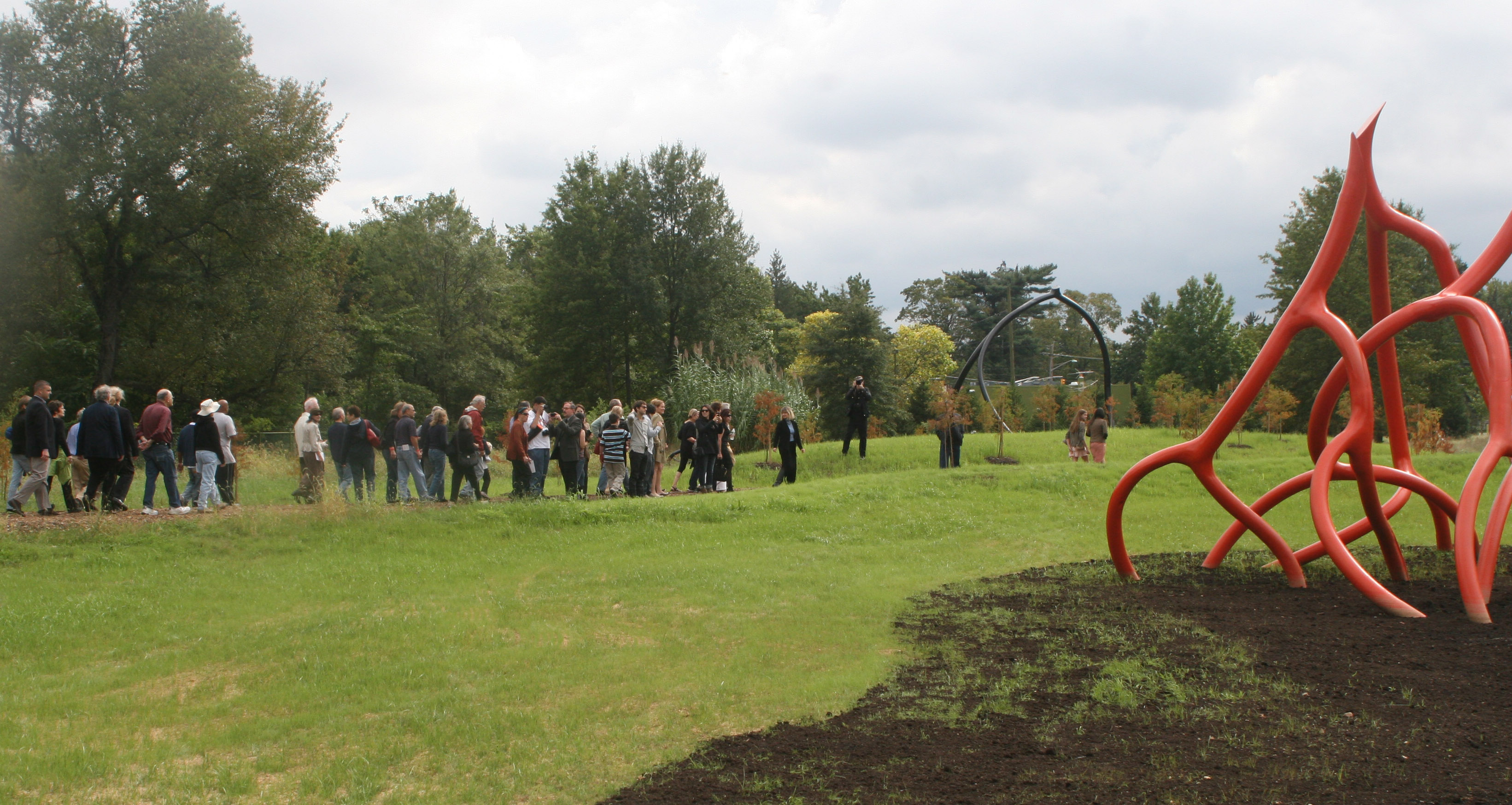
The Wildflower Meadow @ Grounds for Sculpture w/Tobin’s Aerial Roots

Visitors descend upon the newly-opened meadow. Aerial Roots will be in residence for about a year. By spring of 2012, the wildflower meadow should be well-established; the plan was to provide a native ecology setting (for central NJ near the Delaware River) in which sculptural works could be displayed. As the smaller trees mature, they will screen some of the sculptures, lending the possibility of surprise as the visitor walks the paths. Right now, the meadow is more of a flat setting for the steel roots–we can see everything from the rise as we enter the park. In time, revelations may be part of the experience. Visit the mature areas of GfS to get some idea of how the meadow may evolve naturally around the artwork.

Surprise is, for me, one of the hallmarks of wonder, awe, and art. I like to be surprised when I view or read or listen to works of art. Surprise leads, when the work is good, to revelation and reflection. It is not the sum of the aesthetic experience, but it seems to me a necessary component.