Heaven, hell, & halos

After 30 years, my husband and I still take part in the Goschenhoppen Festival each August. You will find I have mentioned it in many an August blog.
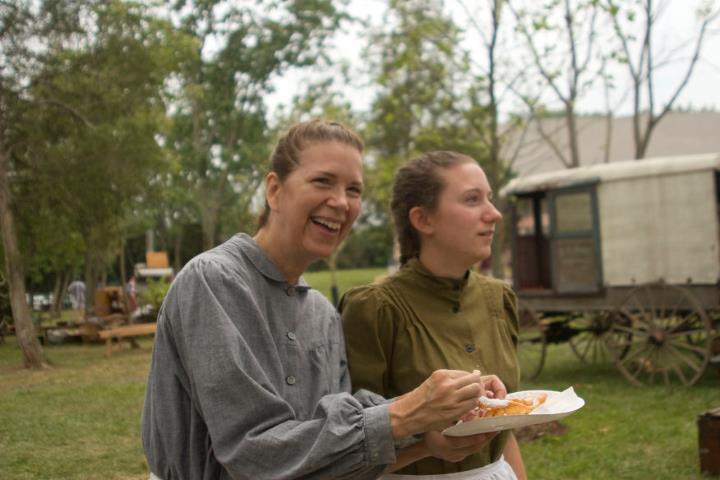
The photo at left is from 2010 or thereabouts, when the festival had newly moved to the park in Perkiomenville, PA, which is where the beautiful Antes House (ca. 1736) is located. My daughter and I were enjoying funnel cake. The park’s trees have grown considerably since then, and there’s more shade for demonstrators (and visitors). We were grateful this past weekend that the sunny days were not as humid as some years and that there haven’t been downpours to churn the parking areas into mud. And though neither of my own offspring could participate this year, it was lovely to see their festival-friends now grown, married–some having kids of their own–and still showing up to volunteer at the two-day reenactment of Pennsylvania German folk life of the 18th & 19th centuries.

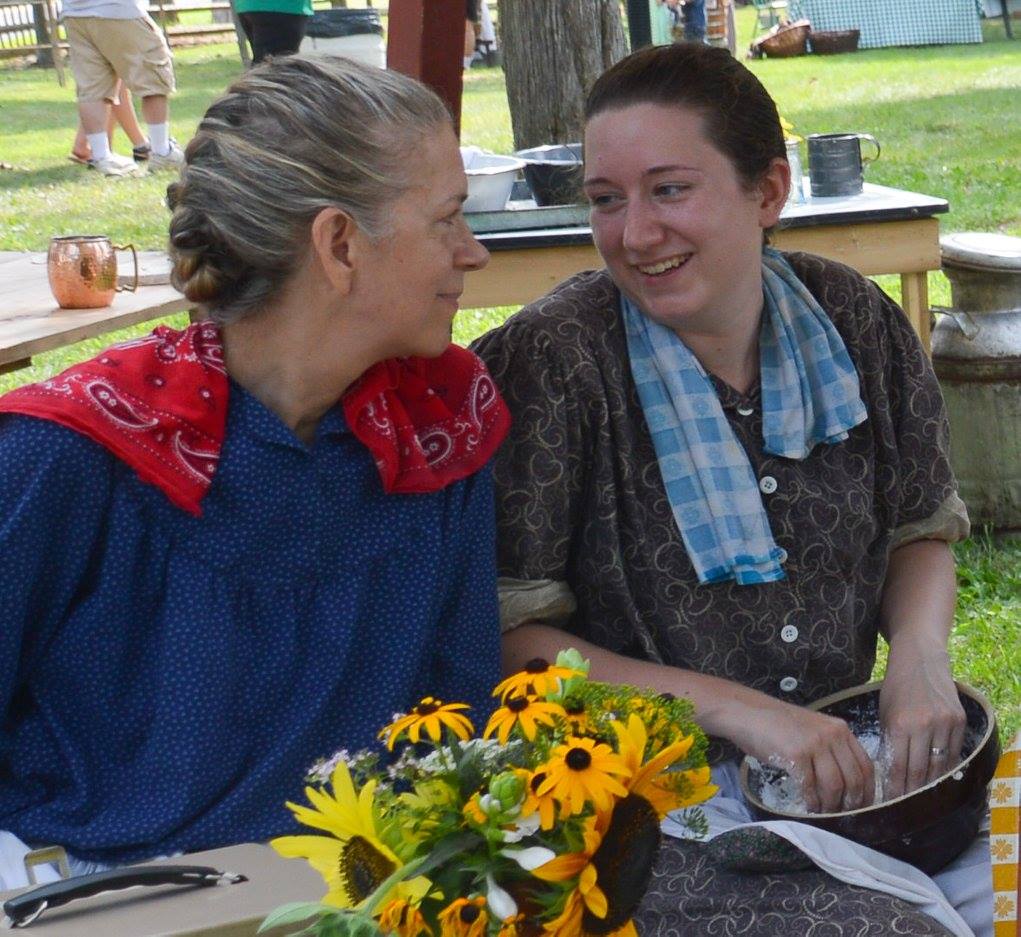
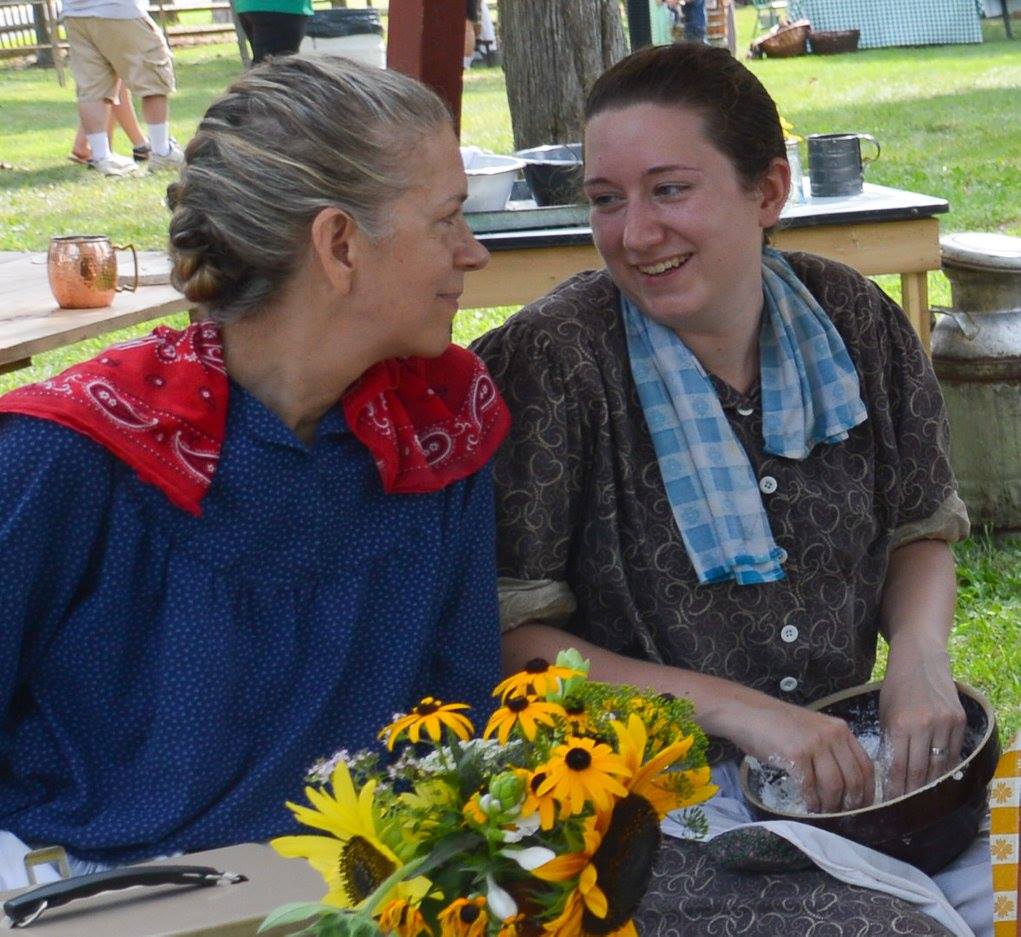
My demonstration is in the 19th-c household and foods area, and each year I am assigned a couple of young “apprentices,” girls ages from 12-17 in gingham work-dresses. This year a friend’s daughter was thrilled to be old enough to officially participate. She is full of wondering about life and is the sort of child who poses her questions and speculations aloud. She’s also at the age when she’s taking church classes for confirmation, and she’s interesting to talk with when she wades into her thoughts about Big Subjects. I often find myself telling her that the things she wonders about are puzzling even to grownups. Because it’s true.

Yesterday she asked about someone we knew who had died: “Do you suppose they went to heaven?” Yikes. While it might have been a good opportunity to throw a wrench into religious indoctrination, I felt her parents might not appreciate that. I merely responded that I didn’t see why not. But this little exchange reminded me of my own wrestling with the idea of heaven and hell when I was her age. From fairly early on, I just couldn’t imagine that the cartoonish heaven of winged souls wearing halos was in any way real; and though hell was also mentioned frequently in church liturgy, prayers, and hymns, my dad’s belief in a god who was forgiving made hell seem unlikely. So the information I took in was confusing.

It is no less confusing to me now, but I no longer sweat over it the way I did as a child. Anyway, the conversation with my little friend called to mind a poem I’d drafted after returning from a visit to the Metropolitan Museum of Art’s exhibit “Siena: The Rise of Painting, 1300-1350” which reminded me of how I loved Medieval and early Renaissance art when I was a youngster. All those saints and crucifixions. All that gold and iconography. I must have had a gothic tendency!

This draft may be more about art than about heaven, and more about envisioning than about anything else. It's not a finished poem, but who cares on this bright, late-summer morning?
~


Halos

What interested me most about
paintings of Jesus was
the glow around his head
because I saw such auras everywhere
when sun silhouetted our cat
in the dining room window
or lit up dew on tall grasses.

In later years I studied art
and learned the problem of cheating
light from solid pigments
the paradox of density layered
so some artists applied gold dust
to depict the nimbus gleam.

Yet even my little sister’s
fine blonde curls or the hairs
on my own skin could shine
that way illuminated like crowns
of hickory trees some autumn
morning long in brightness
no art to it at all.
August

August is the month of the Sealey Challenge, which basically urges those who like/love poetry to read a book of poetry each day of the month. I haven’t given myself the challenge this year, but I am posting individual poetry books on my Instagram account daily–books from my personal library, mostly–and that means that I read a few of the poems, too. Sometimes I get carried away and re-read the entire book. [@aemichaelpoet]

This is not a bad thing.

Meanwhile, August this year behaves as it usually does, weather-wise: blisteringly hot and wiltingly humid. That would be okay except that June was so hot and dry and now an early hurricane has begun its climb up the coast; for now, we are stalled in a heat dome, and by Friday we may be inundated with rain. All of this means that my tomatoes are likely to split just as they all get plump and ripe. It also means that our annual folk life festival (Goschenhoppen) is likely to be a muddy, damp affair with fewer attendees than usual. These things happen, and they happen more frequently when the planet undergoes climate change.

~

August, as most of us learned back in grade school, is named after the emperor Augustus, whose name means “venerable, noble, majestic.” [Source: my favorite, Etymology Online]. The online source notes that “In England, the name replaced native Weodmonað ‘weed month’.” Weed month is a perfect name for August, and I think I will adopt it from now on. It certainly fits the current state of my vegetable patch as the dog days keep the outdoors too miserable for heavy labor in the dirt.

At least for me, however, the laboring can be optional as long as I don’t object too strenuously to a haggard-looking garden. The people who are truly hard workers this time of year are construction and road crews, landscaping crews, farm workers, roofers, line workers, and others who have to brave the heat and humidity to make a living. Also the janitorial staff crews at schools and dorms and other older buildings that don’t have reliable–or any–air conditioning. When we are outdoors working at the festival in August, we get a taste of how challenging it is to do physical work in the heat. This is actually an educational aspect of the festival for those who participate, especially for younger people who are new to the festival. We remind them that people worked like this all the time, in summer and during snowy winters and in the rain and without electricity…with no escaping it, since they needed to work hard just to stay alive.

Perhaps unfortunately, our forebears’ grinding efforts may have led to the idea that only hard work will save us and make us morally upright human beings. Few of the early Germanic settlers here had much time to read or compose poetry, to savor novels, to learn to play an instrument. Art was acceptable to a degree, so long as it decorated otherwise-useful objects. The poetry of the Bible was acceptable, but it wasn’t studied for its beauty. A person with my sensibilities and temperament would probably have been an outlier in Goschenhoppen’s historic community. If I’d lived to be 66 in the early 1800s, I’d be considered “an old cripple,” mostly blind and bent over with arthritis and stenosis. But maybe I’d be the kind of old woman who tells stories.

On the other hand, maybe I’d be considered a witch! I guess it depends on what sort of stories one decides to tell.

At a previous year’s festival, with my daughter. Bewitching the local kids with potato candy!

Book launch, travel, PR

Highland Park Poetry press has set up a book launch/poetry reading for The Red Queen Hypothesis (and me) with poet Rene Parks and an open mic to follow. This event takes place Saturday, September 9th at 5 pm, at Madame ZuZu’s, 1876 First Street, Highland Park IL. Here’s a link, and here’s another link. It’s a ways to travel from eastern Pennsylvania but a good reason for yours truly to visit a new place, meet new people–including the book’s publisher–and listen to other poets.

Too often, perhaps, I stay around the home front, indulge in my introversion by gardening and reading, and shy away from promoting my work. Lately, it’s been months since I did any submitting. There was my participation in the annual Goschenhoppen Festival, then a short but lovely week in North Carolina, camping and seeing friends. Now, the veggie season is starting to wind down–tomato sauce simmers on the burner–and I will have fewer excuses for why I am not sending out poems.

But my travel for the year is not quite done. In September there’s one more trip away from PA, and after that we can settle into autumn. I have writing plans, so once we return, I need to create a schedule that is flexible enough I can stick to it but framed clearly enough that it feels necessary and not difficult to integrate into my days and weeks. Every one of my writer friends knows how challenging that can be. Wish me luck. There’s a chapbook that’s been languishing in my desk area for quite a long time, but to which I’ve recently returned; there’s a ream of poems under 21 lines that might make up a collection, too. Then there’s the next manuscript, rather grief-heavy at present, that I need to re-think and revise.

Oh, and all those poem drafts I have not looked at in awhile…

Then there will be the next round of promotion, not just for RQH but for a collection for which I just signed a publishing contract! That book may be released as soon as April or May of 2024. We shall see. After the drawn-out publication wait for this last book, I will not be holding my breath. Still–it’s heartening news on the poetry front.

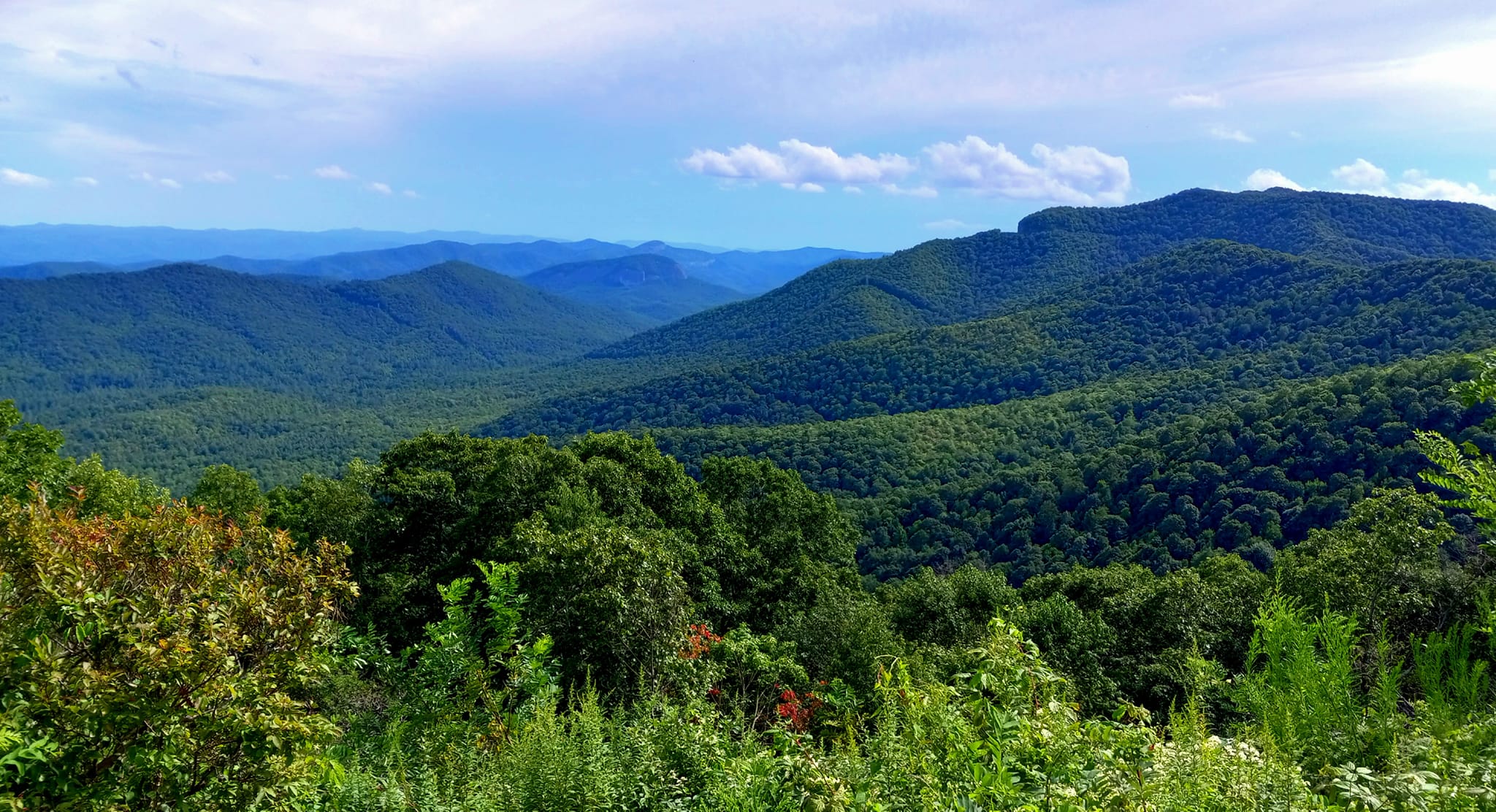
Above, Blue Ridge Mountains in August.

How it’s done

The annual Goschenhoppen Folk Life Festival happens this week–Friday and Saturday–and for the first time ever, neither of our now-grown children can participate. Nonetheless, my husband and I will be at our respective craft demonstrations, showing visitors how people a century or two ago solved the requirements of living in the region before there were highways, diesel shipping lanes, power grids, electric appliances, and cars–but after Europeans displaced indigenous people and started sawing down the forests. We had a taste of pre-power grid life ourselves early this week when a fast-moving storm made us lose electricity for 24 hours.

Visitors to the festival often marvel that they “never knew that’s how it was done.” They buy pickles or jam in a jar in the supermarket and figure it’s all made in a factory somewhere (which is true, today); meat comes packaged, and who thinks about how rope is made, or flour, or candles? One part of the festival demonstration includes butchering. I won’t post a photo (though there is one here), since some people get uncomfortable about it, but if you eat meat it might be worth remembering where it originated. In the late 1990s, I wrote the following poem about it. I may as well post it today! But the image I am adding is instead a nostalgic one of my daughter and me at the potato candy stand in 2016.

~

Hog Butchering Demonstration, or Deconstructing Breakfast
 
Cleaving bone and muscle 
beneath tough hide,
the man with the knife starts his
slow disassembly,
describes cuts of meat,
holds out intestines, uncoiled:
“used for sausage casings”—
removes the bladder
to rinse and inflate—
children’s game, an old-time balloon.
 
The carcass resembles nothing
the audience usually sees
whose meat arrives in cellophane
processed—slices, nuggets.
The children, especially,
have never watched the studious
and useful taking-apart 
of a body, never witnessed
anything dead
but the flattened,
nearly unrecognizable bodies 
of road-killed opossums.
 
No comparison, this 600-pound hog, 
hooked and dangling, its interior 
opened with jigsaw precision.
The man with the knife 
is a revelation.
They stare fascinated
at the butcher’s truth
carving an exact history of
their breakfast bacon.
 
~

Here’s something lovely

…from Maria Popova at the Brainpickings site: book loving and writing and art and literacy and library connect to produce this event/display at the New York Public Library. I was in the city just last week–rats, I missed this. (But I did see Ken Price at the Metropolitan Museum of Art and spent part of a lovely afternoon at Untermyer Park again).

~ Please click on the links! (I know they’re kind of hard to see on this theme)~

MEANWHILE…

I’m on blogging hiatus again while I get accustomed to my work week and while we prepare for the Goschenhoppen Folk Festival (or on Facebook here) this coming Friday and Saturday. Not a time to get much writing done, nor much reading.

A festival participant prepares apples for drying

A festival participant (19th c) prepares apples for drying

Young apprentices (18th c) at work

Young apprentices (18th c) at work