Not a brisk pace

Recently, a physician I see (for fibromyalgia and related conditions) suggested that I need to walk more often because “walking is the best exercise for you and will give you more energy in the long run.” The advice surprised me a little; I love to walk and, except when the weather is very cold or super wet, I walk most days. It turns out that what she meant is that I should be walking for 40 minutes or so “at a brisk pace.” When I asked her to define what she considered a brisk pace, she said two or three miles an hour.

This poses a slight problem for me because while I am happy to walk around my yard, woods, and neighborhood for 30-40 minutes almost daily, I can’t say I do it at a brisk pace. I get distracted and stop to look at things. Bugs. Worms. Toads. Birds. Flowers. New leaves. Nests. Spiderwebs…I loaf along, as Whitman claimed to do. Some days I start out with good intentions to keep up a lively pace, maybe even to the point where I can feel my heart rate going up. And then–was that a redtail hawk overhead? Did I hear an ovenbird? Oooh, the Solomon’s-seal is in bloom!

Today–the walk was very wet, as we’ve just had about 3″ of rain–musing on my not-exactly-exercise ambulations, I thought of this Mary Oliver poem.

Walking to Oak-Head Pond and Thinking of the Ponds I Will Visit in the Next Days and Weeks

by Mary Oliver

What is so utterly invisible
as tomorrow?
Not love,
not the wind,
not the inside of a stone.
Not anything.
And yet, how often I’m fooled–
I’m wading along
in the sunlight–
and I’m sure I can see the fields and the ponds shining
days ahead–
I can see the light spilling
like a shower of meteors
into next week’s trees,
and I plan to be there soon–
and, so far, I am
just that lucky,
my legs splashing
over the edge of darkness,
my heart on fire.
I don’t know where
such certainty comes from–
the brave flesh
or the theater of the mind–
but if I had to guess
I would say that only
what the soul is supposed to be
could send us forth
with such cheer
as even the leaf must wear
as it unfurls
its fragrant body, and shines
against the hard possibility of stoppage–
which, day after day,
before such brisk, corpuscular belief,
shudders, and gives way.

~

At my place, it’s feeder creeks I hear and think I may visit, not ponds, but I identify with the mood of this poem. Walks offer me that joy, that unfurling of leaves, ferns, everything…time to reflect and feel gratitude. If I don’t do quite as well by my heart and muscles as I ought to, maybe my psyche or soul will compensate. If I loaf, it’s a purposeful, sweet loafing, the kind of activity that poets tend to do; it gives me energy of a non-physical sort. (And I think Mr. Whitman would concur.)

Walt Whitman in mid-life, probably a bit younger than I am now.

Persistence & belief

I wrote a poem for my brother 25 years ago or more, when he was in his early 30s and having mysterious and frightening cardiac issues. He was working on geological and wetlands surveys for the county and feeling fairly uncertain about his career, as often occurs when one is in early mid-life. My initial drafts included a quote from a Rilke poem and some geological terminology. That poem draft, as a whole, didn’t quite “work,” however. I gnawed on it for well over a year, tweaking and revising. I showed it to Ariel Dawson, a friend (alas, now gone) whose critique and suggestions I respected. She gave me some ideas for revision and told me she thought this was a poem with real possibility. I just hadn’t quite gotten to the final possibility yet. She told me it was a poem I should believe in, keep working on.

Some years later, after a major reworking, I sent it out. Several times. No one accepted it; a couple of years later, I realized where it was in need of a change. Tried that. It felt better to me. But no one accepted it for publication. Fast-forward about 18 years, and I made yet another change in the poem. I thought maybe it was still worth submitting to journals. Nope. But, last year, reassessing some older work, I came across this poem and thought it was actually a pretty good poem, worth sending out a few more times. One might say I believed in the poem.

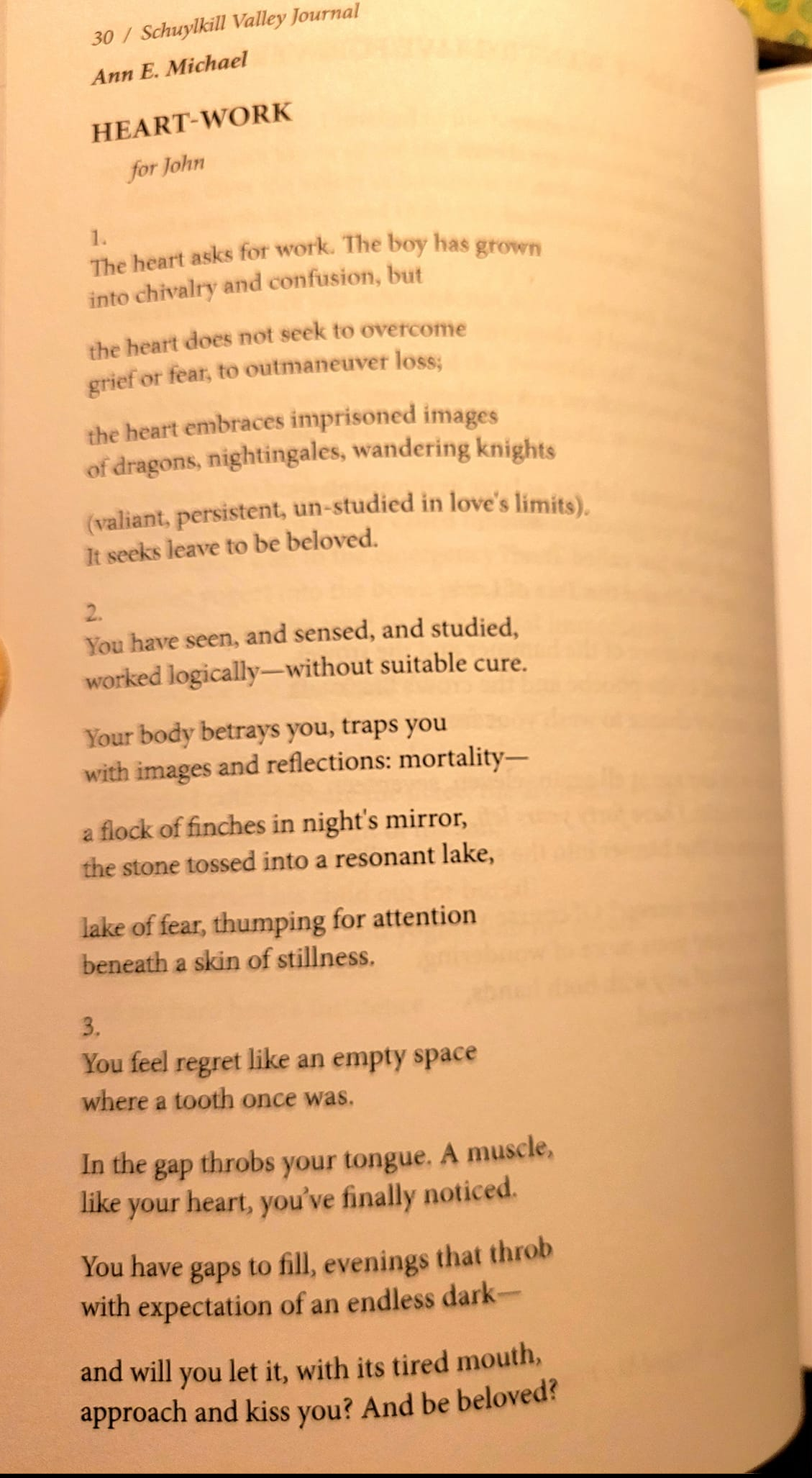
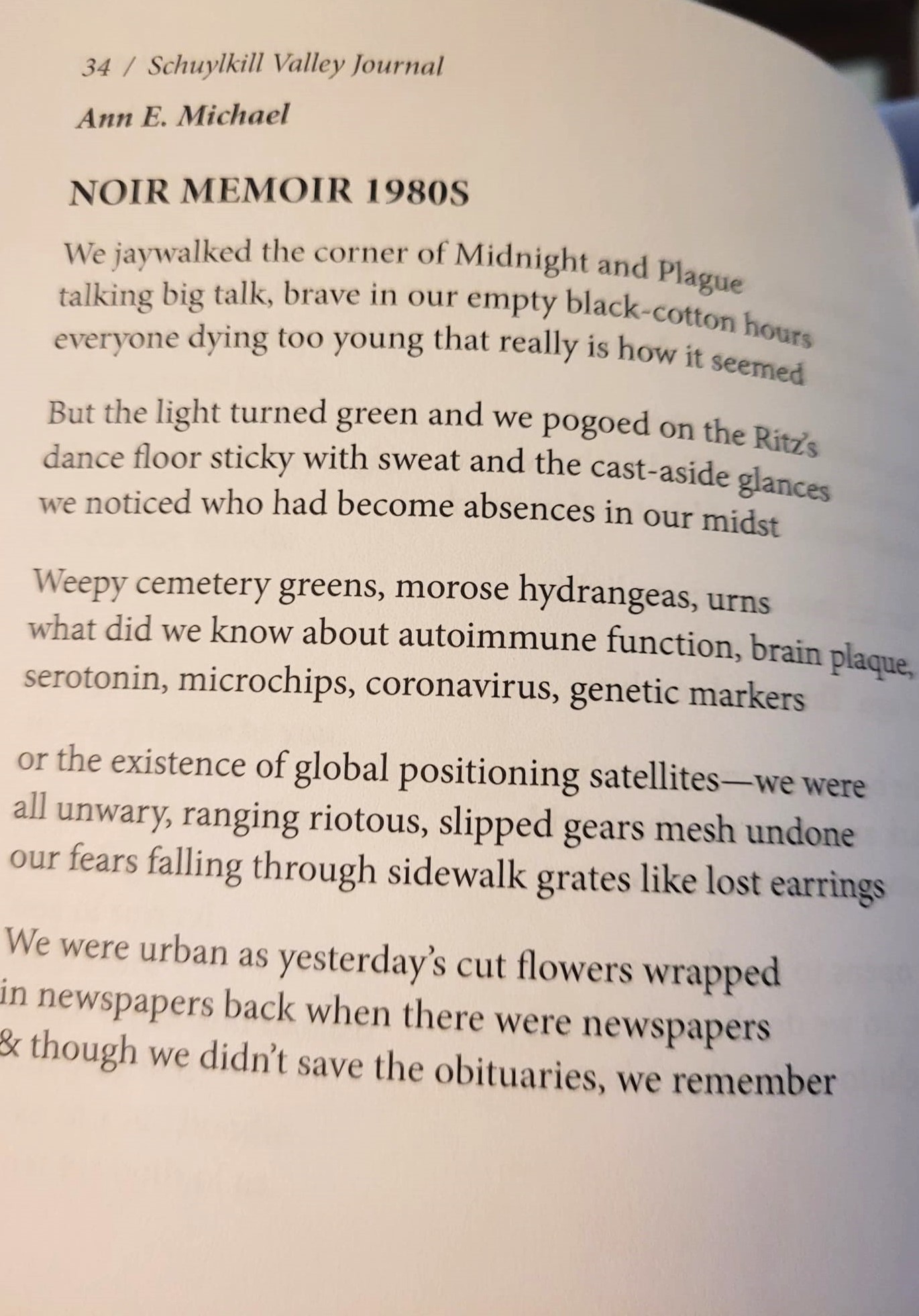
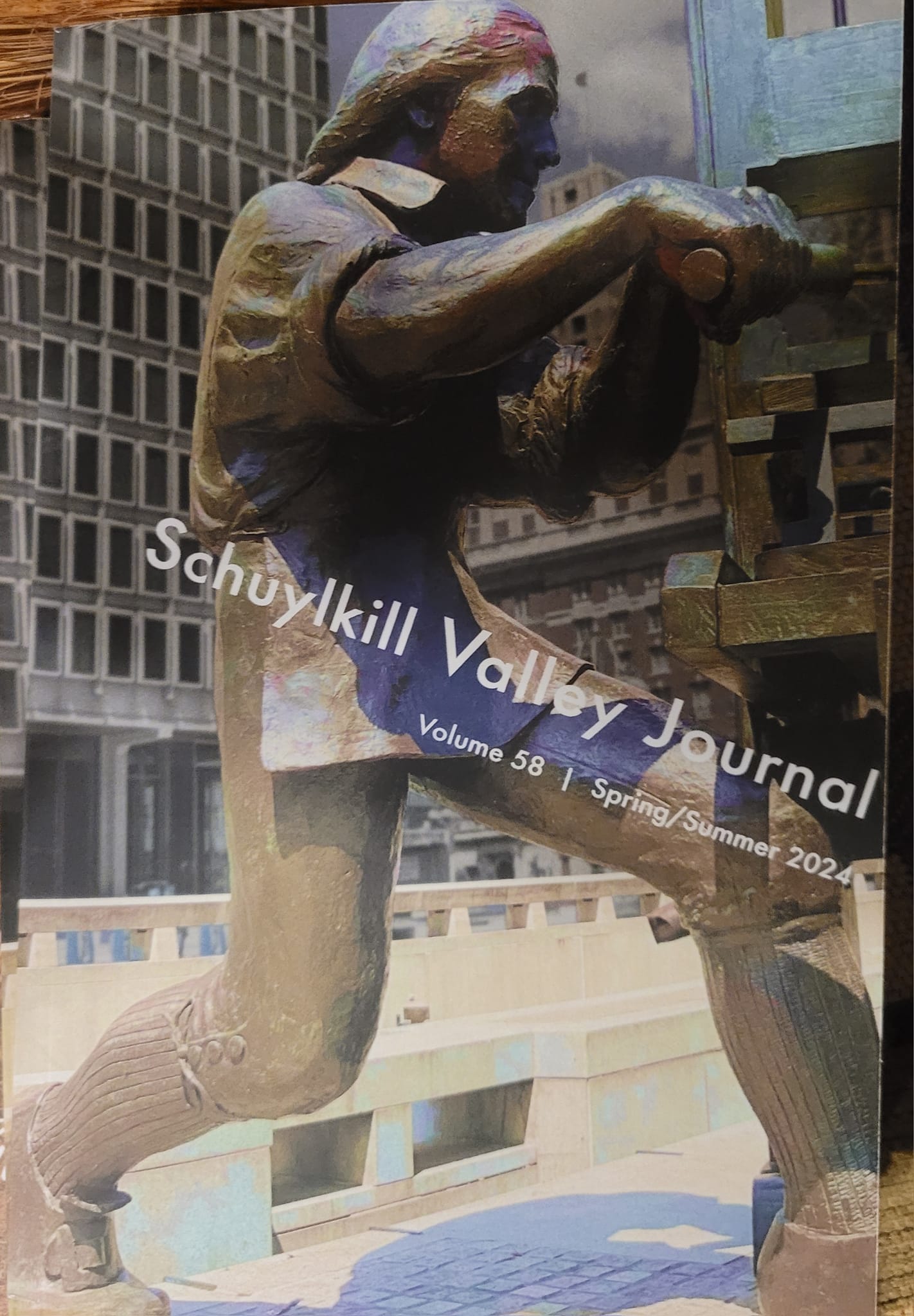
This post is to say: Be persistent, writers, and do believe in your work! Because Jane Edna Mohler at Schuylkill Valley Journal chose “Heart-Work” and two of my other poems for the issue that just came out in print (and I do love print journals!). [Purchase the issue by clicking here]

That poem found its way into print 25 years after I first drafted it.

Something equally as nice occurred when I received the print copy in my mailbox. Peter Krok, the long-time editor in chief at SVJ (since 1990) and a long-time colleague-in-poetry, sent along a lovely note in which he praised Jane Edna’s editorial sensibilities and then kindly said he felt that my poem “Heart-Work” was exceptional. How frequently does that happen? Not often, I can promise you–although I suspect such comments are more likely from small independent journal editors and presses. Those lovely people are involved in the arts for the love of poetry and the humanities. When they find time, they can be marvelously encouraging. Let us thank them personally and to the world!

~

Abundance!

In all my born days, I’ve never had a Poetry Month start off with such an abundance of publications–and, as it will probably never happen again, I’m going to post the links here.

Siren for Somebody Else” offers a mother’s perspective on waiting, unable to get to sleep, for a child who is out late on his own. It appears in RockPaperPoem.

Interpreting the Conversation from Another Room” shows up in Stick Figure Poetry #13. The poem originated during the years our son lived with us and played online multiplayer games in his room, but it morphed into something a little more sinister.

Fevered” came almost out of nowhere but resonated with some early readers who contend with mental and emotional challenges. It’s also a poem about love and compassion, I suppose. The journal Philadelphia Stories published it in the latest issue.

Gyroscope Review is a print journal that also offers a Kindle and a PDF version, the last of which is free to download, though the paper book is lovely and only $12 on Amazon. My poem “Bach and Birdsong” starts the issue off…a meditation on springtime.

Whew! This post goes with my “Gratitude” post of last week!

~ The poem below appears in my chapbook Small Things Rise & Go, FootHills Publishing:

Nap in a Treehouse

Alone in my children's treehouse,
I read 300 poems from the Chinese.

Sunlight slants over the cornfield,
flies buzz, the afternoon is warm.

This first day of autumn,
insomnia's caught up with me.

After so many sleepless nights,
I doze with Li Po and Tu Fu.
~

Gratitude

Fountains of gratitude are flowing in my heart today despite the gray, humid weather that seems to set off every imaginable ache my body could have. ❤

Wow, that was a sentence of hyperbole and cliché, for which I apologize; let me begin again. I’m grateful for a number of reasons that I want to mention so I can give appropriate and public thanks to the people who have added to today’s happiness. The list starts with Dave Fry of Godfrey Daniels Coffeehouse & Listening Room in Bethlehem PA, who hosted an evening of poetry–with musical interludes and conversation–this past Wednesday evening. Two members of my long-time writers group and I read our poems and talked about a few poetic forms (haiku, waka/tanka, tanka prose, and short forms generally). Dave supplied some comments to encourage audience reflection and performed interludes on guitar. One observation he made is that the classic blues song follows a structure that has similarities to a short poem form: Line, Repeated line, Commentary line (often like a poem’s “turn”).

It was a lovely event and great to share the writerly camaraderie of a long & successful critique group onstage: Marilyn Hazelton and Susan Weaver are often the first readers of my own poems. I’m grateful for their support and for the way Dave gave us the opportunity showcase poems and maybe teach a few audience members new things about poetry. Another plus was that I sold a few books! Grateful to those folks, too. That’s one way to support the arts.

Thank you as well to my Best Beloved, who attended despite feeling a little lousy from allergies, and to those of my local friends who came out to hear us. The venue charges a cover, and not everyone’s willing to shell out for poetry. Therefore, I bow deeply to you all who do.

Today I also received a kind gesture from poet, scholar, educator, and blogger Lesley Wheeler. On her blog (which you really might want to follow), Lesley wrote a mini-review of my book The Red Queen Hypothesis and Other Poems, last summer. I’m thrilled that this week she included a mini-review of my brand-new book, Abundance/Diminishment (“ectoplasmic micro poetry reviews“). My book was in such good company! See the link above, between parentheses, for her comments on books by Diane Suess, January Gill O’Neill, Elizabeth Savage, and Jen Karetnick.

For promotional reasons, (ha!), I’ll close with what Lesley says about the collection:

“I have a similarly eerie sense of connection with a sympathetic mind reading Ann E. Michael’s Abundance/ Diminishment. This book tallies losses and bounties: it’s full of mathematical and scientific language, but what it counts and categorizes is deeply emotionally freighted. In ‘Filling Out Forms at the Gynecologist’s Office,’ she subtracts the number of her children from the number of times she’s been pregnant. In ‘Tongues,’ a child of six, mocked by classmates for the tongue sandwich in her lunchbox, prices out peanut butter–even as she loses her immigrant mother’s language. Also like Seuss’s book, this is poetry of maturity, from a time of life when a person has to begin giving it all away. I’m especially grateful, these days, for books from midlife and beyond. I learn what I need to know by reading them.”

I’m grateful, too, Lesley!

Reading not writing

But the next best thing to writing is reading. Or maybe it’s the other way around; if I had not loved reading, I would never have started writing.

Stacked beside the bed:

A Book of Psalms (Stephen Mitchell)

The Book of Joy (Archbishop Desmond Tutu, Dalai Lama XIV, Douglas Abrams)

The Book (Keith Houston)

The Darker Fall (Rick Barot)

Theory of the Lyric (Jonathan Culler)

Shifting the Silence (Etel Adnan)

Noise (Kahneman, Sibony, & Sunstein)

Haiku 2021 anthology from Moonstone Arts Center

I love how the first three books all have BOOK in their titles. The Adnan and the Mitchell are re-reads that settle my soul while keeping my mind active and inquisitive. The Book of Joy has been surprisingly helpful to me so far (I am reading it a bit at a time while other things are going on).

Anyway, I can garden. We have had plentiful rain and now I have plentiful beans, basil, zucchini, carrots; numerous tomatoes cluster under leaves, so whenever they ripen we’ll have more splendid organic tasty produce. I will continue to pull out the crabgrass, wild mustard, pigweed, smartweed, etc. Culling, cultivating, collecting sunlight through my vegetables and through my skin (yes, I wear sunscreen–and a hat)…there are worse things in life than an inability to compose poems. And I can read, thank heaven. Reading poetry, and reading about poetry, provides plenty of joy.

One of the practices of joy mentioned in the Dalai Lama’s & Desmond Tutu’s book is gratitude. Fortunately, that practice has never been difficult for me.

under clouds /heat rises from soil /beans grow plump


Gratitude & Qigong

My mother is still living. I am grateful for that.

My mother and I get along well. In that, we are fortunate.

Furthermore, although she is an octogenarian, my mother is in reasonably good health. Another reason for gratitude.

Her interests are varied, and she’s willing to try new things. My mother has always been quietly innovative about life. She has pursued alternative therapies for health and emotional well-being, read difficult texts, studied disciplines and subjects that challenged her, traveled the world, lived in foreign lands.

Mostly, she has been a care-giver of one kind or another. This past weekend, I took my mother with me to a Qigong and Mindfulness retreat, thinking she could use a couple of days of restorative practices and a little time off from care-giving for others in order to care for herself. In addition to several hours of “medical qigong” (Yi gong), we learned some practices for spiritual qigong (Tao gong), got information about implementing a plant-based diet, observed a tea ceremony, tried our hands at Chinese bamboo brush painting, and followed a labyrinth path in a walking meditation. It was quite a significant conclusion (of sorts) to my recent weeks of thinking about consciousness as presented by various “Western” thinkers on the subject.

Yin-Yang

Kirkridge Retreat Center hosted the weekend. Kirkridge’s organization is dedicated to peace, compassion, and community–to the concerns of social justice and to individual healing. It is a peaceful place, located on a steep, wooded hill. The setting alone fosters a sense of restorative energy. Our teachers were excellent, informative, and full of grace. The meals were terrific. The crickets sang sweetly and the moon shone amidst the clouds. My mother and I felt grateful for the event, the weather, the place, the people, for the breaths animating our bodies and for one another.