Mud & connections

My region’s been unusually low on rainfall the past 18 months, but this year April showers seem almost to be compensating…my veg patch is mud. Weeding and more sowing will just have to wait. I walk around the neighborhood and my yard and the woods, squelching through muck and stopping now and again to upend a rock or rotten log and see who’s active now. Lots of worms and arthropods, the occasional spider, many ants.

In such moist circumstances, we get fungi; I’ve been enjoying Lesley Wheeler’s new book, Mycocosmic, which I’ve read twice now–once for content and sound, once to learn more from the poems’ craft structures, all the while fascinated by the science of fungus, which she incorporates into many of these poems. It’s a richly rewarding book, sometimes sorrowful, always intelligent, full of insightful poetry. The collection includes some poems that feel like spells, chants, divinations that suggest there are always imaginative methods for coping with anger, unfairness, and loss. Exploring the vein of how interconnected the natural world is, and the human world (with other humans and with the Earth) feels so vital to me, and Wheeler’s book pivots on this vitality. Look at the way Harry Humes threaded through my life, for example, in small but meaningful ways. The same goes for Lesley and for so many other people with whom I’ve shared intersections, interweavings, and connections over the years. That butterfly effect of influence. (Now that I think of it–Harry Humes has a book with that title: The Butterfly Effect). Or are those networks mycelial, as Lesley Wheeler suggests?

~

More connections: grad school was long ago now, but I’ve maintained a few colleagues from those days and will always treasure the fact that earning an MFA led to meeting fascinating people. For example, the recent issue of The Bookends Review features an interview my fellow Goddard alum Ian Haight conducted with me last summer. He asked me about teaching humanities, about higher ed in these fraught times, about AI and creative work, about my residency at Joya, and about poetry in general…https://thebookendsreview.com/2025/04/09/poetry-the-humanities-and-aesthetics-an-interview-with-ann-e-michael/. Some thought-provoking questions–thanks, Ian! And thanks to The Bookends Review for curating the interview into the journal.
Rest in poetry

National Poetry Month has brought with it a sad bit of poetry news: Harry Humes has died. If you are unfamiliar with his work, you might want to check Penn State’s PA Book site’s biography of him, and then find one of his books:

https://pabook.libraries.psu.edu/literary-cultural-heritage-map-pa/bios/humes__harry

He was an excellent poet, influential for many folks–especially for Pennsylvania writers–and while I never knew him well, our lives intersected in some surprising ways over the years…

~

In 1982 or thereabouts, I resided in Philadelphia and was participating in many poetry readings, mostly open mike events. Carol Ann Robertson, who lived at that time in Philly but who had connections in the Lehigh Valley, told me that Bethlehem’s Godfrey Daniels listening room hosted a monthly poetry reading and invited me to drive up with her to hear someone named Harry Humes read. If I recall aright, three or four Philadelphia poets crammed into her compact car and headed north. We arrived early and were introduced to Harry, who seemed to have quite a case of nerves; that surprised me, since he was my parents’ age and a professor. Apparently this was one of his first, or perhaps his first, public reading–whereas I had been reading at open mikes since I was in my early 20s and was pretty much over my nervousness. (Years later he told me he’d fortified himself with a bit of scotch before the event.)

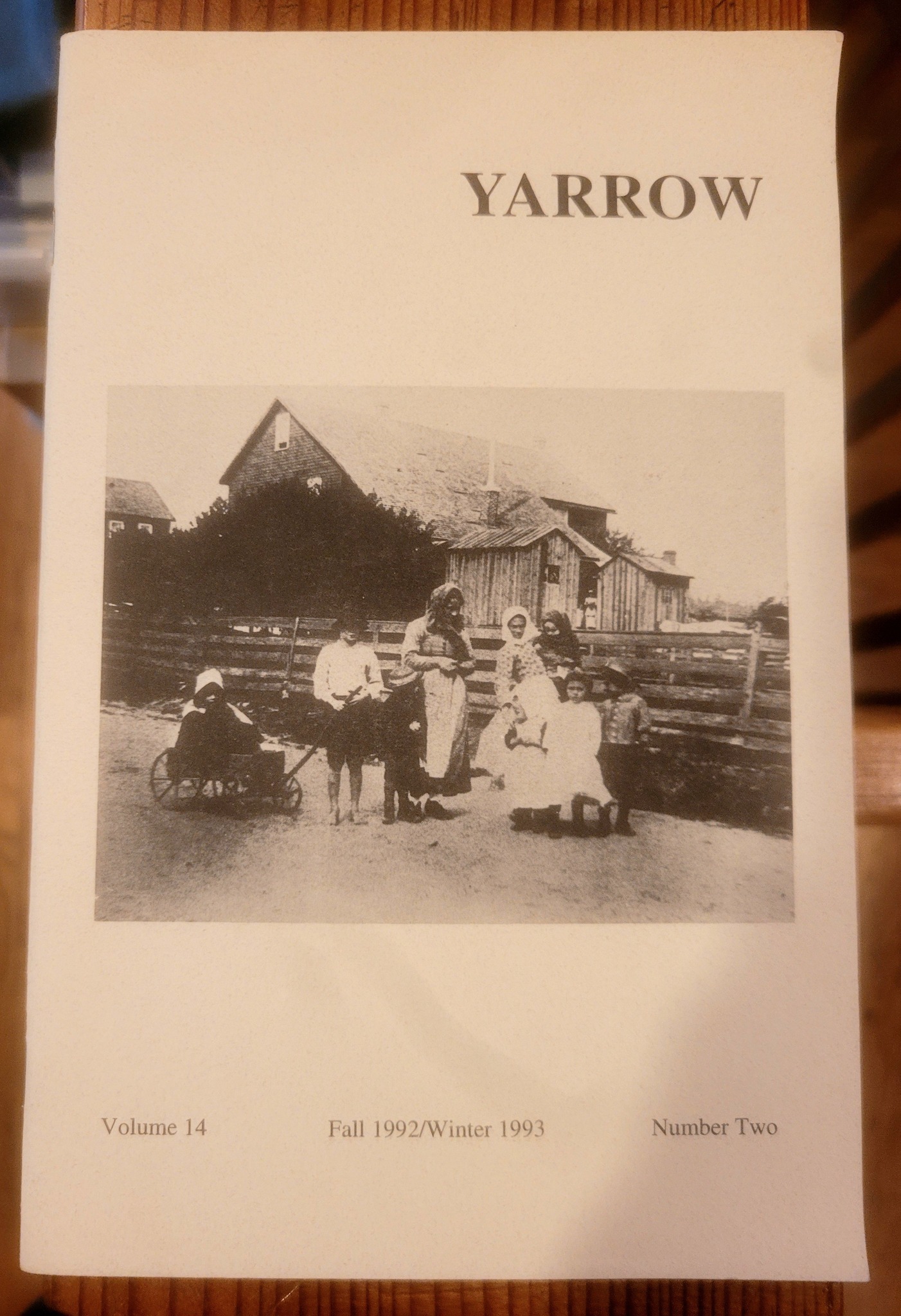
It was a beautiful reading. His work was both accessible and mature, and he clearly knew what he was doing when it came to writing poems. Indeed, his first full-length collection, Winter Weeds, came out shortly afterwards. Anyway, I moved out of Pennsylvania for awhile and, when I returned, it was to the very suburban Lehigh Valley. In 1992, I sent some poems to Yarrow, a lit journal published at Kutztown University–Humes was the faculty advisor and editor then, and he chose to publish my prose poem La Barbe.” For which, Harry, many thanks. I was so busy with toddlers that I was hardly submitting any work anywhere, or finding much time to write. The publication was a boost for me.

Then, in the peculiar way of small-world eventualities, my husband hired Harry’s wife, Nancy, as copyeditor for a Rodale Press magazine. I found that out when, a few weeks after she’d been hired, my beloved asked whether I had ever heard of a poet named Harry Humes! (By that time, Humes’ fourth collection, Bottomland, was in print)…

~

When I was hired at DeSales University around 2005, I learned that DSU held an annual poetry event for high school students. I attended/participated often, and Harry Humes–who was a good friend of the program’s administrator (Steve Myers)–was always involved in the workshops and events. Humes had retired from Kutztown by then, and was writing more poems, fishing, and enjoying family life. He always greeted me with a big smile and asked about my writing. That sums up for me what kind of person he was: generous; possessed of a self-effacing, even self-deprecating humor; kind and encouraging to people just starting out in poetry.

Here’s a poem of his that I like a lot, which I clearly recall him reading that day at Godfrey’s so long ago: https://www.poetryfoundation.org/poetrymagazine/browse?volume=154&issue=3&page=13

And here is one of his best-known poems, the title piece from his 2004 book. Harry, thank you for gracing us with your words. We’ll remember them for a long time.

~

August Evening with Trumpet

Up in the woods a neighbor or stranger
who has had enough of August,
its spider webs and first yellow

near the roots of things,
has out of the blue found his old voice,
wailing away everything

he can remember.
Perhaps he will play
right through fall and winter,

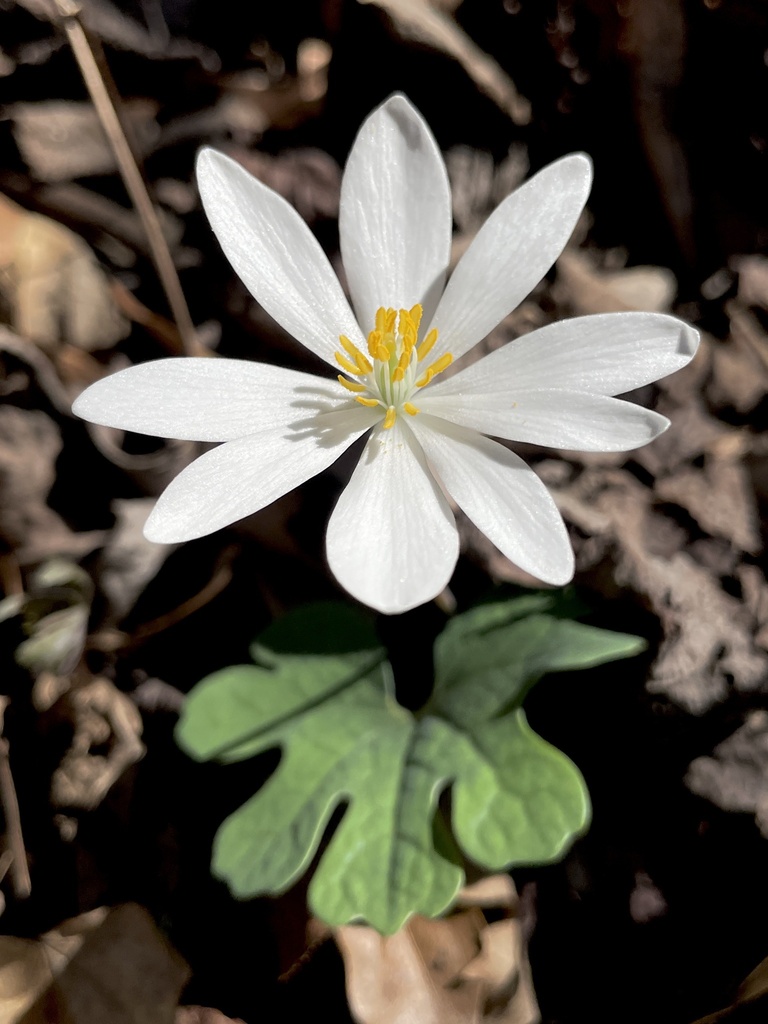
not stopping until bloodroot
and anemone blossom.
But now it is almost dark.

Mist veils the fields,
and last sounds play out
as simply as longing or breath.


Copyright © 2004 Harry Humes All rights reserved
from August Evening with Trumpet
University of Arkansas Press

Throwing mud

This week, I got the potatoes in the ground; last week, it was spinach. In between, a lengthy late-March cold snap and yes, more rain. But also a visit from a Dear One and a trip to parts of Pennsylvania I seldom have had reason to explore. Although I have lived in PA’s Lehigh Valley for nearly 40 years–longer than I have lived anywhere else–I confess a lack of familiarity with many areas of the Keystone State. Philadelphia and its suburbs I know well, and Reading and Lancaster, to a lesser degree; and our family often visits Gettysburg. We travel west and north to go camping now and then. I’ve been to Pittsburgh a few times and seen Falling Water and the Cathedral Trees and both branches of the Susquehanna River. Penn State just twice, once when I was chaperoning high school sophomores to History Day competitions.

Pennsylvania is a big commonwealth: 46,055 sq miles. It’s a good place for poetry, though I leave it to poets such as Harry Humes and Jerry Wemple (among others–looking at you, Dave Bonta) to explore its varied climate, geography, history, and culture. Mostly I stay within the confines of my own back yard, which is large and varied enough to inform me for a lifetime.

But the Dear One had planned to give her dad a pottery workshop with a well-known potter, Simon Leach, as a 70th birthday gift. That birthday fell during covid, however; the long-delayed weekend in Millheim PA thus did not take place until this past week. I have never placed my hands on a potter’s wheel (though I ought to try it sometime) and just went along for family togetherness and to visit the arboretum at Penn State, slightly out of season but still a very pleasant place to walk, by myself, on a cold but sunny Sunday. It rained on Saturday, so I sat by the fireplace at our B&B and read novels. Could anything be more perfect?

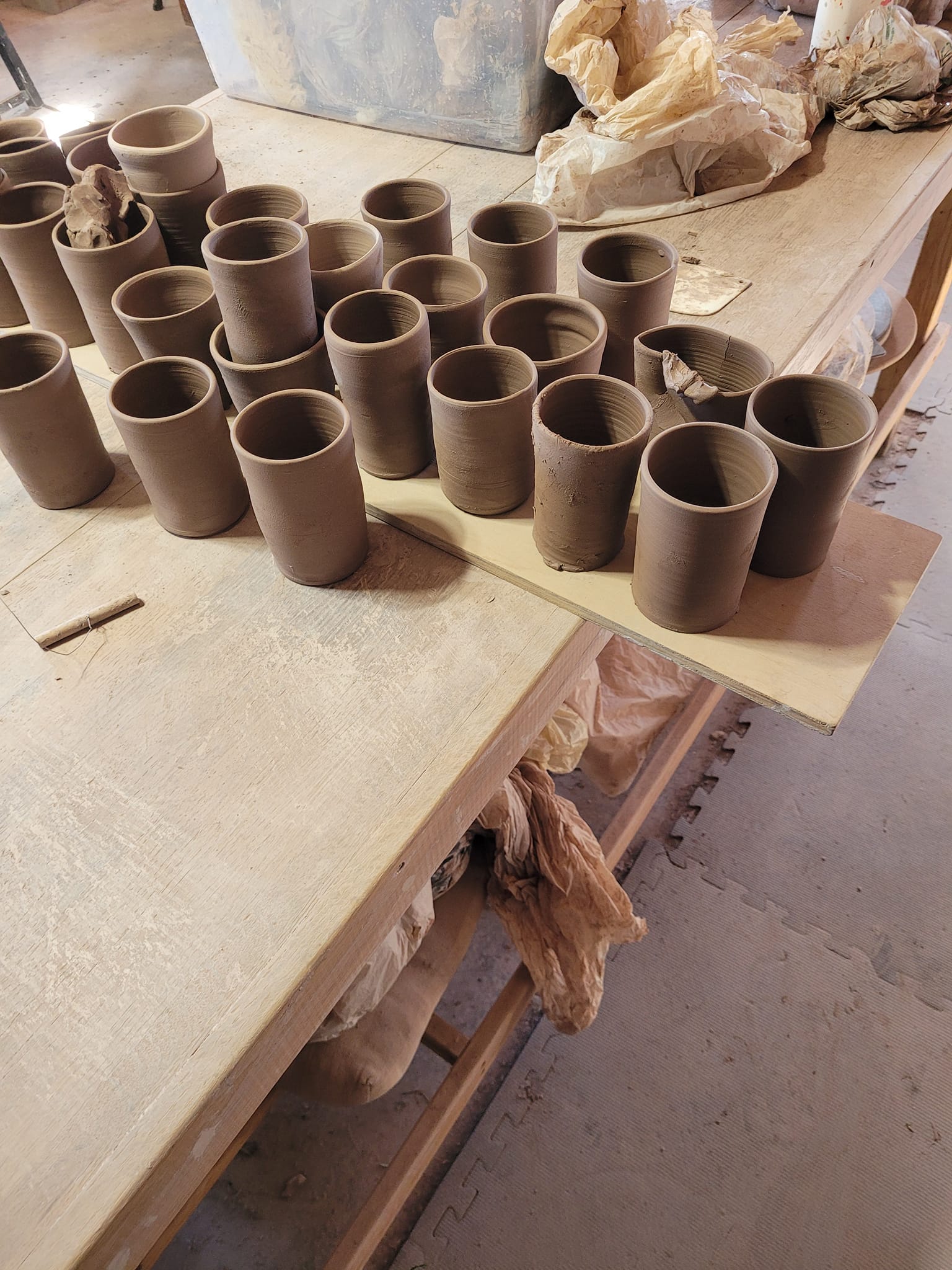
The task of Leach’s workshop was to practice making cylinders. It was a muddy job indeed. Here’s a photo of some of the student results. Dear One is quite adept at cylinders; indeed, she’s a good potter and sells much of her work, a skill she enjoys when she’s not providing emergency medical care to dogs and cats.

Leach uses the slogan “Keep practicing!” Yeah, that’s how you get to Carnegie Hall, right? But it is also how people get better at any skill, even those who are preternaturally talented in music, art, dance, etc. That includes writers. I have to remind myself that it is now time I got back to my routine of writing, revising, and the practice practice practice part of composing poems. The garden, the daughter, the travel, and the novel-reading have been splendid distractions, but as National Poetry Month approaches (April!), I ought to get myself back into routine.

A routine’s generally looked at as mundane–a tedious necessity. It needn’t be that way, I keep reminding myself. It can be as fun and messy and surprising (or frustrating) as throwing mud.

clay cylinder practice in Leach studio