Reading in shade

It’s the time of year when, according to the lunisolar calendar, we move from 小暑 xiǎoshǔ–when the heat begins to get unbearable–to 大暑 dàshǔ, the hottest time of the year. It may also be the greenest time: my garden suddenly plumps out huge squash leaves, giant sunflowers, masses of beans, zinnias, basil. The tomatoes are finally burgeoning after a late start. It’s too hot to spend much time weeding and pruning: I harvest what I can and retreat to the shade as soon as possible, where I can read.

A friend recently lent me a book of short stories, Human Sacrifices, by María Fernando Ampuero, an Ecuadoran writer. It’s been ably translated by Frances Riddle, and the stories are startling and harrowing. Not something to check out for a light summer read on the beach, but memorable and thought-provoking. One critic says Ampuero’s work is South American gothic. I don’t agree–and I think it’s kind of a cheesy shortcut in a review–but perhaps that phrase does convey the flavor of some of her stories. Anyway, it’s always a treat to find a writer whose work I’m unfamiliar with and whose work is admirable.

I’ve been taking a break from reading poetry, though that wasn’t planned on my part. July brought a wedding, a death, and some travel; and now, in the intense summer doldrums, I prefer to read for entertainment or information, or just to pass the time. Poetry takes more brain and heart space for me, more “intentionality” or concentration, than most non-fiction books or novels do. This is not to say any other genre is less demanding in and of itself. It’s a personal quirk: I am more attentive when reading poetry than I am when I read other forms of literature, probably because I’m unconsciously (or consciously) endeavoring to learn something of the craft and style and context of poems by other poets. It’s a method of processing how to write poems. But as I have no plans to write fiction or non-fiction, I read such genres for entirely different reasons.

Usually I try to read outside on the porch, in the hammock, on the garden swing. Some days it is just too damned hot and humid, though, and I resort to the air-conditioning indoors. The indoor climate has no flies or gnats but also no bird songs, cicada hums, cricket calls, breezes, scents of summer. Indoors is less than ideal (except in the teeth of winter!).

Recently I’ve added a shade garden where the chicken run was in decades past, under the umbrella of our largest white oak. I haven’t yet added a bench, but a lawn chair suffices for now. Alas, it is a bit buggy, but so is the hammock. The pleasure of summer reading in shade outweighs the inconvenience of the minor fauna…most of the time.

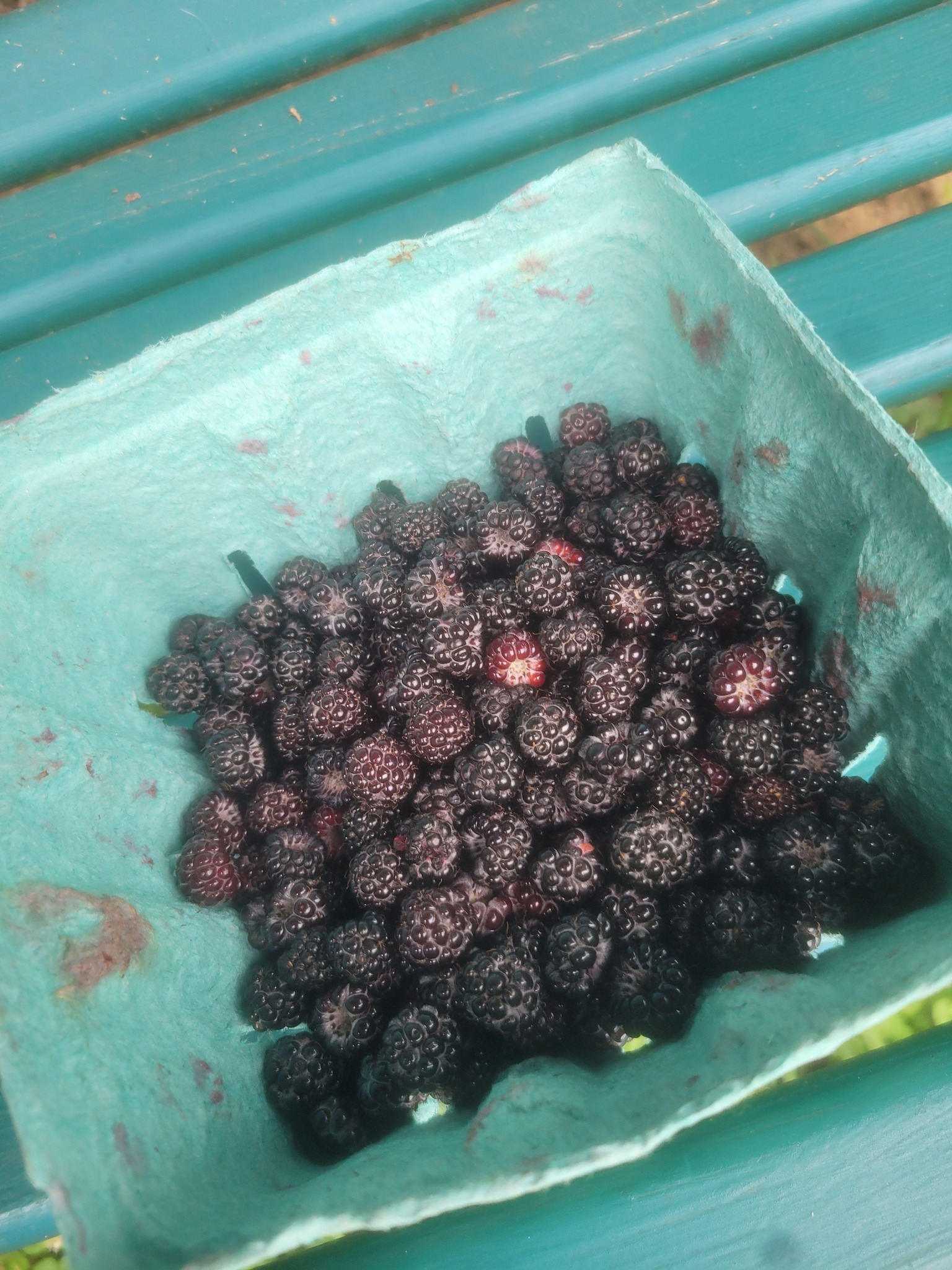
Blackberries

[note] *Hmmm. Somehow, I backposted this post. It was written June 23rd, post-solstice!

Actually, they’re wild black raspberries, someone informed me. They usually ripen around the end of June, and everything eats them–orioles, robins, catbirds, deer, possums, raccoons, possibly even foxes. Black bears, if they’re in the vicinity, though we haven’t seen one here.

Humans enjoy eating them, too. Usually I don’t get more than a few for yogurt or ice cream toppings, but this year–a bonanza. Maybe the canes liked all that rain. Harvesting them is quite a task, because the canes are in the hedgerow thicket and twined about with poison ivy and cat’s-claw and other spiky and rashy flora, not to mention the thorns of the berry canes themselves. And harvesting comes as the hot, humid weather descends on this valley, making the effort a sweaty and uncomfortable one. I always think of farm workers, almost all of them immigrants, who get hired to do this sort of work–the vital work no one else wants to do. They deserve better pay and considerably more compassion than they generally receive. Half a quart of blackberries cost me half an hour of sweat, many scratches, and a swath of dermatitis; but, like Flopsy, Mopsy, and Cottontail, I had bread and milk and blackberries, (for breakfast).

Current mood: harrowing. Aghast. These two poems, though I wrote them many years ago, seem apropos to the moment.

~

Like Thumbelina

Where there’s green foliage
so dense my eyes ache
I spend an hour in shade
snacking on blackberries
the birds haven’t found.
My head hurts from the agonies
of money. The cell phone rings.
Ferns and five-leaf vines
muffle street sounds,
a little colony of feathery mosses
sits under a tree-burl shelf.
I find a hole pressed snugly
against old roots and leaf-mulch.
Like Thumbelina,
I want to curl myself inside
a sassafras leaf, sleep
beneath a toadstool
undiscovered,
unmolested,
temporarily free.

~~
Thicket

Behold the thicket:
it is deep with brambles.
It is blackberries in July,
wineberries in August.
Move, and the thicket
impedes you, catches
your sleeve,
plucks you awake.
The bee is here. The spider.
The thicket is alive, and crawling.
Green with jewelweed to salve
rashes from the thicket’s
poison ivy. Green with prickly
horsenettle, coarse pokeberry,
the brilliant, twining nightshade:
thickets sweat poisons
as well as fruits.
I have brought you here to show
that you can never get through,
not unscathed, not without
brutality of some kind,
the saw, machete, knife.
This tangle no amount of patience
will ever undo—
it will overtake you,
grow into your hair,
invite warblers in to nest,
spiders to unfurl their orbs.
You must learn not to hate
before entering the thicket;
you must acknowledge all its ways
to understand its wild embrace.


Sweltering

I do not much care for air conditioning, and I believe it is bad for the environment; yet I admit I’m grateful for it lately, as I reside in one of the many regions of the USA that’s been enduring dangerously high temperatures for more than a week straight. I feel lucky that we’re not struggling with the heat wave–that we can shut up the windows and turn on the AC. We’re also in an earlier-than-usual drought situation though the air feels muggy and humidity has been as high as 98%.

My garden needs water every day; I generally water in the evenings because that is when the garden is in shade. The barn swallows swoop around me as I make sure the tomato and cucumber plants’ roots are getting a deep soaking. While I water, I watch for insects–fireflies, moths, dragonflies. And for bats, which have returned but aren’t as numerous as they once were. It’s pleasant for me that there are fewer mosquitoes and gnats, but I’m concerned about a drop in the number of junebugs and moths, and even (yes) mosquitoes. The heat and drought have taken a toll on all kinds of wildlife.

This morning, a pair of finches dive-bombed a squirrel that was up in the pear tree, chasing it far into the hedgerow. It may have been after the unripe pears, but squirrels also sometimes eat songbird eggs or chicks, especially when the squirrels are nursing kits or when there’s a lack of other food. The deer are so thirsty and desperate for greens that they’ve eaten every last hosta in my landscape, including the ones right up at the house foundation. They are consuming plants they have overlooked before, but I can’t blame them. Since it has been so miserable outside, I haven’t picked black raspberries this year; I’m sure the deer are happy about that. But I do wish they’d eat the poison ivy, wintercreeper, oriental bittersweet, and honeysuckle vines…that would make my landscaping tasks easier!

I’ve kept a garden journal for 30 years. If you have a garden, you don’t need to be an environmental scientist to recognize that the climate is undergoing changes. This is not a political statement but a fact. Everything right now is stressed–including the gardener! The stress enters into my consciousness and, I suppose, into my creative life. My poem drafts of the past week have been a bit on the bleak side.

Here’s a draft of one of the 7-line poems I was working on last week. Suits the weather, I guess.

~


Sweltering

A description accurate for the days past solstice
when even the wind lies sweating in a hammock
unable to rise for a brief turn around the block.
Blackbirds slow their trills, robins shelter in shade,
all the tasks we should tend to we leave undone.
Hours of lethargy seep into skin and set up house,
keeping us damp, achy, sunburned with the blues.

~