Last messages

End of another year. This one included some truly joyful times that will stay with me for quite awhile. But in that almost-inevitable reflection that arrives with the winter solstice, I find myself recalling dear ones whose lives closed in the past 12 months. I used to have physical reminders of friends and family, the last card or letter they wrote, something to put into a file or drawer or keepsake box and take out from time to time; a photograph or two, or maybe a recording of their voice on tape. Now that human communication has mostly migrated to the digital, to the “cloud,” those tangibles are much less common. But the messages persist.

A few weeks back, I migrated to a newer cellphone and, in the process, moved a year’s worth of text conversations to the new device (I’m not sure how I did that). All the old messages popped up, including three from dear people who are now deceased. Quite a different form of “ghosting.” I’ve kept in an online folder many email messages from my most frequent correspondent and long-time friend, who died February 1st, but I can’t quite bring myself to look at them yet. And it isn’t quite the same experience as opening and unfolding old letters.

I can’t bring myself to delete the messages from my phone, however. I suppose at some point that will occur, perhaps in another upgrade. Letters are ephemeral, too; all it takes is flood or fire. We have to rely on our minds, our memories, when it comes to recalling loved ones. Maybe that is what elegy is for, I don’t know.

~

As for the present–the Spirit of Christmas Present* ?–some of my Best Beloveds will be gathering here and there with me soon. Once the holiday hubbub dies down and the lonelier, cold January days arrive, I have poetry workshops to look forward to. They’ll be online, which suits my schedule in winter. Last year, I enrolled in two such workshops and found they spurred me to get a good deal of writing done, so I figured I might try repeating the process. Anita Skeen is doing another series for The Friends of Roethke Foundation with readings, prompts, and discussion on “writing toward wisdom.” In Dickens’ era, I’d be considered old enough to be wise (though most of us, Dickens certainly included, know better about age inevitably bringing wisdom). But the operating word for Skeen in this case is “toward.” It will be interesting to see where she takes her workshop participants in the new year.
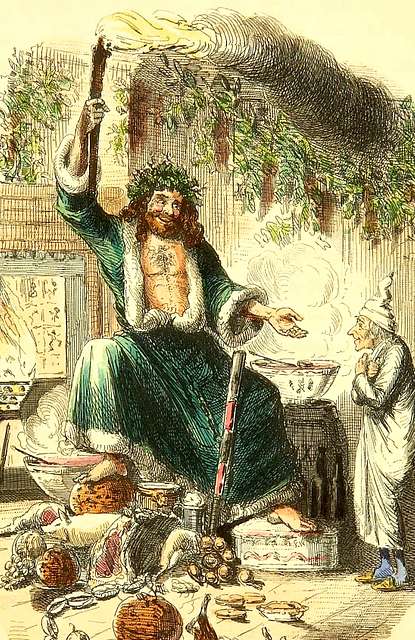
* John Leech illustration

Correspondences

Dear Beejay,

Remember how we used to correspond by email every week? Sometimes more often. You, the best correspondent ever, though we never wrote paper letters–in those pre-internet years, we’d lost touch, moved too often; no postal mail from you until, once we were connected again, you sent me a birthday card. And tomorrow is your birthday. So here’s your birthday email. You see? I didn’t forget.

It remains dry here. That spate of rainy days in early April? Over with and barely a half an inch since then. I’m watering my veg garden daily. Today I sowed another row of spinach. The first and third sowings are doing well, but the second sowing didn’t germinate–can’t figure out why not. The lettuces and other greens are looking good, and the strawberry plants are in bloom. I even took a chance and planted some zucchini seeds. The task of thinning lettuce and carrots is indeed tedious, but it is a lovely day and the air is mild; and frankly, thinning carrots is less tedious than sending poems out to literary journals, I know you’d agree.

I’ve been reading a lot of contemporary poetry. It comforts me somehow, even when the poems are sad or angry poems (that seems to reflect the times, which poetry can do). Your own writing, who has it? Does it exist on some hard drive somewhere? You always were excellent at organizing things. A talent I envy and do not possess.

Anyway, I did a bit of weeding to prep for the tomatoes and peppers when the seedlings are ready to transplant, but I got a late start on them and may not even move them to the garden until after my trip to New Mexico. Right now we’re getting pollen blow here. I expect your pollen blow was over two or three weeks ago, and that the azaleas are past their showy bloom time down there. I know how you love azalea season. And the beach–I guess you won’t get there this year.

I do find myself, at odd moments, wondering about your cats. When our lives were routine and there was nothing of interest to write about, we could always turn to cat anecdotes. Today, my Nessie joined me in the garden while I was working on the carrot patch. The catnip plant in the herb bed has leafed out quite early, and Nessie stretched his whole lean body over it and lolled himself into a snooze-fest, exposing his white belly. You would have laughed. You always called tuxedo cats “Holsteins.” I’m insulted on Nessie’s behalf.

When a person we love dies, I guess there’s an impulse–almost an instinct–to memorialize them, at least among those of us in “Western societies.” Or maybe it is a human impulse, I can’t say. I have written too many poems of elegy, and there will be more; but sometimes, it takes awhile before I feel I have the right perspective or frame of mind to write about them, or about my feelings of loss. Today, so much reminded me of you, Beejay, that I had to write something. If not a poem, then an epistle–the way I used to write to you, of ordinary things, the garden, cats, seasons, poetry.

Happy birthday, wherever you are.

Equinoctal

Torrents. We had rain in torrents, and it went on for days from February into March and then on…and on. Constant alerts on the cell phones: “Flash flooding.” Doldrums set in. In an effort to accomplish anything at all, I even started to sort through and organize my attic.

Talk about desperation!

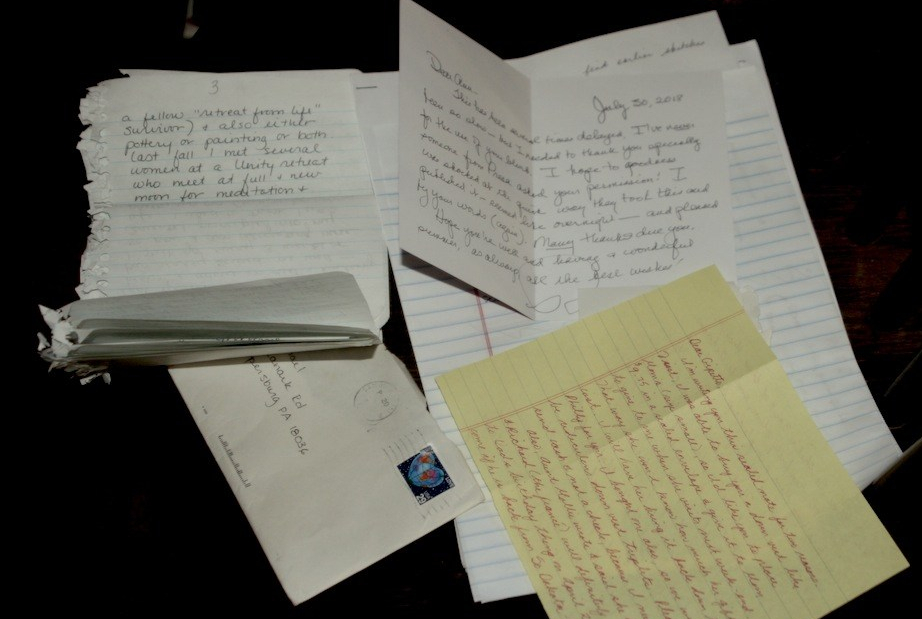
The attic project isn’t finished–the weather turned mild and clear two days ago, so I ran to the garden to get to work out there–but it turned out to be a more rewarding task than I expected. I started by tackling the Christmas stuff, then the books (SO many books), children’s toys (the kids are in their 30s and there are no grandchildren), and moved on to paper correspondence. Letters! Postal mail. Epistles. Why I have saved so much of my correspondence from 1975 to the present, I cannot explain. Maybe that’s a thing that people who love words just naturally do, the same reason I have kept so many books. I certainly don’t need all of it; but that was part of the task, sorting what I want to keep and agreeing to recycle the rest. I also found odd ephemera, such as photocopied posters for long-ago poetry readings, broadsides of poems, xerox-zines from the early 1980s, and ancient mixtapes on cassette.

~

There’s some sorrow with this project. So many of my former correspondents have died. I find my grandmother’s looping script, my dad’s distinctive handwriting, my dear friend David Dunn’s nearly-illegible scrawl. Reminders of times past. Maybe that is why we keep ephemera: to remember what we thought, at the time, was important.

Maybe it is, maybe it isn’t, by the time we reach our later decades–if we’re fortunate enough to reach them.

I keep gardens for different reasons. Not to remember the past but to see what the present can bring.

~speaking of the present~

My new book can now be ordered from the publisher, if you find Amazon problematic (and there are good reasons for that). The link is here.

Why don’t you write?

I was an avid letter-writer once, a great correspondent, a reliable pen pal. In return, I received long, descriptive letters from far-flung friends and relished every trip to my mailbox to discover what had arrived that day. A letter from a friend? A poem rejection? A poem acceptance? A postcard from a family member off traveling? Critique and feedback from a poetry-colleague on a series of poems? Junk mail, bills…

These days, my mailbox mostly disgorges junk mail and bills. The few friends who write lengthy correspondence usually do so by email (which I do, truly do, appreciate). My keen interest in other people’s thinking, and my opportunity to acquire perspective into their lives, must now be satisfied by other means. That’s why I follow blogs and other “long-form social media.” (I thought I had coined that term, but apparently it has been in the lexicon awhile.)

Is a letter just a blog written for an audience of one? Is a blog a diary written for an imagined public, or is it a letter to the world? What purpose do private journals serve for those of us who keep them? And what’s behind the urge to keep old correspondence? The discovery of a cache of letters features in many novels and in a host of memoirs and histories, so there’s some kind of human-interest frisson resonating there. Perhaps the simple fact that such writings were intended to be private–that audience of one–piques curiosity.

For me the hardest aspect of letting go of past correspondence is that so many of the people to whom I wrote letters have died. In my attic, there are boxes of letters from these departed friends…suggesting a different meaning for the phrase “dead letter.” In a similar vein, there certainly exist blogs by now-dead writers that remain in the cloud, hanging stuck in the interwebs. Are these memorial pages, or are they digital ghosts, and to whom do they belong?

Photo by Pixabay on Pexels.com

The intersections and overlaps between these related forms of written expression intrigue me. And the nosiness interests me, too. Isn’t that one reason we like to read literature–to get an intimate peek at how other people behave, respond, solve problems, form relationships, think about society and values? To imagine to ourselves what bad behavior feels like and what its consequences can be? Or to find insights as to what generosity and love can accomplish; to gain a sense of empathy, even compassion. Plays, memoirs, novels, and poems operate like that. I’m not sure blogs and diaries work quite the same way with their readerships, but they may do.

Maybe what keeps me following any kind of writing is just the fact that I love to read.

~

Why don’t you write me?
I’m out in the jungle, I’m hungry to hear you
Send me a card
I am waiting so hard to be near you
Why don’t you write?
Something is wrong
And I know I got to be there
Maybe I’m lost
But I can’t make the cost of the airfare
Tell me why (Why, why)
Why don’t you write me?
A letter would brighten my loneliest evening
Mail it today
If it’s only to say that you’re leaving me…

Paul Simon

Conferencing, distance

Rather at the last minute, I found out that West Chester University’s Poetry Center was hosting a virtual conference during National Poetry Month. Previous WCU poetry conferences have been in person, and often in June; I used to attend when I had the time and money, since I can drive to West Chester in about an hour. For years, my full-time job has interfered. This time, the fee was low and the panelists and readers were people whose work I enjoy. While I could not attend all of the sessions or enroll in a 3-day workshop, I could at least “zoom in” to many of the events.

I’m glad I did. But before I write about this year’s conference, a brief history of my experience at past WCU Poetry conferences.

Initially, the conference poets focused on formal poetry: writing in forms, meters, and employing rhyme at a time when the major forces in U.S. poetry leaned more toward free verse. Dana Gioia was one of the co-founders, and the conference brought in such writers as Anthony Hecht, David Mason, Rachel Hadas, Marilyn Nelson, Richard Wilbur, Molly Peacock, and Timothy Steele…to name just a few (I haven’t forgotten the others, I just cannot list them all!). If you’re not familiar with them, Google their names and locate some of their poems; their work is considered “formal.” By some. The term itself is rather fraught. I’ll skip that argument for now.

It took considerable bravery on my part to participate in the conference the first time I attended, because I was writing mostly free verse, was not an academic, and was more or less acclimated to being a not-very-ambitious stay-at-home mother. I’d started my MFA program, however, and told my advisor that I wanted to learn the things I’d missed concerning historical patterns of poetry. I loved and grew up with rhymed and metered poems but had no idea how to create them. Hence: the WCU conference, which happened to be near enough that I could get away and back for four days and not have to do too much re-scheduling to accommodate my kids, pets, garden, and spouse.

Frankly, I was intimidated. The poets were all so…accomplished. Most were college professors, many were critics, lots of them had written books–lots of books–and even many of the people attending had won prizes and had significant publications. They were keenly and frighteningly “smart” folks, well-read and well-traveled. But after awhile, I felt more at ease. Sam Gwynn, Molly Peacock, and David Mason were hilarious. Rachel Hadas demonstrated intense and generous listening, and was so kind. And I learned so much (and bought so many books…) that I attended at least four more WCU conferences. Then I got too busy.

The Poetry Center and the conference have changed directorship a few times. For awhile, the late (and wonderful) Kim Bridgford, who later established the Poetry by the Sea Conference, was at the helm; currently, the Center’s guided by Cherise Pollard, who came up with the theme that drove this year’s panels and workshops: The Healing Power of Empathy. Healing and empathy are qualities we need when times are hard and seas are rough. It’s important to remember that healing requires change. It’s a change-state verb. Sometimes those changes feel uncomfortable, painful–and empathy can help, as long as we employ it in an active way (empathy as a change-state).

I managed to draft a sonnet in 15 minutes, thanks to Molly Peacock, and heard some new-to-me voices in poetry, and listened to poets who are deeply engaged in the work and art of poetry discuss their processes, enthuse over their influences, and say what drives their curiosity. I found kindred writers who are, like me, endeavoring to put voice to people with dementia and express the grief we experience as our Best Beloveds lose personality, language, ego-consciousness.

Lesley Wheeler shared the writing prompts her panel put together on her blog, here; she and her four co-panelists (see blog) reflected on feeling across distance, another apropos topic in the current times. It seems we can and do find methods to be human together, even when we are apart. I think of all the letters I wrote when I was in college, and afterward, as I moved around the eastern USA, changed addresses, and tried to keep my friends and family informed as to who I was and what my interests were. In my attic, there are boxes of correspondence written in the days before email. Many of them are now letters from ghosts. Words I will never hear again from living mouths, but a way we kept “in touch” despite, and over, distance. And still do.

Letters

I have been reflecting on the practice of letter writing and how it improves writing skills because it is, essentially, practice in written composition.

I teach writing, and one thing I notice among students who ‘don’t write well’ (in their words) is that they struggle to develop a voice in their written essays. In the hundreds of years before telephones and tablet devices, literate people learned a voice and style not through school essays but through frequent letter-writing practice. If a total stranger were to read aloud to me letters from my two grandmothers, I could identify which grandma penned which letter by style alone.

The adventurous 19th-c. traveler Isabella Bird, to take another example, once wrote a 116-page letter to her sister, Henrietta! Bird’s letters form the basis of her many travel books, which are entertainingly told with an eye for humor and for accurate, sense-based description–her voice remains intact in her work, long after her death.

Today’s poem draft is a prose poem in the epistolary mode.

~

Entanglement

I think of you so often, especially when weeding the perennials, a task
we have so often done side by side and in so many seasons, you and I knee-deep
in goldenrod and wild aster that invades the irises and wild indigo each June,
or earlier in the season, on chill and drizzling April days, clearing shot-
weed, ground ivy and chickweed from the creeping phlox and daffodils.
You’d be dismayed at the state of my ornamentals this year, your perfectionist
streak critical of the stray wanderers, stands of sedum that need dividing,
the dust on my piano, ottoman replete with cat hair, my cupboards in disarray.
I miss your diligence and vivaciousness, the way you take your coffee scalding
hot, your eye for color, your bold opinions I have so studiously ignored.
Today it is raining and the book I’m reading describes quantum entanglement
theory, “a physical phenomenon that occurs when pairs or groups of particles
are generated, interact, or share spatial proximity in ways such that the
quantum state of each particle cannot be described independently of the state
of the others, even when the particles are separated by a large distance.”

I miss you.


~

IMG_5768


Epistle as writing practice

I am often asked by my peers why “young people” do not come to college with exemplary writing skills. Because I feel protective of my students, I wish to defend them–not always an easy task. My first response is that they have not had enough practice in writing to develop adequate fluency, and I generally follow that by admitting that many of my students have never really read books for leisure or out of passionate interest and that they are quite adept at other forms of communication (social media, looking at you!). Last year, I decided to spend one class period on epistolary writing. I recognized that one way I developed confidence in expressive writing was by writing letters. Lots of them. Every week to my parents, almost as often to my sister, to my best friends, to sweethearts, grandparents, anyone I cared about. Probably 30 years of letters, which later morphed into lengthy emails as the technology developed. Letters. Who writes them any more? Certainly not today’s college freshmen, if my students offer any objective measurement of their generation. The epistolary mode offers students a chance to exercise the use of second-person as a governing pronoun, a style that formal academic writing shies away from except in certain forms of persuasive writing–the opinion column, for example. Teaching my students NOT to employ “you” is such a constant effort that I thought letting them write letters would give them a much-needed break from prescribed academic conventions and allow them to loosen up their sentences a bit. Before I assigned in-class letter-writing, I asked whether any of them ever writes letters. Not one hand went up. I withdrew from my tote bag a clutch of old correspondence (yes, of course I would be that person who keeps the letters people write to me). After flourishing an envelope–with a 29-cent stamp–I disclosed the contents, a ten-page, handwritten letter from a dear friend. The students audibly gasped. “How long did that take to write?” “Did you read all of that?” Sure! When long-distance phone calls were expensive, letters were social media. We couldn’t just snapchat a photo of ourselves standing on a pile of snow and caption it “Snow!” We’d have to send a photo. Or we’d have to describe without the visual–and this is a practice my students have almost never had to employ. Lack of informal writing practice translates into lack of writing practice, period. I even read passages from three letters aloud, and the students were impressed with the vivid writing…writing by “non-writers.” “You could write like this, too,” I told them. “You just haven’t needed to do it, and therefore you think you can’t do it.” Then I asked them to think of a person, a specific person, and come up with a reason or purpose to write to that person, and then just write. The response was amazing. Some of these students wrote more in 15 minutes than they ever have for an in-class assignment. Most of them enjoyed it! One student even said that “this old style of long form texting intrigues me” and plans to start writing letters to a sibling once a week. Success! ~ Letter Writers Alliance is an informal site promoting the hand-written, postal-mail delivered epistolary correspondence. Members can sign up to find a pen pal or just browse the site for stationery, pens, letter-writing tips, etc.

Writers, letters

26 January 1983

AnN aNn ann ANN!!

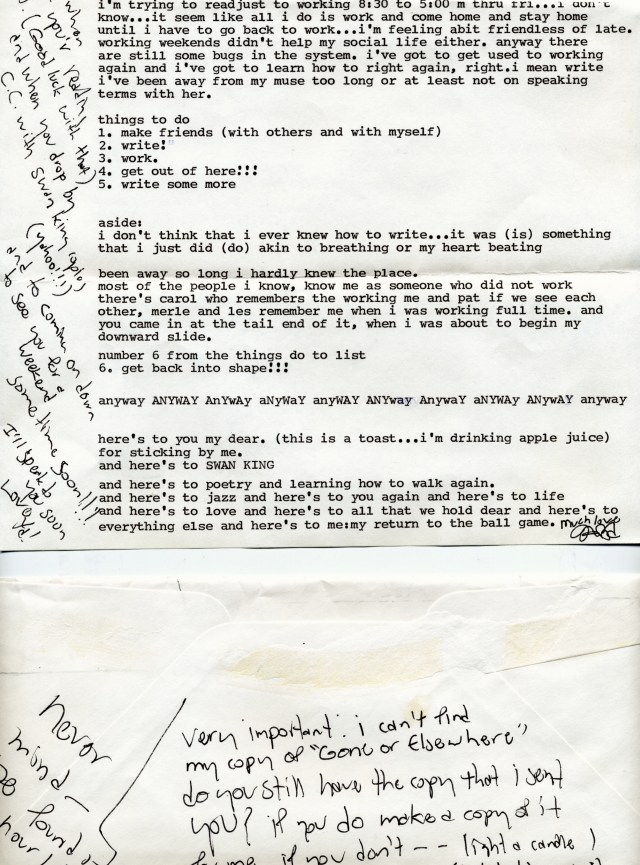
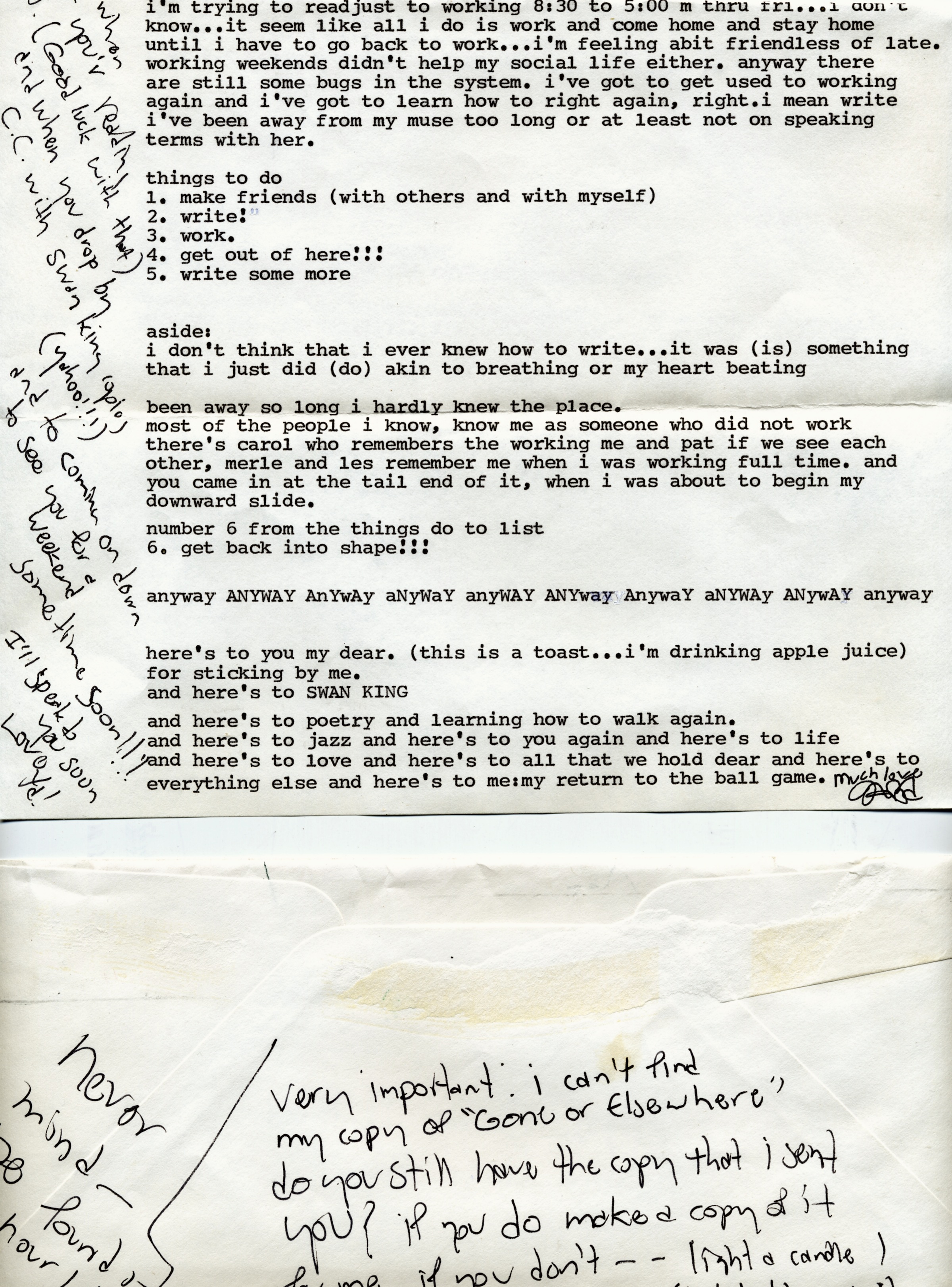
…it seems like all i do is work…i’m feeling abit friendless of late. working weekends didn’t help my social life either. anyway there are still some bugs in the system.i’ve got to get used to working again and i’ve got to learn how to right again, right. i mean write. i’ve been away from my muse too long or at least not on speaking terms with her.

things to do

  1. make friends (with others and with myself)
  2. write!
  3. work.
  4. get out of here!!!
  5. write some more

(aside:)

i don’t think that i ever knew how to write…it was (is) something that i just did (do) akin to breathing or my heart beating

been away so long i hardly knew the place.

number 6 from the things to do list

6. get back into shape!!!

ddunn1983002


anyway ANYWAY anyWay anyWAY aNYWay anYway ANyway anyway–

here’s to you my dear. (this is a toast…i’m drinking apple juice) for sticking by me.

and here’s to SWAN KING

and here’s to poetry and learning how to walk again. and here’s to jazz and here’s to you again and here’s to life and here’s to love and here’s to all that we hold dear and here’s to everything else and here’s to me: my return to the ball game.

much love. david.

~~