Milling & worthiness

Probably because I have been stalled on my manuscript (see previous post), I’ve been reading blogs and speaking with friends about the whole “project” of publishing poetry books. People sure have widely varying opinions. It had occurred to me there would likely be some controversy over this even in a world as small as poetry; but I am surprised at how heated poets, and publishers, can get concerning the whys, whens, and hows of poetry collections. Whether a poet’s work is ready, for example, or–as some folks might put it–worthy of a book or chapbook, and when in one’s “career” is the time to put a book out into the world…and whether the time it takes and the costs of submitting and contest fees are worth the effort or act as a barrier to the underfunded, the less-known, and the uninitiated (or to people who just are not very good poets).

Where a writer is in her poetry (career, journey, artistic path, life, whatever) surely makes a difference in whether or when she pursues manuscript-making. Some folks suggest getting a chapbook out as soon as one has enough good poems because a chapbook looks good on a poet’s CV. Others insist it is better to wait and get work published poem-by-poem in journals and literary sites.

Some poetry publishers are more selective than others, so writers new to the process are likely to feel discouraged when they keep getting rejections from these “top tier” places. There are publishers who are less selective, but sometimes writers get warned away from having their manuscripts produced by a so-called poetry mill. “Get your books accepted and published by the best-regarded publishers,” they’re advised; a chapbook-mill press will not look as good on the CV.

But getting that manuscript accepted by the best-regarded place can take a long, long time. (Speaking from experience!!) What to do?

I’d advise poets who want to compile a manuscript to think about what the purpose of doing so is. There are more reasons than you might realize. Are you trying to get a job in a creative writing program? Are you trying to stand out in the crowd? Do you want to publish mostly for your friends and relatives? Or for yourself? Do you need publication in order to stay on the tenure track? Does your manuscript represent the creative output of a difficult time that you want to make art from and share with others? Are your poems gathered together in order to inform, to argue/convince, to entertain, to be relevant in the moment? Is your manuscript a kind of personal document, a memoir in verse and, if so, do you view it as important for other people who may relate to your experiences? How crucial is is to have the book published soon? Do you think it is important to have the book be a prizewinner?

These are just a few things to consider. Other reasons abound. And at any rate, thinking about what you want your book to be or do or accomplish should help you to decide the where and how of getting it into print. Or if that is even necessary. These days, poets can garner quite a few readers by having poems that get posted online in literary blogs, journals, social media platforms, and other sites. Do you really need, or care about, having a book? What makes the process “worth it”?

Then there’s self-publishing–which, thanks to Lulu, Amazon, Blurb, BookBaby, and similar businesses is not that hard to do–and which no longer carries quite the stigma of “vanity presses” (though if you are trying to get tenure, I’d advise against this choice). Not all of us feel up to learning the ins and outs of templates and design limits that these businesses offer. Some presses began their lives as ways to self-publish or to publish the work of a poet whose work wasn’t getting much attention; Lamont Steptoe started Whirlwind Press (now defunct) to publish Dennis Brutus‘ poetry, then started publishing his own work, then morphed the press into Whirlwind Magazine for several years. Of course, there is no promotion at all; poets have to do their own PR even with some very good presses, and self-publishing requires even more.
Photo by Pixabay on Pexels.com

Then there are the “mills” I mentioned earlier. These would be poetry publishers that, critics note, are less “discerning” than the hard-to-crack literary presses. The ones I know of are not as predatory as vanity presses and are easier to work with than the Amazon-style self-publishing route. Some of them offer promotional advice or social media activity, and some may invite their authors to participate in regional group readings. And in fact, I have had one book and a chapbook or two published by presses I’ve heard referred to as mills. I suppose the publishers might object to the characterization, but it doesn’t bother me.

My feelings on getting my books in print have evolved over the years, and I think that they should. I am no longer a young poet new to the challenge of getting my poems into magazines (they were all print when I was starting out) and thinking about whether I wanted to work in the creative writing field or not. As it turns out, while I did earn an MFA, I never really used it in the academic area where I ended up. But I attend writing conferences, engage in critique, send my work out for publication–singly and in manuscript form–which are all parts of the poet’s career (if you can call it a career).

At this point in my life, I want to make books! I love books, and I love reading poems in books and not on a screen of any kind. It doesn’t matter to me if my books win prizes (though one did!) or are published by top-tier literary presses (er, no…), or if they ever result in my earning anything from my writing (not yet…). Yes, I want my manuscripts to be worthy–by which I mean that a few readers find something of value and enjoyment in them. On balance, that seems good enough for me.

~

Collecting & creativity

Somehow or another, I completed a chapbook manuscript. The longer collection is coming together, as well. Yet it feels to me as though I have not spent nearly enough time on my creative work. And when I find myself awake at 3 in the morning, it’s not poetry that runs through my mind. Usually those wee-hour thoughts are work-related. I guess that makes me normal.

The next step, once a writer has completed a manuscript, is to have another writer or two review it; I’ve done that, too. So now? I guess I submit the work and find out whether a publisher agrees the poem collection does the job of poetry.

And I get prepared for rejection. Comes with the territory.

Upon reflection, the reason I feel I haven’t been doing creative work is that I am not generating many new poems right now. Some, but not many. But let’s re-think the process of revision: it’s a process of deciding upon the order poems should appear in a book, and which of the poems ought to be there to speak to one another, to resonate with one another (and with the imagined future reader). Hey, I am using my imagination here, and I am doing creative work. If all I ever do is generate new poems, those poems won’t have a chance to go out into the world and endeavor to speak to other humans.

Figuring out how to make that happen is the creative work of revising, editing, rethinking. Imagining the reader. Striking the tone of each individual poem to see whether it adds harmony, or works with a fugue-like trope, or changes the mood to minor, or unleashes a surprise. The book of poems can have an arc or act as a chorale or zigzag about to keep the reader on her toes.

The collection of poetry, when it is not yet a book, presents problems the writer and editor must solve. Problem-solving requires creative thinking–I tell my students this almost every time I see them in class!

Will the manuscripts find homes? That’s a different “problem.” Meanwhile, more new poems, more revisions, maybe more manuscripts ahead…while I await the first frost, while the leaves turn and fall. All part of the cycle.

Not a perfectionist

My late mother-in-law, may her memory be for a blessing, spent much of her last decades gardening. I learned a great deal about flower gardens from her, and we discussed cultivars and shade-loving plants and pest control with the sort of enthusiasm that avid gardeners well know. She enjoyed landscaping her place with colors and textures, carefully tracing expected bloom times as well as plant heights and spreads so that the beds produced an ever-changing canvas to delight the eye.

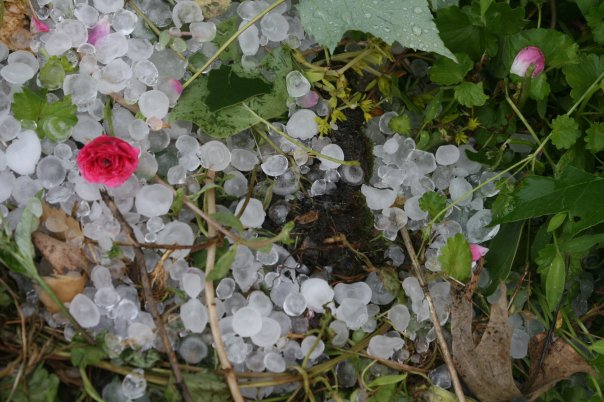
hail and roses

Hail: One of Nature’s curveballs

Except: Nature is always throwing curve balls. My mother-in-law’s gardens were beautiful, but she always eyed them critically. It is true that most gardeners notice what isn’t thriving, where the weeds are, or what has not grown out or bloomed as hoped. That comes with the territory. But the process of gardening is so much more enjoyable, even soothing, when one is not a perfectionist.

Not being a perfectionist myself, I find that time in the garden acts as a meditative oasis. It is part mindless physical labor, part problem-solving, part mindful awareness of the environment. This year, I’m making it even easier by planting fewer vegetables and fruits and more blooms to attract pollinators; I’ve a smaller variety of produce but am experimenting with some new (to me) seeds–a melon from the Caucasus, a few heirloom tomatoes, black beans as well as green ones.

I learn as I go–as I cull and thin, inspect insect damage, note responses to growing conditions. It occurs to me that this activity bears a resemblance to the writing process, particularly when putting together a collection for a chapbook or longer manuscript. In that undertaking, I’m also not a perfectionist; and I should not be quite so quick to gainsay the need for the perfectionist attitude when creating one’s art (as long as it does not lead to fruitless caviling).

But I’m just not constitutionally ordered towards that sort of purist idealism. The best I can do with my poems is similar to the best I can do with my gardens: devote mindful attentiveness to the “product” and try not to worry about eventual outcomes.

“Write a little each day, without hope, without despair.”  —Isak Dinesen [Karen Blixen]

See what grows.

IMG_1547

By July–who knows?


Collection

As I’ve previously mentioned–I have been putting together another manuscript of my poems–a collection. I had a few ideas on how to make the poems work as groups, but it turns out they are not happy together. I don’t think a poetry collection needs an “arc,” but I like to have the poems converse with one another in some way. Resonate with or inform one another. That’s what I am enjoying in Louis Simpson’s 1980 collection Caviare at the Funeral. I realized my aim in collecting my work was off when reading his book just recently…and now, I am reconsidering my manuscript approach. Again.

This may be one reason why, despite being a fairly prolific and reasonably well-published poet (in journals, etc.), I am so pokey at getting books into the world.

But I am considering what it means to be a collector, which is not the same as a curator. There is a difference between collecting one’s work and curating it into an experience for a reader (including oneself). Curating has never been my strength: I was the kind of child who collected things randomly, attempted to organize a doll or rock collection, but mostly just had little piles of stuff that interested me.

That’s poetry, too…little piles of stuff that interest me.


Manuscripting redux

I have read reams of advice and guidance on how to choose poems for a collection, how to order them, whether to construct an arc in a poetry collection, and so on. I have also had the excellent personal input of good poets and mentors in the process, all of which leaves me deeply grateful and still stumbling when I once again begin the process.

One challenge is excess. I have put off revising for collection for a few too many years, and now I need serious critique and culling; thus, I didn’t know where to begin (as I mentioned in an earlier post). Given a problem, however, creative people tend to develop a method. I chose the simplest one I could come up with: start by pulling all the published work that is not in my previous collections, and see what happens.

What I will discover–in fact, in the early process, already have noticed–is that not all work accepted for publication in a poetry journal reflects my judgment of my strongest poems. Then, too, down the road I will pull some good poems from the evolving manuscript because they do not play well with the others…that is, in terms of tone or subject. As I add things up, I’ll begin to see what might be missing or needed, or I’ll be reminded of an unpublished piece that ought to be included.

This work is exciting. And it takes weeks or months. It will change; my feelings about what I want the collection to say will change.

And then the reading will begin. I will read and re-read the book-as-it-exists and ask generous friends to read and critique the whole.

If I were a more ambitious and organized person, I might approach the manuscript process differently–certainly sooner, and possibly with more of a projected arc in mind from the start. I know that putting together another manuscript will be yet another learning experience, different from chapbook-writing, different from the past books I have composed. The poems differ, too–of course! My perspective, my physiology, my experiences, even my environment, though I have lived in the same house for 20 years.

At this stage, a month or so into the process, a coherence begins to occur. Yes, a book exists in the piles of poems. Probably two books, in fact–but let me begin with abundance (or perhaps, with diminishment) and proceed from there.


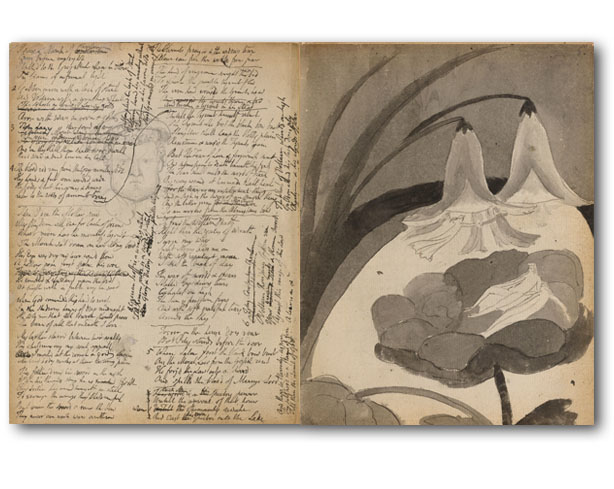
http://www.ebooktreasures.org/william-blakes-notebook/
[Not my manuscript…William Blake’s]

Manuscripts

A draft, inspired by the book Meetings with Remarkable Manuscripts and related to a series of poems titled “Self Portrait as…”

Self Portrait as Illuminated Manuscript

This one exhibits some damage:
a missing folio, signs of mildew
and rodent chewing—calfskin a protein
and rats inevitably hungry.

It lacks signs of eminence (even books
have breeding), meant for use
and not for show. No burnished gold
for the initial letters, no sign of patronage

or dedication, though the illustrator
had a talent for small birds and
winsome sheep. The marginalia’s
interesting for what it doesn’t record–

genealogy absent, no list of relics
or property. The uncial style, workman-
like and unremarkable; the parchment
rough, irregularly cut; the binding,

late 18th century, carelessly done.
Yet any medieval manuscript is rare,
expensive in its era, product of cutting,
scraping, grinding, sewing, economies

of the book. Scribe correcting his copying
error, following his exemplar. Illuminator
in his carrel, sketching foliage and dove,
flair of alphabet and the glory of god.

If somewhat the worse for wear after
six or seven centuries, anonymous,
modest, pedestrian, this manuscript’s
survived. That is one of its merits.


Honestly, I originally wrote the last line as “That is its only merit.” But I felt that was disingenuous, particularly given the title and the series of poems I’ve composed on this semi-ekphrastic self-portrait theme. Probably I possess other merits. As would any surviving medieval book.    🙂