“Next Big Thing”

A friend & colleague-in-poetry, April Lindner, has invited me to participate in the round-robin writing blog event (termed a “blog hop”) called “The Next Big Thing.” Thanks to Molly Spencer for coordinating this web-event, which has been going awhile, so she is no longer curating it as actively. At the end of this post, I’m linking my readers to a handful of other participants. From their sites, you can locate others…and so on! We hope to foster discovery of writers our own blog followers–or random visitors–are not yet familiar with, and to spur readership in general. I love to read, and I have a mission to introduce more people to reading, to poetry, and to contemporary artists–especially word-artists. Therefore, I’m thrilled to be asked to add my 2¢ to The Next Big Thing…even though some of the formulated “interview questions” lend themselves more to fiction writers than to poets. Some of the answers may end up sounding a bit far-fetched, or simply silly.

But poets do possess senses of humor, folks. We are not all depressive garret-dwelling introverted cynics. [Ha!]

~

Now to commence with the interview questions:

What is the working title of your next book (or story, or project)?

I have two. One manuscript is finished, and I am seeking a publisher–that one is titled The Red Queen Hypothesis. The work-in-progress is tentatively called Barefoot Girls.

Where did the idea come from for the book?

imagesThe Red Queen Hypothesis seems to be culled from a bunch of my poems musing on science. I love science because it is so weird, much odder than so-called real life. Also, the nomenclature…I swoon over those latinates, Greek roots, and things-named-after-other-things. Here’s the biological definition of the Red Queen Hypothesis from Wikipedia: “an evolutionary hypothesis which proposes that organisms must constantly adapt, evolve, and proliferate not merely to gain reproductive advantage, but also simply to survive while pitted against ever-evolving opposing organisms in an ever-changing environment.” As Alice and the Red Queen are hurriedly running through the chessboard of Wonderland in Through the Looking-Glass, the Queen remarks, “Now, here, you see, it takes all the running you can do, to keep in the same place.” Don’t we often feel that way?

PBS has a good little article on it here, for those who want to learn a little science with their poetry.

Barefoot Girls evolves as I revise. As of now, the poems are memoir-based about being a teenaged girl in New Jersey, and many of them allude to Bruce Springsteen songs. The collection is, I suppose, lyrical narrative in style. Mostly free verse but with some ballad-type pieces and even a sonnet or two. I may have some trouble getting that manuscript into print because I have to get Springsteen’s permission to use a couple of epigraphs. God knows how long that will take–or if it is even possible!

What genre does your book fall under? Poetry. No other genre need apply.

Which actors would you choose to play your characters in a movie rendition?  

I would love to have Gary Cooper or Barbara Stanwyck play characters in my poems, which makes about as much sense–since they are dead–as making a movie of a poetry collection.

What is the one-sentence synopsis of your book?   

Life, love, family, environment, death, memory, animals, youth, curiosity, god.

Will your book be self-published or represented by an agency?

1) No.

And 2) –you have got to be kidding! Literary agents in the USA generally avoid poets as though we harbor west Nile virus.

How long did it take you to write the first draft of your manuscript?

Four years, generally, though some individual poems evolve more slowly. My first full-length collection, Water-Rites, took much longer…closer to ten years.

Who or what inspired you to write this book?

Ah, the “inspiration” question. I have a deep indifference to the question of inspiration. I suggest you read other writers on this topic.

What else about your book might pique the reader’s interest?

The Red Queen Hypothesis includes numerous poems that employ formal strategies, as well as plenty of nonce forms; I think of them as experiments, the way scientists frame their work though experiment.There are also philosophical undertones. It is a book of questions that are scientific, speculative, spiritual and philosophical. Barefoot Girls, the project in process, also poses questions–but of a different kind. More social and gender-related questions, more coming-of-age curiosity. The fact that these poetry pursuits came one after the other intrigues me since they seem in many ways fairly unrelated. Perhaps I will discover the relationship as I continue to revise Barefoot Girls.

Meanwhile, if anyone can suggest a publisher for RQH, I’m all ears!

Who are you tagging for The Next Big Thing?

~As The Next Big Thing is on hiatus, I suggest my readers browse for it or follow the links below that will lead to other links & literary discoveries!!

Here are some other Next Big Thing posts:

http://boysinger.wordpress.com/2013/02/24/the-next-big-thing/
Favorite poems

In my last post, when writing about reading poems of grief, I mentioned Robert Pinsky–former US Poet Laureate. When Pinsky was Laureate, he promoted the program now called “The Favorite Poem Project.” The concept was to demonstrate that poetry appeals to a diverse audience; there are so many styles and types of poetry, on so many topics, that anyone can find a poem that appeals. Teachers, plumbers, teenagers, soldiers, business executives, mail carriers, truckers, grandparents, schoolchildren–anyone who had a poem that had special meaning was invited to say a bit about why or how that poem meant so much and then to read the poem aloud to an audience. Pinsky’s project included favorite poem reading events, and videorecordings of such events, now archived at the site…and a book.

This year–this past Tuesday, to be quite exact–I took part in a favorite poem reading at the college where I work. I find these readings rejuvenating. Sometimes the stories that surround the poem choice are heartwarming, sad, or funny. Some readers tell an anecdote about a favorite teacher, relative, friend, or book; it’s wonderful how those stories “work” with the chosen poem. The director of information technology related the story of how, when her mother was in labor with her, her mother was taken to the hospital by hearse because taxis in the south did not serve her “black neighborhood.” A dance professor offered the romantic story of his long-distance courtship with his (now) wife via letters and poems…and Neruda. An instructor spoke of his fascination with attics and his father’s estrangement from the family and then read Stanley Kunitz‘s amazing poem “The Portrait.”

The poem I read was also a Kunitz poem, “The Snakes of September,” one of his later works. I am not sure this is my favorite poem–indeed, I would be hard pressed to come up with one only, and I might choose Ben Johnson’s “On My First Son” or Mary Oliver’s “Wild Geese” or Li-Young Lee’s “The Gift” or…well, there are dozens. I just chose one I thought would suit the evening, a poem with a garden in it, and an allusion to Eden, and the lovely phrase “the wild/braid of creation/trembles.” It speaks to me.

Look for poems that speak to  you. Keep them near  you, on the fridge or by your desk, in a notebook by your bed, or in your heart. Share them if you feel the urge; you will be doing good.

Blessings for National Poetry Month and always.

“The Visionaries” [a poem by a friend]

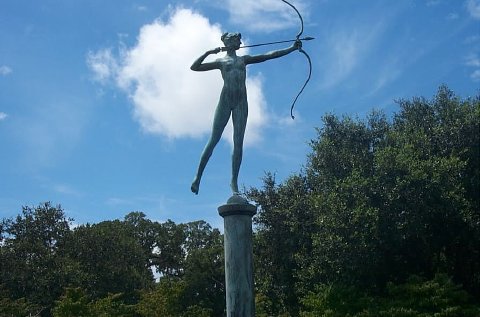
"Diana" by Augustus Saint-Gaudens; photo by Pete Finneran 2000. Image courtesy of Brookgreen Museum.  www.brookgreen.org

“Diana” by Augustus Saint-Gaudens; photo by Pete Finneran 2000. Image courtesy of Brookgreen Museum.
http://www.brookgreen.org

A poem by Beejay Grob © 2013

The Visionaries

We too had seen the gardens
sculpted by every season now.
A significant collective ‘we’–
myself, and practically anyone
I could target; one-by-one,
rain, autumn, winter night.

The family album holds each
posing sandwiched on a tailgate
flocked outside the aviary;
all standing straight as statues,
shot by the granite Pegasus.
Everyone except you, Muse.

Beneath a hospitality of waving
palmettos, feathering Carolina skies
from here to Charleston,
the stone-silent Visionaries
lean in from their perch,
reflecting in their secret oracle.

I took a stab at it when Orion
hung low over midnight oaks,
a carved moon enlightening Anna:
Why so many huntresses?
I determined her quivering gifts
sighted monumental occasions.

Walk among the springtime
blooms, the lubbers mating openly,
or in summer’s dead heat–
count the times she made a point
to cast herself as Diana,
the female Archer.

~ ~ ~

National Poetry Month, 2013. Many thanks to Beejay Grob, who wrote the poem and who introduced me to the beauty of Brookgreen Gardens in spring.

Brookgreen Plantation and Sculpture Gardens, Myrtle Beach SC

Comparison as analysis

April may be the cruelest month, may be the time of cherry blossoms hung with snow, may be the time to celebrate poetry–as if we could confine it to one month, those of us who love it–anyway, it is also the last full month of the spring college semester. After endeavoring to impart some understanding of the principles of literary analysis of poetry to my students for the past ten weeks, I assigned a short paper that taught me a great deal. Perhaps it taught my students something, as well.

It occurred to me that metaphor–indeed, most figures of speech–are based upon likenesses, direct or analogous or implied. Yet we Western thinkers are taught to observe differences first and foremost. We learn that red is different from blue, that a ball is different from a block; and I am not disputing those differences. When we speak metaphorically, however, we imply similarity instead. My students default to contrast for analysis and to similarity for description.

There’s nothing inherently wrong with that; it’s very Aristotelian. But what if we turn things 180 degrees? Think of Linnaeus, who classified so many plants and animals; he grouped life forms according to likeness. The differences branched off from the similarities. He described what was overtly or subtly similar, then analyzed for differentiation.

Any two poems have at least a few things in common, so I asked my students to do a comparison-only study, briefly, in a 2-page paper. Initially, they had a great deal of trouble with the assignment. They wanted to contrast. Their interests lay in what was noticeably different about each poem. They genuinely struggled to stay on the topic of similarity, but the outcomes were some of the best papers I have yet had from this class. A student told me that this exercise “really made me think.” Yin-Yang

Fascinating response, really. What does it tell us about our brains, our education, our observational instincts, that we want to stress difference before similarity? Is this a Western civilization thing, or an in-our-DNA-thing? I wonder.

The process that makes a person think, though, is a learning process for certain. Once we can recognize similarities between disparate works of art, we can perhaps recognize similarities between philosophies, religions, human beings. The very differences may become beautiful or intriguing rather than frightening or alien. We may learn to become more comfortable with variety, and more appreciative of it. I know my reading life would be much the poorer if I refused to read, try to understand, or value novels or poems that seemed challengingly “other.” I do not love all of the work I read, but everything teaches me something.

The poems below are very different. In what ways, specifically, are they alike?

Spleen (by Charles Baudelaire, tr. by Robert Lowell)

I’m the king of a rain country, rich
but sterile, young but with an old wolf’s itch,
one who escapes Fenelon’s apologues,
and kills the day in boredom with his dogs;
nothing cheers him, darts, tennis, falconry,
his people dying by the balcony;
the bawdry of the pet hermaphrodite
no longer gets him through a single night;
his bed of fleur-de-lys becomes a tomb;
even the ladies of the court, for whom
all kings are beautiful, cannot put on
shameful enough dresses for this skeleton;
the scholar who makes his gold cannot invent
washes to cleanse the poisoned element;
even in baths of blood, Rome’s legacy,
our tyrants’ solace in senility,
he cannot warm up his shot corpse, whose food
is syrup-green Lethean ooze, not blood.

~ ~
Arrival (by William Carlos Williams)

And yet one arrives somehow,
finds himself loosening the hooks of
her dress
in a strange bedroom–
feels the autumn
dropping its silk and linen leaves
about her ankles.
The tawdry veined body emerges
twisted upon itself
like a winter wind . . . !

~

(These poems are shared under the Creative Commons and are copyrighted by the estates and/or publishers of these poets)

Judging poems

During National Poetry Month, a local newspaper (Lehigh Valley Press) sponsors, with a local public radio station (WDIY), a poetry contest for children ages 6-17. This year I was one of seven people, most of us educators, on the judging panel.

Judging poetry is always a rather fraught endeavor, and when one is reading the work of novices–particularly very young ones–setting standards can be challenging. What were we looking for, exactly? How could we decide whether the writing of one 14-year-old was “better” than the work of another? How to assess the poetry of 8-year-olds?

Our coordinator and organizer began with such questions and by asking us to describe what each of us seeks in any poem–not poems by children, but any good poem. Would children’s work feature any of these attributes? Successful attempts at poetic strategies or craft, for example–we may be able to determine that a 10-year-old’s work shows signs of poetic craft. Imagery that moves beyond the expected or clichéd? Young people often prove quite capable of that part of writing.

We are experienced in the classroom, too, and can usually tell when a child’s work shows signs of being ‘overly-coached’ by a well-meaning adult. Alas, all too often an adult’s interference deadens the imaginative if occasionally grammatically-incorrect approach children take. We can also tell which poems come of a classroom assignment when we get submissions of numerous 7-line poems on “snow.” This is not to suggest that none of the poems are worthy of note: an imaginative writer of any age can probably create a lovely piece conforming to the assigned framework. But, as teachers, we found ourselves responding to the assignments themselves (“That’s clever and would work well with third-graders, too;” “They must be studying the Black Plague;” “Looks as though they made a word bank for this one;” and so on). We had to remind ourselves to look at the work itself for the earmarks of imaginative ideas and use of language.

Interestingly, first-place poems seemed obvious and agreement was usually unanimous. This was true for elementary school, middle school, and high school writers: the best work does stand out.

Choosing the second and third place poems was more difficult and resulted in lively conversation about what makes a good poem, what matters more: authenticity of experience? discernible voice? vivid imagery? clear use of craft? emotional expression? imagination? Each of the judges had useful insights that reminded me of the value of thoughtful criticism and the value of poetry-as-art.

It was also heartening to read the work of so many young people who showed a willingness to play with words, to think about aesthetics and feelings and language, and to show their work to others. I’m grateful to the teachers who took the time to introduce their students to poetry and to encourage their pupils to write.

I celebrate myself…

April is National Poetry Month in the USA, and I begin the month with Walt Whitman’s famous phrase and will attempt to duplicate the joyous urgency of his call to celebration. That means I am going to try to post just a little more frequently in April.

Poetry month began this year with a wonderful act of creative largesse on the part of a friend who sent me a poem…dedicated to me. Receiving a gift like this one is humbling; and it has been quite a long time since anyone’s written a piece for me. David Dunn, to whom my collection Water-Rites is dedicated, wrote a few poems for me or inspired (indirectly or directly) by our friendship or my family and surroundings. But he died over a decade ago, and since then I suppose I have had to learn to celebrate myself.

Not that this is a bad thing–celebrating the self–but for some of us it presents certain cultural or psychological obstacles. In this, Whitman has been an important teacher for me. As a great observer, loafer, lover of the world and all its beings, he was able to include himself among the beloved. My background, Protestant, agrarian, modest, surrounded by the biblical entreaty to remain always humble before God, combined with a natural shyness, means that I have had trouble admitting of self-celebration in any form and under any circumstances. I don’t take praise comfortably. The left hand shouldn’t know what the right hand is doing.

However, Whitman seems contented in his skin and in his world and follows a different parable as model: he does not hide his light under a bushel.

Walt Whitman in mid-life

Walt Whitman in mid-life

Furthermore, his passion admits of compassion and of aesthetic appreciation for all of the “Kosmos.” Each breath, scent, texture, color, hue, person, idea, object, sentient or non-, living or inert or dead long-past or recently, religious or scientific or imagined comes to life in language through line, syntax, lists, descriptions, words. I think there is a hint of zen-like acceptance in Whitman’s most lasting poetry, the vulnerable willingness to accept all that we experience and to do so non-judgmentally.

Thank you, Beejay, for the poem. I feel inspired anew. And as I celebrate all poets and the valuable, irreplaceable, gorgeous, ancient art of poetry this month, I shall endeavor to embark upon the celebration of myself (davening to ol’ Walt with humble pleasure). Therefore, a reminder:

My book Water-Rites is still in print, and Brick Road Poetry Press sells it (as does Amazon.com, where poetry-lovers can purchase the book in e-book form for Kindle). Dawn Leas reviews it at Poets Quarterly this month. Click for the link here!

May April be full of revelations in the form of poems for you.  water-rites by Ann E Michael

Interview

“Who has not sat, afraid, before his heart’s
curtain?  It rose:           the scenery of farewell.
Easy to recognize. The well-known garden…”
–Rainer Maria Rilke
~

primrose by Ann E. Michael

Herewith, a recap of my side (much edited) of the ArtsAlive! conversation this past Sunday at Soft Machine Gallery. SØrina Higgins was also reading and being interviewed by Lehigh Valley Arts Council director Randall Forte, but I can’t adequately summarize her insightful comments. You can find her book here, however.

~

RF: What is your favorite poem in the collection Water-Rites?

AM: I hate to try to pin down a favorite poem, by my favorite writers or by myself. I once heard Billy Collins reply to that question by saying his favorite poem is always the one he is currently in the process of writing. That’s kind of cleverly evasive, but it’s also a little true. Though sometimes I hate the poem I’m currently working on…

I like the title poem, but I get a kick out of “Doxology” because it is so odd; and perhaps my favorite poem is “Tailfeathers” or “The Big Umbrella” or, for purely sentimental reasons—not because it is my best poem—“At Bull’s Head Pond.”

~
RF: What was the most difficult poem to write?

AM: The most difficult poem to complete was probably the long poem in the center of the collection, “The Valley, the Whitetail: A History.” That was difficult in terms of managing the length and the purpose of the poem; also, it required some research. Yes, occasionally poems take quite a bit of research—I have no desire to be inaccurate when I am writing about history or geology or botany (though I often am, inadvertently, despite my best efforts). Not all poetry is solely a work of the imagination.

There are other ways to be “difficult” however. A poem that was hard to complete was the elegy “I Shall Never Be Nearer,” which came quickly initially but took a long, long time to revise and to come to terms with. Not all of these poems—or any of the poems I write—are “about” me or my experiences, I mean, not as biographical as they may seem. But this poem does deal very specifically with the death of my close friend. It was the day after I learned of his passing, and, completely numbed and sleepless, I went with my family for a canoe trip on the lake. I titled this poem “Single Lines” for several years while I was revising it, because the images came to me in – well – single lines. Single images. I must have revised little tiny things in it oh, about 14 times. So I guess that means it was “hard to write.”

~

RF: So, the opposite question. Which poem was easiest to write?

AM: Some poems do come quickly and relatively easily. Not often, and sometimes those that come rapidly end up being sort of crappy poems. But “Lot’s Wife” only underwent about 2-3 drafts and mainly arrived, haiku-like, as a visual image that carried with it some cultural freight.

Another poem that arrived rather miraculously is “River by River.” That was the result of a car trip to Indiana with my kids and is kind of a list poem. It spooled out as a result of a kind of inadvertent prompt. Will Greenway and Elton Glaser were looking for poems about Ohio for an anthology. I read the call for work, went back to my notebook about the car trip, and recalled an incident with my son and a roadmap. The editors chose it as the opening poem in the main text of the book—immediately following the preface poem by James Wright. I felt completely graced and humbled.

~

RF: How did you choose the title of the collection?

AM: Early on, while I was working on my graduate thesis project, I chose the title for the book. I’d written the title poem but hadn’t really thought of it as the title poem until I recognized how many of the poems dealt with drought or with bodies of water or rain or artworks that portrayed water. And spelling the second word as “rites” as in ritual, rather than as an other interesting aspect of water—the “rights” to water that have caused so much conflict over the centuries—seemed fitting given that there are also rites associated with death. Funerary rites, religious rites. And rites in the form of chants and dances people have done to invoke rain during times of drought. So there’s a pun there, rights and rites, and I love literary puns.

I wanted to use Steve Tobin’s sculpture as the cover art, and Steve granted the rights for that photo (more rights, legal rights) and Keith at Brick Road approved of the image for the book cover. So I am gratified by all of that. The sculpture is an early work of Tobin’s, when he was making art using surgical glass piping. It’s environmental, site-specific art that really looks like a splashing creek. But it isn’t—it is glass.

~

RF: Tell us about your publishing history and about how and if poetry publishing has changed over the years.

AM: I had my first poem published in a tiny literary journal back in the days of Xerox-ed micro-magazines, 1981 or 82. I’ve been publishing pretty regularly since then, regularly but not ambitiously. Lots of individual poems and essays in individual journals. I had no academic reason to get a book out, and I had no real direction either. It didn’t seem to be on my to-do list when I was in my twenties. Then, at 30, I had my children. Most of my creativity went in the parenting direction, though I continued to write. I didn’t really work toward book publication until about 1999. Then I began to think about it—after David Dunn had died. In fact, I got a chapbook and a full-length collection of his work out after his death. This is hard to do—to convince a publisher to put out a book posthumously. After all, the poet cannot promote his work. That’s hard on small publishers. But I succeeded. So I thought, I guess I can get my own books published. Maybe. And my first collection was a chapbook Spire press published right after I graduated from Goddard, 22 poems about building a house, sort of ecologically-invested nature-type poems.

Things have changed in the world of poetry publishing, but it is still hard to get your work into actual print—ebooks and POD self- or partially-self-published options, as well as the web and blogs, have changed the spirit of the poetry world only marginally, though I do think these options have made it possible for more people to read and encounter poetry. The absence of critical, discerning, well-read editors & proofreaders is a loss, in my opinion; but poetry is finding other ways to deal with that. And those editors are still out there. Underpaid and overworked and cranky, but out there nonetheless. MFA programs, perhaps. Critique groups have maybe replaced salons and absinthe cafes. I don’t know.

~

RF: Any advice for aspiring poets who want to get published?

AM: I’d advise aspiring poets to be ambitious. But there are many ways to be ambitious. I’m a bit of a plodder, but I hang in there. I’m not great at networking or schmoozing or even being sort of normally assertive—I’m quite shy with strangers and hate to ask even small favors…like asking an editor to consider publishing my work. Or asking people to host readings. I mean, that goes with the job, but it’s taken me a long time to get good at doing that. I hate that stuff lots more than I hate being rejected. I don’t take the rejections hard at all. My weaknesses lie in other areas. So I can say, if you want to get published, you might not want to do what I did…anyway, if you are eager to see print soon, you might want to be more assertive and organized. On the other hand, I have been self-promoting rather badly for thirty years; and I’m okay with that because the poems are better after thirty years even if my publicity skills are not.

I’m kind of outside the box as far as the “po-biz” goes. I do my job at the college, which is only marginally poetry-related, and then only when I am teaching a section of intro-to-poetry. (Mostly I teach remedial comp and tutor students in English; I like to remind myself that Kay Ryan has the same kind of job!). I attend conferences when I can get away and when I can afford them; I have taken seminars and workshops over the years, but not religiously or frequently. The “big thing” I did for my so-called career was to get an MFA from Goddard College in 2003. This was after I had won a PA Council on the Arts Fellowship—back when the council was giving those out. Please lobby your congress people for an increase in federal and state arts funding. That was so crucial for me, earning that grant. A great confidence-builder.

Since then, I’ve earned my MFA and have four chapbooks and this full-length collection coming out and a job in academia that I probably wouldn’t have if it hadn’t been for my graduate studies and a certain amount of dogged persistence of a sort of quiet variety that I seem to possess in abundance. I still send out individual poems for publication in print and online, though not as often as I should if I were really eager to stay on the po-biz radar. I keep up a blog and a Facebook page for “promotional purposes” but don’t expect to see me on your Twitterfeed anytime soon. Technology takes me away from my reverie zone and is, generally, bad for my poetry. What’s good for my poetry are long walks, gardening, and genial loafing, visits to museums, viewing architecture and geological formations, long face-to-face chats with friends, and reading reading reading.

The quote that opens my book, the Rilke quote, kind of sums that up for me. It’s really the well-known garden that makes me recognize where the poems are coming from. The scenery of farewell, in this case, opened up the place this collection began, in loss and later in fullness.

Another poetry event

To anyone living in the Lehigh Valley area of Pennsylvania, a reminder about my two upcoming readings–one this Friday (April 20, free, at Blind Willow Bookshop) and one on Sunday the 29th. The event on the 29th is a fundraiser for the Lehigh Valley Arts Council, so there is a $10 fee.

Details are on my Events page.

This weekend, after the bookshop event, I plan to post a recap here. Meanwhile, enjoy the blossoms of springtime.

azaleas by Ann E. Michael

redbud

photo: Ann E. Michael