Reverberations

Elegant words–and urgent ones. Lee Upton’s book of essays Swallowing the Sea offers the following passages, which are resonating with me today:

“How can we live in the midst of a reality that outpaces our ability to comprehend it? How can the ancient springs of poetry–rhythmic language shaped to be remembered, language that often assumes nature as an inspiration–survive in circumstances that disintegrate memory and nature…?

“Poetry demands that we…actively attend to both the shapes of mayhem and the shapes of controlled order as they are enacted in language. That is, in poetry more than in any other verbal genre, readers bring an expectation that not only do all elements matter down to the comma and the white space at the end of a line and between or within stanzas, but that each of these elements, no matter how widely arrayed, may tug at other elements and condition the whole. The poem is an echo chamber where we listen to the reverberations that otherwise dissolve into the white noise of anxiety.”

~

James Fenton has said, “The writing of a poem is like a child throwing stones into a mineshaft. You compose first, then you listen for the reverberation.”

~


waterfall

Spring cycle

This morning, five deer grazed languidly at the farthest edge of the meadow near the treeline. Some minutes after the small herd moved away, a lone doe hopped into view.

She was familiar to me. I have posted about her before–the doe with the missing leg, whose home base is located in our area. The University of Michigan’s Museum of Zoology website says odocoileus virginianus (the white-tail) lives an average of two years in the wild, but our semi-suburban region lacks large predators (other than cars) and offers quite a bit of protection. Maximum lifespan in the wild is 10 years, and I know that this particular doe is at least eight years old by now. She seems as spry as ever; very likely she is gestating another fawn.

The deer are pests in many ways–gardeners despair of deer depredations of ornamentals and native plants alike, and we also worry about their role as hosts of Lyme disease. Nevertheless, the deer and I co-exist peacefully, and their appearance at the fringe of the grassy field has signaled spring this year as they emerge from having “yarded up” in their camouflaged territory during the deep, snowy winter. They reestablish their familiar trails through the vines, thorn bushes, and grasses.

And there is something soothing about the cyclicality of the roving deer, the reappearance of their well-worn paths…even about my annoyance at finding the crocus leaves cropped and the branches of the pear trees nibbled.

Also, do forgive the pun–but what could be more endearing than this sight from May of 2011?

ann e michael

When foraging, females leave their offspring in dense vegetation for about four hours at a time. While waiting for the female to return, fawns lay flat on the ground with their necks outstretched, well camouflaged against the forest floor. Fawns withhold their feces and urine until the mother arrives, at which point she ingests whatever the fawn voids to deny predators any sign of the fawn.


The wildest moment

This morning we were visited by thousands of starlings, whirring in a murmuration of wings and twittering enough to raise quite a din. I was wrapped in a warm robe and standing on the back porch because my vegetable garden patch is finally free of snow, and I just wanted to remind myself that the earth lies waiting (and spring will indeed arrive). I heard the flocks arriving, not an uncommon occurrence this time of year, but had never observed such a huge group in my yard and treeline before. And they came so close! Spinning past me at eye level, five feet away.

I felt almost as if I were among them, and for the first time could see how individual birds suddenly reverse themselves–pivoting on a pinion-tip–followed by some in the group while others swooped away on a different arc. There seemed to be flocks within the general flock, each with its own pattern of loop or zig-zag, rushing level or stopping briefly on the muddy grass, some settling, some leaping, their flight paths intersecting…others taking a second or two to hover in the air as if deciding which invisible line to pursue.

The noise floored me. I felt my whole body respond, eyes wide, heart racing: awe, or elation, not fear. I noticed the neighbors’ cat, who often spends hours on my sunny back porch, had backed himself into a corner and was sitting alert but a bit cowed by the loud, wild activity of the birds.

Here’s a short article from Wired that includes a video and some links to research on the physics and dynamics of starling flocks, including the delightful theory of “critical transitions” which smacks of metaphorical possibilities I think I must explore in a poem someday soon.

I’ve looked for videos of starling murmurations, and there are many–but most of them show the flocks from a distance and leave off the noise of the birds, substituting new age music (see below). For me, part of the experience is aural. Too bad I did not have the means to capture today’s wildest moment; that must be left to the imagination.

Trees & tombs

On a brisk and clear autumn day, I visited Brooklyn’s magnificent and park-like Green-Wood Cemetery. Established in 1838, the burial grounds were planned as a gently-rolling landscape of hills, winding paths, ponds, and specimen trees in what was then rural Long Island. The “History” tab of the National Historic Site’s webpage says:

By 1860, Green-Wood was attracting 500,000 visitors a year, rivaling Niagara Falls as the country’s greatest tourist attraction. Crowds flocked to Green-Wood to enjoy family outings, carriage rides and sculpture viewing in the finest of first generation American landscapes. Green-Wood’s popularity helped inspire the creation of public parks, including New York City’s Central and Prospect Parks.

These days, US citizens feel far less connected to death, and the concept of picnicking among gravesites may seem creepy. The organization devoted to keeping up the cemetery as a historic site (it is, by the way, still an active cemetery) offers tours: visitors can tour the catacombs, visit graves of famous people, take an architectural monument & mausoleum tour, and see the sculptural highlights of the cemetery.

The sculptures are largely figural pieces and tend toward the Gothic sentimentality of the late 19th century: draped urns, weeping maidens wearing Greek chitons, triumphant angels, busts and full-length portraiture, columns and more columns (Corinthian being far and away the favorite). If such monuments appeal to you, Green-Wood is decidedly worth a visit; it is also a favorite among history buffs. A Revolutionary battle was fought on those grounds, and there are some early graves from the Dutch pre-Revolutionary era, not to mention the inherent historical interest of a major city mortuary established in the 1830s.

Here’s a flickr site devoted to images of Green-Wood.

~

While history and art interest me a great deal, what most arrested my attention at Green-Wood were the trees. Seldom do I get to see dozens of 170-year-old oaks, 100-year-old weeping beeches draping their boughs over paths and tombstones, large female gingko trees that drop their smelly orange fruits on the ground, old elms that survived Dutch elm disease, enormous cedars and firs of every description, majestic walnut trees (the woodlot at my house sports only some weedy black walnuts). Three tall, long-armed people embraced the circumference of one of these old oaks…

GreenwoodTree2-26Oct2013

Loving up the trees at Green-Wood.

~

There are hundreds of species of trees at Green-Wood, aptly named; and in fall the colors are handsome. I can imagine the pastel colors of the flowering trees there in spring!

So I think of the place of the dead as a fantastic terrarium of living things encased in city streets, a bubble of micro-environment–470+ acres–wherein thrive trees, a wide variety of birds, ornamental grasses and flowers, shrubs (too many hydrangeas, perhaps), squirrels and, judging by the dug-up divots evident in grassy areas, skunks, opossums, and possibly raccoons.

And yes, I recognize that cemeteries have a reputation for good soil because the plants are “fertilized” by human remains–undeserved reputation in modern times due to sanitation requirements and at Green-Wood, where many of the interred are not even in the ground. Even if and when human decay complements the soil nutrients, the idea doesn’t bother me. I am enough of a scientist, and enough of a Buddhist, to appreciate the biocycle.

Endemophilia

This poem is sort of my version of endemophilia, describing (as Albrecht defines it) “the particular love of the locally and regionally distinctive in the people of that place. It is similar to what Relph … called “existential insideness” or the deep, satisfying feeling of being truly at home with one’s place and culture.” You might want to check out Glenn Albrecht’s site for more detailed definitions and philosophical/psychological reasons for inventing names for such concepts.

My long-poem in Water-Rites, “The Valley, the Whitetail: A History,” probably fits the term endemophilia more closely than the poem I’ve posted below–which may one day appear in print if I can find a publisher for my next manuscript. But the long-poem is a little too long for a blog post.

[I have an idea: buy a copy of Water-Rites from Brick Road Poetry Press, and read it there!]

~

Suburban Georgic

A mild day in February. Good chance
there’ll be more snow or ice. Walk slowly,

note the footprint of a hosta, dormant, or
the arrow-shaped deer hoof in hardened soil.

Look more closely for the ravages and burrows
of rodentia—woodchucks, voles and mice.

You may discover where squirrels have
hidden seeds or laid waste to crocus corms—

try to restrain your wrath. Decide
how best to counter such yearly looting;

strategy keeps the mind sharp. Grubs,
for instance, in your lawn—a different tack,

and this year you may succeed, and keep
the skunks from rooting through the grass.

Weigh, in your mind and pocketbook,
the relative costs of pesticide and herbicide.

It might be the year to go organic,
though there’s even odds the dandelions will thrive.

Ease your troubled breast from lawn woes.
Raise your eyes to forsythia, to witch-hazel,

observe critically the shrubs’ bare bones,
decide what needs the kindest cut,

find your saw and pruners, time to oil
and sharpen—your fingers itch—

but it’s a little soon. To assuage your
yearning, cut back the redtwig osier

so its new growth will flush crimson.
Consider forcing blooms indoors—

aren’t there soft, small swellings on
the slim wands of pussywillow?

When the next storm hits, dream of columbine
and narcissus. Get out your Horace, and wait.

ann e michael

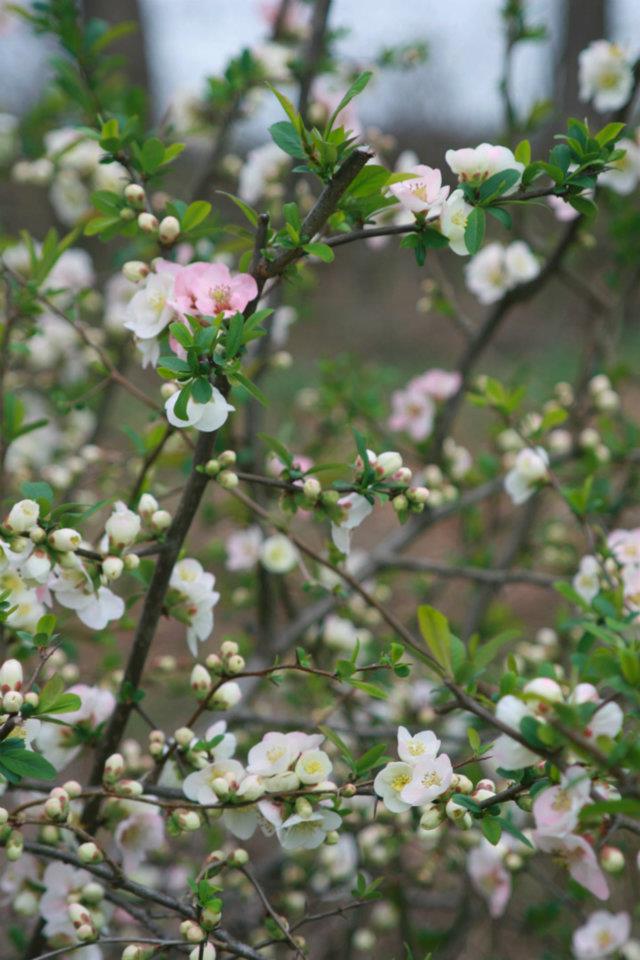
quince blossoms

~

© 2008 Ann E. Michael

~

Waiting, in the place I call home, for spring.

Lost trees

Image

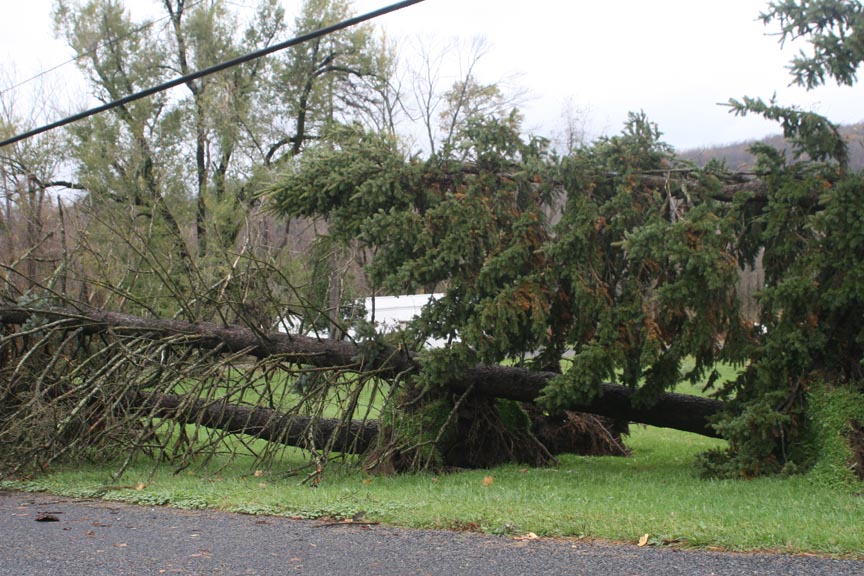
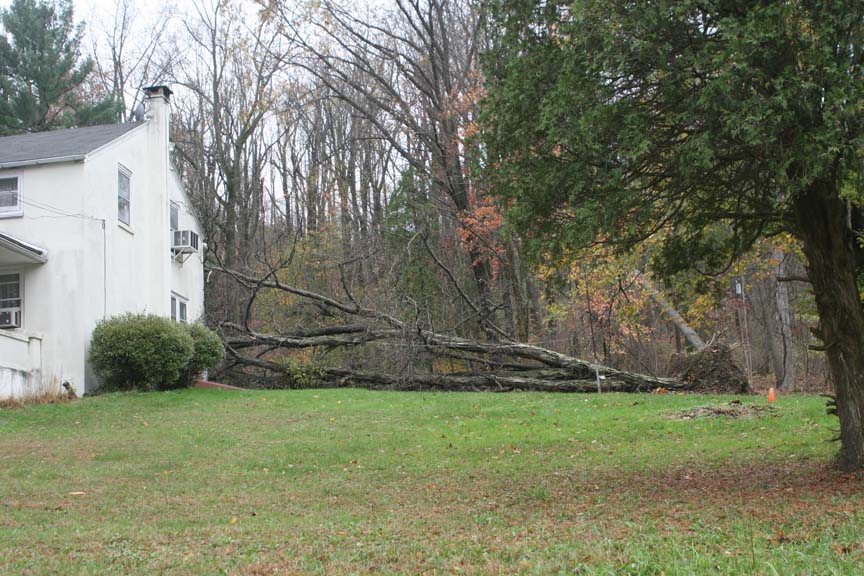
Herewith, some photos of neighboring tree damage. There is an environmental aspect to huge devastating storms…some of my neighbors’ houses have been standing for over 150 years. Some of the trees are 50-90 years old.

Image

Not old by, say, Asian or European standards. But pretty mature and historic for the USA.

Image

New Jersey and Staten and Long Islands were hit much worse, as they also got sea-water surges and flooding. Here, we mostly had tree-down damages. Wires snapped, pulling out transformers and knocking down utility poles and wires.

It was a different type of storm from the ones we experienced last year at around this time (see my post from 2011).

Things are gradually returning to normal. I wish to thank, whole-heartedly, the men (and a few women) who work on the utility and tree crews and who came from all over the USA to help out. Convoys of utility trucks have been greeted with joy by all of us in the mid-Atlantic states. May we never have to return the favor–may you and your loved ones remain safe, sound, and connected! But if you do need help at any time, I hope we can return the favor.

Place

A family member has recently complained that she wants to move from her apartment because her feelings for the place have changed. It’s been on her mind so much that she seems obsessive about this urge to find a more suitable home, somewhere she feels she can “fit in.” My response, initially, was compassion; then, I began to feel irritated (other people’s obsessions often seem irritating). I’ve been reading essays by the Norwegian philosopher Arne Naess for the past few days, however, and his work has tempered my irritable response. Place matters.

Naess was an originator of the “deep ecology” movement, a follower of Gandhi’s non-violence philosophy, a mountaineer; his influences include Taoism and Spinoza. Deep ecology, as a movement, is fairly controversial and has been subject to some pointed criticism–but as a philosophical practice, its inquiry and premises have been valuable to subsequent thinking and critical problem solving as applied to the earth and its environmental limitations.

What appeals to me about Naess, though, is the personal aspect of his “ecosophy,” a term he coined to refer to earth-wisdom, to place-wisdom. He called his own place-wisdom Ecosophy T: the “T” stands for Tvergastein, a mountain he loved and sometimes chose to live on. Living above the timberline for weeks at a time, Naess observed tiny flowers, diverse lichen forms, changeable and severe weather systems, mice, foxes, herds of reindeer bedding down in front of his hut. He contemplated life’s interconnectedness, the concept of peace in all aspects of earth-dwelling, compassion for all sentient beings, respect for earth-forms from rock to plant to insect…


(saxifrage photo–http://torirotsstitches.blogspot.com)

As Buddhist studies say: “When one has great loving-kindness towards all sentient beings, there are limitless beneficial effects.” Naess seems to have believed this whole-heartedly. He loved the mountain, he loved the miniature saxifrages, he loved the view of the valleys and the lake. These things enlightened him about the inherent earth-wisdom of the place itself. All of his thinking seems to spring from the mountain’s earthy source, its seasons. A mountain seems unchanging to most of us, but Naess appreciated its transformations. Such acceptance can lead to an abiding sense of peace and peacefulness, and certainly to a comfortable feeling of belonging to place.

I understand that urge to belong to place. It’s one reason I have stayed in one region for so long: I do not live in an area of breathtaking natural beauty or harsh extremes, as Naess chose to do, but I respond to my surroundings deeply here in the valley. The temperate climate with its four distinct seasons, the plants I recognize, the familiar birds and mammals, insects and toads, salamanders, the gravel and the different soils, the creeks and meadows, the agricultural fields and–yes–the suburban sprawl and nearby highways all make up the place where I exist. It’s comfortable, and it is comforting, and it is always surprising in small ways as I push my observations and attempt to deepen my understanding of and connection with the place I call home.

There have been times I’ve had to leave places that felt like home, and there’ve been times I’ve felt uncomfortable in the place I dwelt. And I needed to move on when that discomfort became too nagging, to irritable to ignore.

So I’m back to my place of compassion again.

Here’s “Urge for Going.”

http://www.youtube.com/watch?v=Z3EofN3Flag

A great din

My friend Ann sent me this link to an NPR story on cities (Adam Frank on “The City as Engine”).

Frank closes on a note similar to Mumford’s closing chapter: “We live at a moment when cities are poised to become the dominant mode of human habitation on the planet. But we don’t yet know if such a mode can be made sustainable for more than a century or two.”

An earlier observation of his got my attention, however. He says–

There is a word that applies to the sound of cities which almost never gets applied to nature: “Din.” The din of cities heard on the rooftop as a rising wall of noise is a testament to the true nature of cities as engines of organization and dynamos of disorder.

The first time I became aware of this din of acoustic entropy, I was sitting across from Manhattan on the cliffs of Weehawken, N.J. It was night and the great city was blazing from horizon to horizon. Its low rumble of noise flowed like a breeze blown at me from a mile away across the dark river.

The reason this stopped me is that just a fortnight ago, I heard the word “din” applied to nature.

One of my nephews had just arrived for a visit. He’s been living at Oxford, attending school for several years at that ancient and venerable British institution; and he grew up in England outside of London in the suburbs (Buckinghamshire). My husband retrieved Max at the airport in the evening, and they arrived at our place past dark. We live in a semi-rural area of eastern Pennsylvania where we are surrounded by fields, meadows, woodlots, state roads, and the inevitable housing development. And it is August, a lively time for insect life.

As we unloaded my nephew’s luggage from the car and walked him toward the door, he stopped and looked about curiously. “What is that great din?” he asked, “Is it birds, this time of night?”

Din?

He was referring to the cicadas and tree crickets (and probably a few tree frogs and the occasional flying squirrel). I suppose they do make quite a racket, though we are accustomed to the noise–the ‘dynamos of disorder,’ as Frank would say. When we explained, he remarked, “Oxford is quiet. But I do realize it is its own peculiar world.”

Nice to know there are pockets of organization somewhere: no acoustic entropy at Oxford.

Nonetheless, I treasure our noisy regional denizens and prefer their din to the roar of motorcycles, trucks, and  cars that speed past on the state road, although those noises have their own associations and dynamics and perhaps charm…the way I still find the sound of trains appealing because it reminds me of my childhood summers at my grandparents, I can imagine there are people who associate the rumble of vehicles and the great acoustic roar of cities with pleasant things.

Here is a photo of a cicada. A colleague says they are “the ugliest bugs in the world.” This one doesn’t look so awful to me.

Din, discord, or music. Ugly or appealing. To each his or her own.


Here’s a link to the tree cricket–one of several American varieties:

black horned tree cricket

Control

middle island ~

Human beings crave control. We want to be the masters of our own fate or to believe that there is a master of our fates who can be entreated or persuaded, propitiated or cajoled into helping us to gain control of our lives or the lives of others. We want to change the weather so that the rain falls when the soil needs rain, wetting the seeds we’ve sown, and so that the warmth comes when our plants need warmth. We want the sea to be calm and the fog to lift when we are ready to set sail. We want fine, sunny days when we visit the beach to swim or head out for a picnic. We want just enough snow so that school’s canceled, but not so much that our power goes out. We pray. We dance. We chant. We invent little private rituals and participate in community rituals.

We want to control our health. It does not seem to be an unreasonable aim. We want to control our relationships–just enough to keep ourselves happy. We want control over our careers and  our income–not so much to ask. We want to be able to make our own decisions. We want choices so that we feel we have control over our lives.

My gardens are my analogy today. I’m still endeavoring to exert some control over my vegetable garden, but I kept my purposes modest this year; I planted fewer beans, fewer tomatoes, fewer peppers, fewer potatoes, no onions, no peas, no edamame, no radishes…the walk-through rows are wider so it is easier to weed. Beginning with the dry warm winter and some assemblies of challenges that do not pertain to the garden, the season looked “iffy.” Then came lashings of showers in May. A challenging season, but not insurmountable. I have been gardening a long time, and I have methods of adapting to things I cannot control. It comes with the territory.

The ornamental beds have presented the most difficult struggle with my need to control the space I (somewhat ridiculously) consider my own. When the beds get overgrown–as they are now–I know that I can accept their exuberant rioting with the successful weeds. I can say, “This is what nature intends. There is beauty here.”

overgrown

I do know that. But the controlling mind–the monkey mind–says, “Too much penstemon; it’s gotten aggressive. Deadhead the peonies. Pull up the plantian, the wild asters, fleabane, wild garlic, crabgrass, bermuda grass, creeping charlie, five-leaf vine. Get the seedlings out of there (mulberry, redbud, oak). Mulch. Keep the rabbits off the hostas. Move the marybells. Get the weeds out of the alchemilla…”

My head clouds with fog. The seas get rough and I despair, because I cannot control things. Not even a small garden.

Instead, I could be meditating on green. On the amazing variety of leaf-shapes, on dappledness (like G. M. Hopkins):

Pied Beauty

Glory be to God for dappled things—
For skies of couple-colour as a brinded cow;
For rose-moles all in stipple upon trout that swim;
Fresh-firecoal chestnut-falls; finches’ wings;
Landscape plotted and pieced—fold, fallow, and plough;
And áll trades, their gear and tackle and trim.

All things counter, original, spáre, strange;
Whatever is fickle, frecklèd (who knows how?)
With swíft, slów; sweet, sóur; adázzle, dím;
He fathers-forth whose beauty is pást change:

Práise hím.

~

Here is one aspect of my ornamental garden. Overgrown, yes. Lush, diverse, lovely in its unrefined way. Until I have the wherewithal to tear through and divide and move and mulch, this is not a bad view, the definition of … lack of restraint, ornamentals gone wild. Freedom, I suppose.

A little too much of some good things.

As we grow, we learn to let go. So I am told. Garden, you have a chance to go wild!

And I guess I have the opportunity to learn to live with that.