Illusions, connections

Reading Proust again returned me to some of my own past reflections on memory and self, the capital-S Self. A decade or so ago I spent considerable time reading in philosophy, physics, and neuroscience in an endeavor to get a grip on human consciousness and, perhaps, behavior. I posted about some of these texts on this here blog, in between writing about poetry, the garden, and my teaching job. Recent coincidences of reading returned me to this topic, “the hard problem of consciousness,” and made me consider how our embodied selves/minds/awareness: use shortcuts to manage the overwhelming inputs of our environments; define who we are using subjective if physically-based perceptions; and fail to see the obvious because of habituation and the apparent need to confirm what we believe we know. Illusions! The Vedic concept of Māyā, Plato’s Theory of Forms…propaganda, Penn & Teller, quantum physics, complexity theory, Marcel Proust, complementarity. I have a lot on my mind.

If it IS on (or in) “my” “mind.” For there’s even some question about that, as proposed by Neil Theise in his book Notes on Complexity. Just as light can be a wave or a particle, depending upon perspective and viewer (see: complementarity), it’s possible that our minds or selves can be individual and separate but also connected and boundary-less. The subtitle of this text is what appealed to me: “A Scientific Theory of Connection, Consciousness, and Being;” so far, I’m enjoying it and finding inspiration.

It’s needed, inspiration. Despite a few plunges into new drafts (see here), I have not been writing much for at least two months, and I miss it. The ideas from physics and neuroscience that intrigue me include potential metaphors and terms such as quenched disorder, endosymbiosis theory, and holarchy. These–along with the hard problem of consciousness–all have some relationship to complexity theory, and Theise does an elegant job of writing about complicated science concepts for the non-expert.

I ran across Notes on Complexity right after finishing Sleights of Mind, a book about the neuroscience behind the sort of illusion we call entertainment magic: sleight of hand, sawing people in two, mentalist “mind-reading,” and other performances; the authors, Susana Martinez-Conde, Stephen Macknik, and Sandra Blakeslee, are trying to discover more about how brains work (or filter, and sometimes don’t work so well) by studying how we get fooled by illusionists. This is a fun book, even more fun for me because one of my Best Beloveds has long been an enthusiast of magic shows and magicians. Martinez-Conde and Macknik are neurologists, so–unlike Theise’s text–this book is very body-mechanics in its basis. Their work reminded me of how amazing the human physiological system is. And it’s entertaining.

Before these non-fiction reads, I was finishing up with Proust who, in his own creative way, was exploring the interiority of the human self and carefully observing human interactions, behaviors, assumptions, prejudices, and aesthetics. Not neuroscience, because there is no science to it, but definitely related to how our brains and bodies process experience. My sense is that poetry works that that way for me: it’s not an abstract stream of thought but something inextricable from bodily experience, maybe even, through the environment in which we exist, something deeply connected to everything, a global being-there.

The way we process experience (and is this consciousness?) is largely what leads us to the arts, to make art or to appreciate it, and to decide what feels compelling, important, beautiful. And it’s not all in our heads.
Perfumes and tunes

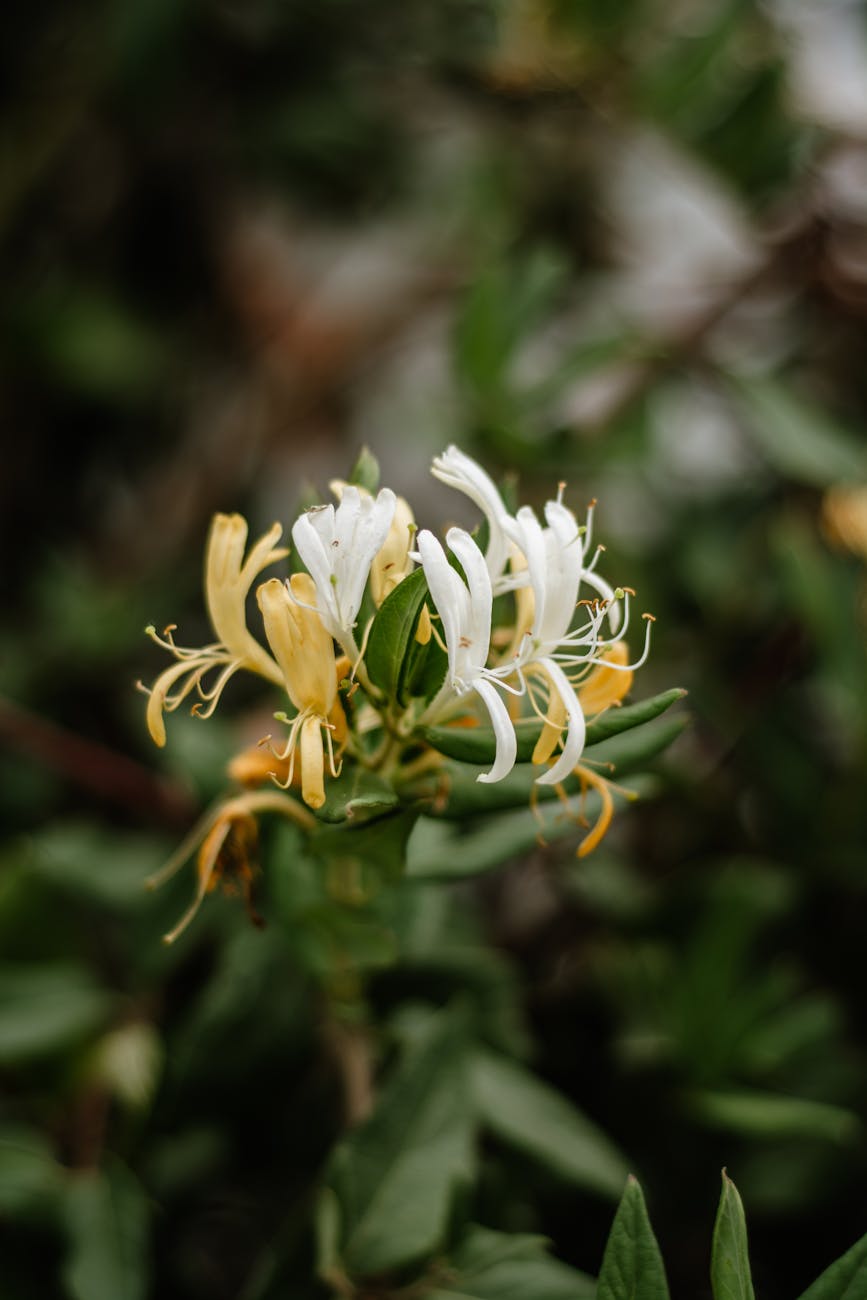
This time of year, certain blooms and fragrances evoke my childhood memories. I spent most of my childhood and all of my adolescence in southern New Jersey, along the Delaware Bay; the swampy coastal plains have now largely burgeoned into suburban housing developments, but in the late 1960s there were actual townships with old-fashioned suburbs–the kind with sidewalks–and many a privet hedge that bloomed in early June with small, white spires that gave off a faint scent. In overgrown areas of meadow and scrub, the sweet smell of Japanese honeysuckle perfumed muggy evenings. And while I don’t recall much scent from the mimosa trees in bloom on Harvey Avenue, once those fallen pink blossoms began to rot on the sidewalk, they added a distinct punk that meant summertime. The honeysuckle is blooming here now, making me wonder about the neuroscience behind the sense of smell. Gotta check out these books, perhaps: Kiser reviews four recent books on olfaction.

On a side note, none of these evocative plants are native to the Americas: Ligustrum vulgare, Lonicera japonica, Albizia julibrissin–and yet I associate them with South Jersey. It is almost like a refrain in my memory-mind.

To speak of associations reminds me of Alexis de Tocqueville. I’ll post a quote of his below, one that makes me think of language and poetry and science. But back to refrains:

Musical refrains also run through my brain, evoking memories and nostalgia, or just being irritating “earworms.” At any given time such tunes may include Tchaikovsky’s Serenade for Strings, strains from a late Haydn quartet, one of many Springsteen songs, Marvin Gaye’s version of “I Heard It Through the Grapevine,” or–most confounding of all–the Chock-full-o’Nuts jingle from the 1960s or some similar commercial sloganeering. Why such things wear a familiar groove in the gray matter I don’t know, though Oliver Sacks’ book on music (Musicophilia) and Daniel Levitin’s This Is Your Brain on Music offer some insights, and I’m thinking of reading this one by Samuel Markind when it comes out later this year.

Alas, I’m not gardening because once again the garden is awash in mud, so I entertain myself with endeavoring to discover how/why my brain works (and yours, and anyone else’s), since that’s one of my favorite lines of inquiry when I can’t work outside. I will take a sodden walk later and dwell on possibilities while enjoying the scent of the invasives; I’ll work on some poetry revisions; maybe I’ll listen to music…and freely associate with any and all possibilities. Here, as promised, Alexis de Tocqueville:

“When citizens can associate only in certain cases, they regard association as a rare and singular process, and they hardly think of it.

When you allow them to associate freely in everything, they end up seeing in association the universal and, so to speak, unique means that men can use to attain the various ends that they propose. Each new need immediately awakens the idea of association. The art of association then becomes, as I said above, the mother science; everyone studies it and applies it.”

Honeysuckle photo by Nadiye dabau015fu0131 on Pexels.com

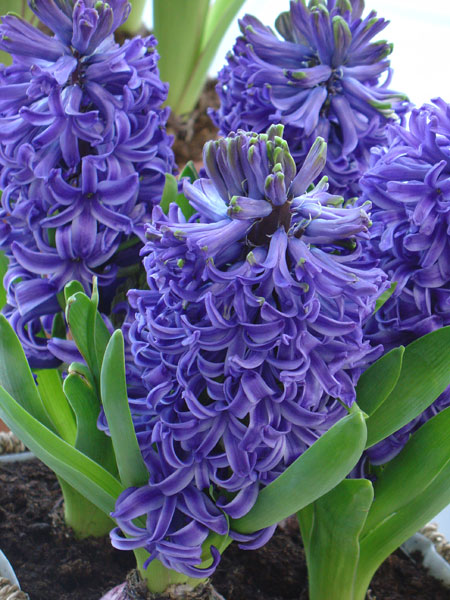
Hyacinths & biscuits redux

hyacinth burpeeI wrote about synthesis in this post of 2017 while reading a series of complex books. Now I am thinking of how poems involve synthesis. Today’s rather quirky draft seems to have emerged from life experiences. Academics–you know who you are–will understand the irony. I’ll leave it at that.

~

This is the 29th day of my composing a poem a day for National Poetry Month! Tomorrow–perhaps a recap of the experience. Or maybe just a long exhalation.

~
Peer Review

In The Journal of Complete Sentences,
there are, as per Table 1.
And under review, a wide range of
studies that. Research may show,
for example. Admittedly,
gaps. Or the tapering off.
Speaking apparatus offers one method
demonstrating correlation of,
and relationship with.
These abstract concepts in no way
refute previous empirical
results that strongly imply.
Indeed, studies employing fMRI
techniques to track neurotransmissions
offer qualitative.
The many degrees of distance.
Past case studies. Analysis.
As Appendix D suggests.
No closer to an understanding.

~


Book review, mind review

My book group chose to read Michael Pollan’s latest: How To Change Your Mind. The subtitle says a lot: What the New Science of Psychedelics Teaches Us About Consciousness, Dying, Addiction, Depression, and Transcendence. That’s a bundle of complicated concepts Pollan takes on, but he recognizes his task looms large and that he can only make forays into the many overlapping arenas the book explores.

His approach–he uses this in his other books and articles, too–is a mix of serious research and journalism (interviews, mostly) and personal inquiry and experiences. If you have read Second Nature or The Omnivore’s Dilemma, you might find this one to be a more “difficult book.” It is heavily documented and features neuroscience (brain pathways and structure, mostly), psychology, pharmacology, and chemistry (tryptamine-related molecules). Not to mention mushroom biology and mushroom hunting, and serum produced by plants, toads, and ergot.

What attracted my book group members to this text is its chapters on dying; as a hospice volunteer myself, and having read articles on the potential value of psychedelics among people with terminal illnesses, this part certainly interested me.

Pollan writes: “The uncanny authority of the psychedelic experience might help explain why so many cancer patients in the trials reported that their fear of death had lifted or at least abated: they had stared directly at death and come to know something about it, in a kind of dress rehearsal.”

These outcomes seem significant enough that we ought to find ways to employ them in our palliative care work. In my own, somewhat limited, experience with dying people, those who are less fearful of death–for whatever reason that may be–stay alert longer, respond better to palliative efforts (pain medicine, massage, positioning, and so on), and are more likely to comfort their loved ones. They die more “easily,” if dying can ever be called “easy.”

~

Yet I found the parts of Pollan’s book which deal with the huge question of what consciousness is and where it resides most relevant to my own interests. Yes–that difficult neurobiology stuff. Pollan suggests, with the healthy pragmatism of the skeptic, that empirical approaches to consciousness based on the idea that “the brain is meat” (viz, medical science) are unlikely ever to explain consciousness fully or to anyone’s satisfaction. In other words, consciousness may possess a component one might name “spiritual.” Here is how he frames this concept:

“…it seems to me very likely that losing or shrinking the self would make anyone feel more ‘spiritual,’ however you choose to define the word, and that this is apt to make one feel better. The usual antonym for the word ‘spiritual’ is ‘material.’ That … is what I believed when I began this inquiry—that the whole issue with spirituality turned on a question of metaphysics. Now I’m inclined to think a much better and certainly more useful antonym for spiritual might be ‘egotistical.’ Self and Spirit define the opposite ends of a spectrum, but that spectrum needn’t reach clear to the heavens to have meaning for us. It can stay right here on earth. When the ego dissolves, so does a bounded conception not only of our self but of our self-interest. What emerges in its place is invariably a broader, more openhearted and altruistic—that is, more spiritual—idea of what matters in life. One in which a new sense of connection, or love…seems to figure prominently.”

~~

When I was much younger, I considered myself “spiritual.” I stopped using the term once I began a more serious exploration of my life and began to study philosophy, psychology, aesthetics, phenomenology, and consciousness more intentionally. But the crucial components–connection, relation to and with others (sentient and not), and love–those I have always understood as necessary. Even though my ego has never “dissolved” quite the way Pollan describes.

So maybe I can go back to considering myself somewhat spiritual. At this moment in life, Nature and Others matter more than accomplishments and outcomes.

Welcome Spring, welcome Spirit. Namaste, Amen.

iris reticulata

iris reticulata

Connections


4446_1159463871068_1826910_n

August has arrived and a few of our incoming freshmen are on campus already, as well as students on various fall sports teams who need to get a jump on the competition season. It was quite awhile ago that I was a teenage person entering my first year at college, but each year our students arrive with the same anticipation and excitement I felt. They’re ready to exercise a little responsibility, a little freedom, and to make the kinds of connections–personal, emotional, and intellectual–that will affect the rest of their lives one way or another.

~

In the 1970s, science historian and television broadcaster James Burke created and hosted a show called Connections. I was a fan of the series because I loved the surprising ways discoveries, events in history, people, and accident led to innovations and the criss-crossing of continents and ideas. The interdisciplinary aspect of human culture, of science and the arts, fascinated me as a teen. Those networked ideas have shown up many times through my life.

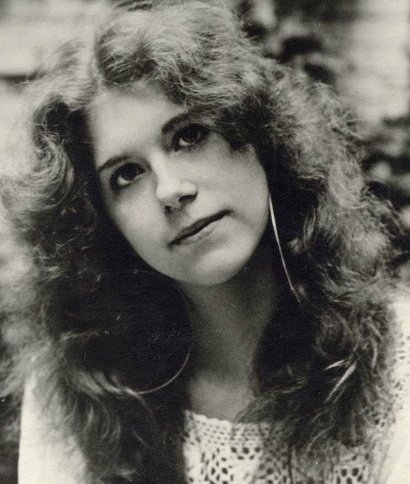
Connections: The photo above was taken by my fellow student Steve Lohman when we were freshmen. Steve later attended Pratt School of Art.  We lost touch for a long time, and–I have forgotten how–I found his metalwork while I was looking for cover art for my book of poems The Capable Heart.


running_horse

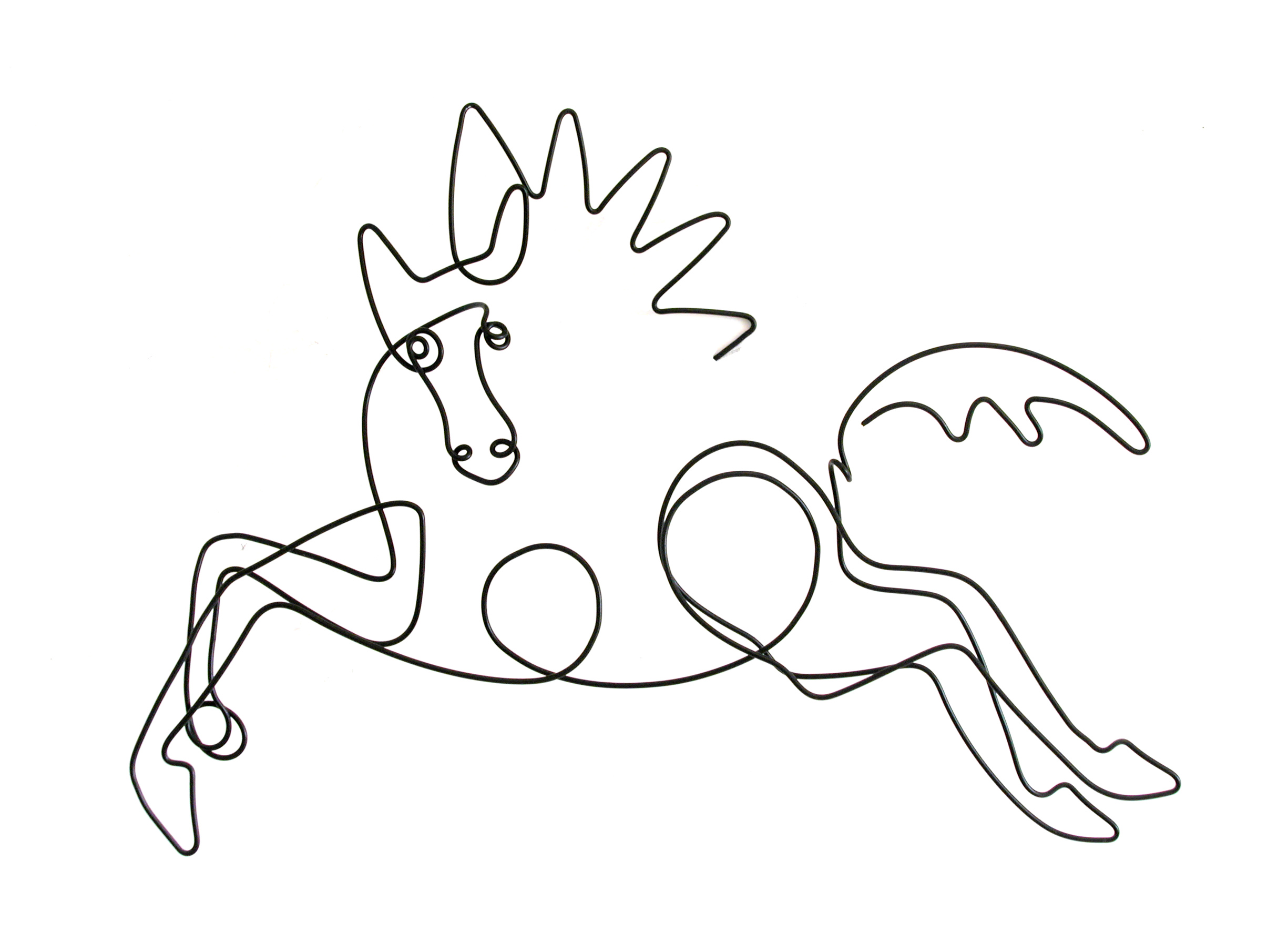
Running Horse by Steve Lohman

Connections: I liked Steve’s wireworks, but I remembered him as a photographer. Granted, what a person pursues at age 17 or 18 is easily liable to change–but I was curious about how he started doing sculpture. When he mentioned he’d attended Pratt, I asked if he had ever met Toshio Odate, who taught there for years. “One of my favorite teachers!” said Steve. “I loved his class.”

Connections: My spouse took a job writing for a woodworking magazine, where he met Toshio, who wrote about Japanese tools and woodworking techniques. Meanwhile, Toshio was creating his own works of art at his home as well as mentoring many students. He’s now a long-time friend of ours. (Photo of Odate’s “Pride of New England,” below, by Laure Oleander).

toshio-pride copy

Connections: Neural networks, the embodied mind, the ways writing assists in psychological healing, the twists in a good novel’s plot, the turn in a poem, metaphor, surprise. The unexpected thrills us–unexpected connections fill us with curiosity and a kind of joy, as does the closure.

~

Connections: The commercial creation Thinkhub, invented for teaching, offers yet another example of connections. A cultural thinkhub project based in Toledo, midstory.org has produced my poem “River by River” as a soundscape: click here.

The project researchers found my poem in the anthology I Have My Own Song for It: Modern Poems of Ohio. Look around, folks–connections are everywhere, and we learn from them.


Process

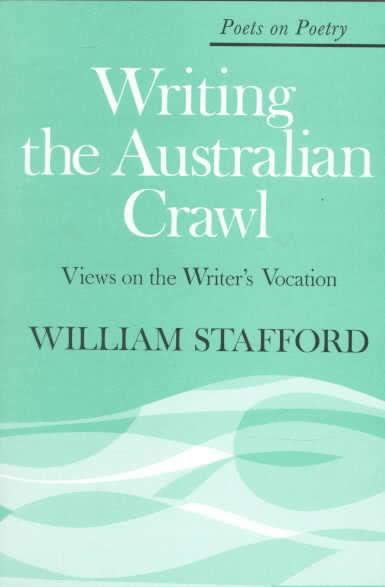
William Stafford:

A writer is a person who enters into sustained relations with the language for experiment and experience not available in any other way…A writer is not so much someone who has something to say as he is someone who has found a process that will bring about new things he would not have thought of if he had not started to say them.

Writing is a process that elicits consciousness in the individual writer, often as the writing unfolds. Flannery O’Connor: “I write because I don’t know what I think until I read what I say.” Joan Didion: “I don’t know what I think until I write it down.”

imagestafford

Perhaps oddly–perhaps not–Stafford’s definition that what a writer is comes down to what a writer does bears a certain resemblance to Gerald Edelman‘s “neural Darwinism” theory (ca. 1989 in Bright Air, Brilliant Fire, a more reader-friendly version of models developed in his neural topology trilogy*). Edelman basically says consciousness isn’t a “thing in itself” so much as it is a process that the embodied brain does. The brain’s processing capabilities are individual and endlessly myriad and they operate, claims Edelman, through the re-entry of information in intricately complicated links and physiological systems.  Thus, through evolution’s incremental layering of human beings’ brains, what we call higher-order consciousness makes its appearance.

And then on to gesture, semantics, lexicon, syntax, language, culture, &c.

~

Gerald Edelman:

What is daunting about consciousness is that it does not seem to be a matter of behavior. It just is–winking on with the light, multiple and simultaneous in its modes and objects, ineluctably ours. It is a process and one that is hard to score. We know what it is for ourselves but can only judge its existence in others by inference.

…Once a self is developed through social and linguistic interactions on a base of primary consciousness, a world develops that requires naming and intending. This world reflects inner events that are recalled, and imagined events, as well as outside events that are perceptually experienced. Tragedy becomes possible–the loss of the self by death or mental disorder, the remembrance of unassuageable pain. By the same token, a high drama of creation and endless imagination emerges…The wish to go beyond these limits [of embodiment] creates contradiction, fantasy, and a mystique that makes the study of the mind especially challenging; for after a certain point, in its individual creations at least, the mind lies beyond scientific reach…the reason for the limit is straightforward: The forms of embodiment that lead to consciousness are unique in each individual, unique to his or her body and individual history. [italics mine]

To me, this passage–in a book about neural mapping and brain physiology–feels “poetic.” But what do I mean when I say the concept of embodied consciousness, and consciousness as a series of intricate, synthesized processes, coincides with being a writer? Or in my case specifically, a poet?

It has something to do with taking in the world–through the senses, which is all my body’s really got–and synthesizing all those years of experiences, memories, books I’ve read, poems and plays I’ve loved, people I’ve known, relationships with the environment and with human beings and with other creatures, the whole of my personal cosmos. Referents and reentrants. Relationships actual and imagined. “The remembrance of unassuageable pain.” The process of loafing through the world.

Writing, where much of my so-called consciousness dwells. Not in the outcome, the resulting poems or essays, but in the doing.

~

More about writing-related processes and politics here: Poet Bloggers


* Neural Darwinism: The Theory of Neuronal Group Selection; Topobiology: An Introduction to Molecular Embryology; The Remembered Present: A Biological Theory of Consciousness.

Friendships

April: a busy time. During my busy times at work or on the home front, I often spend less time with my friends.

The best thing about that is: my friends understand. They will still be there when I crawl out from under whatever has me crushed for time, whether it’s illness, job stress, time-consuming family-related challenges, home maintenance, garden or lawn work, travel, or depression.

[insert here, me, waving to my friends!]

Social media is no substitute, although I confess to using it to keep connections with those I care about. Social media, for example, has been significant in helping me to stay in touch with poetry colleagues; but much as I admire and learn from other writers, they play different roles in my life than friends do. Also, even from the beginning of my Facebook use, I knew the platform essentially was a “me and those like me” social bubble.

The specter of “us vs. them” has raised its snarling head on social media sites ever since the early days of chat rooms. There’s a reason for that, and Natalie Angier of The New York Times reports on some recent findings in this article:


~

Meanwhile, on the “unalloyed good” side of friendship–The real friend listens, gets busy herself, drops a line now and then if I’ve been absent for awhile, and drops everything if I find myself in difficulties and ask for help.

She or he also shares my brainwaves, apparently–and not just metaphorically! The studies Angier writes about in the article below offer some really intriguing possibilities about human beings as social animals and how our brains work. PubMed.gov lists a large number of research articles that examine the topic of health, neuroscience, and sociability; the interconnectedness strikes me as relevant and fascinating.


~

Boy, do I love neuroscience! This work synthesizes physical actuality with metaphorical possibilities in ways that inspire me.

Probably, there will be poems. Meanwhile, if you want to watch some brain functions in action, some cool animations: http://www.neuroplastix.com/styled-99/therapeuticanimations.html


Evolution of the neuron

I have just read, albeit slowly, Werner R. Loewenstein’s Physics in Mind: A Quantum View of the Brain. Having finished the book, I can attest I understand his argument even though my grasp of the physics involved is decidedly at the novice level. The last three chapters of the book were what drew me to reading it in the first place–those chapters cap the text with his model of how Evolution (he anthropomorphizes the theory) “chose to design”–in its exemplary, concise way–complex systems that led not just to life but to sentience.

Loewenstein compares neuro/biological processes with computers in terms of their being processors of information from the environments. He seems enthusiastic about computers in general, but he argues that artificial intelligence remains far away from evolving into sentience because consciousness requires many kinds of parallel processing that intersect and interact and filter out information. That complexity, he claims, will be difficult to engineer; yet over eons, the process of evolution accomplished it through a combination of physics, chemistry, and biology.braintrust-small

Loewenstein prioritizes the physics aspect: how electrical pulses in neurons parallel electrical pulses (attraction and repulsion) in atoms, how these behaviors can combine to create compounds or release energy; he uses analogies and spends several chapters on the eye, its neurons and dendrites and cones and rods, to demonstrate how a system of information reception and filtering can occur that relays information to the brain and then back to other information receptors and actors in the body of a worm, bird, or human being. Get enough relay systems going, and sight + touch + smell + hearing + taste evolve into the living animal. At some point, the multiple parallel information systems develop into consciousness (Loewenstein does not speculate where that point occurs–it is still “a mystery,” he admits).

~

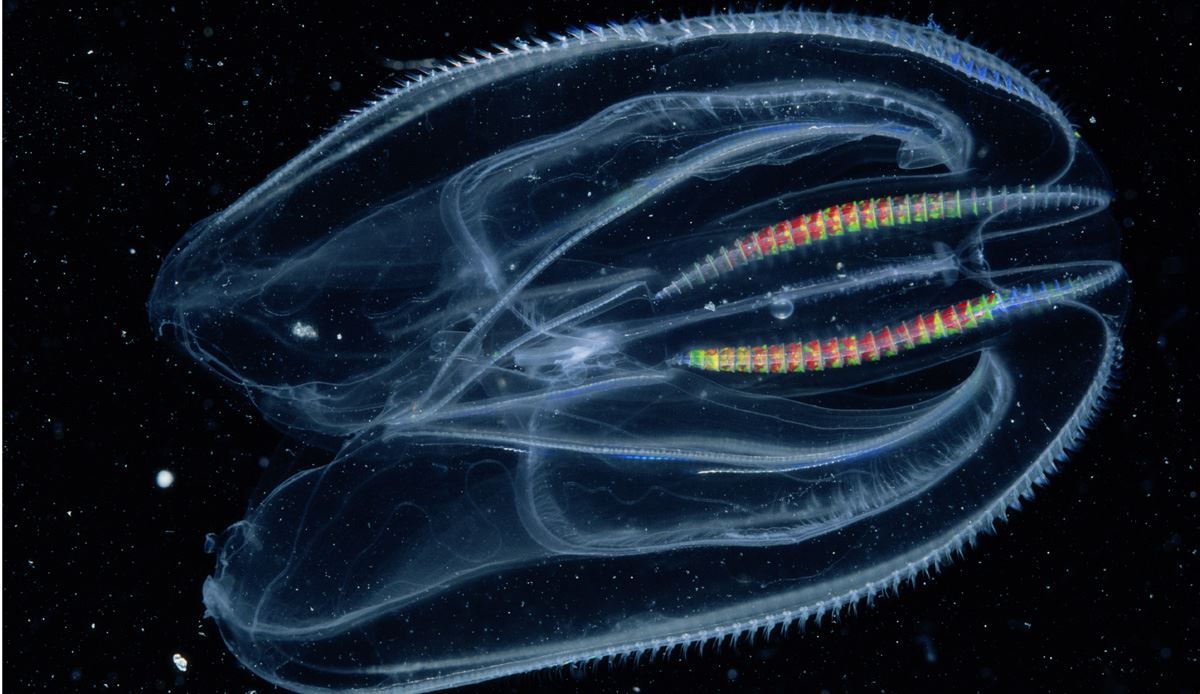
Douglas Fox, writing in Aeon, quotes neuroscientist Leonid Moroz as saying, “There is more than one way to make a neuron, more than one way to make a brain.” In this fascinating article, Fox follows Moroz’s lengthy study of ctenophores, jellyfish-like creatures about which little is understood–though Moroz and his team of researchers are changing that. At the same time, their work suggests that our previous understanding of brain development is not necessarily the only model out there for how neurons and synapses can get information processed and acted upon to sustain a life. If that life is lived under very different environmental circumstances, maybe evolution might “choose” different paths of systematic information processing (ie, “thinking”).

…when he failed to find common neurotransmitters in ctenophore nerves back in 1995, it wasn’t simply that his tests weren’t working; rather, it was because the animal wasn’t using them in any way. This, says Moroz, was ‘a big surprise’.

‘We all use neurotransmitters,’ he says. ‘From jellyfish to worms, to molluscs, to humans, to sea urchins, you will see a very consistent set of signalling molecules.’ But, somehow, the ctenophore had evolved a nervous system in which these roles were filled by a different, as-yet unknown set of molecules.

Fox poses the researchers’ questions this way: “how divergent can nervous systems be? Do we truly understand how life senses its surroundings and behaves?” Science has generally, post-Darwin, followed a straight-line approach to evolution; but good scientists recognize that sometimes the road less traveled by has made all the difference.


Although the very idea of “sentient jellyfish” might appall many people, I wonder what sort of consciousness ctenophores would develop.  🙂

Difficult books & the death of reading

books1

Philip Yancey worries about “the death of reading” in a recent Washington Post opinion piece; he says that even he, an inveterate reader and possessor of several thousand books, finds it harder than it once was to read for several hours each day. He feels distracted by modern technology’s urgency yet suggests reading–now more than ever–offers not just intellectual but neurological rewards:  “neuroscience proves…it actually takes less energy to focus intently than to zip from task to task. After an hour of contemplation, or deep reading, a person ends up less tired and less neurochemically depleted, thus more able to tackle mental challenges.” (Yancey does not cite the study, so I cannot do so; I think he picked this information up from Nicholas Carr’s book The Shallows).

I find I still have time to read; but I am not a well-respected writer of books, articles, opinion columns, and blogs, nor am I asked to appear in public as a speaker very often. Yancey has a life that requires hours at a computer. My life contains less urgency from an audience, although my students–when classes are in session–certainly supply a sense of “prioritize me!” that can get distracting.

Most of us recognize that there are many forms of urgent distractions in our lives.

Anyway, I continue to apply myself to books.

~

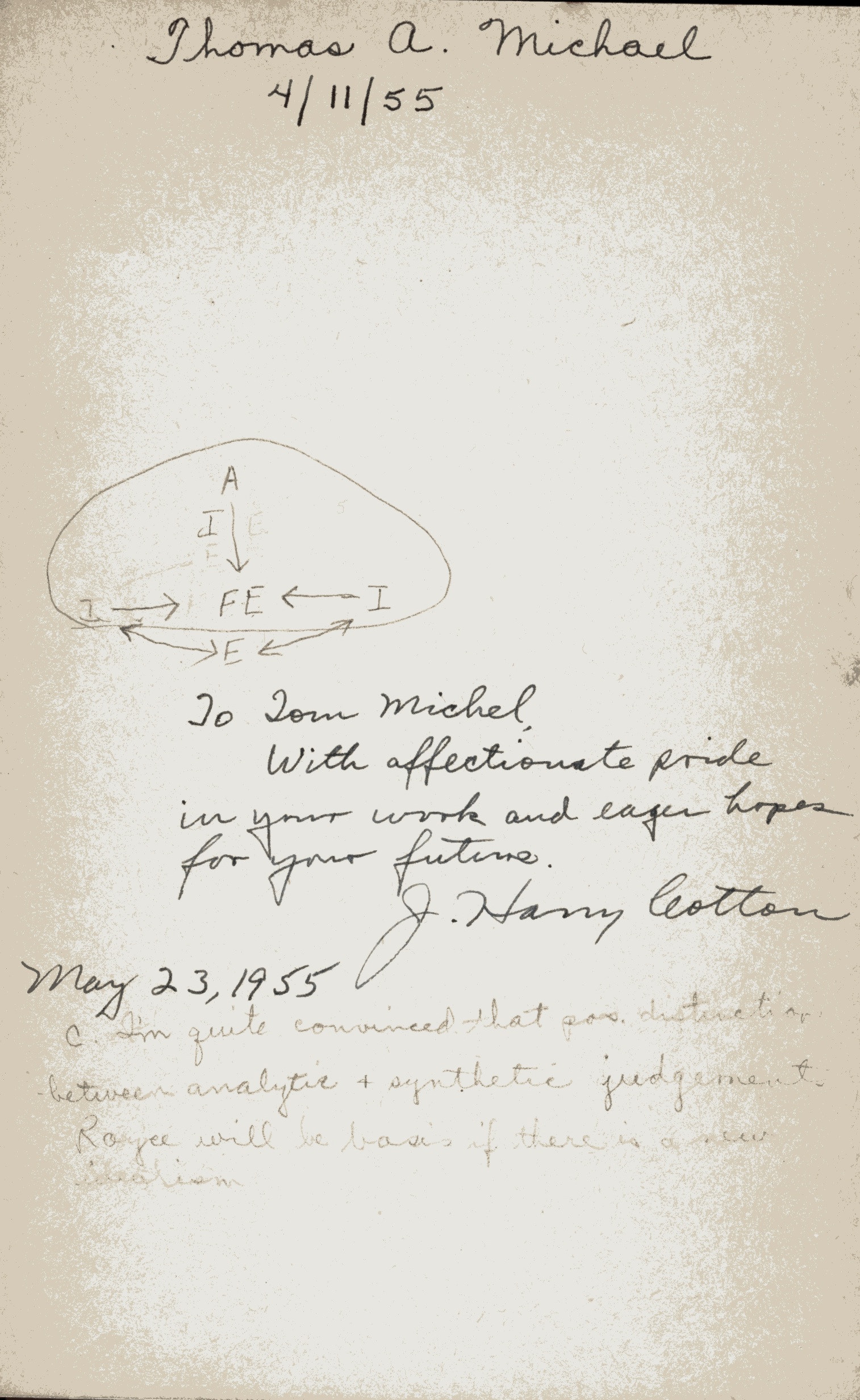
My latest difficult book has a bit of family history. Royce on the Human Self was written by one of my father’s college professors, J. Harry Cotton, and published in 1955. Harry Cotton was a Presbyterian minister who later taught at Wabash College, where my father encountered him. My dad gave me this book a month ago, saying, “I thought you might be interested in this one. I came across it in my shelves and read it, thinking I’d never read it before. But apparently I had, because I see that I annotated it in the margins. And I hadn’t recalled that he inscribed it to me.” The human self must overlap with consciousness, so why not introduce myself to Royce, especially given the circumstances?

Josiah Royce is not a name I encountered in Philosophy coursework, even when I was studying William James’ work (it was undergraduate study, so we did not get to James’ correspondence with Royce and their disagreements over the Absolute; James & Royce were colleagues and very good friends).

dadcotton

My father notes the misspelling of his name by Dr. Cotton. I note the logic chart my father annotated above.

Royce’s philosophy was rather Hegelian–he studied in Göttingen–and he was a long-time proponent of “idealism” (defined in what strikes me as a rather phenomenologist way) based upon his rendering of what constitutes the Absolute. According to the Stanford Encyclopedia of Philosophy entry, “In his later works, Royce reconceived his metaphysics as an ‘absolute pragmatism’ grounded in semiotics.” Royce moved from idealism into the possibility of objects, which took him for awhile on a symbolic logic train of thinking. He loses me a bit there, despite Dr. Cotton’s quite clearly-written summaries.

An intriguing aspect of the book, for me, is my then-22-year-old father’s marginalia. Sometimes, his notes–in handwriting that has hardly changed in 60 years–make a comment [“Royce denies a self-evident truth contra-Descartes”]. More often, there is a question, or some underlining, that suggests where his interests lay. I notice he seems to have skimmed over the “Logic as the Science of Order” chapter (that’s a section I found to be a bit of a slog myself).

I wonder whether the last chapter, which covers Royce’s late thinking on Christianity, the problem of evil, and salvation, would have made any sense to a person as young as my dad was in ’55. By the time Royce got to his most mature philosophical thinking on god and the human self, he was in his 50s and had experienced the loss of a young adult son to “madness” and typhoid. These are the sort of events that mature the thinking of a thinking and feeling human being such as Royce obviously was. In our early 20s, few of us have that kind of depth to our understanding of mortal, ethical, or spiritual issues.

~

Nevertheless–my father, influenced to some extent by his Uncle Raymond and by Harry Cotton–chose to go to graduate school in Theology. He may not recall whether Royce’s work on Salvation or Christianity had any bearing on his decision. But I wonder. I think of my dad–a classic extrovert, despite his prodigious reading habits–when I read the following words by Royce concerning the community and the relational aspect of the human self (in the Absolute, or in god, as referred to by the use of his in this quote):

And as the moments of my finite thought are to me when I reflect upon my own meaning and upon the relations of many moments of my life, so my neighbors and I are to the larger Self when, discoursing together about the same objects, we find ourselves as it were but moments in his inclusive unity.

All one. There are many philosophies and theologies that stress that premise.


Coincidence & synthesis

I adore random synthesis. I love how coincident information, ideas, and experiences connect to enrich my understanding or pique my interest.

Today, a friend sent me a link to a chapter from the Dalai Lama’s book and another friend sent me to New York Magazine‘s Science of Us blog to read Cody Delistraty’s piece on the neurology of poetry reading. Meanwhile, I have been cleaning my bookshelves and reading Jane Hirshfield’s Ten Windows.

books1Delistraty’s essay reports on a study (in Germany) conducted by Eugen Wassiliwizky, a researcher at the Max Planck Institute for Empirical Aesthetics, on what happens in the human brain when people read or hear poetry. The Institute has sponsored quite a few studies on the neurological responses to the arts, which offers researchers not just the findings from one area of aesthetics but the opportunity to compare responses across artistic disciplines.

For example:

…[Neurological] responses… seemed to be unique to poetry: Scans taken during the study showed that listening to the poems activated parts of participants’ brains that, as other studies have shown, are not activated when listening to music or watching films.

The authors also found evidence to support the idea of poetry’s pleasure as a slow-building experience, or what they called a “pre-chill”: While listening to poems they found particularly evocative, the listeners subconsciously anticipated the coming emotional arousal in a way that was neurologically similar to the reward anticipation one might get from, for instance, unwrapping a chocolate bar.

Delistraty notes that in this study, “the poetic lines that most emotionally stirred people were also most memorable for them later.”

Our brains ready themselves for surprise, delight, arousal, some emotional leap in the poem–even before the poem ends–anticipation. I know that feeling well. We are anticipating some kind of surprise or delight as the poem unfolds in our reading or listening real-time imaginations: a kind of freedom that we anticipate but cannot expect (the poem may surprise us in ways we had not anticipated; or it may disappoint our hopes).

Hirshfield writes:

On the one hand…poetic transformation occurs by what might be called the paradox of intimate distance. The freedom inherent in art to choose stance, attitude, approach, form, word, is in itself an act of emancipation. When distance increases…we often feel more, not less, because we are able to take in the whole.

What we “take in” as whole includes the phenomenon of reality, even though the poem operates in the imagination–another paradox. Reading a good poem, then, opens consciousness. bkmk-violet

I realize that in the years keeping this blog, I have never yet found a satisfactory understanding of what makes human beings conscious or from whence consciousness originates; but that’s one reason I keep reading and writing, Socratic gadfly that I am. And that brings me to the third random reading that, to my mind, synthesizes well with the essays I’ve mentioned. Here’s an excerpt from one of the Dalia Lama’s books that was posted on Lion’s Roar, a Buddhist-oriented website. In this chapter, His Holiness has been visiting with neurosurgeons and brain researchers at the cutting edge of medical science–people deeply, empirically engaged with the science of the human mind:

~

The Buddhist understanding of mind is primarily derived from empirical observations grounded in the phenomenology of experience, which includes the contemplative techniques of meditation…

The view that all mental processes are necessarily physical processes is a metaphysical assumption, not a scientific fact. I feel that, in the spirit of scientific inquiry, it is critical that we allow the question to remain open, and not conflate our assumptions with empirical fact…A crucial point about the study of consciousness, as opposed to the study of the physical world, relates to the personal perspective. In examining the physical world, leaving aside the problematic issue of quantum mechanics, we are dealing with phenomena that lend themselves well to the dominant scientific method of the objective, third-person method of inquiry… In the realm of subjective experiences, however, the story is completely different. *

~

Part of what makes poetry, or any art form, “work” is that appeal to the subjective. Subjectivity excludes the empirical; there’s always, somehow, more to art than science can explain–wonderful as science is. Delistraty writes, “poetry transcends…methodical scrutiny. It valorizes the unconscious, opening us up to new perspectives; it implies the possibility of unlimited pleasure.”

Hirshfield names that pleasure, that surprise, that alteration within the reader “hope” –a wonderful synthesis.

snowdrops

~

* The Universe in a Single Atom by His Holiness The Dalai Lama; full discussion on https://www.lionsroar.com/studying-mind-from-the-inside/