Small, refreshing

Another day. One that the calendar claims occurs in 2026, although at times I disregard the calendar–another human-made thing, and I find so many human-made things destructive and frustrating. It’s not as though a “new” year puts away what has happened the previous 365 days the way I can put away the holiday decor. Which I haven’t actually done as yet. Anyway, we’re still in the first week of January, and Twelfth Night has barely arrived, so if I do want to acknowledge the calendar I can excuse my lack of clearing-away. But I can’t clear away the losses of the past year, and I don’t want to. I want to remember my friends for as long as I can.

It’s true that wintry walks offer quiet splendor (sometimes) and a chance to reflect, but mostly winter affords the chance to stay inside, curled up with a book or browsing through garden catalogs. Theoretically, it’s a good time to revise and submit my work; often, however, I don’t get to that process because winter is also a low-energy time for me. I powered through a fibromyalgia flare two days after New Year’s Eve because loved ones were visiting, but there’s a bit of fallout as a result–worth it, though; and I’m chuffed about taking poetry workshops later in the month. Meanwhile, reading books! I got a Samuel Hazo collection from my local library, I’m reading Wendell Berry and Richard McCann, and Ada Limón’s You Are Here is on my to-read pile. I’ve also felt inspired by the start-of-a-new-year blog posts Dave Bonta has curated on his Poetry Blog Digest. Many writers and books there I want to check out, and many writers and poets feeling some of the same things I’ve been feeling about the past year and what to make of the years ahead.

So to recharge, as it were, I’ll do small, refreshing things this January: take photos, doodle with watercolors, read books, tromp about in boots, meet pals for morning coffee, draft poems, play with images, as per Johan Huizinga–“To call poetry, as Paul Valery has done, a playing with words and language is no metaphor: it is the precise and literal truth…What poetic language does with images is to play with them.”
Last messages

End of another year. This one included some truly joyful times that will stay with me for quite awhile. But in that almost-inevitable reflection that arrives with the winter solstice, I find myself recalling dear ones whose lives closed in the past 12 months. I used to have physical reminders of friends and family, the last card or letter they wrote, something to put into a file or drawer or keepsake box and take out from time to time; a photograph or two, or maybe a recording of their voice on tape. Now that human communication has mostly migrated to the digital, to the “cloud,” those tangibles are much less common. But the messages persist.

A few weeks back, I migrated to a newer cellphone and, in the process, moved a year’s worth of text conversations to the new device (I’m not sure how I did that). All the old messages popped up, including three from dear people who are now deceased. Quite a different form of “ghosting.” I’ve kept in an online folder many email messages from my most frequent correspondent and long-time friend, who died February 1st, but I can’t quite bring myself to look at them yet. And it isn’t quite the same experience as opening and unfolding old letters.

I can’t bring myself to delete the messages from my phone, however. I suppose at some point that will occur, perhaps in another upgrade. Letters are ephemeral, too; all it takes is flood or fire. We have to rely on our minds, our memories, when it comes to recalling loved ones. Maybe that is what elegy is for, I don’t know.

~

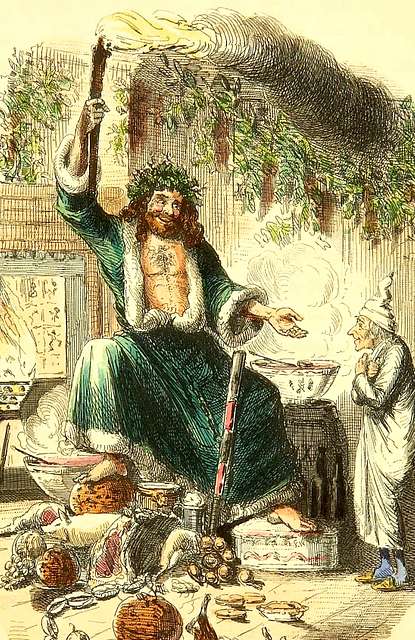
As for the present–the Spirit of Christmas Present* ?–some of my Best Beloveds will be gathering here and there with me soon. Once the holiday hubbub dies down and the lonelier, cold January days arrive, I have poetry workshops to look forward to. They’ll be online, which suits my schedule in winter. Last year, I enrolled in two such workshops and found they spurred me to get a good deal of writing done, so I figured I might try repeating the process. Anita Skeen is doing another series for The Friends of Roethke Foundation with readings, prompts, and discussion on “writing toward wisdom.” In Dickens’ era, I’d be considered old enough to be wise (though most of us, Dickens certainly included, know better about age inevitably bringing wisdom). But the operating word for Skeen in this case is “toward.” It will be interesting to see where she takes her workshop participants in the new year.

* John Leech illustration

lìchūn

As is not uncommon in our region, we have a warm and sunny spate of days that evoke thoughts of spring…often thoughts that are dashed by late-arriving snow and ice storms. The days are an hour longer than they were at the December solstice, and some plants bloom or start to bloom: witch hazel, snowdrops, hellebores, skunk cabbage, winter aconite.

In the Chinese lunar-solar calendar, these weeks mark the start of spring: 立春 lìchūn. (Hence the new year commences, celebrated this year on February 10.)

I love the emergence of new growth in springtime and enjoy looking for buds and leaf-tips, but winter’s crucial to this environment. It plays its role by enforcing dormancy and restful, unperceived rejuvenation. Nonetheless, sometimes I resent the way it teases–knowing that the freezing will return and that mid-March snows are not uncommon here. That has made me think to post my poem “Spring Lies,” which appears in The Red Queen Hypothesis.
~~

Spring Lies

Sun through fog. The leaves of beech trees gleam
low under the tall expressive line of ash and poplar
whose topmost reaches, feathered by the mist,
wait budded but un-leafed. The starlings stop, are
tethered to their twigs for brief collective
breaths and urgent calls that rally all
to action once again—a whir, black-speckled sky,
the poplars barren after the birds’ brawl
moves off. An hour goes by. The meadow’s damp
expanse reveals patches and threads of green.
Here, mud seems harmless: winter has decamped.

Meanwhile, a small town near a river bank
sighs beneath a dank slide, silenced, loses
all but longitude and latitude.

People want to feel the home they choose is
safe but, at best, they stake a compromise—
fire, flood, crime rate, mud. Spring’s temperate. Spring lies.

~

About time

It is the last day of the calendar year, and tomorrow evening a full moon will shine over our snow-dressed meadow. End-of-year events have left me thoughtful about time, memory, fear, love, and other such. Which brought to mind this poem I wrote quite a few years back. It’s part of The Red Queen Hypothesis manuscript.

Let 2018 be a time to press against the dam and swell into your next adventure.

~


Counsel

Wait for that wisest of all counselors, Time. —Pericles, Plutarch’s Lives

Always, you have hated the wait,
fidgeting at the desk, the queue, your bed.
You suffer the malaise of the young
whose imaginations collide
with the world’s dull and repetitive ways,

for whom responsibility is a petty bureaucrat
in a cheap gray suit
watching the clock you punch, counting
irretrievable minutes you spend
doing work you cannot love.

Do not despair.
After you’ve done some time
in the slow slog of nickel and dime
your passions, silvery as fishes,
will gather in schools that swell and press
against the dam—

that damn ordinariness
dulling your heart—
and spill themselves brilliant into
the crooked creek of your next adventure,
each carrying in its small body
the germ of an idea, yours
to pursue.

~

waterfall

Writing the new year

To renew myself as a writer of poetry, I need–every now and then–some way of re-engaging with the work of writing itself. Revision, for example, often means hard effort slogging through material I wrote long ago; but the process renews my dedication to the salvageable poems and sharpens my analytical and evaluative skills.

Sometimes there’s no saving a poem, but the concept behind it might be worth exploring in an essay.

Sometimes there’s no saving a poem, but the words needed to be expressed at that time.

Revision requires taking a stance of compassionate distance from the work itself so that I can feel both judgment and kindness toward my own poems. The bonus here is that, often, the work of revision gets me writing new work.

Beside my desk at this moment is a stack of poems I spent the past few days thinking about and revising. The work creates its own energy; the buzz of words and imagery emanates…

I feel ready to write the new year.

🙂

objects, stories


To endure

I have been contemplating the word endure, particularly in relation to my continuing curiosity about consciousness and in relation to physical enduring when the body is in pain.

Reading an excerpt from Husserl (the first proponent of transcendental phenomenology) that–admittedly, taken out of context–places consciousness in relation to time, I realize endure implies the concept of time itself even though time doesn’t make an appearance in its etymology (see below). Husserl writes:

Every temporal object has a duration…but in the type that is duration we have a distinction between the expanding, flowing duration and the momentary durations.

He suggests that there are “filling-in” types of duration, or time-phases, that arise to create “a continuous consciousness of unity whose correlate is an unbroken unity,” giving us the impression of sensuous unity in time. I wonder if our sensations of  physical pain operate in the synapses of the brain in somewhat the same way: momentary (acute), and filling in over time or flowing (chronic).

When we suffer, we call upon endurance to sustain ourselves. The verb form connotes the negative more commonly, such as to endure oppression, abuse, harassment, pain, humiliation. It is an active verb.

etymology: late 14c., “to undergo or suffer” (especially without breaking); also “to continue in existence,” from Old French endurer (12c.) “make hard, harden; bear, tolerate; keep up, maintain,” from Latin indurare “make hard,” in Late Latin “harden (the heart) against,” from in- (see in- (2)) + durare “to harden,” from durus “hard,” from PIE *dru-ro-, from root *deru- “be firm, solid, steadfast”

Nonetheless, strength is also implied, a resilient firmness that people tend to value. What is the current perspective on being steadfast? Is it to harden (become stubborn and inflexible) or to be solid? Don’t we admire the person who has endured much and yet, one way or another, lived life as it presented itself however hard the circumstances? And are those positive or negative traits, as our culture views them? Customs endure. Prejudices endure. When we call someone a “hard person,” it is seldom a compliment. Yet being steadfast is generally considered a virtue.

It’s interesting to note that the adjective form of endure has a more positive connotation–

enduring (adj.) Look up enduring at Dictionary.com

“lasting,” 1530s, present participle adjective from endure.

An enduring work of art; an enduring love. Something that defies time by lasting through those temporary durations and through the fillings-in. We human beings wonder whether our consciousness, what many have called our souls, are enduring in the sense of expanding over time and past the demise of our corporeal selves. But great literature, great music, great art suggests there are many ways to endure.

In the New Year, my hope is to become attentive to what endures; to extend compassion and love more widely and more deeply; to read good books and take in good works of art; to be good at what I do reasonably well, tending to myself and to others with as much grace as I can muster. Some years challenge us more than other years. Let us choose to endure.

Love is all you need