Northern Stars (2023) Celestino Marco Cavalli
~
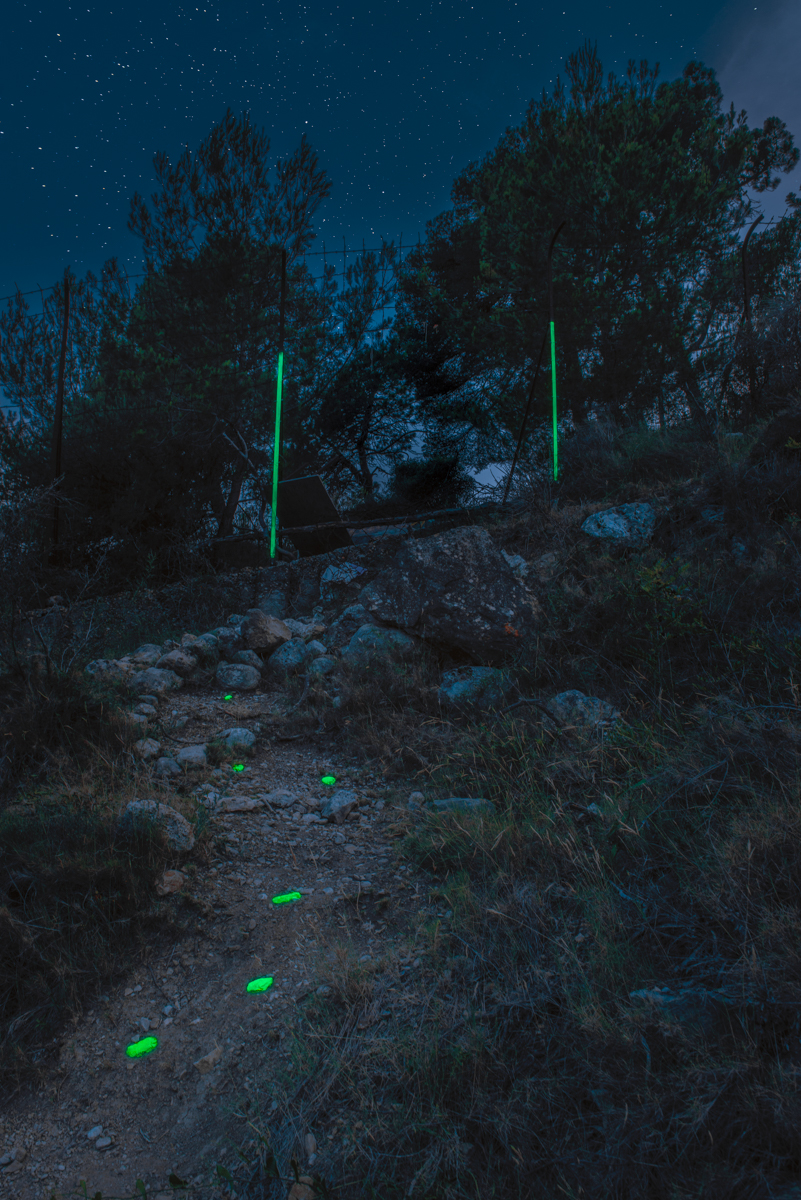
A phosphorescent path
connecting Italy and France
through glowing stones
that look like stars.
A poetic and political action.
~
https://www.celestinomarcocavalli.xyz/work.html
The installation shown here was created by one of the artists I met while at Joya, Celestino Marco Cavalli. The link above will take you to a description of his project. In brief, it is a series of fluorescent-painted stones that follow a trail refugees travel on their way from the Mediterranean, through Italy, and into France. The website does not include the many photographs Celestino took during his 5-month visit there to document the conditions under which emigrants travel–the trash they leave as they abandon belongings, the graffiti and the notes to others they leave in caves and hollows, the prayers they write, the places they shelter from the sun or rain or cold weather. Do the refugees litter the mountain paths? Yes. Do they do so out of desperation? Also yes.
This installation is innovative, compassionate, and political–also problematic; as always, borders between nations are fraught with concerns about each country’s boundaries, laws, rules and regulations. These days, most immigrants taking this trail (through Italy) have come from the global south, where the climate damage wrought by industrial nations has made living in poverty even harder and fostered political unrest. And the immigrants take huge risks–with no guarantees that they won’t be deported, or preyed upon by criminals who exploit their vulnerable status.
I’ve never been a refugee, an exile, an immigrant. I have met quite a few, though–often very young people, students I encountered at the college where I worked, students from Haiti, Dominican Republic, Turkey, Syria, Lebanon, Mexico, Venezuela, Pakistan, Eritrea, Viet Nam, Kenya…and my husband’s stepmother, who arrived at Ellis Island from Austria between the wars. And a colleague who was stranded at college in the USA when the Ayatollah took power in Iran, and a fellow employee from Cambodia, who lost her entire family except for one brother to the Khmer Rouge. Whenever I hear about the politics of immigration (which is often), I think of them: how hard they work, what they sacrificed to get here, how hopeful they are, how challenging their lives have been and continue to be. And their grief.
The following is a persona poem--"A persona poem is a poem in which the poet speaks through an assumed voice" (Academy of American Poets). Celestino's Northern Stars is my "prompt."

~

Refugees

Because we must hide by day
and travel at night, darkness hinders.
The narrow stony trail offers options:
turned ankles, torn skin, or a precipice
that takes us sliding down the mountain,
an avalanche of self, death’s prospect.
No one arrives eager for exile;
we’re just trying to save ourselves,
our families, a few belongings
we used to think were precious.

The way we take may be steep—
everyone knows that metaphor—
what we never expect is how much
it is an unburdening of all
we thought was necessary,
an education in physical need.
Shoes, for instance, more critical
than underwear. Ancestors emigrated
on callused feet without watches
or water bottles. The least cut could
go septic, a child’s wail could betray us
to predators or enemies. Still true.

One by one we let things go, abandoned
in shallow caves with other people’s
remnants, plastic bags and t-shirts,
books, candlesticks, so much trash after all—
even our skins can barely hold what
we need anymore. We arrive shriven,
numb as feldspar, having walked so long.
May we have water? May we rest, with our
children in our laps, and sing the songs
our parents taught us not so long ago.

 ann e michael