Changes & alterations

We built our house here about three decades ago. At the time, I was young and excited about landscaping the place; although I had been growing our own vegetables for years by then, I was fairly new to ornamental gardening. I made mistakes; I underestimated the speed at which shrubs and trees grow; I thought I could keep a handle on invasive species; the world of various bark beetles and aggressive vines was new to me; and I had no idea how hard it would be to manage almost seven acres without, say, a team of landscapers.

Or how rapidly an environment alters when the climate changes, and when cornfields and early-growth wooded areas become housing developments, parking lots, and streets. I have learned a great deal and much looks different now than thirty years ago, but the swallows still return to my garden between April 26 and May 6. My land contains fewer efts in May than it used to, but the gray frogs, spring peepers, wood frogs, and toads make their usual frenzied chorus at mating time each spring.

~

Recent changes have come from the emerald ash borer, which has decimated, or worse, the green ash native to this valley. The huge trees have come crashing down during the past 10 years, making hard work for us even if it does provide a bit of firewood. Cutting, splitting, stacking hardwood isn’t a task I’m much good at anymore. Thirty years ago, maybe…and there does not seem to be any good that comes of this tree loss, which I’ve been mourning each year as we have less and less of a woodlot treeline above the hedgerow and see more and more of the neighboring subdivision.

But on my damp, early-morning walk today, I perceived some changes that I should have expected and that offer a glimmer of hope for native trees and shrubs–despite the proliferation of Russian olive, multiflora rose, Amur honeysuckle, mugwort, wintercreeper, Asiatic bittersweet, mile-a-minute weed, and more colonizing invaders than I can tick off in one blog post. There, beside the tractor path, along the edges of the hedgerow (for edges are where things happen most quickly), I observed more tree saplings than in past years. With the vase-shaped, leafy arcs of green ash absent, sun reaches further through the thickets. And there I spot horse chestnuts starting to push up, tiny walnut trees, oak trees of differing species, “baby” hickories and maple varieties, along with understory’s smaller shrubs and trees like amelanchier, ironwood, redbud, buckeyes.

Granted, most of them won’t survive to maturity, but some of them will–gradually re-making the woodlot unless other disturbances undo the renewal.

I won’t be here in another 30 years to find out, but I find hope in these saplings. I’m also happy to see that the little woodland and field wildflowers such as false Solomon’s seal, jack-in-the-pulpit, wild violets, and mayapples remain. And though I find myself swearing inwardly at the way the Russian olives grow massive along the property line and the invasive bittersweet sends thick tendrils coiling up into the trees, it’s not the fault of the plants that they got here. Humans brought them to North America, and the plants–like European colonists–became a bit too successful in their new homes, pushing out what was here before their arrival. Am I any different, really, than the dandelion or the honeybee? My ancestors came to these shores not so long after those species were imported with earlier “settlers.”

~

The rain we’ve been getting means I haven’t been out weeding in the vegetable garden. After I take my walks, I come inside to dry off and do household chores, or make soup, or work a little on my poetry. I feel excited by a little writing project I have recently given myself, and I’ve also been playing around with drafting prose poems. Next week, I head to the high desert again for further inspiration and a chance to travel with a good friend, visit museums, and spend some time with my daughter. When I return in mid-May, the gardens, the meadow, and the woods will already be much changed.
Seemingly small stuff

Things to view, things to think about.

Sub Rosa’s post on floral aesthetica here.

IMG_4663

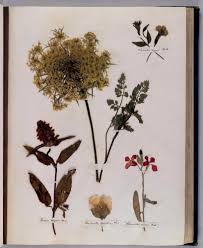
Emily Dickinson’s herbarium, thanks to Harvard (it takes a few seconds to load) here.

qalace ed

William Bartram‘s 18th-century drawings of American flora.

bartramx

~

Lovely words from Lesley Wheeler, and so true for me, too: “…reading and writing puts me in an honest place. Plus, while poems contain struggle of all kinds, they also constitute separate worlds it can be a great relief to enter, because good poems are not unjust or disruptive of bodily integrity.”

Far afield

My desire has been to wander, but my inclination does tend toward staying at home. One reaches a point in one’s life, however, at which wandering will shortly become more challenging than it was in youth. Also, it gets far too easy to stay comfortably within one’s zone of familiarity, which limits transitions and other difficult things.

Recently, I went far away, found myself (among other interesting places) in a field and happily fell into familiar behaviors I follow at home. In this case, scoping out the local flora and minor fauna in the hills in July.

IMG_4797

We were touring a small region of a small but extremely varied country: Portugal. The field featured small lizards that were so quick I couldn’t photograph them; dozens of types of wildflowers and grasses and their assorted tiny pollinators; robins, black redstarts, kestrels, and other birds I couldn’t identify. I am pretty sure we saw a hoopoe, which for me is exciting, though I expect it is not uncommon in Portugal.

As a humanities geek who loves Medieval and Renaissance art and architecture, I love the old cities; and the sea’s appeal abides, but the mountain regions appeal to the introverted gardener and naturalist in me. I was pleased with the quiet, with the pure air and blue sky, the twisting roads, the small farms. Most of all I was pleased to find so many plants and pollinating creatures in the field next to where we stayed for two nights, not far from the Peneda-Gerês National Park.

Some of these flower photos feature at least one bee or wasp or beetle-y thing. Below, a common sight on the mountains: heather, flourishing as well as it does in the British moors. Not much rain, but many misty mornings, even in July.

IMG_4702

This region is wind farm country. There are large, electricity-generating windmills atop much of the range, and quite a few of the many small rivers are dammed to create electric power and places to fish and swim. There’s certainly very little air pollution up in the hills…I have visited few places so pristine.

More little critters among the field flowers. Easy to overlook, despite how vivid these photos may appear.

IMG_4706

Nice to dwell, if only for awhile, in a place that offers a beautiful change of perspective.

Biodiversity, biodestruction

As the poems in my first collection, More Than Shelter, convey, I experienced mixed emotions about building a house and residing as human animals on a field that was in the process of reverting to wildness. It is a terrific privilege to “own” several acres of property and to dwell and raise food and children here. We have, after nearly 20 years, settled many of our challenges with the environment and its flora and fauna; and often, our lesson has been to let the environment be itself.MTS002

That means our “lawn” has largely reverted to clover and to grasses that can compete with weed seeds. That means we have meadows fore and aft and shrubby, scrubby hedgerows of mixed brush along a thin row of trees and rocks. It means we cannot entirely rid the area of invasive, non-native plants or the insects that come with them. And if a season passes without regular, careful maintenance–the environment will creep in on our living spaces very quickly.

On the other hand, a commitment to use no chemicals–or as few as possible (some exterior house maintenance requires paints and finishes that just are not environmentally-neutral) has meant that the property has good biodiversity for its size. So many kinds of avian life: scrub-loving little brown jobs, woods-dwelling owls and thrushes, turkeys, four varieties of woodpeckers, brightly-plumaged orioles, cardinals, jays, bluebirds, tree swallows, and goldfinches. Also the transient hawks, buzzards, and herons, and the grass-dwellers such as killdeer–to name a few. We are host to winterberry, serviceberry, dogwood, elderberry, nannyberry, mulberry, cherry, and wild grapes, so the wild fruit-eaters adore the place. Foxes, deer, groundhogs, raccoons, squirrels, chipmunks, skunks, opossums, even coyotes and possibly a black bear graze here.

They do not always stick to the margins and the flora. Sometimes they get into the trash cans or the compost heap (I once disturbed a deliriously happy raccoon sucking on a mango pit). Owls and foxes feasted on the guinea hens that refused to go back into the chicken run at night.

This description has not even gotten as far as the insect life, which is lively indeed–nor to the little bats, nor the oak trees’ flying squirrels.

~

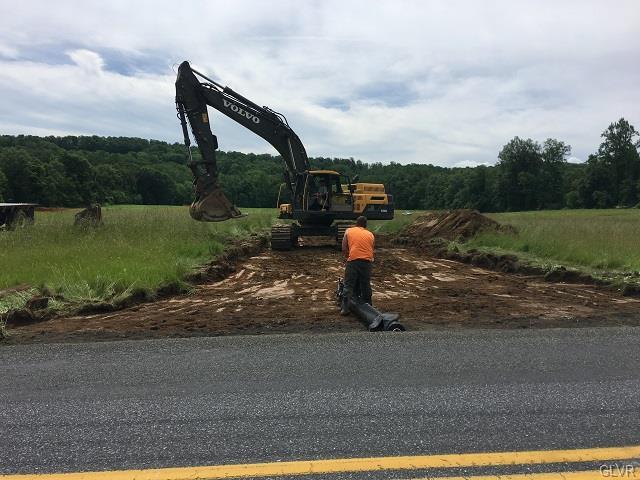
For the last decade, we have been among several neighbors who worked to slow the development of about 60 acres that lies immediately east of us and extends up the last low rise of the Appalachian foothills (Blue Mountain/Great Valley section). We have had some success in limiting the development: there are now 40 acres of preserved land on the north side of the slope, and the “estates” will consist of 13 township-approved house lots instead of the initially-proposed 52.brunner

But the site preparation process has begun in earnest this summer, and each morning–an hour or so after the birds start their chorus–the bulldozers and front-end loaders rev up and begin the crash-&-bang, the delivery of large culverts made of concrete, the dump trucks with their loads of gravel, the engineered changing of swale and drainage.

We were guilty of such disruption ourselves 20 years ago, when we installed the house we love on the land we think of as our own. I try not to mourn the loss of the field next door; it was never ours to begin with, and in so many ways, neither is the property on which our house sits.

The land belongs to no one. It is earth’s. If it belongs to anything it is to the generations of dragonflies, lightning bugs, red-tail hawks, barred owls, and rotund skunks, all of which preceded our appearance here by centuries.


Control

middle island ~

Human beings crave control. We want to be the masters of our own fate or to believe that there is a master of our fates who can be entreated or persuaded, propitiated or cajoled into helping us to gain control of our lives or the lives of others. We want to change the weather so that the rain falls when the soil needs rain, wetting the seeds we’ve sown, and so that the warmth comes when our plants need warmth. We want the sea to be calm and the fog to lift when we are ready to set sail. We want fine, sunny days when we visit the beach to swim or head out for a picnic. We want just enough snow so that school’s canceled, but not so much that our power goes out. We pray. We dance. We chant. We invent little private rituals and participate in community rituals.

We want to control our health. It does not seem to be an unreasonable aim. We want to control our relationships–just enough to keep ourselves happy. We want control over our careers and  our income–not so much to ask. We want to be able to make our own decisions. We want choices so that we feel we have control over our lives.

My gardens are my analogy today. I’m still endeavoring to exert some control over my vegetable garden, but I kept my purposes modest this year; I planted fewer beans, fewer tomatoes, fewer peppers, fewer potatoes, no onions, no peas, no edamame, no radishes…the walk-through rows are wider so it is easier to weed. Beginning with the dry warm winter and some assemblies of challenges that do not pertain to the garden, the season looked “iffy.” Then came lashings of showers in May. A challenging season, but not insurmountable. I have been gardening a long time, and I have methods of adapting to things I cannot control. It comes with the territory.

The ornamental beds have presented the most difficult struggle with my need to control the space I (somewhat ridiculously) consider my own. When the beds get overgrown–as they are now–I know that I can accept their exuberant rioting with the successful weeds. I can say, “This is what nature intends. There is beauty here.”

overgrown

I do know that. But the controlling mind–the monkey mind–says, “Too much penstemon; it’s gotten aggressive. Deadhead the peonies. Pull up the plantian, the wild asters, fleabane, wild garlic, crabgrass, bermuda grass, creeping charlie, five-leaf vine. Get the seedlings out of there (mulberry, redbud, oak). Mulch. Keep the rabbits off the hostas. Move the marybells. Get the weeds out of the alchemilla…”

My head clouds with fog. The seas get rough and I despair, because I cannot control things. Not even a small garden.

Instead, I could be meditating on green. On the amazing variety of leaf-shapes, on dappledness (like G. M. Hopkins):

Pied Beauty

Glory be to God for dappled things—
For skies of couple-colour as a brinded cow;
For rose-moles all in stipple upon trout that swim;
Fresh-firecoal chestnut-falls; finches’ wings;
Landscape plotted and pieced—fold, fallow, and plough;
And áll trades, their gear and tackle and trim.

All things counter, original, spáre, strange;
Whatever is fickle, frecklèd (who knows how?)
With swíft, slów; sweet, sóur; adázzle, dím;
He fathers-forth whose beauty is pást change:

Práise hím.

~

Here is one aspect of my ornamental garden. Overgrown, yes. Lush, diverse, lovely in its unrefined way. Until I have the wherewithal to tear through and divide and move and mulch, this is not a bad view, the definition of … lack of restraint, ornamentals gone wild. Freedom, I suppose.

A little too much of some good things.

As we grow, we learn to let go. So I am told. Garden, you have a chance to go wild!

And I guess I have the opportunity to learn to live with that.