“The Visionaries” [a poem by a friend]

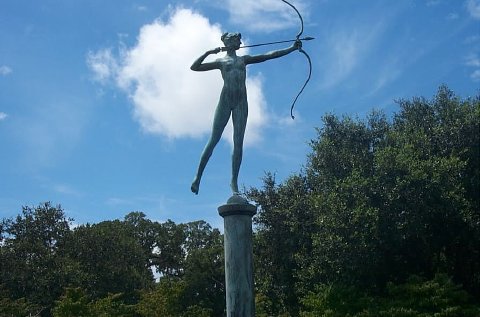
"Diana" by Augustus Saint-Gaudens; photo by Pete Finneran 2000. Image courtesy of Brookgreen Museum.  www.brookgreen.org

“Diana” by Augustus Saint-Gaudens; photo by Pete Finneran 2000. Image courtesy of Brookgreen Museum.
http://www.brookgreen.org

A poem by Beejay Grob © 2013

The Visionaries

We too had seen the gardens
sculpted by every season now.
A significant collective ‘we’–
myself, and practically anyone
I could target; one-by-one,
rain, autumn, winter night.

The family album holds each
posing sandwiched on a tailgate
flocked outside the aviary;
all standing straight as statues,
shot by the granite Pegasus.
Everyone except you, Muse.

Beneath a hospitality of waving
palmettos, feathering Carolina skies
from here to Charleston,
the stone-silent Visionaries
lean in from their perch,
reflecting in their secret oracle.

I took a stab at it when Orion
hung low over midnight oaks,
a carved moon enlightening Anna:
Why so many huntresses?
I determined her quivering gifts
sighted monumental occasions.

Walk among the springtime
blooms, the lubbers mating openly,
or in summer’s dead heat–
count the times she made a point
to cast herself as Diana,
the female Archer.

~ ~ ~

National Poetry Month, 2013. Many thanks to Beejay Grob, who wrote the poem and who introduced me to the beauty of Brookgreen Gardens in spring.

Brookgreen Plantation and Sculpture Gardens, Myrtle Beach SC

Judging poems

During National Poetry Month, a local newspaper (Lehigh Valley Press) sponsors, with a local public radio station (WDIY), a poetry contest for children ages 6-17. This year I was one of seven people, most of us educators, on the judging panel.

Judging poetry is always a rather fraught endeavor, and when one is reading the work of novices–particularly very young ones–setting standards can be challenging. What were we looking for, exactly? How could we decide whether the writing of one 14-year-old was “better” than the work of another? How to assess the poetry of 8-year-olds?

Our coordinator and organizer began with such questions and by asking us to describe what each of us seeks in any poem–not poems by children, but any good poem. Would children’s work feature any of these attributes? Successful attempts at poetic strategies or craft, for example–we may be able to determine that a 10-year-old’s work shows signs of poetic craft. Imagery that moves beyond the expected or clichéd? Young people often prove quite capable of that part of writing.

We are experienced in the classroom, too, and can usually tell when a child’s work shows signs of being ‘overly-coached’ by a well-meaning adult. Alas, all too often an adult’s interference deadens the imaginative if occasionally grammatically-incorrect approach children take. We can also tell which poems come of a classroom assignment when we get submissions of numerous 7-line poems on “snow.” This is not to suggest that none of the poems are worthy of note: an imaginative writer of any age can probably create a lovely piece conforming to the assigned framework. But, as teachers, we found ourselves responding to the assignments themselves (“That’s clever and would work well with third-graders, too;” “They must be studying the Black Plague;” “Looks as though they made a word bank for this one;” and so on). We had to remind ourselves to look at the work itself for the earmarks of imaginative ideas and use of language.

Interestingly, first-place poems seemed obvious and agreement was usually unanimous. This was true for elementary school, middle school, and high school writers: the best work does stand out.

Choosing the second and third place poems was more difficult and resulted in lively conversation about what makes a good poem, what matters more: authenticity of experience? discernible voice? vivid imagery? clear use of craft? emotional expression? imagination? Each of the judges had useful insights that reminded me of the value of thoughtful criticism and the value of poetry-as-art.

It was also heartening to read the work of so many young people who showed a willingness to play with words, to think about aesthetics and feelings and language, and to show their work to others. I’m grateful to the teachers who took the time to introduce their students to poetry and to encourage their pupils to write.

I celebrate myself…

April is National Poetry Month in the USA, and I begin the month with Walt Whitman’s famous phrase and will attempt to duplicate the joyous urgency of his call to celebration. That means I am going to try to post just a little more frequently in April.

Poetry month began this year with a wonderful act of creative largesse on the part of a friend who sent me a poem…dedicated to me. Receiving a gift like this one is humbling; and it has been quite a long time since anyone’s written a piece for me. David Dunn, to whom my collection Water-Rites is dedicated, wrote a few poems for me or inspired (indirectly or directly) by our friendship or my family and surroundings. But he died over a decade ago, and since then I suppose I have had to learn to celebrate myself.

Not that this is a bad thing–celebrating the self–but for some of us it presents certain cultural or psychological obstacles. In this, Whitman has been an important teacher for me. As a great observer, loafer, lover of the world and all its beings, he was able to include himself among the beloved. My background, Protestant, agrarian, modest, surrounded by the biblical entreaty to remain always humble before God, combined with a natural shyness, means that I have had trouble admitting of self-celebration in any form and under any circumstances. I don’t take praise comfortably. The left hand shouldn’t know what the right hand is doing.

However, Whitman seems contented in his skin and in his world and follows a different parable as model: he does not hide his light under a bushel.

Walt Whitman in mid-life

Walt Whitman in mid-life

Furthermore, his passion admits of compassion and of aesthetic appreciation for all of the “Kosmos.” Each breath, scent, texture, color, hue, person, idea, object, sentient or non-, living or inert or dead long-past or recently, religious or scientific or imagined comes to life in language through line, syntax, lists, descriptions, words. I think there is a hint of zen-like acceptance in Whitman’s most lasting poetry, the vulnerable willingness to accept all that we experience and to do so non-judgmentally.

Thank you, Beejay, for the poem. I feel inspired anew. And as I celebrate all poets and the valuable, irreplaceable, gorgeous, ancient art of poetry this month, I shall endeavor to embark upon the celebration of myself (davening to ol’ Walt with humble pleasure). Therefore, a reminder:

My book Water-Rites is still in print, and Brick Road Poetry Press sells it (as does Amazon.com, where poetry-lovers can purchase the book in e-book form for Kindle). Dawn Leas reviews it at Poets Quarterly this month. Click for the link here!

May April be full of revelations in the form of poems for you.  water-rites by Ann E Michael

Endemophilia

This poem is sort of my version of endemophilia, describing (as Albrecht defines it) “the particular love of the locally and regionally distinctive in the people of that place. It is similar to what Relph … called “existential insideness” or the deep, satisfying feeling of being truly at home with one’s place and culture.” You might want to check out Glenn Albrecht’s site for more detailed definitions and philosophical/psychological reasons for inventing names for such concepts.

My long-poem in Water-Rites, “The Valley, the Whitetail: A History,” probably fits the term endemophilia more closely than the poem I’ve posted below–which may one day appear in print if I can find a publisher for my next manuscript. But the long-poem is a little too long for a blog post.

[I have an idea: buy a copy of Water-Rites from Brick Road Poetry Press, and read it there!]

~

Suburban Georgic

A mild day in February. Good chance
there’ll be more snow or ice. Walk slowly,

note the footprint of a hosta, dormant, or
the arrow-shaped deer hoof in hardened soil.

Look more closely for the ravages and burrows
of rodentia—woodchucks, voles and mice.

You may discover where squirrels have
hidden seeds or laid waste to crocus corms—

try to restrain your wrath. Decide
how best to counter such yearly looting;

strategy keeps the mind sharp. Grubs,
for instance, in your lawn—a different tack,

and this year you may succeed, and keep
the skunks from rooting through the grass.

Weigh, in your mind and pocketbook,
the relative costs of pesticide and herbicide.

It might be the year to go organic,
though there’s even odds the dandelions will thrive.

Ease your troubled breast from lawn woes.
Raise your eyes to forsythia, to witch-hazel,

observe critically the shrubs’ bare bones,
decide what needs the kindest cut,

find your saw and pruners, time to oil
and sharpen—your fingers itch—

but it’s a little soon. To assuage your
yearning, cut back the redtwig osier

so its new growth will flush crimson.
Consider forcing blooms indoors—

aren’t there soft, small swellings on
the slim wands of pussywillow?

When the next storm hits, dream of columbine
and narcissus. Get out your Horace, and wait.

ann e michael

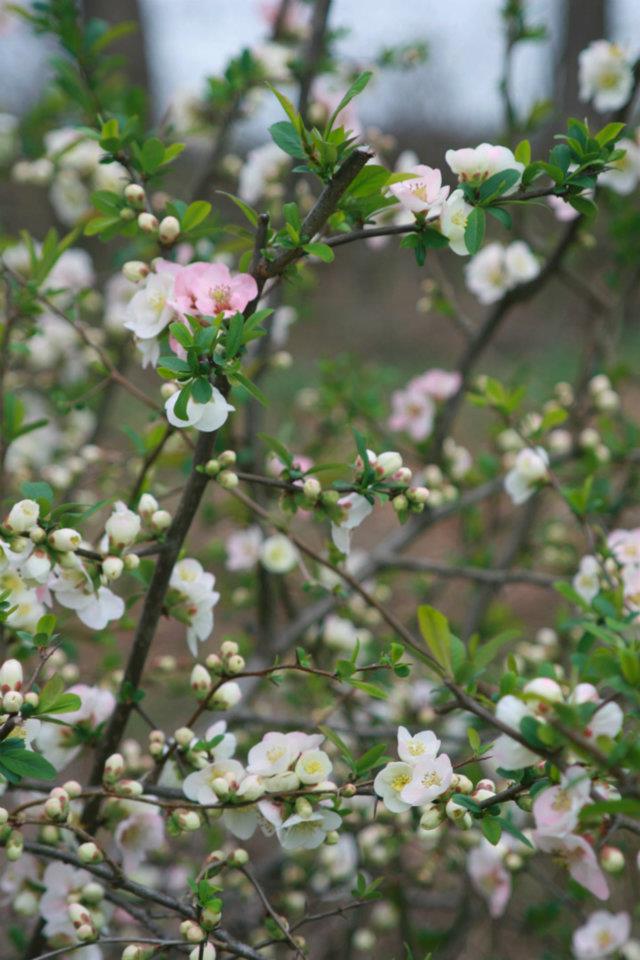
quince blossoms

~

© 2008 Ann E. Michael

~

Waiting, in the place I call home, for spring.

Toponesia and poem

Here is a poem by Virginia Hamilton Adair that demonstrates, perhaps, the idea of “toponesia”–loss of connection with place. The speaker recalls the beloved beach in its decay and in its beauty; she also recognizes that the tide erases all–talk about amnesia!

Buckroe, After the Season, 1942

Past the fourth cloverleaf, by dwindling roads
At last we came into the unleashed wind;
The Chesapeake rose to meet us at a dead end
Beyond the carnival wheels and gingerbread.
Forsaken by summer, the wharf. The oil-green waves
Flung yellow foam and sucked at disheveled sand.
Small fish stank in the sun, and nervous droves
Of cloud hastened their shadows over bay and land.
Beyond the NO DUMPING sign in its surf of cans
And the rotting boat with nettles to the rails,
The horse dung garlanded with jeweling flies
And papers blown like a fleet of shipless sails,
We pushed into an overworld of wind and light
Where sky unfettered ran wild from earth to noon,
And the tethered heart broke loose and rose like a kite
From sands that borrowed diamonds from the sun.
We were empty and pure as shells that air-drenched hour,
Heedless as waves that swell at the shore and fall,
Pliant as sea-grass, the rapt inheritors
Of a land without memory, where tide erases all.

from Ants on the Melon. Copyright © 1996 by Virginia Hamilton Adair

Homescape poems: Solastalgia

Note–The poems below are used only as illustrations and used by virtue of the Creative Commons theory; the copyrights belong to the authors or their executors.

~

I’m thinking about the nostalgic overtones of the “changed” homescape here, or the notion of solastalgia as coined by Glenn Albrecht (see earlier post). At first I planned to use a poem with overt environmental themes (as of the home that has been denuded, altered, destroyed–many good poems exist on that theme). Then I thought to look more obliquely at the idea of solastalgia as an emotional state, for home is deeply freighted with psyche.

One form of “solastalgia” is represented here, I think, in Philip Larkin’s “Home Is So Sad”:

Home Is So Sad

Home is so sad. It stays as it was left,
Shaped to the comfort of the last to go
As if to win them back. Instead, bereft
Of anyone to please, it withers so,
Having no heart to put aside the theft

And turns again to what it started as,
A joyous shot at how things ought to be,
Long fallen wide. You can see how it was:
Look at the pictures and the cutlery.
The music in the piano stool. That vase.

~

Another aspect of solastalgia, in this section of Gary Snyder’s “Four Poems for Robin,” relates to the homeplace in the form of a relationship, one bound up with the excitement of youth, college, the orchard with its tall dry grasses and love’s “grave, awed intensity.” Yase village is located near Kyoto; the speaker of the poem identifies where (and when: December) he resides while reflecting on an autumn day in his past.

December at Yase

You said, that October,
In the tall dry grass by the orchard
When you chose to be free,
“Again someday, maybe ten years.”

After college I saw you
One time. You were strange.
And I was obsessed with a plan.

Now ten years and more have
Gone by: I’ve always known

where you were–

I might have gone to you
Hoping to win your love back.
You still are single.

I didn’t.
I thought I must make it alone. I
Have done that.

Only in dream, like this dawn,
Does the grave, awed intensity
Of our young love
Return to my mind, to my flesh.

We had what the others
All crave and seek for;
We left it behind at nineteen.

I feel ancient, as though I had
Lived many lives.
And may never now know
If I am a fool
Or have done what my

karma demands.
~
I’d be interested in finding out which poems you consider solastalgic. Meanwhile, I am going to browse my collection for poems that are endomophilic…

AWP follow-up

photo Ann E. Michael

winterhazel

Snow fell on Boston. Not a big snow, however, and rather typical for a late-winter storm: damp, swirling but not biting, swift-melting once the sun appeared two days later. Early Friday morning, I trudged with a friend over the as-yet unshoveled sidewalks to breakfast on Newbury Street at Steve’s. We met with conference buddies who are all members of the WOM-PO [women’s poetry] listserv. It is lovely to meet face-to-face people who have been virtual colleagues and splendid to discuss poetry over a good breakfast.

~

It is also a relief to realize that I have finally learned how to manage conference-going. It is all a matter of pacing and, I suppose, of taking poet William Stafford’s advice and lowering one’s expectations. The hardest challenge is making the choice between blowing the budget on terrific food (in a big city, wonderful restaurants abound) or on books, because the bookfair at the Associated Writing Programs’ annual conference is enough to inspire swooning among literary bibliophiles.

In three huge exhibit rooms, small presses and literary and university presses displayed chapbooks, literary journals, and books that range from minuscule to tabloid-sized, books that are handmade, letter-pressed, offset, print-on-demand, stapled, ribbon-sewn, die-cut, fancy-boxed, reprinted, spare, florid, illustrated, edgy, deckle-edged, marbled, second-hand, one-of-a-kind, limited-edition, mass produced, commercial, educational…in all genres including mixed-genre, collaborative, collage, anthology, with an emphasis more on the literary than the commercial text. These books can be devilishly hard to locate, even with the existence of Amazon and online sellers; and holding them in your hands is a far more convincing sell than seeing a picture file on your computer screen.

Heaven for poetry-readers, there are also wonderful creative non-fiction books, collections of short stories, novels, books on prosody and poetics, the craft of writing, on creativity and inspiration and toil and revision and on the complex and controversial topic of teaching writing. Oh, and there are people, too. Most of the attendees are writers of one stripe or another who are congenial and curious or else walking about with the glazed expression of the overwhelmed.

Or some combination of the two.

~

I exercised considerable restraint and managed not to load my bedside table with two months or more of reading material (see a related post here). And I got some terrific ideas for teaching writing to college students and found some wonderful poets whose work I want to study. The last night of the conference, I listened to the mesmerizing Anne Carson read an indescribable take-down of the fifth book of Proust’s À la recherche du temps perdu, the section titled The Captive (Albertine). It’s been years since I read Proust, which I did almost out of stubbornness in my junior year of college, but the book came back vividly enhanced by Carson’s peculiar approach to pacing, language, scholarship, whimsy and satire. I like what the Poetry Foundation’s biography says about her after the release of her text The Autobiography of Red:

According to John D’Agata in the Boston Review, the book “first stunned the classics community as a work of Greek scholarship; then it stunned the nonfiction community as an inspired return to the lyrically based essays once produced by Seneca, Montaigne, and Emerson; and then, and only then, deep into the 1990s, reissued as “literature”and redesigned for an entirely new audience, it finally stunned the poets.” D’Agata sees Carson’s earlier work as an essayist everywhere in her poetry, along with her deep absorption in Classical languages. Carson’s work, D’Agata alleges, asks one to consider “how prosaic, rhetorical, or argumentative can a poem be before it becomes something else altogether, before it reverts to prose, to essay?”

~

Altogether, Boston provided nourishment of many kinds: gustatory, intellectual, emotional, poetical…food for thought.
An eBook arrives

Thanks to Brick Road Poetry Press, there is now a Kindle version of my poetry collection Water-Rites. I think the only place to purchase it is Amazon.com and the link is here: Water-Rites ebook.

I haven’t forgotten about posting poems of place-longing and homescapes. Just feeling a bit short on time this week.

water-rites_cover

Endemophilia, toponesia, psychoterric states

Thanks to poet Annie Finch, I came across a thoughtful essay in Aeon magazine–an exercise in synthesis and interdisciplinary thinking that connects with Naess and his notion of ecosophy; and with Bachelard and others whose work I have lately been reading and thinking about. Liam Heneghan combines ecology, botany and topography with Winnie-the-Pooh and explores transience and trans-placement from several viewpoints. He looks at how so many of us are transplants, foreign “invaders,” culturally and biologically, and asks us to think about how we feel about place–home-place, in particular.

Not all of us connect with the concept of a home-dwelling anymore; but if we do so, that place is generally closely associated with childhood, observes Heneghan. He cites environmental philosopher Glenn Albrecht and says:

…we do not yet have an adequate vocabulary to address our ‘psychoterric’ states — or how the state of the Earth relates to our states of mind. To balance the negative psychological state of ‘nostalgia’, a couple of years ago Albrecht proposed ‘endemophilia’ (the sense of being truly at home within one’s place and culture — or ‘homewellness’). To balance the term ‘topophilia’, a love of place, Albrecht opposes ‘solastalgia’ — the desolate feeling associated with the chronic decline of a homescape. Solastalgia names the emotions we have at the loss of species and habitats through climate change and other environmental changes. We should all expect a lot more of it.

I do know those feelings, and I feel happy to have terms for them! Yet I argue that we do have an adequate vocabulary for how the state of the Earth relates to our states of mind, and that vocabulary is artistic. I believe the finest expression of these kinds of emotional-memory sensations can be found mainly through art. My task for myself in the coming weeks is to gather a few examples of endemophilia, solastalgia, and other “psychoterric states” in poetry. I’ve already got a few in mind.

Please read Heneghan’s essay if ecopoetics or the notion of homescape appeals to you.

Memoir & the lyrical narrative

I have decided to devote two class periods to exploring the lyrical narrative with my students. The reason evolved from, not exactly a revelation, but a dawning awareness that this particular mode of poetry connects more easily with students than other modes.

Popular music, of course, sets the contextual stage here. American country music fills the nation’s highways and airwaves with lyrical narratives and modern-day ballads. The story-song appears in a wide range of musical genres from rock to rap, born from simple blues narratives and Appalachian ballads and from John Henry and Casey Jones to glam-rock “epic rock ballads,” new wave, Motown, British invasion (think “A Day in the Life”) and quirky indie lyrics–not to mention huge hits like “Lying Eyes” and “The Devil Went Down to Georgia” or oft-played 70s narrative songs like “Cat’s in the Cradle” or Bruce Springsteen’s “Thunder Road.” These tunes are all before my students’ time, but they have their own lyrical narrative popular songs; they “get it.”

Bruce Springsteen: lyricsThunder Road

Bruce Springsteen: lyrics
Thunder Road

Narrative lyrical poems hook readers who might not otherwise spend much time closely reading a poem because of those critically important pronouns “I” and “you” and because there’s a human impulse to stick with a story. We want to know how it ends; and we want to figure it out in our own subjective ways, to put the speaker/writer’s experience into our own (or vice versa) and interpret the narrative on our own terms. We also like to be a little surprised.

Why?

I’ve touched on the topic of the cognitive need for narrative in a previous post, and on Boyd’s story-telling impulse research (here), and now–in light of reading the lyrical narrative poem–I want to offer an excerpt from Oliver Sacks. In an excerpt from Speak, Memory, Sacks writes:

“There is no way by which the events of the world can be directly transmitted or recorded in our brains; they are experienced and constructed in a highly subjective way, which is different in every individual to begin with, and differently reinterpreted or reexperienced whenever they are recollected…Frequently, our only truth is narrative truth, the stories we tell each other, and ourselves… Such subjectivity is built into the very nature of memory, and follows from its basis and mechanisms in the human brain. The wonder is that aberrations of a gross sort are relatively rare, and that, for the most part, our memories are relatively solid and reliable. We, as human beings, are landed with memory systems that have fallibilities, frailties, and imperfections—but also great flexibility and creativity.”

How can we honestly interpret a poem without acknowledging immediately that our brains are highly subjective processing organs that inherently interpret and experience input differently? Our personal narratives, our memories and recollections, limit, expand upon, and influence our interpretations. That is why I insist that my students accept all “expert interpretations” of famous works with a grain of salt. Every human brain re-creates based upon subjective, unique processing; the fact need not keep us from admitting of rational thinking, but it must affect human interpretations of phenomena. Especially subjective phenomena such as art.

This is also the reason I warn my students not to assume that the speaker of the poem is the poet himself or herself. Poets invent, and they can invent personas. Furthermore, in their efforts to write truths–emotional truths, lasting truths–they may alter physical, actual, memory-based “truth.” In other words, maybe the story happened just that way. Or didn’t. Though “for the most part our memories are relatively stable and solid,” the paradox of art is that altering the facts can lead to deeper truths. Sometimes the facts seem altered from one perspective but not from another. Other times…well, I confess, I myself have changed some facts in poems in order to make the poem better. In such cases, craft supersedes the need for stony factuality. I guarantee I am not the only writer who employs this strategy.

Whose life is it anyway? And whose art? Sacks reminds us of the loosey-goosey aspects of recollection: “The neuroscientist Gerald M. Edelman often speaks of perceiving as ‘creating,’ and remembering as ‘recreating’ or ‘recategorizing.’” Thus, the lyrical narrative is a form of memoir, created through individual perception and recreated through the process of memory itself. Which, all of us being human and therefore fallible or otherwise liable to err, and subconsciously quite able to lie to ourselves, means that the lyrical narrative could end up as mythical as the stories of Mount Olympus.

And just as compelling to generations of human listeners or readers.

A voyeur’s fascination that the reader may be witness to the human-talking-to-human in the framework of a storyline is a significant part of what engages audiences. This poem might be memoir! It may be true. It may be genuine experience, something to which I can relate. There’s emotional frisson, or thrilling curiosity, or the dread of knowing it will all end badly. But I must know; and I want to believe it might be true. Tell me sweet lies, oh troubadour!

~

*Note: the image above is not Bruce Springsteen’s handwriting. He prints. An example of his actual lyric drafts is here.