Adventuring

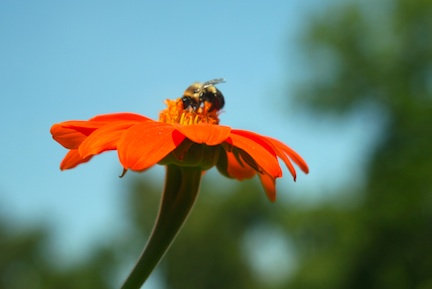
The weather here has been hot and somewhat humid, though it continues to be dry–much drier than autumns used to be. Drought extending past August into October is becoming a more usual thing, according to my garden journal. One plant that thrives this time of year is tithonia (Mexican sunflower), and it attracts monarch butterflies like crazy. These are the monarchs that go adventuring: the super-generation of these insects that makes the 3,000-mile trip to Mexico. Here’s a brief blog from the Xerxes Society that has some quick facts. The monarchs I see in my garden may, if they are lucky enough to survive the trip, live up to 9 months, which is well past the life span of spring and early summer generations.

They are not even returning to a place they know or have ever been. Human science has never yet determined how monarch butterflies of the last summer generation find their way to Mexico. They just go adventuring, floating on air currents, supping on flowers as they travel.

I’m about to go adventuring, as well, traveling further east than I’ve ever been, in the company of one of my favorite persons in the world–my daughter. She and I had long talked about taking a mother-daughter trip together once I retired, and sooner is better than later! She found an environmentally-conscious adventure tour business that offers some really intriguing historical/archeological/environmental hike-and-bus options. We’ll find out whether the company is worth recommending & I’ll report back here, meanwhile keeping our destination unrevealed for now. A little mystery is fun.

While I am taking this trip for reasons beyond writing inspiration, I can’t help hoping it will act as a prompt and opportunity for drafting new poems. I’ve been working on new drafts, and revising older ones; but I have to admit that for awhile my creative mojo has been a bit off. Yes, this happens to any so-called “creative” occasionally, but it never feels terrific. One prefers the juicy, challenging urgency of creative flow. Wish me luck (and traveling mercies).
The color orange

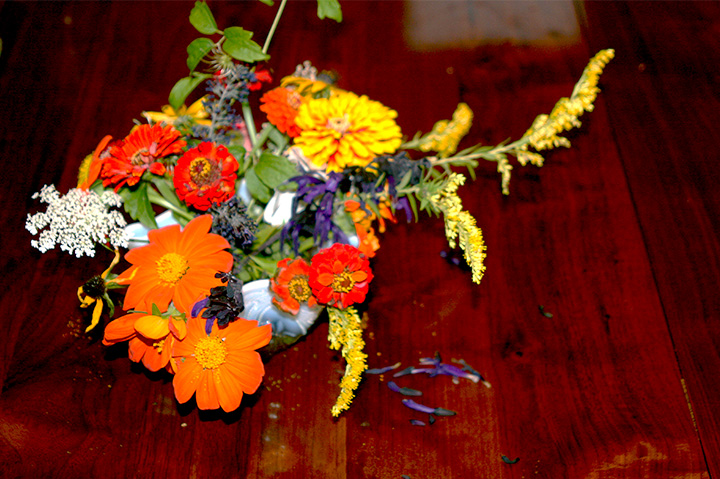
bouquet

Late summer bouquet five days past its first blush…

~
The crickets are raising their “voices” each night; the darkness lasts a little longer, and the color orange emerges from the green of midsummer to remind us of all that is beautiful in the world, despite __________________________ [insert your list of unpleasant, tragic, disheartening things].

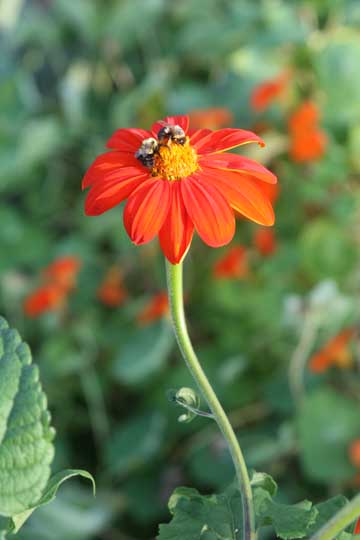
Here is my encomium to the Mexican sunflower, tithonia rotundifolia, a favorite of bees and monarch butterflies and also a favorite of my daughter’s, so it has special aesthetic-emotional appeal for me. The poem I’d like to write to the sunflower has not yet materialized, so praise in prose will have to do for now.

mexican sunflower, bee by Ann E Michael

Autumn approaches. I like autumn, though some of my dear ones do not–but one thing universally salvages the early weeks of the season, no matter how a person feels about the encroaching cooler weather: orange. Even people who don’t care for the color in clothing or decor admit that, in nature, the color orange attracts the eye, enlivens a scene, brightens the dullest corner.

Nasturtiums, zinnias, the last hurrah of daylilies, butterflyweed, and early-turning foliage such as sumac and sassafras sport the color well. There are also pumpkins and squashes warming up fields; and in some areas, there are butterflies wearing the hue: monarchs, viceroys, fritillaries.

But nothing delights in a bright red-orange so well as the Mexican sunflower, which evokes the warm climate of its designation and likely origin (I haven’t done a great deal of research on the plant. I know that tithonia diversifolia is native to the region of Central Mexico and am merely guessing that the rotundifolia variety has its roots there, too–excuse the pun).

monarch.ann e michael

It sports well with one of its showiest pollinators, the gorgeous, orange, monarch butterfly.

Tithonia likes full sun and does not mind a bit of drought–all reasons it managed well in Mexico. It’s also ridiculously happy in the American Northeast, at least in the Mid-Atlantic region where I garden. The plants grow 6-9 feet tall and are veritable fountains of pleasing, brilliant points in the late-summer garden. They attract bees, butterflies, hummingbirds, and small songbirds and have few pests. Deer dislike their “hairy” leaves, and slugs and beetles seem also unimpressed with their food qualities.

Or perhaps the “pests” appreciate the blooms’ aesthetic value, as I do. [Okay, too much anthropomorphism there, I admit.] tithonia.2sm

Furthermore, as long as I get out to the garden and dead-head the plants regularly, they bloom right up until the first hard frost.

And they cut well for bouquets (see the not-excellent photo above).

When there is so much sorrow going on in the world, it may seem odd that a flowering plant can offer respite–a moment or two of awe, of joy, the discovery of a bumblebee with its legs pollen-yellow or a monarch’s slim proboscis coiled just above brilliantly golden stamens amid a red-hot orange daisy-shaped blossom…and maybe, above, an autumn-blue sky.

Not art, but nature. Both valuable to human creatures.