Mid-March

Tulip poplars begin to plump out their winter bud scales, where they will leaf out later in spring.

A marsh hawk zips overhead, winging above the treeline and vanishing over the northern hill.

Early ornamentals bloom: crocus, snowdrop, aconite, i. reticulata.

Red-winged blackbirds make the mornings noisy–they have so many different songs and calls that three or four of them sound like multitudes, almost drowning out our year-round singers, the song sparrows. Early migrant passerines have returned, but it’s still winter here. Some bugs have gotten active and are emerging from hibernation or incubation. No bees as yet. When I turn over rotting logs, I find amphibians’ eggs and lots of different varieties of soil centipedes.

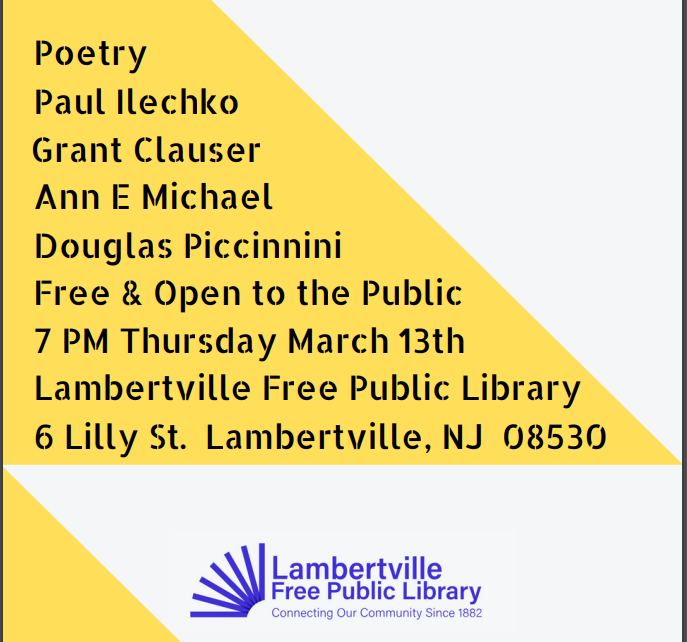
And, of course, worms. March’s moon is sometimes called the Worm Moon, and tonight there’s a total lunar eclipse around midnight here in PA. Is that auspicious? It’s also when I will be reading at the Lambertville Free Public Library in Lambertville, NJ. I’m excited to participate in an on-site, in-person reading again…I’ve been hibernating a bit from poetry events, but it is time to get stirring.
At the end of the month, I’m packing up for a brief trip to Los Angeles, where I will be attending one day only of the annual AWP Conference (Saturday’s Book Fair!) and spending the rest of the visit with my son. The conference always offers a terrific infusion of writerly companionship, community, and inspiration. Whereas time with my son offers love, cool places to see and eat and hike, a host of things I didn’t know I wanted to learn, and many moments of hilarity and conversation. It’s hard that he’s so far away–hard for me; I don’t think he minds, he is busy and having fun, which is as it should be.

Also, yes, the whole situation here in the USA is something I never could have imagined as a younger person, when I somehow had an unquestioning faith the US Constitution could actually be workable as an enduring rule of law. That careless people who value money over community could indeed disrupt that 1787 document was always a possibility (the moneyed property owners and slaveholders had their way with the original, after all), but most of us didn’t see this coming–naive, I suppose. Busy with our own concerns. I get it, and maybe we deserve what’s coming, but [ugh]. A concerned European friend recently asked me how I was faring under the stress of these first three months, and I told him that since making art (poetry) has generally been an unconventional act/behavior/response even under the patronage system, my response is to keep making art. Granted, it isn’t much, nothing earth-shattering, not gonna change society that way; but it keeps us observant little non-conformers on our toes, creative, and flourishing in the face of weirdness and oppression.

Which is something we can do. Like early bloomers in the cold days of late winter.

winter witch hazel blooming in snow

Resilience & interpretation

I know many of the readers who follow this blog are not citizens of the United States. Perhaps you have been hearing about the contenders for our upcoming presidential election and feeling some dismay. Perhaps you are particularly concerned about calls for identifying citizens based upon their ethnic background and religious choice.

If so, I assure you that there is push-back here from people who recognize that persons such as Mr. Trump embarrass the nation. It appalls us to see a person who feels he can ignore the U.S. Constitution running for the presidential office simply because he has money and recognition…although the free and open laws of the country permit him to proceed.

Trump’s proposal to identify some of our citizens by creed or heritage violates the Constitution in several ways. It violates Amendment One’s provisions for freedom of religious expression, and Amendment Four, the right to privacy; and the section of Amendment Five that relates to being held answerable to a crime and deprived of liberties without due process of law; also, Amendment Fourteen Section 1. Many, many U.S. citizens know that such proposals are merely rabble-rousing slander and could not be enacted without completely controverting the Constitution. These people are not wealthy entertainers, and they do not make the news, but they exist and–with any luck–they will vote.

A person running for the highest office in his country should know its laws thoroughly, but nothing in our Constitution says he (or she) must. We citizens are to blame, as clearly many of us are not terribly familiar with the laws of the United States of America, either. U.S. citizens should become more aware of our responsibility to learn about the Constitution, the importance of the vote, and the need to be rational thinkers when we go to the polls. Our democracy’s founding documents were drafted by people who earnestly, if perhaps idealistically, believed that human beings are capable of rational decision-making.

Granted, they also thought they were granting voting rights to property-owning men. The Constitution has been altered over time; it is a resilient, flexible, and enduring piece of prose that’s been the source of frequent interpretation.USConstitution From a literary standpoint, resilience and interpretation are what keep “classics” alive and relevant as works of art, though close readers can also use context, history, and speculation about original intent to examine a piece of writing they love and respect.

I have no idea of how I will vote next November. But I do know I will consider, more than personal values, the values of the nation under whose laws I currently reside. I’m reminded of the wisdom-teachings of Jesus in the Gospel of Matthew–

He said to them, “Then render to Caesar the things that are Caesar’s; and to God the things that are God’s.” Matt. 22:21

The people listening to Jesus went away “amazed” (Matt. 22:22). There is something ambiguous in that response that speaks to me today, something worth meditating upon, something worth interpreting.

~

Reasonable, calming…

Campaign rhetoric is  hardly deserving of the name. The commentator who attempts to persuade or question through the means of valuable, thoughtful rhetoric endeavors to avoid fallacies and ballyhooing. But such commentators are scarce as hen’s teeth. Apparently, we citizens of the USA are not considered intelligent enough, are not respected enough, by our politicians and their media handlers to be worthy of genuine discourse or reasonable argument. We are also far too emotional and prone to grand-standing and stereotyping, the media-savvy promoters must imagine. With a certain amount of dismay, I admit there may be some truth to that pathetic view of the average US voter; but I want to believe we are better than that.

In the thick of a presidential election, therefore, I find it pleasant to retreat to the calming, reasonable, optimistic (though cautioning) prose of Marilynne Robinson. For those of you who, like me, feel a sickening pressure around the whole election brou-ha-ha, I suggest a few hours reading and re-reading her recent book of collected essays, When I Was a Child I Read Books. Robinson makes no secret of her perspectives as a Christian, Protestant, US citizen, and reasonable, thinking, person of letters (humanities canon through and through…). She also establishes how her perspective widens rather than narrows her views, offers her “gentler” interpretations of the Old Testament and of Calvin’s writing and teachings, and argues her opinion with an erudition, elegance, simplicity and wisdom that is exceedingly rare today, particularly during presidential election years…and among people identifying themselves as “Christians.”

In “Open Thy Hand Wide,” Robinson parses the difference between rationality and reason and reminds us of what the word “liberal” originally meant (and how its meaning has changed and become vague). By the way, though a rational person in terms of her use of rhetoric, Robinson is squarely in the arena of reason, which she defines — with sources, thank you — as less numerical and more courageous and intuitive, ie human, than the merely rational.

Is her work ever political? Is it ever not political? It depends upon  how one defines “political.” Robinson is deeply engaged with the human community. I think she would agree with Lewis Mumford on the city’s best purpose as being there to protect the welfare of its citizens, even the least of its citizens, and would agree that one of the most significant values of civilization is the creation of art. Certainly she here asserts that the highest purpose of nationhood is to establish justice (civic, human justice), to keep domestic peace within the nation itself, to secure freedom and liberty for all members of the society equally, and to keep the populace safe while promoting the common welfare of all the people.

I believe she is well aware–though she doesn’t say it even  once in this book–that this stance makes her a classic patriot, a defender of the US Constitution, even as it also means that she can easily be branded a “liberal” for her well-argued stance that the USA was not established as a capitalist nation but as a generous democratic one devoted to the public welfare (ie, “good”), and what the difference between those theories are.

Just a week or two ago, I visited the US Constitution Center in Philadelphia. The performance offered there (“We the People”) and the interactive and non-interactive exhibit halls do a good job of reminding US citizens that the Constitution is a living document that established a government like no other before it, a document amenable to change and interpretation even as it establishes fundamental rights. Let us look at the Preamble and connect it with Robinson’s essays and ideas:

“We the People of the United States, in Order to form a more perfect Union, establish Justice, insure domestic Tranquility, provide for the common defence, promote the general Welfare, and secure the Blessings of Liberty to ourselves and our Posterity, do ordain and establish this Constitution for the United States of America.”

Reasonable. Generous–even Liberal. Secure for the people–no caving in to irrational fears; offering human justice because divine justice is not for us to determine; defense, not aggression; attentiveness to the general welfare (not of the privileged few)…and liberty: the chance to live as safe a life as God and the randomness of earthly environments allow without the oppression of other human beings to weigh us down.

You really have to read Robinson’s measured, calm prose and clear reasoning to feel the optimism; I cannot do it justice. I will just say that reading her book has made me feel much less depressed during a time when lack of discourse and logic has made me almost lose my hope about the democratic process.

Molte bene, Marilynne.