How to start

My students often get confused at the beginning of their essays; a common complaint is “I don’t know how to start!”

I feel for them. Beginnings are difficult. Recently I was wondering why that is so.

~

Driving home during a blizzard–concentrating on seeing the road, staying off the shoulder, anticipating the curves, watching for oncoming vehicles. Tense, I’m trying not to clutch the steering wheel. Eight miles home seems long when the visibility is nearly zero and the back roads have not been plowed. And then a blur of activity to my right, a thunk against the passenger side window, and a sweeping shape looms in front of me, veers; a fan, dark stripes, pale breast-feathers, strikingly yellow claws. I’ve nearly hit a broad-winged hawk. And that thunk was a smaller bird that had been harrying it through the snow.
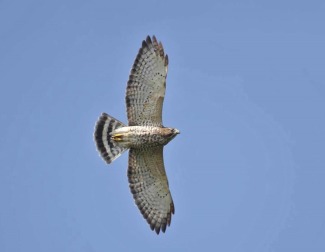
Broad-winged Hawk Flying

A startling incident, that experience heightened my awareness of where I am (in the world), in which environments (natural and human-made), and when (now!).

Sometimes, happenstances such as this evolve into, or figure in, poems that I will eventually write. The image, the occurrence, offers a way in.

~

Returning to my question about how to start: the blockade many people make for themselves is that they think they have to know what they want to say before they write anything. “What is it I am trying to say?” the writer asks. We have been instructed to keep in mind our aims when we write.

I suggest it may be a mistake, though, to figure out what one wants to say before trying to write. When my student writers are truly stuck at the start, I ask them to write what they notice, what they experience, what they hear. Just write it down, describe it: the soft thud of the sparrow (if it was a sparrow–allow for speculation), the sound of wind against the car body, the clearly-visible buteo in the windshield where before there had been near-whiteout. What is it I want to say about the drive, the shock, the tension, the world of natural things? I don’t yet know, but I am writing.

~

Thanks to Hawk Mountain Sanctuary and Raptor Preserve, Kempton PA.

Clouds & trees

One benefit to living where I do is the way the sky looks in early autumn. Another is the brilliancy of leaves as they change color.

This time of year, even my commute to and from work offers moments of beauty. There are sunrises as I get ready for work, sunsets as I drive home each evening. The skies have been so glorious lately that a friend of mine posts photos on his social media account every day. Autumn arrives, and I wish I were a painter.

Cloud textures: yesterday morning, stippled so densely I could easily imagine ice crystals clustering together in the atmosphere a thousand feet above me. Bouncy puffs, striations, streaks. Today, a more consistent palette of repeated half-rounds. A stream of grey, white, and slate blue overhead, highlighted with thin bands of yellow.

Meanwhile, the trees–first the hickories going golden, then other tints. Today, I noticed the scarlet of a tupelo aflame at the edge of a field and the first big sugar maple shifting to orange. Many of the smaller ornamental trees take on burgundy hues. I can’t describe these landscapes in words! I want words to be pigments. I feel stalled. Maybe I am just making excuses for why I have not been writing poetry lately–(I don’t want to confess to writer’s block, as obviously I am writing!)

10934149_10208044582216651_8508294618826705064_o

Here’s a nice video from Slate that speculates, based on recent science, about why there are more red colors in North American trees than in European trees. Click here!


Drought

I hate droughts. I’m a gardener who lives in a temperate region that, on average, receives about 1,150 mm of precipitation annually (45″). Here we are, in the middle of springtime, blooms on the dogwoods and azaleas, peonies beginning to bust out; and I haven’t heard the welcome noise of rain on the roof for over 5 weeks. Generally, May brings this region 2-4 inches of rain. I miss it, and so do the birds and the deer and the insects and the salamanders and toads…and the few remaining farmers.

I water my vegetable garden daily, but I cannot water the whole lawn, the perennial beds, the hedgerows where the larger trees grow. So the grass becomes crisp. And I worry that a strong wind, or a sudden downpour (please?!), might topple a weak-wooded tree that’s been gasping for nourishment.

Drought is also so metaphorical. It signifies lack. A lack of ideas, a creative drying-up, a kind of writer’s block where words harden into obstacles–those things are droughts of a kind that stop thinkers into stasis. If you don’t move, you end up mired.

Not too distant a stretch from the concrete phenomenon of drought to the existential phenomenon of an artistic or emotional “dry period.”

There are several ways to contend with droughts; some require large-scale changes in industry, agriculture, population centers. On the smaller scale, I practice a version of xeriscaping; after years of experimentation, I have learned which plants hold up best under extremes of dry periods or deer depredation. I am alert as to which seedlings are hardiest, which plants can contain themselves in a sort of dormancy until the rain comes. That means I have to let go of my desire to grow certain species and cultivars no matter how envious I am of the way they flourish in someone else’s garden.

And it’s the same with a droughty period in my creativity. Certain things I let go of; I work instead with what struggles along in the mud cracks, what creeps under the brickwork or waits for the next real rainfall. There’s often surprising beauty in those hardy emotions and ideas that stay around when the going gets tough, the things that manage to find shade or that–like cacti–prefer a drier clime.

Being adaptable is important if one wants to make art, to write poems, to compose. Because life isn’t always going to offer ideal circumstances for the creative or aesthetic effort.

~

I hate droughts not only because they hurt my plantings but because they signal a potential disaster in terms of global climate change, and because thousands of people die for lack of that essential element–water. I recognize, though, that suffering sometimes motivates human beings to make changes, to create new approaches…even to make art.

Life is complicated. We evolve through change.

Meanwhile–let it rain!

Quiet earthiness

The beloved life partner of a long-time friend was interred in a green burial today, a glorious May morning full of flowers (she loved gardening…); and I find myself with little to say.

It’s been that way for the past two weeks. Not exactly writer’s block, as I have in fact drafted several poems, but an extreme sense of turning-inward. My nature is reflective–I’ve always fallen into the introvert category (INFP for those who are familiar with the Myers-Briggs assessment)–but my job requires pretty constant interaction with other people, students and colleagues for the most part, and quite a bit of listening and talking. I enjoy my job and find it rewarding; but the stressful weeks just before exams, when term papers are due, can be challenging for a person whose inclination is to read books and putter in the dirt.

I planted seeds in the earth, and picked flowers. And then placed flowers on a coffin woven of reeds which was lowered into the earth.

Returning home the quiet overcame me. I’ve been reading poetry today instead of the Sunday New York Times.

Also, I’ve been reading books on “good death” and “mindful dying,” and the guidance of some sensitive and experienced authors seems appropriate and grounded.

But grief is hard. It’s probably one reason we invented philosophy, religion, and poetry.

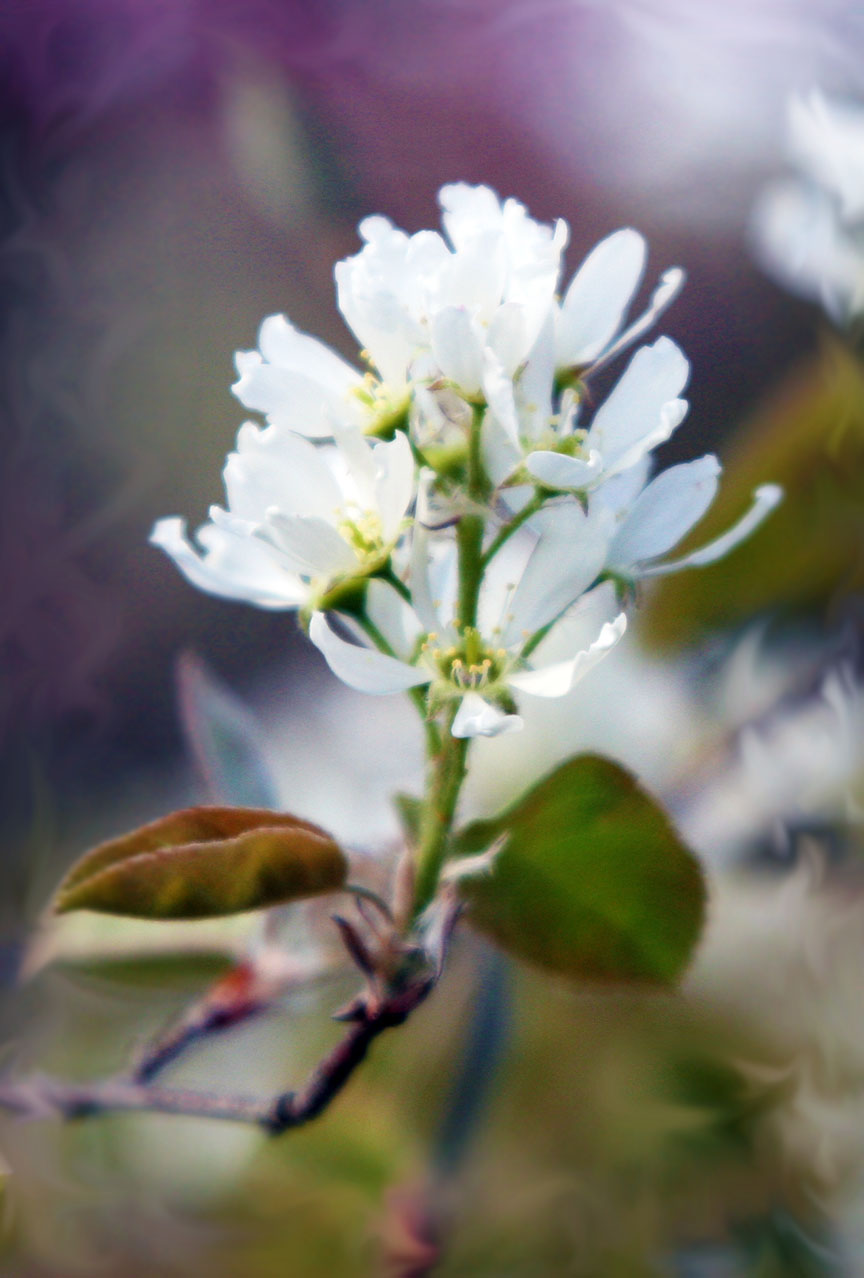
Shadblow, also known as serviceberry.

Shadblow, also known as serviceberry.

One of my go-to anthologies for sorrow is Pinsky’s The Handbook of Heartbreak, which I’ve mentioned in a previous post. In addition, I opened Christian Wiman’s book Every Riven Thing at random and came upon his poem “From a Window“–

Incurable and unbelieving
in any truth but the truth of grieving…


The poem comforted me (and I read other poems today, by other poets, that also comforted me). This one ends with the following stanzas:


Of course that old tree stood
exactly as it had and would


(but why should it seem fuller now?)
and though a man’s mind might endow


even a tree with some excess
of life to which a man seems witness,


that life is not the life of men.
And that is where the joy came in.


~
The joy comes in, somehow, through the quiet and the dirt and the trees.

Depression & the creative process

I was recently chatting with a psychiatrist about the creative process, specifically among poets. He admitted that he doesn’t know much about poetry, but I was nevertheless surprised to learn that he believed the stereotype of the poet who works most creatively when depressed.

“You deal with depressed people all the time,” I said. “Do they strike you as particularly motivated to do anything creative?”

He admitted that one hallmark of depression is loss of motivation–to do anything, let alone create expressive art of any kind. So it would follow, I suggested, that a period in which a person is seriously working at what he or she loves would be unlikely to coincide with a full-blown depressive episode.

“What about those poets who write about, say, staring out a window and sadness,” he asked, “They seem to write about being depressed, to express the feelings of depression.”

True, some poets experience depression (some commit suicide, too); and some express those feelings in verse. Yet none of the working writers I know who struggle with forms of depression write while in the midst of the “black mood.” They can only write well when the mood has not seized them fully; and while they may try to convey those feelings of the ‘inexpressible,’ they write and especially, revise, the work during more productive hours when melancholia has tapered a bit.

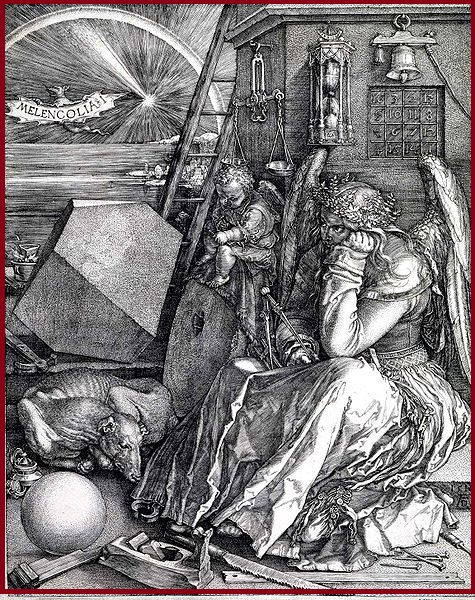
Melencolia_I_(Durero)

Drurer’s Melencolia I (wiki images)

It takes concentration, creativity, and analysis to craft a poem that adequately means what depression feels like. You cannot access such things when you are truly depressed. Some writers want to portray the experience; others want to explain it; still others prefer to write about the desire to escape, or even to embrace, the melancholy; others simply relate what they observe. Trying to pigeonhole all writers who address despair defies reason and suggests that all writers undergo the same feelings and experiences. Excuse me, we are individuals–diversely, wildly, enthusiastically unique.

That said, I cannot make the claim that no one has ever created a great work of art or poem while in the midst of a clinical depression; I merely posit that it’s likely that poetry composed while the author is gripped by existential melancholy will not meet the poet’s own standards.

Lewis Wolpert, a biologist and author, says, “I claim that if you can truly describe what it is like, then you have not had a true depression. It’s an illusion, and completely unlike anything else. When you are immersed in it, you enter a world without reference points, so once you recover it is very hard to relate how you felt.”

A world without reference points–that is the attraction depression might hold for a writer: the creative summons to relate an experience that is essentially beyond description. But most writers are not able to answer that summons while in the depths themselves.

And many writers are not troubled by depression at all. [See this 2012 article from the UK’s Mental Health Foundation for essential insight and clarification of an earlier study–that abstract is here.] The studies do suggest that writers are more likely than the general population to have bipolar disorder, which makes a kind of sense to me: after the sinkhole of a depressive period, the active “manic” phase might permit a writer to accomplish a great deal, including possibly a description of the void. Or it might not.

At any rate, I hope that people–psychiatrists, for example!–eventually recognize that we should not stereotype artists and poets any more than we should stereotype people who have mental illnesses, different accents, or skin color that is dissimilar to our own. What makes artists “different from other people” remains a mystery despite years of research and speculation, and my gut feeling is that the difference has more to do with other aspects of the creative process than it does with depression of any stripe.