Helpless

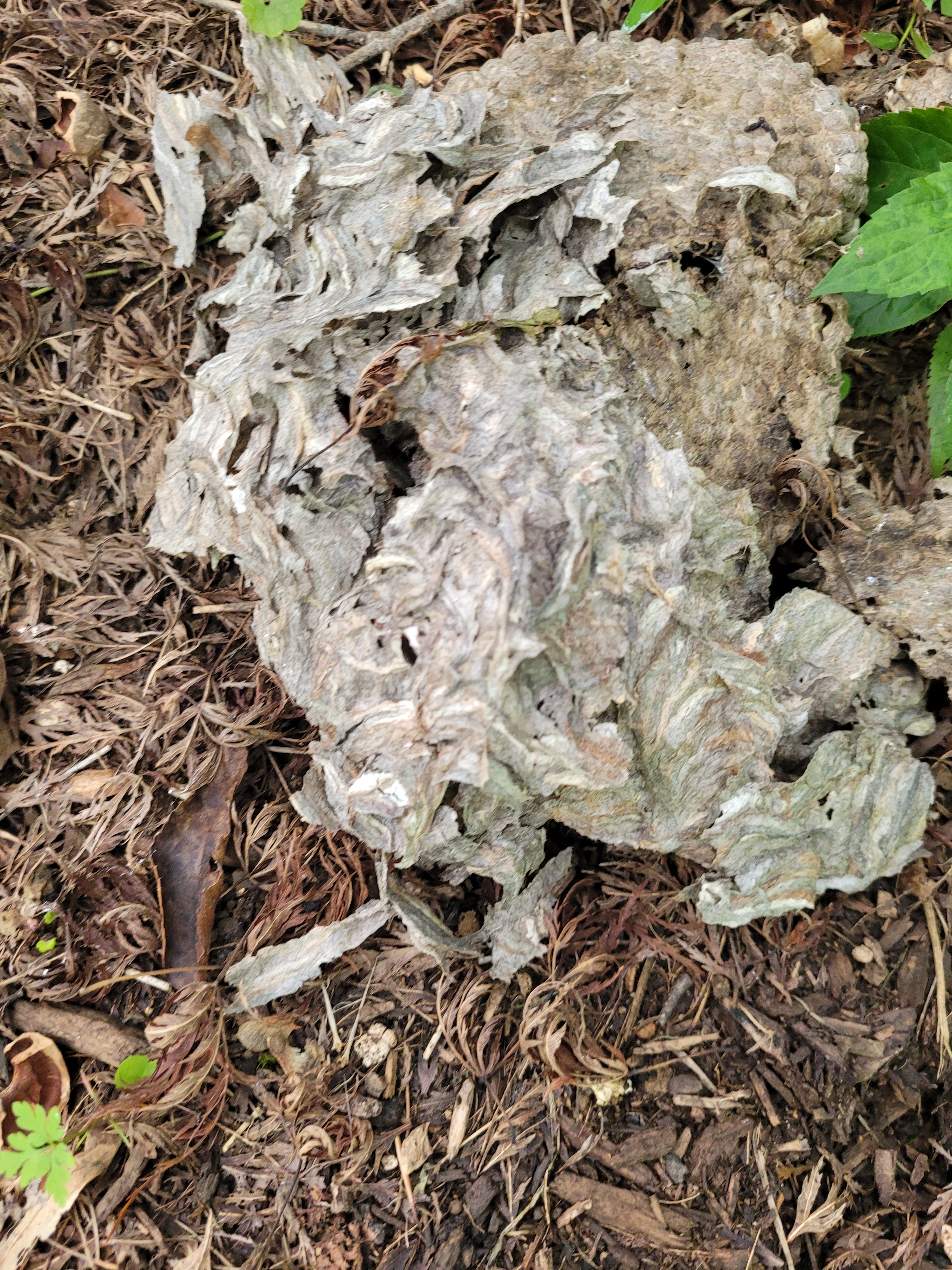
The weeding continues apace. I no longer do a clean rake-up of the gardens in autumn, because I now know that bees and other creatures overwinter in foliage debris; but it is imperative that I get the worst of the vines and perennial invasives out of the beds. We had a bit of rain recently, so I went out to claw and pull. Underneath the spreading Japanese maple, I found this:

~
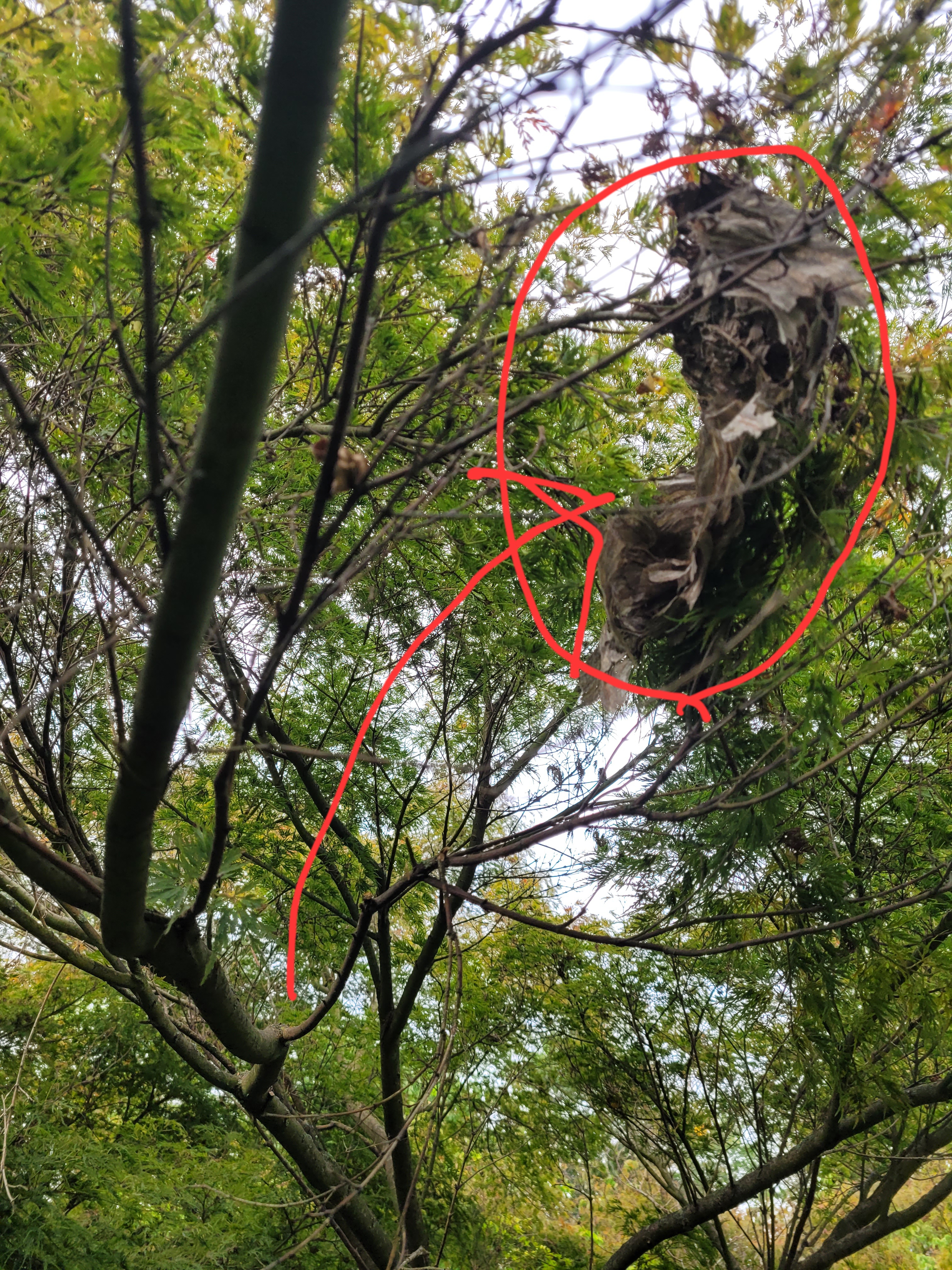
At first, I thought I’d found a fungus. Upon poking, I realized it appeared to be sections of a paper wasp nest. Hmmm. It took some craning of my neck and crawling much further beneath the tree, but there it was–the remains of a paper wasp hive dangling above me. Certainly it looked unoccupied, but I crept out from under the boughs just in case.

Under the tree, and twined throughout the flowerbed, I found quite a few sumac seedlings and plenty of poison ivy vines. Sumac and poison ivy are native plants, not invasive species like loosestrife and wintercreeper, but I don’t fancy having them in my perennial gardens. More yanking will be required soon.

~

At least I am doing something that, while rather disheartening–the weeds will always come back, weeding’s as endless as housework–keeps me moving and outdoors and occupied so that my mind whirs around less. It appears I’m weeding as a coping strategy while my mother continues to spiral toward whatever is next for her. Hospice care. Death. The inevitable, with the unknown “when”.

What bothers me most about her situation is how helpless she has become. My mom endured some childhood traumas, times when she truly was helpless. She learned to find and deal with her anger, with trouble and conflict, with physical pain, but she hates feeling helpless. And over the years, her inherent pragmatism and stubbornness, as well as her patience and a little emotional counseling, have served her well. I can only recall once when I saw her feeling helpless (and only briefly). It rattled me, but I was also impressed by how quickly she regained emotional equilibrium and took a small action toward…well, toward not being helpless.

And now, she is. Helpless, I mean. She cannot speak, feed herself, walk, or even sit up unassisted in bed. The prognosis for her recovery is so-so. She may manage to regain a little self-sufficiency. Or not. After all, she’s 91 years old.

The paper wasp hive seems like an analogy to me. When it has served its purpose, for all that it sheltered its denizens so well, it rattles apart, breaks down bit by bit, no longer resembles itself. Helpless in the wake of another winter coming on.

~

My father never cared for Neil Young, didn’t like his vocal delivery. But my mom heard the Déjà Vu album over and over in our house when we were teens, and she liked it.

~

Poem-ish thing

I don’t really feel ready to write what’s on my mind today. I do appreciate the cooler weather that means I can mindlessly pull weeds from the perennial beds and the vegetable garden without sweating or sunburn. Here’s a spur-of-moment poem-ish thing to mark, for myself, the place I’m at.

~

All morning, redtails shriek overhead
pleas or threats
or just announcing their presence
they don't much care
how I interpret them.
I don't interpret them.
Listen only for brown crickets,
whirring cicadas that have begun
to wind down late in August.
My father died in an election year
77 days before he could have
cast his vote. I'm reminded of that now,
how distracted I was and how,
though the election mattered,
my father mattered more.
For most of us, what's near the heart
obscures other concerns. Look:
there is dew on the grass,
barn swallows have
already left the garden.
~

Action, observation

I got my latest manuscript more or less under control. It took eight months of wrestling, tweaking, cutting, revising; I’m still not certain it is “there,” but I’m going to start submitting it at last. The process of submitting to publishers tends to be lengthy, but just doing it keeps my mind engaged with the poems as a collection. After I send the manuscript out, and especially once it is returned to me, I feel more agile about further editing. This is assuming it won’t be picked up right away, but that isn’t a bad assumption, based upon my experience.

Furthermore, thinking about the book and where to send it keeps my mind occupied, keeps me in a place in my life where I can take action, where what I decide to do might matter a little bit. That’s a frame of mind I can use at the moment, when my mother has begun to decline rather more rapidly (and there’s not much I can do to stop a 91-year-old from dying, however long it takes). When a former student is recuperating from major accident trauma in the neurology unit of a nearby rehabilitation center. When a long-time friend has suffered a brain bleed and hip fracture–and now, dementia–and will likely live out her days in assisted living or a nursing-care institution. Not to mention the broader concerns and tragedies I hear about in the media, which affect me and those I love less (for the moment), but which have long-range consequences that few of us can avoid.

If there is little I can do to make a difference, I can still do something. We contribute to the life of the cosmos in many different ways. I try to be constructive when I can and otherwise remind myself to enjoy the things life offers. Recently an enjoyment has been the incredibly cool photographs made by my Joya colleague Johanna Rönn. Also Alison Pollack’s tiny mushroom photography posted to Instagram. The internet offers almost as much joy as it subtracts. You might enjoy these images, too.

I’m reveling in local produce, too, which has been lovely this year–good peaches, pears, apricots, though the sweet corn has been a bit disappointing. At my house, we are eating lots of cucumbers and tomatoes.

Also enjoyable? Mornings and evenings on our back porch, looking out at the woods. True, we are saddened by continuous loss of trees along the treeline, and it means work ahead in fall: chainsaws and splitting and stacking. But. In the evenings, bats and the last of the lightning bugs, tree cricket chorus and cool breezes. In the mornings, tea or coffee with the cat at our feet, finches hitting up the sunflowers and amaranth for seeds. Today, a hummingbird flew over from the buddliea and hovered not ten feet from us, weaving ever so slightly as if observing and determining what we might be.

Photo by Chris F on Pexels.com

August

August is the month of the Sealey Challenge, which basically urges those who like/love poetry to read a book of poetry each day of the month. I haven’t given myself the challenge this year, but I am posting individual poetry books on my Instagram account daily–books from my personal library, mostly–and that means that I read a few of the poems, too. Sometimes I get carried away and re-read the entire book. [@aemichaelpoet]

This is not a bad thing.

Meanwhile, August this year behaves as it usually does, weather-wise: blisteringly hot and wiltingly humid. That would be okay except that June was so hot and dry and now an early hurricane has begun its climb up the coast; for now, we are stalled in a heat dome, and by Friday we may be inundated with rain. All of this means that my tomatoes are likely to split just as they all get plump and ripe. It also means that our annual folk life festival (Goschenhoppen) is likely to be a muddy, damp affair with fewer attendees than usual. These things happen, and they happen more frequently when the planet undergoes climate change.

~

August, as most of us learned back in grade school, is named after the emperor Augustus, whose name means “venerable, noble, majestic.” [Source: my favorite, Etymology Online]. The online source notes that “In England, the name replaced native Weodmonað ‘weed month’.” Weed month is a perfect name for August, and I think I will adopt it from now on. It certainly fits the current state of my vegetable patch as the dog days keep the outdoors too miserable for heavy labor in the dirt.

At least for me, however, the laboring can be optional as long as I don’t object too strenuously to a haggard-looking garden. The people who are truly hard workers this time of year are construction and road crews, landscaping crews, farm workers, roofers, line workers, and others who have to brave the heat and humidity to make a living. Also the janitorial staff crews at schools and dorms and other older buildings that don’t have reliable–or any–air conditioning. When we are outdoors working at the festival in August, we get a taste of how challenging it is to do physical work in the heat. This is actually an educational aspect of the festival for those who participate, especially for younger people who are new to the festival. We remind them that people worked like this all the time, in summer and during snowy winters and in the rain and without electricity…with no escaping it, since they needed to work hard just to stay alive.

Perhaps unfortunately, our forebears’ grinding efforts may have led to the idea that only hard work will save us and make us morally upright human beings. Few of the early Germanic settlers here had much time to read or compose poetry, to savor novels, to learn to play an instrument. Art was acceptable to a degree, so long as it decorated otherwise-useful objects. The poetry of the Bible was acceptable, but it wasn’t studied for its beauty. A person with my sensibilities and temperament would probably have been an outlier in Goschenhoppen’s historic community. If I’d lived to be 66 in the early 1800s, I’d be considered “an old cripple,” mostly blind and bent over with arthritis and stenosis. But maybe I’d be the kind of old woman who tells stories.

On the other hand, maybe I’d be considered a witch! I guess it depends on what sort of stories one decides to tell.

At a previous year’s festival, with my daughter. Bewitching the local kids with potato candy!