Northern stars

Northern Stars (2023) Celestino Marco Cavalli

~
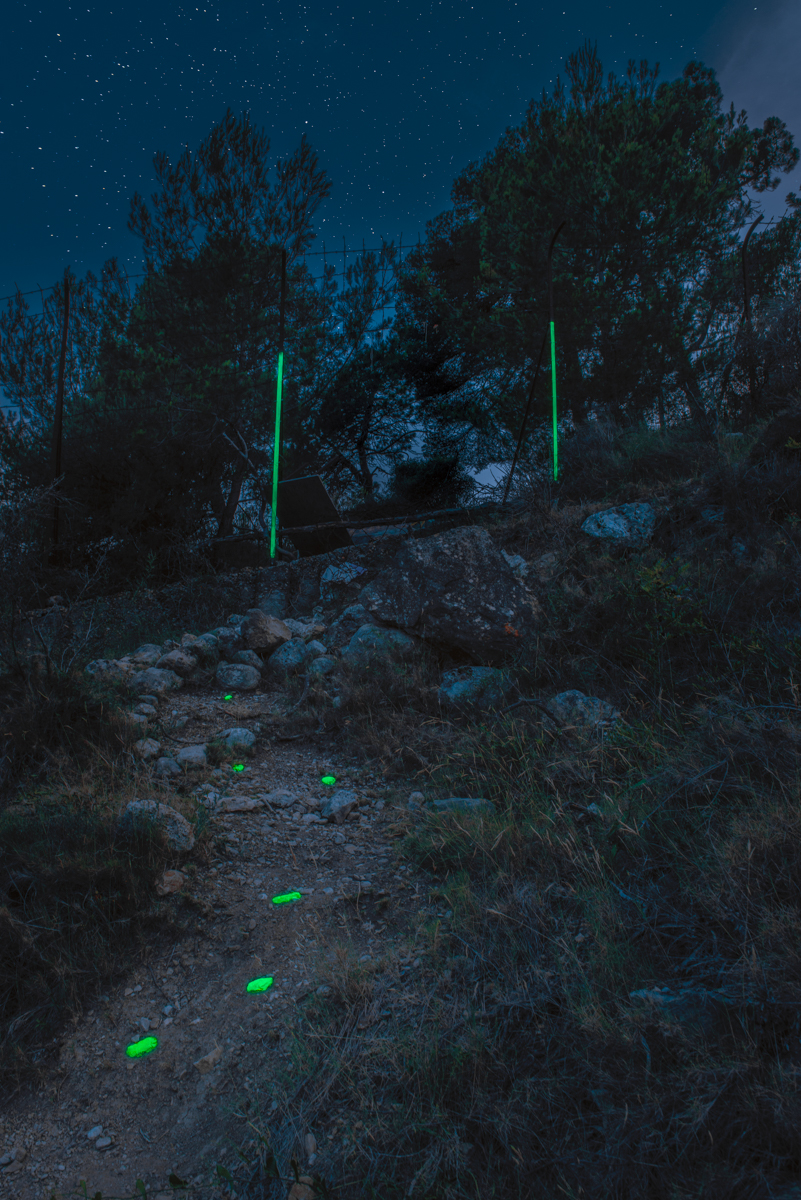
A phosphorescent path
connecting Italy and France
through glowing stones
that look like stars.
A poetic and political action.

~

https://www.celestinomarcocavalli.xyz/work.html

The installation shown here was created by one of the artists I met while at Joya, Celestino Marco Cavalli. The link above will take you to a description of his project. In brief, it is a series of fluorescent-painted stones that follow a trail refugees travel on their way from the Mediterranean, through Italy, and into France. The website does not include the many photographs Celestino took during his 5-month visit there to document the conditions under which emigrants travel–the trash they leave as they abandon belongings, the graffiti and the notes to others they leave in caves and hollows, the prayers they write, the places they shelter from the sun or rain or cold weather. Do the refugees litter the mountain paths? Yes. Do they do so out of desperation? Also yes.

This installation is innovative, compassionate, and political–also problematic; as always, borders between nations are fraught with concerns about each country’s boundaries, laws, rules and regulations. These days, most immigrants taking this trail (through Italy) have come from the global south, where the climate damage wrought by industrial nations has made living in poverty even harder and fostered political unrest. And the immigrants take huge risks–with no guarantees that they won’t be deported, or preyed upon by criminals who exploit their vulnerable status.

I’ve never been a refugee, an exile, an immigrant. I have met quite a few, though–often very young people, students I encountered at the college where I worked, students from Haiti, Dominican Republic, Turkey, Syria, Lebanon, Mexico, Venezuela, Pakistan, Eritrea, Viet Nam, Kenya…and my husband’s stepmother, who arrived at Ellis Island from Austria between the wars. And a colleague who was stranded at college in the USA when the Ayatollah took power in Iran, and a fellow employee from Cambodia, who lost her entire family except for one brother to the Khmer Rouge. Whenever I hear about the politics of immigration (which is often), I think of them: how hard they work, what they sacrificed to get here, how hopeful they are, how challenging their lives have been and continue to be. And their grief.

The following is a persona poem--"A persona poem is a poem in which the poet speaks through an assumed voice" (Academy of American Poets). Celestino's Northern Stars is my "prompt."

~

Refugees

Because we must hide by day
and travel at night, darkness hinders.
The narrow stony trail offers options:
turned ankles, torn skin, or a precipice
that takes us sliding down the mountain,
an avalanche of self, death’s prospect.
No one arrives eager for exile;
we’re just trying to save ourselves,
our families, a few belongings
we used to think were precious.

The way we take may be steep—
everyone knows that metaphor—
what we never expect is how much
it is an unburdening of all
we thought was necessary,
an education in physical need.
Shoes, for instance, more critical
than underwear. Ancestors emigrated
on callused feet without watches
or water bottles. The least cut could
go septic, a child’s wail could betray us
to predators or enemies. Still true.

One by one we let things go, abandoned
in shallow caves with other people’s
remnants, plastic bags and t-shirts,
books, candlesticks, so much trash after all—
even our skins can barely hold what
we need anymore. We arrive shriven,
numb as feldspar, having walked so long.
May we have water? May we rest, with our
children in our laps, and sing the songs
our parents taught us not so long ago.
Just reading

Sunday evening, my weeding stirred up so much dust and chaff that I needed to wear a bandanna around my nose and mouth. A continuous late-summer drought. There are still tomatoes and basil, sunflowers and zinnias, but the avian migration has been going on for some weeks and the days are getting shorter. Just after equinox, three weeks without rain; at last the sky clouds over and drops a little moisture on the parched soil. Yellow leaves sift onto the lawn. Small flocks of robins rejoice in the softer top layer of dirt, pull at grubs and worms, then fly off.

~

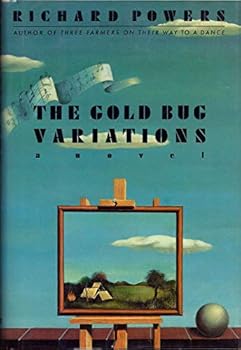
The rain’s necessary, and I’m grateful. Rainy days, however, take issue with my body–or, probably, the other way around. The need to take NSAIDs and rest offers the opportunity for just reading. This isn’t a bad thing, especially as I had Richard Powers’ novel The Gold Bug Variations to hand. It’s a tour de force of pattern, structure, code-breaking, DNA-building, relationships, love, chemistry, music, art, literature, and much more. I love the references (the narrator is a reference librarian), the minutia, history, alliteration, lists, compilations*, the whole thread of the novel’s dramatic arc, its relationship (mathematically, metaphorically, structurally) to music and the work of the gene-sequencing science. The book tells the parallel stories of couples who fall in love 25 years apart, the coincidences and randomness, the patterns that may not be patterns. I’m thoroughly wowed by an author who puts so much research into his writing and makes everything fit somehow.

Powers must have been about 33 when he completed this novel. I can’t imagine being so wise about human behavior and so informed about the sciences and music theory at that young age. Well, for one, I’m not as brilliant as he is; and two, I was raising toddlers when I was 33, which is a science unto itself and as revelatory as any book I could have been reading or writing in early mid-life.

But I digress. This book interests me on so many levels that I’ll be thinking about it for weeks. I may have to re-read it, take notes next time. I kept wanting to underline passages–it’s a library book, and marginalia is a no-no. I can imagine reading it again to the strains of the Goldberg Variations–indeed, I read a few chapters to said accompaniment this time. This is not a swift and easy read: it took me awhile to feel warmed up about the narrator, though she’s funny and smart. By the end, I loved her like a friend.

Honestly, novels seldom get me this excited or inspired. I’m glad I had a crappy day so I could justify lying around and “just reading.” As if “just reading” is not a worthwhile endeavor. The weeds can wait.

~

* re compilations: a word Powers employs often in this novel is the neologism/computer programming term “kludge.” I wasn’t familiar with it. But it’s a terrific word! https://www.etymonline.com/search?q=kludge

Crabgrass

I have been at work in the vegetable garden during the past few dry, sunny, late-summer days–it has been rather droughty here–and pulling up weeds in an effort to get an early start on putting the patch to bed for autumn. I have decided not to do any late-season sowing this year, and therefore I can pretty much tear up everything if I feel like it. Today I was thinking about my mother-in-law, who died in 2017, but who was sometimes my partner in the garden, or I in hers, when we were younger. I learned a great deal about ornamentals from her.

At her property, crabgrass was a particular scourge. I remember us weeding flower beds together while she muttered, “Crabgrass! Always crabgrass, how I hate it!” It struck me odd at the time that she pronounced it “crebgrass,” with the first “a” like a short “e”, because she said the word “crab” and similar words with an open short “a.” It was almost as though she reserved that pronunciation to express her ire at this particular weed. She liked weeding at my house partly because I had so little crabgrass. Plenty of other weeds, but not much crabgrass.

Our weeding together took place over 15 years ago, when my gardens were on the new side, maybe a decade old. Today, however, I find my vegetable patch very much colonized by digitaria sanguinalis…one of the finger grasses, a very successful weed that can produce 150,000 seeds per plant. My garden now hosts both smooth and large crabgrass; the former is much easier to pull, though it can set seed even when it is mowed to under an inch in height! Large crabgrass, when it gets going, can grow over a foot tall and have a base rosette of 10″ with a star-like (or crab-like) set of leaves and quite tenacious roots, for an annual.

While I worked (too late, I really should have gotten to the weeds long before they began to set seed), I heard my mother-in-law in my mind: “Crebgrass! How I hate it.” Well, dearest Gene, I have finally encountered the Eurasian colonizer in my own gardens. And I miss having you around to sympathize with my plight.

 Maudib | Credit: Getty Images

There’s a metaphor here, I know there is. Maybe there’s a poem in this experience, too? For the time being, pulling weeds reminds me of someone I loved–and takes my mind off of another person I love, whose dwindling and decline (her “diminishing”) stay uneasily in the background of everything I do these days.

In the between-season time, with autumn almost upon us, I want to remind myself of the joys that come along with the crabgrass. Such as the brown crickets and the morning glories and the goldenrod…and memories of people for whom I have cared a great deal.

~

báilù

白露 báilù is the section of the lunisolar calendar that refers to the two weeks before the autumnal equinox; the translation is “white dew.” Misty mornings here and there, damp grass, dew spangling the tent spider webs in the meadow, draping the grasses and goldenrod with white gauze. Brown crickets sing, but the cicadas have left off. Nuthatches return. Squirrels knock walnuts off the branches daily, so there’s a regular thump-thump sound along the treeline. My summer-loving acquaintances bemoan the cooler days and insist summer’s not over until the 21st. My fall-loving acquaintances are picking apples and celebrating the return of pumpkin-spice flavoring to their favorite beverages.

I like the in-between times, the verging of seasons, aspects of change. Change means life, even though the onset of autumn traditionally signals the dying of the year. On my walk this morning, I took photos and made a mental list of changes that are flags of the coming season: acorns on the bough; morning glory still open at noon (in Japanese literature, the morning glory is a signal of autumn’s approach); burning bush shrub going pink; pennants of yellow walnut leaves; ripe wild grapes–deep navy blue, quite sour, and full of seeds; sweet autumn clematis (terniflora) in its whirly seed state, swarming over the hedges; oak leaves, five-leaf vines, and sassafras starting to color; winterberries already red; acorn detritus on the tractor path; pin oak galls (probably thanks to the wasp Callirhytis furva) on a leaf. All of these are mid-September features in eastern PA.

If I were feeling more poetically creative, I might try writing haiku using each of these as the image word. But my current state is fretful. Pulling weeds and taking walks ease my mind a bit. Sitting down to write, not so much. However, reader, I encourage you to try the exercise.

~