Steve Tobin’s exploded clay works showing at Moravian College’s Payne Gallery. Opens this week.
Author Archives: Ann E. Michael

Defending the poetry major
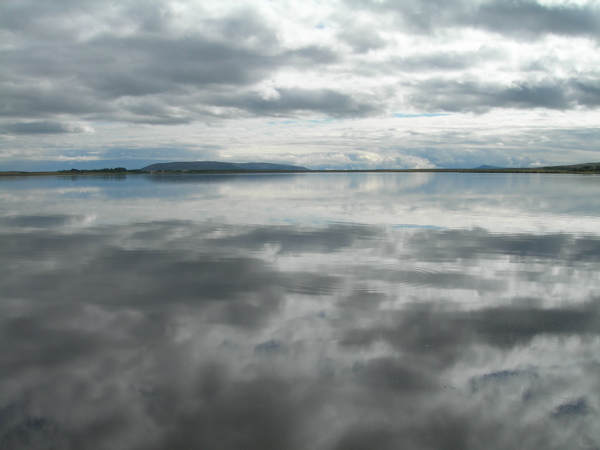
Photo by Annie Abdalla
~
Pity the poor poetry major, long treated with snotty sarcasm as a head-in-the-clouds idealist. “What will you do with that degree?” people ask, shaking their heads at the scholar’s naivete.
Okay, few people dispute that the economy is tough right now. Tough for experienced employees, tough for many small business owners, tough for newly-minted college graduates. I know this first-hand, and I deal most often with the youngest age group I’ve mentioned—undergraduates.
There are hundreds of articles, blogs, and opinion pieces offering tips to students or bemoaning the price of a college degree (and I grant you, the cost is appalling) or telling undergraduates that they need to specialize in certain career areas. The New York Times, for example, ran this article, which warns students away from majoring in such coursework as history, philosophy, and poetry.
Another pop-journalism site suggests that graduates learn “to put your useless degree to use.” Although there are some reasonable, general ideas here, these brief tip-sheets operate under the unlikely premise that we can tell today’s 18-year-old what he or she will need to know in order to be securely employed in, say, 2045.
Mild contrarian that I am, I defend the poetry major. Students have to be diligent to achieve good grades in the poetry track, diligence being just as necessary there as in the so-called hard sciences, which also require analysis (they use more math but require similarly solid logic chops). Poetry is difficult to study; the subject requires keen reading comprehension skills, a good foundation in rhetoric, the ability to analyze, to communicate, and to connect diverse disciplines, cultures, and texts. The same goes for history and philosophy: these are truly challenging areas of study, not good choices for the slacker or the faint of heart.
The people who choose the humanities majors are often accused of living in ivory towers, but that’s a stereotype. Most of them don’t end up in academia. Some of them are entrepreneurs, some are lawyers, some are doctors. Poetry major Ross Martin became a Viacom executive; though that is probably not a terribly common career outcome for poetry folk, humanities majors in general end up in some form of management position 20% of the time, according to research by Georgetown University’s Center on Education and the Workforce.
For a look at the career outcomes, percent employed full-time or part-time, and job earnings for humanities majors, see:
(Link to GU’s CEW on Humanities degree earners)
Yes, it is true that in terms of earnings, the poetry major or history major is unlikely to outperform the person who has a Petroleum Engineering degree. I have to ask, however, given the limited supply of petroleum we’re told exists on earth, where those petroleum engineers will find work in 2045. And job satisfaction—earning enough to get by and feeling satisfied with one’s work and contributions to society—is, while less easily measurable, a byproduct of an excellent education that keeps minds sharp, hearts engaged, and communities intact over the long haul—including during tough times.
The world and technology move rapidly. I typed my undergraduate papers on a manual typewriter and, graduating during the hideous recession of 1979, got jobs that paid like menial labor but allowed me to sit at desks and utilize my spelling, vocabulary, and arts analysis skills, which led to jobs in typesetting that taught me computer skills back in…well, let’s just say “8-inch floppy disk” and leave it at that. Did I have any idea I would be blogging on the cloud using a PC in 2012? No. Have I been able to learn new things by using logic, persistence, research, and creative thinking? Why, yes. Thank you, humanities coursework.
Critics of many stripes claim colleges need to focus more on career development through the creation of specialist tracks. Careerism is a fine concept for a capitalist society, and I have no problem with offering better certification programs for specialists of all kinds; but careerism per se is not what a college education is “for.” A college education serves, when it is effective, to broaden a person’s experiences, deepen a person’s thoughts, and to develop in that person a versatile range of essential critical-thinking and problem-solving skills. Those skills are applicable to many jobs. An excellent gaming programmer I’m acquainted with says his two years of intensive philosophy and literature study helped him enormously when he switched to the technology track: it’s all logic and analysis, and creative thinking is what allows a programmer to excel beyond data-managing. Here’s an article that explains a bit more about the usefulness of the liberal arts education as it pertains to business.
When the job market is tight, we need problem solvers and creative, critical thinkers. It will not matter what these people majored in as undergraduates; what will matter is how flexible they are at responding to the changes around them…or at instituting changes themselves.
Poetry majors can do that for us.
Really.
Feminism
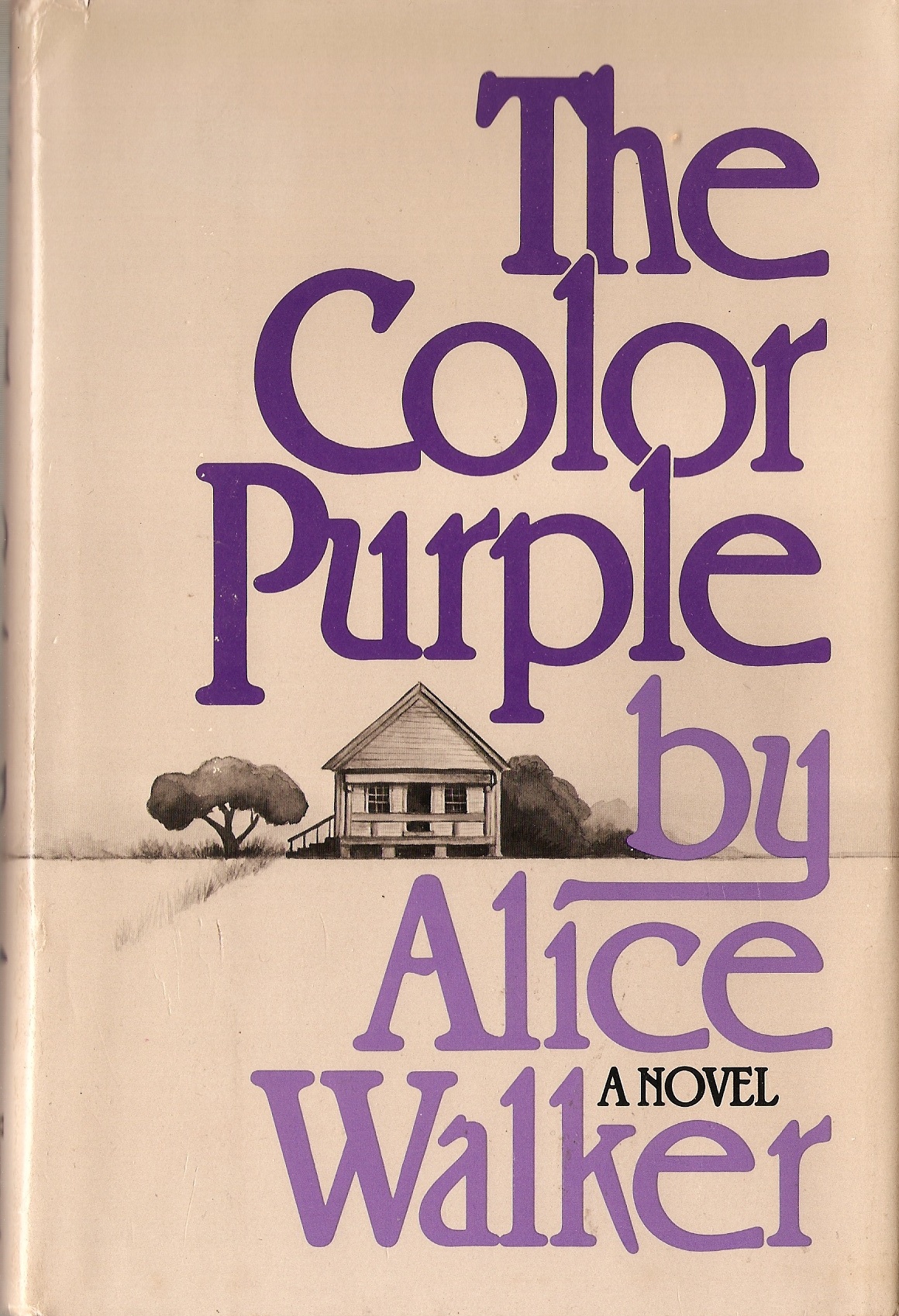
The Color Purple by Alice Walker
I’m thinking about a conversation I had recently with a 21-year-old male student I will call “B.”
B had enrolled in a senior-level humanities class, Contemporary Women’s Literature. He told me he was excited about the texts, which included some books he had wanted to read but hadn’t gotten around to yet, such as The Color Purple. After the first class, however, he felt wary. The reason? “The professor, I’m afraid she’s some kind of a feminist, so maybe I won’t feel comfortable sharing my opinions,” said B, “Like, she seems the kind who’d give me the stink-eye just because I’m a guy.”
“Did she give you the stink-eye in class today?” I asked. (I know the professor, and I know he was wrong about her.)
“No…but she talked about looking at feminism in ‘the most positive light’ as we read the books.”
“And do you have a problem with that?”
B shrugged. “I have four sisters,” he said, “I mean, I’m a guy who respects women so much, I always put the toilet seat down! But I don’t know about looking at books from a feminist perspective…”
I asked him if he could define what “a feminist perspective” means. The short answer is that he didn’t really know, but he hemmed and hawed about “not liking men” and “seeing all masculine stuff as basically bad.”
“So it seems to me your professor was acknowledging that many people have the impression that feminism is somehow a negative thing, and she wanted to make it clear she would be approaching it more positively in terms of social change and literature. Do you think you could be falling into the stereotyping fallacy, B?” I asked.
No, he assured me, he had no sense of male superiority and he felt women were equal to men, should be paid the same wages, could do the same jobs—“but that whole feminist thing,” he added, returning to his earlier vague objection, “I mean, you’re not a feminist, for example—”
Good thing I didn’t have my mouth full of coffee when he said that.
“B, I went to college in the 1970s! I went to liberal arts colleges and took courses in women’s studies in art and literature. How could I not be a feminist?”
He looked taken aback. “But,” he sputtered, “but, you’re reasonable about it…” (“it” being feminism, I gathered).
He was so well-meaning, I almost wanted to take that as a compliment, my being reasonable. How many middle-aged people get called reasonable by 21-year-olds? But, seizing the clichéd “teaching moment,” I asked him from where he might have received ideas of the feminist movement as a legion of self-righteous man-haters and whether this professor’s specific approach to the novels might be a kind of corrective to his or other students’ received notions. After all, I notice that today’s young women often evade being pegged as feminists, even when their values and achievements coincide perfectly with the movement’s aims. He thought about that. And then I had a meeting to attend.
He’s a lovely young man, and I think he will enjoy the class. It may be too much to hope that he felt a bit of perspective shift from our discussion, but one thing’s for sure:
He won’t forget that I’m a feminist! (If merely a reasonable one.)
On Tolerance
Tolerance, as defined in the OED, means endurance, as of pain or treatments; it is also the tiny allowance of imperfection in coining or machinery, the acceptable out-of-round. But the term has become popular recently under its third definition, “freedom of bigotry or undue judgment upon the actions or behaviors of others.” It has indirectly become the target of people who complain about over-use of “politically-correct language.”
Tolerance is not one of the Virtues, but it tends to have a slightly virtuous connotation, sometimes with an irritating hint of self-righteousness. An acquaintance of mine said once, “Quakers! They’re so damned tolerant,” as if it were an attribute to be avoided by sparkling, sexy people who are analytical and quick to judge. I have known some mightily opinionated Quakers in my time and will attest that tolerant folks can hold strong opinions. The connotation of tolerance to mean somehow wishy-washy or evasive is an unfortunate one. And it’s wrong.
My parents taught tolerance. This was a necessary trait in a family full of passionate, witty, highly-opinionated and creative people. I learned that I could disagree with my sister completely and still love her and accept her point of view, even if I could never in a million years adopt her perspective. My father marched on Birmingham and Washington in the 1960s, and we learned that people who do not look like us are no less like us than our neighbors—and we learned to be polite to our neighbors, some of whose values and opinions we didn’t particularly care for, but whom we tolerated as members of the community. Tolerance is a component of empathy in two directions: empathy inspires in us the ability to practice tolerance of others, and the practice of tolerance itself enables us to feel empathy with others.
Without empathy, no altruism; without altruism, no society. Tolerance has an important place in human nature. The simplistic slogan “Teach tolerance” has value only if we can remove the negative slap-dash judgment of tolerance as some sort of liberal-PC value rather than as what it is, a practical behavior necessary for social interaction. Good manners, for one thing. And yes, that means that sometimes we must endure the psychic pain of listening to a person we desperately want to judge negatively, or bear with the person who is slightly “out of round.”
Practicing tolerance doesn’t mean giving up our own values, it merely forces us to withhold judgment a little longer than usual and to endeavor to discern, and acknowledge, another person’s perspective. Can we argue? Can we disagree? Certainly. Will we respect that perspective? Maybe not. But we can learn a great deal from the exercise.
Here is a poem from my collection The Capable Heart. Tolerance and an attempt to understand another perspective are not just for human beings. This poem looks at my daughter’s point of view, my own, and the horse’s. More broadly, the piece is about all of the things I’ve mentioned in this post—if that’s how my reader would like to interpret it. (Of course, I am ready to acknowledge other interpretations and perspectives!)
WAYS WE ARE ALIKE
I wanted a way to embrace
my daughter’s fascination.
To overcome my own fear, with carrots,
with a lead rope and a soft brush.
I touched the withers and the
warm, broad chest;
I held the lead. Let pulsing lips
explore my hands, my jacket.
The narrow nose stretched
under my fingers and
I rubbed the strong, shallow bone
above curious, sensing nostrils.
My daughter tells me the many ways
horses and I are alike.
They are beautiful, and
they understand fear.

Orri. Photo by Ann E. Michael
Why I read poetry
A few months ago, I posted a light-hearted look at mondegreens and malchichés. Clichés are useful to some extent because we believe we know what those phrases mean, and they serve the purpose of general communication. To confess “I’m feeling blue” can elicit compassion from a good friend, or help us to state a mood so that we might, possibly, move on from it. Popular song lyrics employ such figures of speech often, and often to good effect.
But clichés also leave something to be desired, don’t give a full enough account of the human situation. In the poem “Madame la Fleurie,” Wallace Stevens describes a man who looks into a mirror and believes what he sees depicts his actual life. But it is only a reflection; the image is “a page he found in the handbook of heartbreak.” A page in the handbook of heartbreak: that begins to express a more complex and specific feeling.
Poems can express every subtle shade of blue a person might feel. There is Emily Dickinson’s Hour of Lead and Elizabeth Bishop’s art of losing, Langston Hughes’ Weary Blues and Theodore Roethke’s desolation in immaculate places. For thousands of years, poets have understood, and been able to convey, the vivid and expansive range of human emotions that our lively and energetic brains and souls experience—from unbearable grief to listless ennui, from a moment of surprising cheerfulness to the uplifting embrace of romantic or spiritual love. How poets accomplish this subtle connection between people, this empathy, amazes me. Especially as this mutual exchange of feelings takes place through the abstract medium of words.
This is why I read poetry. When a friend’s child died, I consoled myself with Ben Jonson’s words, “farewell, thou child of my right hand, and joy” and nothing else seemed as apropos, even though the poem was composed almost 400 years ago. When life gets tough, Andrew Marvel’s lines about how feeble hope has tinsel wings in the face of magnanimous Despair just about sum up my feelings. Such poems may offer little cheer, yet they can comfort. Through gorgeous language and imagery that is honest if sometimes fanciful, good poems remind us that we are not alone in our circumstances.
Poems identify feelings, places, situations, and allusions to which another human being—perhaps hundreds of years or thousands of miles away—can relate. That relationship has a wonderful effect, for poetry offers a way to connect the rich and complicated scope of our humanity with the lives and sympathies of others, especially during troubled times. I know that my own heart begins rebounding from stress and gloom when I read Neruda’s lines: “through me, freedom and the sea/will bring solace to my downcast heart.” As we navigate through political and economic and personal hassles, we might want to open a poetry anthology now and then, or call up a website such as A Poem a Day or Verse Daily for a fix of shared humanity in an increasingly virtual world. After all, “What the heart longs for,” says Gregory Orr, “the poem accomplishes.”
One person who has taken this poetry inspiration into the wider world is Nicelle Davis. Check out her year-long poetry project at The Bees Knees.
The seed of disorder
“I am the seed of disorder.” –Paul Eluard
From an essay by Ezra Pound (published in The Exile):
“The principle of good is enunciated by Confucius. It consists in establishing order within oneself. This order or harmony spreads by a sort of contagion without specific effort.”
As Lewis Hyde, who excerpts the above passage in The Gift notes, Pound offers an implicit paradox here that he apparently could neither acknowledge nor accept. If “good” is order, how can it spread by “a sort of contagion”—surely a chaotic method of disseminating something supposedly well-structured?
Hmm. I turn now to Wallace Stevens—or rather, to Helen Vendler on Wallace Stevens—to examine further this “idea of order.” Vendler’s interpretation of the order in Stevens’ “The Idea of Order at Key West” includes several approaches. There is order as in organization: the singer in Stevens’ poem creates and hence organizes her physical world. There is order as in command: she orders her world into being by singing, by language. Then there is order as magnitude: “The two Wordsworthian orders of mind and world…exquisitely fitted and yet subtly uneasy with each other,” notes Vendler. The tension Hyde finds and explicates in Pound’s Cantos also exists in Vendler’s examination of Stevens.
Eluard, a poet completely different in style, sensibility, and background from Pound and Stevens, identifies in his poem the workings of that tension, the DNA carrier, the seed of disorder which, it can be plausibly speculated, might well spread its own form of harmony without specific effort, traveling as seeds do through a myriad of dispersal mechanisms such as wind, burrs, digestion and expulsion, burial by mammals, flotation, and the like. (As a gardener, I am constantly amazed at these marvelous mechanisms.)
Well-fitted but uneasy together, disorder through its contagion moves harmony and order to grounds on which what inheres in the seed can survive, even thrive, as it organizes itself into maturity. The seed “follows orders” nature has imposed through genetics. Mind and world, order and self, establish themselves as “good.”
Without that seed of disorder, all is stasis. No art, nor mind nor world, can be produced unless the rebellious seed slips from stem, twig, womb, sac, or lamellae to sing its own idea of order into the world.

For some fabulous photographs of lamellae, see:
Affirmation

I am almost finished reading Parfit’s Reasons and Persons, and I think his conclusions about the self (person) in society and as individual are valid; I have long questioned the self-interest theory of philosophy but only on an intuitive basis as I am no philosopher, merely a student of the discipline.
What strikes me after having read this lengthy and rationally-argued book is that there are so many ways philosophical reasoning does actually intersect with that “most irrational” of impulses, art.
Here is a lovely excerpt from poet David Ignatow, from an essay he wrote in 1971:
“There is no contravening another person’s sense of himself and his world. We must accept it on his terms, though we need not accept it for ourselves…men and women have discovered themselves as individuals, and that this sense of individuality is something among them…In affirming themselves, they affirm all others.”
He later adds that poetry “is formed by the terms with which the person sees himself.”
It seems to me that Ignatow possessed an excellent understanding of the psychological and emotional as well as the rhetorical aspects of poetry–indeed, of any art.
Yearning
For about as long as I can remember, my favorite Christmas carol has been “O Come, O Come, Emmanuel.”
Today, as I listened to an instrumental version scored in a baroque style, I had an insight as to why I have such fondness for the piece. Partly, the appeal is the antiquity of the tone: the carol is quite old, veni veni featuring in sacred songs as far back as 8th-century antiphons, though most sources I’ve checked cite the version we know as dating from the 12th-15th c.
Hence its minor key and simple “sing-ability.” I’m not a good singer myself, but I can sing this carol. The range works for most of us.
But that wasn’t what struck me this morning as the music surrounded me in my car en route to work. What I noticed—felt, in my marrow—is the sense of yearning in this carol. There is something particularly human in the minor-key longing for release, relief, joy, escape, liberty, union with a beloved other, desire that is both physical and spiritual, the yearning for renewal. Not hope but the desire, the longing for hope.
This sense resides in the tune itself, not just in the words of the carol whether Latin or French or English. “O Come, O Come, Emmanuel!” in the text I know best is translated by John Mason Neale and Henry Sloane Coffin, yet the heart-breaking anticipation this carol captures for me has less to do with the rephrasing of Isaiah than with the poignancy of the musical prayer it evokes in me. A sigh, a wisp of possible exultation that is not exactly a promise I can understand but which stays inside me waiting to be awakened.
For various reasons, that yearning for hope resonates with me this year. And always.
Recitations
My brain still hurts, so I have decided to publish a radio commentary I did quite a few years back (for WDIY). If I can locate the mp3 file, I’ll post that, too.
I’ve chosen to post this essay for a number of reasons. The concept of having the time and the motivation to read, recall, and recite poetry seems like heaven to me at the moment. Then there’s the connection to rhythm, to pulse, that operates so fruitfully in metrical poetry. Finally, for sentimental reasons: it’s been ten years since my grandmother’s death, and now my parents have moved into an independent living community, and these events tend to lead to review, reflection, and—in my case—the desire to connect with poetry.
Recitations
—to the memory of Lucille Bohnstedt
My grandmother was born in 1909. As a child, she lived on a small farm in the Midwest, rising early to do chores, after which she’d study her homework by kerosene lamp. I once asked her what subjects she most enjoyed in school, and her answers surprised me. “I liked doing sums,” she told me, “And Latin, and poetry—I always liked poetry.”
This was a revelation. My grandma always seemed such a practical person; I wondered what it was she liked about Latin and poetry. I was aware of her devotion to crossword puzzles—caught up in the crossword craze during the 1920s, she never gave up her love of solving word challenges. I’m sure her Latin helped her decipher many an obscure word. But puzzles involve a different part of the brain than poetry.
I love poetry, so I had to probe more, curious about what my grandmother had studied and learned in verse. Did she recall which poets she liked? No, she had pretty well forgotten, but she liked rhyme and recitation. She had been good at memorizing lines—she liked the rhythms. And those old poems, they told such good stories, some of them sad…
Recitations! Such an old-fashioned concept, but still very popular in the first two decades of the twentieth century. Schoolchildren stood at the head of the class reciting their pieces, and poetic ballads were popular recitations at community gatherings and amateur nights; heart-rending tragedies like Alfred Noyes’ “The Highwayman” (1906) were extremely popular. While most of these poems rhymed, their defining feature is the strong rhythm in the lines which carried listeners —who had never experienced the constant blare of television—into the powerful surge of words. Poems such as Wordsworth’s “Lines”:
Five years have passed; five summers, with the length
Of five long winters! and again I hear
These waters, rolling from their mountain-springs
With a soft inland murmur.—Once again
do I behold these steep and lofty cliffs…
Or Sir Henry Wotton’s ecstatic poem “On a Bank as I sat Fishing:”
And now all Nature seemed in love;
The lusty sap began to move;
New juice did stir the embracing vines;
And birds had drawn their Valentines…”
Many a schoolchild recited Emerson’s “Concord Hymn,” the fourth line of which has become so famous that few of today’s Americans could tell you its origin—
By the rude bridge that arched the flood,
Their flag to April’s breeze unfurled,
Here once the embattled farmers stood,
And fired the shot heard round the world.
The ballads of Edgar Allen Poe—Annabelle Lee was a favorite—and Phoebe Cary’s ballad of the Dutch boy whose finger stemmed a breach in the dike, and Longfellow’s classic poetic stories— “Listen, my children, and you shall hear/Of the midnight ride of Paul Revere…”—these were my grandmother’s texts, her introduction into poetry. I like to imagine my young grandmother milking cows in the darkness and murmuring “By the shores of Gitchie Gumee,/By the shining Big-Sea-Water,/Stood the wigwam of Nokomis,/Daughter of the Moon, Nokomis…” the sound of milk in the bucket echoing the rhythm of her hands as she milks. She earned an A in recitation from this practice. Maybe those resounding rhythms played some part in her steady endurance through a long lifetime that was not always easy.
My grandmother died in March of 2001, one less poetry-lover in the world. At her funeral I read Emily Dickinson’s “Farewell.” This is the poem’s last verse—
Good-by to the life I used to live,
And the world I used to know;
And kiss the hills for me, just once;
Now I am ready to go.
 ~Here is a photo that shows Grandma’s less-practical side. She’s on the right (with her sister Faye), dressed in “flapper” style and riding side-saddle on a draft horse! I really ought to write a poem about this image.
Reasons and felines
“Like my cat, I often simply do what I want to do.”
This sentence begins Derek Parfit’s book Reasons and Persons, a lengthy series of philosophical arguments examining the validity of the self-interest theory, examinations of hedonistic and altruistic behavior, among others, as rational responses to life, and why people choose to do what is against their own or their community’s best interests (i.e., behave “irrationally”)–as well as whether irrational behavior is ever justified and why.
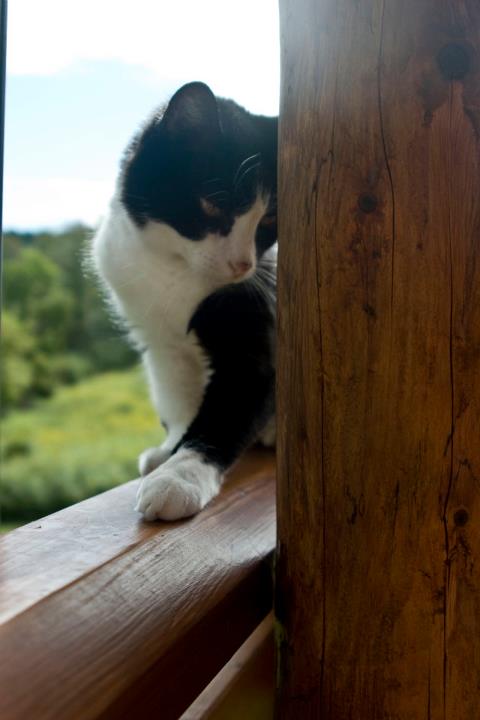
At right, my favorite cat, Topsy. He does what he wants to do.
 Parfit’s book has been a good refresher course for me in how philosophers actually work, devise their analogies, create and endeavor to solve dilemmas, clarify and limit their claims, etc.
But frankly, my brain hurts. (See Monty Python skit, below).
There are times one simply wants to think less about the things that matter, and that desire may not be rational but is certainly human. So while humans do have the opportunity to be reasoning creatures, they also have the opportunity to be like cats: to do what they want to do.
Or not to do, as the case may be.
At present, I’m assessing student work for final grades. This work is rational and should be carried out as objectively as possible against specific criteria. This work is one of the jobs teachers do, besides the job of endeavoring to impart information and to encourage critical thinking on the part of the students. It’s my job, I get paid to do it, and I take it seriously. Nevertheless, today I find myself tired of being the reasoning person.
And so, because I cannot slink over to the sofa and curl up on a pile of blankets, I am posting this:

