Perspective & aesthetics

Officially autumn now–and my lawn litter consists mostly of oak leaves, though other leaves will shortly follow. The showy blossoms of late summer, such as zinnia and tithonia, have begun to fade. Even the tall, bright-yellow, wild goldenrod’s going to seed, turning the meadow into a mass of beige and fading green. Asters and chrysanthemums take their places, drawing the garden visitor’s eyes a bit closer to the ground.

We move toward yin, the earth…which is where I happened to notice that just above the sprawling petunias–still blossoming, though getting a bit peaked–an iris is in bloom, too. This particular iris would not be all that commendable a flower in late spring or early summer when most irises are efflorescing. Its stature is medium, its color a rather wan yellow, its petals unremarkable.

autumn iris

Nonetheless, it’s an iris. In autumn! Apparently, my perspective on flowers changes once the days get shorter. My aesthetic expectations evolve: any rose becomes a wonder, any iris an almost magical surprise amid the mums and ornamental kale. That’s an important observation I try to keep in mind for myself and to teach to my students: perspective alters everything.

~

There are nice hybridization developments on late-blooming or, more accurately, re-blooming irises (this link from the Brooklyn Botanic Garden offers some useful information). I transplanted my rebloomer from an older garden that a long-ago homeowner planted; so I don’t know its heritage, though it somewhat resembles the cultivar “Baby Blessed.”

In the process of trying to track down the variety, I learned a new botanical word: remontant. Remontancy is that quality in a plant that makes it capable of blooming more than once in a season or year. There’s something generous and buoyant in that word, from the French “coming up again.” If hope does not spring eternal, may it at least be remontant. And may my perspective be flexible enough to appreciate seasonal transitions and small, un-flashy irises in autumn.

~

Another sign of autumn: the gleaners in the fields.

Painfully conscious

I’ve just finished reading Melanie Thernstrom’s 2011 book The Pain Chronicles, a journalist’s inquiry into the concepts that “define” pain and the medical discoveries concerning chronic pain, in addition to a bit of memoir as a narrative device. Although I have experience with chronic pain myself, the part of the text that most interested me comes in her concluding chapters, in which she gathers the variously-disciplined evidence of her enterprise to suggest that pain is the ultimate test of the mind-body problem (thank you, René Descartes). The experts Thernstrom interviews disagree on how much we do know or can know about the human brain and how it processes anything, let alone such a complicated psycho-physiological event as pain. Some of them believe human beings will make enormous technological discoveries to unlock our brains’ workings, but the majority seem to have learned from research that each “a-ha!” leads only to further complications. Discussing the outlook for future fMRI scanning in brain research, Dr. John Keltner tells the author:

[N]obody has come up with a rich and complicated enough model to analyze the complexity of the distributed patterns of neural  networks and deduce anything like underlying rules…We’re literally grappling with the fundamental aspects of human beings. We naively believed that pain is simple–it hurts or it doesn’t hurt–so there should be a single brain state we could see every time someone is in pain. But what we’ve stumbled into is the discovery that there’s a relative universe of hurt–that hurting is an immense, rich, and varied human experience associated with an unknown number of possible brain states.

I find some of these analogies, and some of this language, appealing–I can think of poems that express “a universe of hurt.” I embrace the idea that hurting is immense, rich, varied, and human–we are aware (conscious) that we hurt, that others hurt, that hurt can be painful even when it is not caused by a toothache but through loss of a friend or lover…the beloved other, the pain in ourselves. Isn’t compassion born of this awareness? Does art have a place here, too? I wonder.

Thernstrom concludes with the agreement of several expert researchers: “pain and suffering are properties of the mind” [my italics]. That means pain is, at least in part, a property of that elusive thing we generally call consciousness. Scott Fishman of UC Davis explains that “[t]he mind is like a virtual organ–it doesn’t  have a physical address that we know of.” Consciousness, these researchers imply, is not merely the sum of firing neurons, a process that can be considered on some level mechanical. Thernstrom asks, “Do we need to understand consciousness itself in order to understand pain?”

If so, that is a tall order, one the author posits is analogous to understanding aesthetics (what is beauty?). But though the task appears daunting, the discoveries en route make the trek valuable.

Even if we never understand the answer.

neural matrix fiber topography, Johns Hopkins University

neural matrix fiber topography, Johns Hopkins University

Rest & reading

It’s been a busy week, and I am exhausted mentally and physically; I am taking the three-day weekend as relaxation time–which means: reading, mostly. Currently, my “difficult books” concentration is Maimonides’ Guide for the Perplexed, though I am not finding it as challenging as I expected, because Maimonides is a good teacher! I am not among his target audience, however, as I am a woman. He was quite forward-thinking for a 12th century Talmudic scholar with an Aristotelian bent, but women were not considered qualified to study the deep mysteries of metaphysics. [Alas, I read without repentance for my heresy.]

My reading also means catching up with blogs I follow. Here’s the link to Theodora Goss’s latest musings on aesthetics and beauty–a lovely blog-essay. I hope you will read it.

ann e michael


Desire

In a comment on my last post, M. mentioned the sensuality of gardening. Truly, there is little that can offer more joys to the senses or more opportunity for sensual encounters of various kinds than a garden. Bees, wasps, butterflies, moths, all those pollinators going about helping the flowers have sex; the pistils and stamens, the ovaries fruiting, the scents and colors and attractions doing the work of creating what is juicy, spicy, tasty, fortifying, fragrant, or gloriously beautiful. While picking beans in the heat of late July or weeding in the dog days of August, however, the gardener may be forgiven for occasionally overlooking these aspects.

ann e michaelBut the garden can be considered sensual–the garden is all about desire. My desire to feed my family with fresh foods, or to decorate my view with blooms. My desire to share the garden bounty with friends, or to try new varieties of vegetables, or to see what happens if I let that volunteer melon grow.

And if plants can be said to possess any so-called human quality, I can easily anthropomorphize them as desirous. The desire to live, and to live in order to reproduce: these are the most basic purposes of our DNA, and of the plant’s. As a gardener, I manipulate the plant’s desire. I pick the beans before the seeds have ripened in the pods, and the bean plant in its urge to produce seed sends out more flowers, more young and tender green beans. It will continue in its desperate output until the roots are exhausted. Quite the pathetic metaphor, I guess.

The plants evolve each to its own specialty. Those that “choose” dispersal of seed via bird digestive tracts grow vivid against foliage, easy to see. Those that rely on maturing into pulpy rot, to ensure their seeds get nurtured in the soil beneath the parent plant, hide under large leaves close to the earth. The hard pit, the soft seed pouch that requires fermentation to germinate, the barbed husk that gets carried off in the fur on a mammal’s leg–gardeners often foil some of these strategies, but only temporarily. We turn them to our own uses because we desire the sweet kernels, the juicy flesh, the ripe scents.

Meanwhile the plants continue making more of themselves. The wind blows, and delicious summer fragrances enhance it as it floats the pollen toward awaiting receptors; the bees collect pollen on their legs while climbing into and out of flowers (how sexy), the female flowers of the squash stems swell…

What makes our purpose any different from the plants’? Maybe we experience desire not because we are human, but because we exist, as plants do, to leave something of ourselves behind. That something will not always be our DNA, however. It may be a system, a process, a work of art, a story. Something, perhaps, that we desire.


IMG_1547


What I see

When I trek to New York City these days, I generally go for non-tourist reasons; my sister lives in Manhattan. It’s a day trip, and I don’t always avail myself of visits to big-city attractions–instead, I “hang out” with my sister and her family, which tends to mean home-cooked dinners in her apartment and walks around her neighborhood, greeting neighbors in the coffee shop or on the sidewalk. Often, that’s interesting enough, as she lives near Ft. Tryon Park and The Cloisters. On my most recent visit, however, we decided to take the A train south to tour the new Whitney Museum of American Art. It’s located at the base of the Highline Park, with views southward to the new World Trade Center and westward over the Hudson (making our evening visit gloriously pink-hued during summer sunset).

We spent a little over two hours at the museum, and our initial assessment was that both of us prefer the building itself as an architectural experience over the old Whitney building designed by Marcel Breuer. It isn’t all that much “prettier” from the outside; but the interior gallery set-up is more pleasant, light-filled, and navigable by patrons.

The opening show’s titled “America Is Hard to See,” a line culled from a slightly ironic Robert Frost poem (see an excerpt below). And the top floor gallery included a famous painting by e. e. cummings, so my poetry hopes were raised. The 8th floor of the museum was stunningly curated; I had high expectations for the rest of the galleries though, in the end, my reaction was decidedly mixed.

Thanks to Lederman copyright 2015. see whitney.org

Thanks to Lederman copyright 2015. See whitney.org

Levels 7 through 5 follow a chronological order, roughly, in terms of historical and cultural developments from the early 20th century to the present. This is a bit arbitrary, as artists alter their styles, and even their genres, over time–and some artists’ work spans decades, gaining and losing cultural momentum as fashions and criticism also change. As a result, there are clusters of pieces that cover similar themes but do not necessarily speak aesthetically to one another on the gallery walls. This was most obvious in the Viet Nam era gallery, which struck me as garish. The purpose in terms of education and theme was fine, but the aesthetics of the room as a display of art just did not convey, to me, what it might have in another perhaps less chronological arrangement.

Nonetheless, as far as getting visitors acquainted with American contemporary art, the new Whitney may be overall more successful than its predecessor. The former building’s galleries were arranged by donor collections and often had too much of the same, or else too little cohesion, and relied on the visitor’s being already reasonably familiar with contemporary art and art criticism. The exterior platforms of “outdoor galleries” (sculptural pieces) are impressive, though you may want to avoid the exterior stairways if you have a fear of heights.

I am happy to note that Calder’s Circus remains on display, along with the old and, by contemporary standards, poorly-produced video of Calder playing with these creations. I loved this piece as a kid and my own children also loved it.

~

Excerpt from “America Is Hard to See,” by Robert Frost

Had but Columbus known enough
He might have boldly made the bluff
That better than Da Gama’s gold
He had been given to behold
The race’s future trial place,
A fresh start for the human race.
He might have fooled them in Madrid.
I was deceived bywhat he did.
If I had had my way when young
I should have had Columbus sung
As a god who had given us
A more than Moses’ exodus.
But all he did was spread the room
Of our enacting out the doom
Of being in each other’s way,
And so put off the weary day
When we would have to put our mind
On how to crowd and still be kind.

The people on the streets and in the subways and in the neighborhoods were uniformly kind on this warm summer evening. Even when we got in one another’s way. That’s what I saw.

~

Clouds

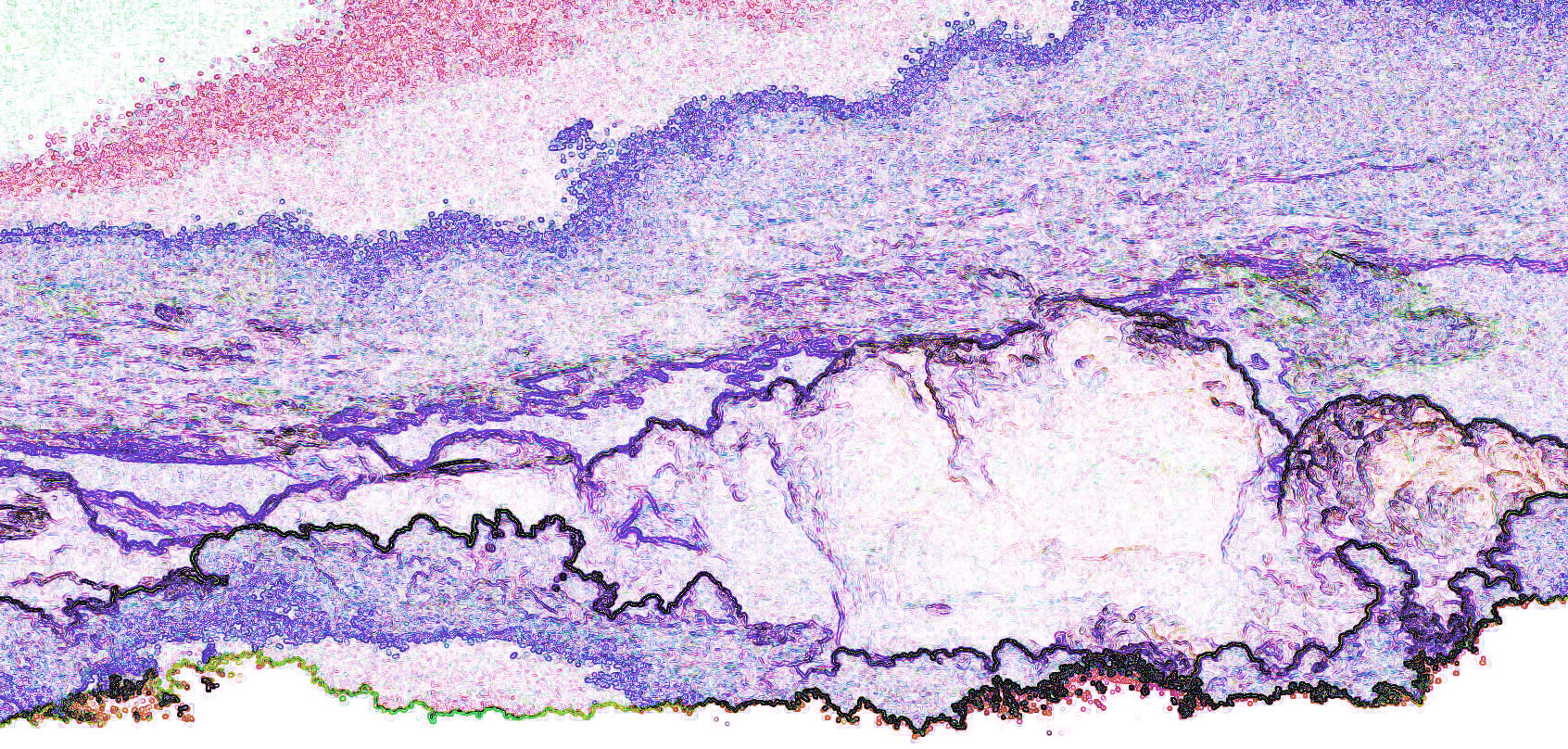
Mid-summer, and the sudden swift storms pass through. Indoors during the excessively warm rains, I try to write a bit. And I play around with clouds on Photoshop.

abstract1

impasto-like


abstact2

outlines

~

But the real sky is truer and more beautiful, ultimately.


IMG_1650~

IMG_1654


House & home

Falling Water

Falling Water

I went on a trip to visit Frank Lloyd Wright’s historic Fallingwater house, which is located in a forested state park area in the southwestern region of the state where I live, Pennsylvania. Pennsylvania is a large state, and in all the years I have lived here I’ve never managed to get to Falling Water; so I was excited. The day we arrived, the weather was perfect, the water was high, and we toured two Wright houses–this one and Kentuck Knob, one of Wright’s last residential design commissions.

Millions of people tour Fallingwater, so the Western Pennsylvania Conservancy folks (who have stewardship of the property) have their hands full maintaining the place, training docents and volunteers, and just keeping crowd control working. Kudos, by the way. They do a good job. Send them donations.

~

At the café (there’s always a museum café), my partner pointed out a letter reproduced on the informational wall–a note from Mrs. Kaufmann, owner of the house. She wrote that initially the home intimidated her a bit, as Wright’s designs tend to force the homeowner to live the way the house dictates, rather than the other way around. Curtains, a typical decor requirement for a 1930s residence in town, were anathema to Wright. In the middle of Bear Run forest, did Mrs. Kaufmann need curtains? No, she eventually decided–the trees provided color and changing light and privacy and were far more interesting than curtains. What initially seemed too austere for her tastes grew on her; she learned to do with less “stuff” and found that the simplicity made the things she did add to the house seem all the more valuable and aesthetically pleasing. The Kaufmanns must really have been special people to embrace the challenges of living comfortably in one of Wright’s homes, indeed, in his most unique residential design.

~

My husband and I designed our current home 17 years ago and have some idea of the compromises owners have to make, most commonly for financial reasons (that was not an issue for the Kaufmanns, who were department-store magnates). As we toured Fallingwater and Kentuck Knob, one thing that hit us is that building codes have changed the way Americans build; you couldn’t get a Wright home design past most local zoning commissions in Pennsylvania nowadays.

For example, 19″ hallways? Nope. 6′ ceilings? I don’t think so. Some of the tight interior stair turns would be disallowed. And, let’s face it, the whole cantilevered balcony situation would set off a hundred bureaucratic red flags.

~

house 2009

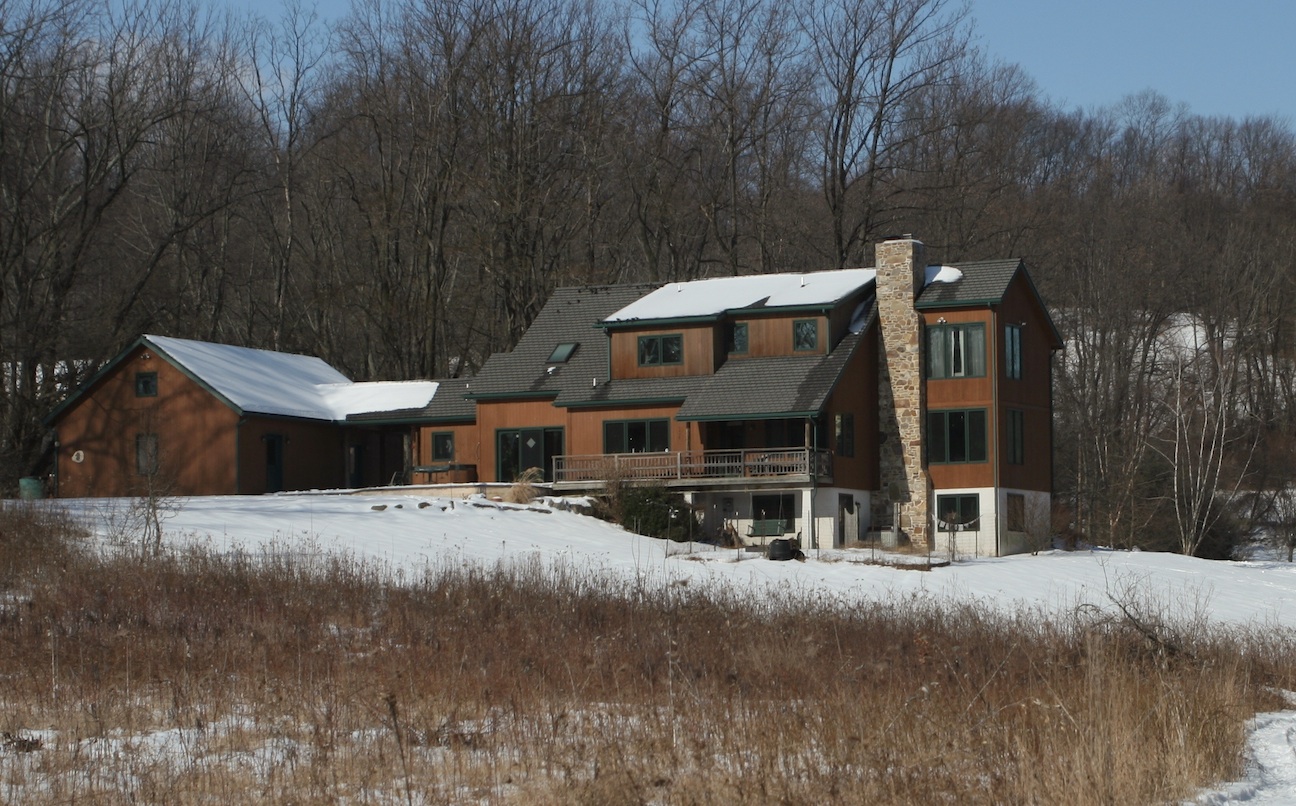
My house in snow, 2009.

My own house had to agree with the local building code. There was also a budget we really could not exceed. Over the years, we have added to the deck, improved the porch railing, completed building interior doors ourselves, worked extensively on landscaping (first adding to it, then pruning back, then…well, there’s been a bit of mostly benign neglect recently). But we have generally lived comfortably in the house and adapted it to fit our needs, the way most people live in a home. As our living situation changes, with children growing into adulthood and moving away, with fewer pets and no more chickens, with less need for a large vegetable garden, we’re thinking of ways to alter the house. Or even to move out of it, and let some other family have a go at its joys and responsibilities.

Its sensibility leans toward a meadow-type or agricultural feel. That suits the region in which we have settled. Which may be the only way our house parallels Fallingwater: it suits the environment and the region in which it is situated. To me, that is one of the main purposes of good architecture, and the rule most frequently ignored by homebuilders.

~

Our home can boast an improvement over Wright’s houses: it doesn’t leak (I lived in one in Grand Rapids Michigan in the 1970s, and can attest to the leaking factor).  🙂

~

For a 3-D computer-animated “flyby” of Falling Water and a half-hour documentary on its history, see this page (Mental Floss). Pretty interesting!

Drought

I hate droughts. I’m a gardener who lives in a temperate region that, on average, receives about 1,150 mm of precipitation annually (45″). Here we are, in the middle of springtime, blooms on the dogwoods and azaleas, peonies beginning to bust out; and I haven’t heard the welcome noise of rain on the roof for over 5 weeks. Generally, May brings this region 2-4 inches of rain. I miss it, and so do the birds and the deer and the insects and the salamanders and toads…and the few remaining farmers.

I water my vegetable garden daily, but I cannot water the whole lawn, the perennial beds, the hedgerows where the larger trees grow. So the grass becomes crisp. And I worry that a strong wind, or a sudden downpour (please?!), might topple a weak-wooded tree that’s been gasping for nourishment.

Drought is also so metaphorical. It signifies lack. A lack of ideas, a creative drying-up, a kind of writer’s block where words harden into obstacles–those things are droughts of a kind that stop thinkers into stasis. If you don’t move, you end up mired.

Not too distant a stretch from the concrete phenomenon of drought to the existential phenomenon of an artistic or emotional “dry period.”

There are several ways to contend with droughts; some require large-scale changes in industry, agriculture, population centers. On the smaller scale, I practice a version of xeriscaping; after years of experimentation, I have learned which plants hold up best under extremes of dry periods or deer depredation. I am alert as to which seedlings are hardiest, which plants can contain themselves in a sort of dormancy until the rain comes. That means I have to let go of my desire to grow certain species and cultivars no matter how envious I am of the way they flourish in someone else’s garden.

And it’s the same with a droughty period in my creativity. Certain things I let go of; I work instead with what struggles along in the mud cracks, what creeps under the brickwork or waits for the next real rainfall. There’s often surprising beauty in those hardy emotions and ideas that stay around when the going gets tough, the things that manage to find shade or that–like cacti–prefer a drier clime.

Being adaptable is important if one wants to make art, to write poems, to compose. Because life isn’t always going to offer ideal circumstances for the creative or aesthetic effort.

~

I hate droughts not only because they hurt my plantings but because they signal a potential disaster in terms of global climate change, and because thousands of people die for lack of that essential element–water. I recognize, though, that suffering sometimes motivates human beings to make changes, to create new approaches…even to make art.

Life is complicated. We evolve through change.

Meanwhile–let it rain!

9th as new

Last week, I tutored a student on a music appreciation paper in which she was asked to review a concert-going experience. Her family background is culturally rich–but not rich in terms of the Western cultural canon. She had heard the name Beethoven; but until this class, as a sophomore in college, she had never listened to his music. She attended a concert that featured a Liszt sonata, two brief Schubert pieces (Ständchen and one other), and Beethoven’s Symphony No. 9.

Because I cannot remember not knowing Beethoven’s music, I kind of envy this young woman’s revelations in the concert hall; what must it be like to hear Beethoven’s 9th symphony, for the first time, as a 19-year-old? I may not be familiar with all of the master’s works, but my parents had some of the symphonies on vinyl back in the 1960s. We listened to classical music on the radio and in church; even commercial television featured famous musical phrases. My sister and I liked dancing around the living room every weeknight to The Huntley-Brinkley Report’s closing theme (2nd movement Beethoven’s 9th).

portrait by Joseph Karl Stieler

portrait by Joseph Karl Stieler

~

Initially, she and I went over the structure of a review and how it resembles an analysis paper. She had used musical terminology reasonably well, and we had grammar and mechanics to work on. What she liked best, she said, was the part with the singers. She found the third movement “a bit boring. I kept wondering if this was the end.” But the fourth movement excited her: “It was really like a celebration or something, and you could see the expressions on the faces of the singers and the musicians, that they were so into it. Like, you kind of wanted to stand up for it, you know?”

Yes, I know–that’s how I have felt when I have heard the piece in concert.

~

Our discussion went on after our work on the paper’s mechanics had ended, though, because she asked me why courses like this one are required for college. Her major is early childhood education, and she says her parents asked her how a course on classical music has anything to do with teaching 4-year-olds.

It turns out I had more to say on that than I realized. Bless her heart, this student was eager to listen. [I have to admit that isn’t as common a response as one might wish.] Many of my friends, I said, are teachers or former teachers; they are among the smartest, most open-minded and curious people I know. They pay attention to contemporary culture and they read about history. They get allusions and references and make clever jokes and know all kinds of things and also, they admit what they do not know and are eager to learn about. They’d play Beethoven for kindergarteners and let them dance to the fast movements and ask them how it feels to hear the slower, sadder late quartets. They might have the children finger-paint to Beyoncé or twirl like leaves to Vivaldi’s “Autumn” or use round colored stickers to make their own “Starry Night” pictures or recite a poem that’s fun to say out loud. Culture is education.

And there’s more, I told her, that has to do with you as a person who understands the culture you are part of. You have to know about politics, especially local and state politics, because teachers need to understand how legislation and budgets can affect income and careers. You might feel uncomfortable in your job if you don’t get your colleagues’ allusions or feel you cannot participate equally in their conversations when the subject turns to culture, history, museums, music, art, policies and fiscal issues. It is fine to admit what you do not know or have not yet been exposed to–but it helps to know where you stand and to show you want to learn.

You’ll learn from your students, too. If you really want to be a good teacher, I said, you will never want to stop learning. Maybe you will reach a point where you don’t need to know a whole lot more about Beethoven, but you will want to explore other subjects. So when you take the required fine arts courses, the required literature courses, the courses in philosophy and math and all that other stuff, realize how all of it will get into your brain somehow, maybe touch a nerve here or there, and help you become a terrific teacher.

Besides, isn’t it beautiful? Even the boring parts…have you ever experienced anything like that before?

“No, honestly,” she said. “I wasn’t sure I was up for it, but it was worth it.”

Written by a human

Here’s a controversy for National Poetry Month–there are an amazing number of controversies surrounding poetry–which takes up the idea of whether a “machine” can write poetry. A good introduction is this CCR interview with Oscar Schwartz, who developed Botpoet as an experiment that is not so much about artificial intelligence as it is about what humans consider to be poetry. And perhaps about what language really is. If you follow the link to the site, you can participate in his research by playing “Bot or Not,” a game in which the player reads a series of poetic lines and then chooses between written by a human or not written by a human.

If you’ve read a great deal of classic and contemporary poetry, you may recognize some of the poems (I did); I suppose that is a way to cheat the system, since I have insider information. Nevertheless, I was wrong embarrassingly often. What, exactly, was I looking for in those words?

I think Schwartz is correct in his assessment of the more general population (though literary types may disagree with general assessments) when he says:

People generally seem to associate rhyming, “Romantic” poetry as being human. And they consider highly abstract, non-traditional poems to be of human provenance. Investigating as to why this might be the case is the project of my PhD.

He points out that written language is arbitrary and abstract, “an artificial medium” to begin with, and may have less to do with being human than we might like to think. Maybe the qualities that make a poem a poem are qualities that reside in the reader/interpreter rather than in the poet, another individual’s aesthetics or sense of what seems “creative.” That might be an unsettling thought for many writers, though it rather appeals to me.

Schwartz continues,

“So the results of Bot or Not, rather than telling us what human really is, is actually telling us that the category of the ‘human’ is an ideological, political space…The Bot or Not project works not because it tells us about computer software, but because it reveals things about what we assume to be human. It destabilizes the category of the human.”

As it turns out, the study of consciousness also tends that way–destabilizing our long-held category of what-a-human-is or what, if anything, differentiates us from other animals. Some interpreters of Zen philosophy suggest that Zen consists in finding balance within the inherent instability of the corporeal world. Or, perhaps, acceptance that humanness may be something we cannot categorize; the challenge then is to learn to flourish in a state of destabilization.

Let me sing the body electric…and the mind (possibly) electronic.

Walt Whitman in mid-life

Walt Whitman in mid-life