When I was a second-grader in Yonkers, NY, our school took us on a class trip to an art museum in New York City. I could not tell you which art museum it was (possibly the Whitney, possibly MoMA), but I remember how vividly impressed I was by one of the things I saw there: a very large mobile suspended overhead, ever so slightly moving. I had never seen anything like it before, and it rocked my world. It was clearly art, but unlike any art I’d seen before. Thus began my lifelong love of art museums, which my parents were glad to encourage.
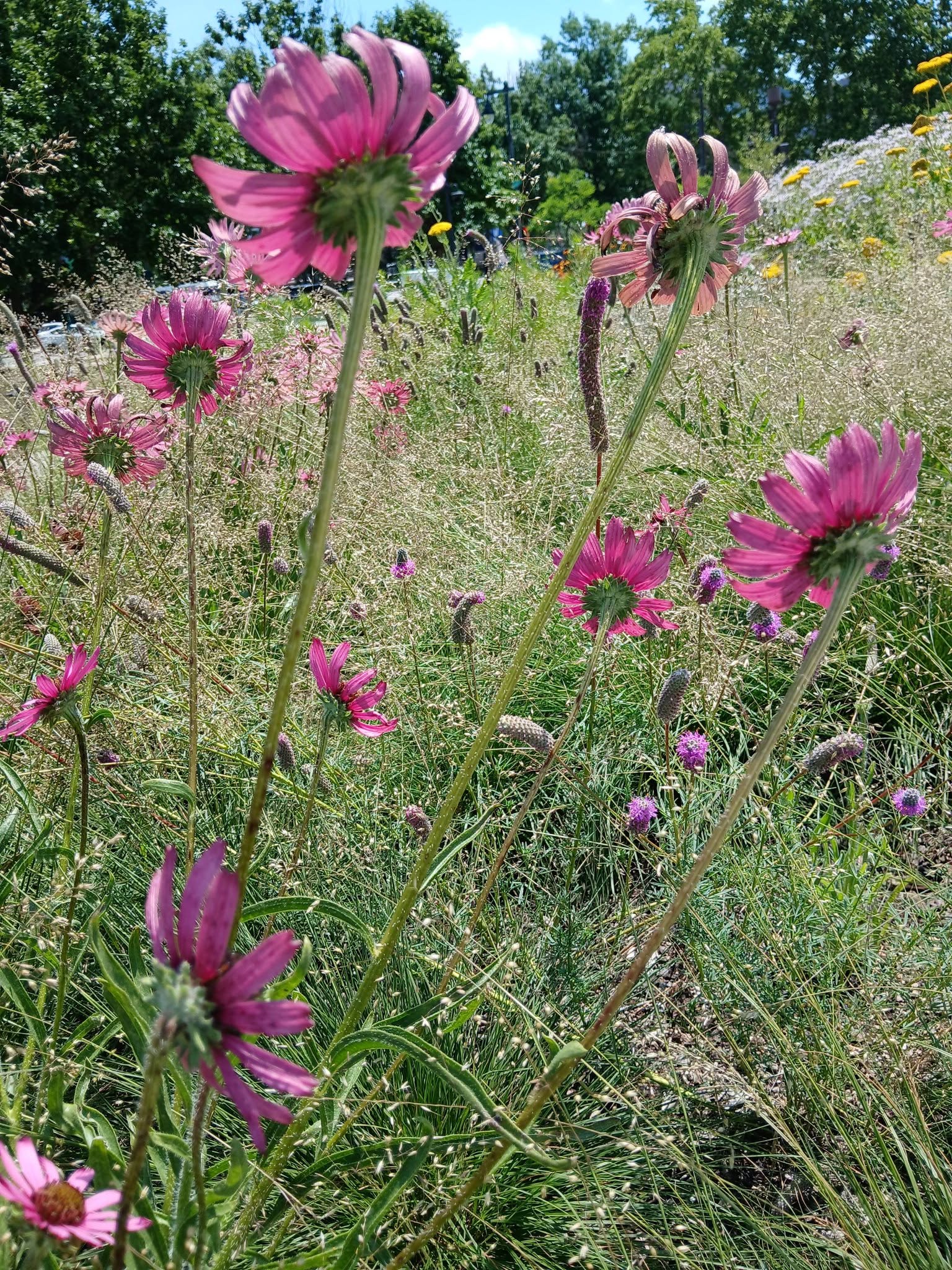
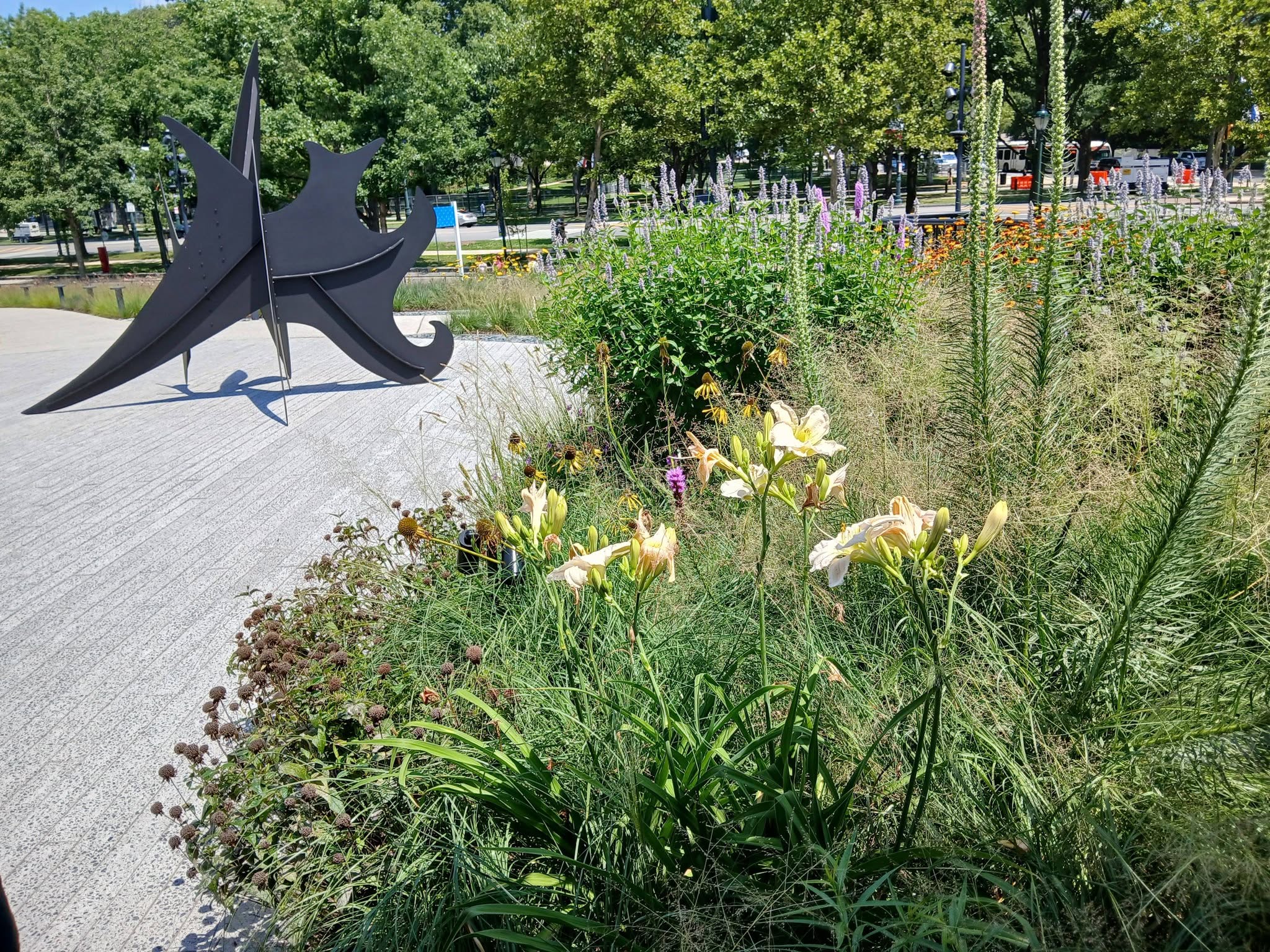
When a new art museum opens near me, which certainly isn’t all that often, I try to get to it. Philadelphia is a little over an hour away, so I was thrilled when I heard about the new Calder Gardens, (opened in late 2025) which combines two of my favorite things–art and gardens. Not to mention the opportunity to wander past old an favorite, the Rodin Museum, as well as the reflecting pools and tall pines surrounding the much newer Barnes Museum, and to stop at Buena Onda for fish tacos. The Calder gardens were designed by Piet Oudolf and are lovely. Evoking plains or meadows in the midst of a very urban environment, the landscaping proves that pollinators will find their way to plants even when surrounded by traffic and skyscrapers. Delicate grasses were setting seeds when we arrived, giving an airy lightness to what was a typical hot, muggy summer-in-the-city day. Bees and butterflies were as busy as the streets.
I have to say that I don’t much like the museum’s exterior, but the interior architecture suits Calder’s works perfectly. The galleries are unexpected, curving, textured, with walls that range from wood to lava-like to smoothly-polished stone, and they feature niches for seating and gazing, in addition to huge windows that look out onto Calder’s larger stabiles that are situated in well-like, below-ground outdoor spaces. Lighting allows intriguing shadows to be cast by the mobiles; a soundscape softly fills one of the galleries. Docents offer detailed talks and answer visitor questions. The whole place, though on the small side in terms of “quantity,” is a memorable experience.
~
On our way to the Calder Gardens, we passed the monumental Philadelphia Museum of Art and noticed that part of the Parkway and “the oval” were blocked off; there was a huge array of theater lights and speakers that technicians were raising in front of the museum’s famous steps. If we’d visited toward the end of the week, we’d have found the Parkway considerably more limited.
Oh, right. July 4 in Philadelphia: always mayhem, but this year the semiquincentennial.
We avoid Independence Day in Philadelphia because I don’t care for crowds, though I’ve been known to make exceptions for a march or a concert. Not to mention the traffic and parking or the fact that Philadelphia in July is miserably hot and humid, absolutely without exception. Anyway, the nation’s 250th doesn’t feel all that celebratory to me. I suppose I have become cynical.
But seeing all the setup in Center City took me back to Philadelphia on July 4, 1976, when my family lived across the river in New Jersey. My parents–they must have been crazy!–drove us into the city for the evening’s bicentennial party. I had just turned 18, my sister was 16, our brother was almost 12. We saw the musical “1776” on the big lawn in front of Independence Hall (no lawn there now–it’s the Liberty Bell Center). We then walked around the city, going from park to park to watch the fireworks, the five of us holding hands sometimes, trying to stay together and not get separated in the crowd. An enormous crowd! It was exhilarating and a bit scary, and I recall thinking that it gave me a sense of what a war zone must feel like. All those bangs and booms, so loud and so frequent I could feel the vibrations in my body; and sprays and fountains of light overhead, and actual fountains reflecting sparklers and fireworks, warning lights, streetlamps; cars driving past, honking; people singing and shouting. There were protesters, too, but despite the protests (we applauded their efforts and the right of citizens to protest), and despite the presence of police and federal troopers, I don’t recall feeling fearful or anxious. It may be the closest I’ve ever gotten to feeling “patriotic.”
Well, I was very young, and I wasn’t following the controversies very closely (curious about said controversies? See this article). I was aware of conflict and division in the USA, but youth tends toward optimism and energy; I was excited about art, music, books, my college education. That was 50 years ago. There’s much I have forgotten, but the arts haven’t let me down in all those years. Poetry, sculpture, music, painting, dance, and the “humanities” sustain me still.